
Inferensys

Glossary

Edge NLP

Edge NLP is the execution of natural language processing tasks directly on local devices to ensure low latency, data privacy, and operational continuity without cloud connectivity.
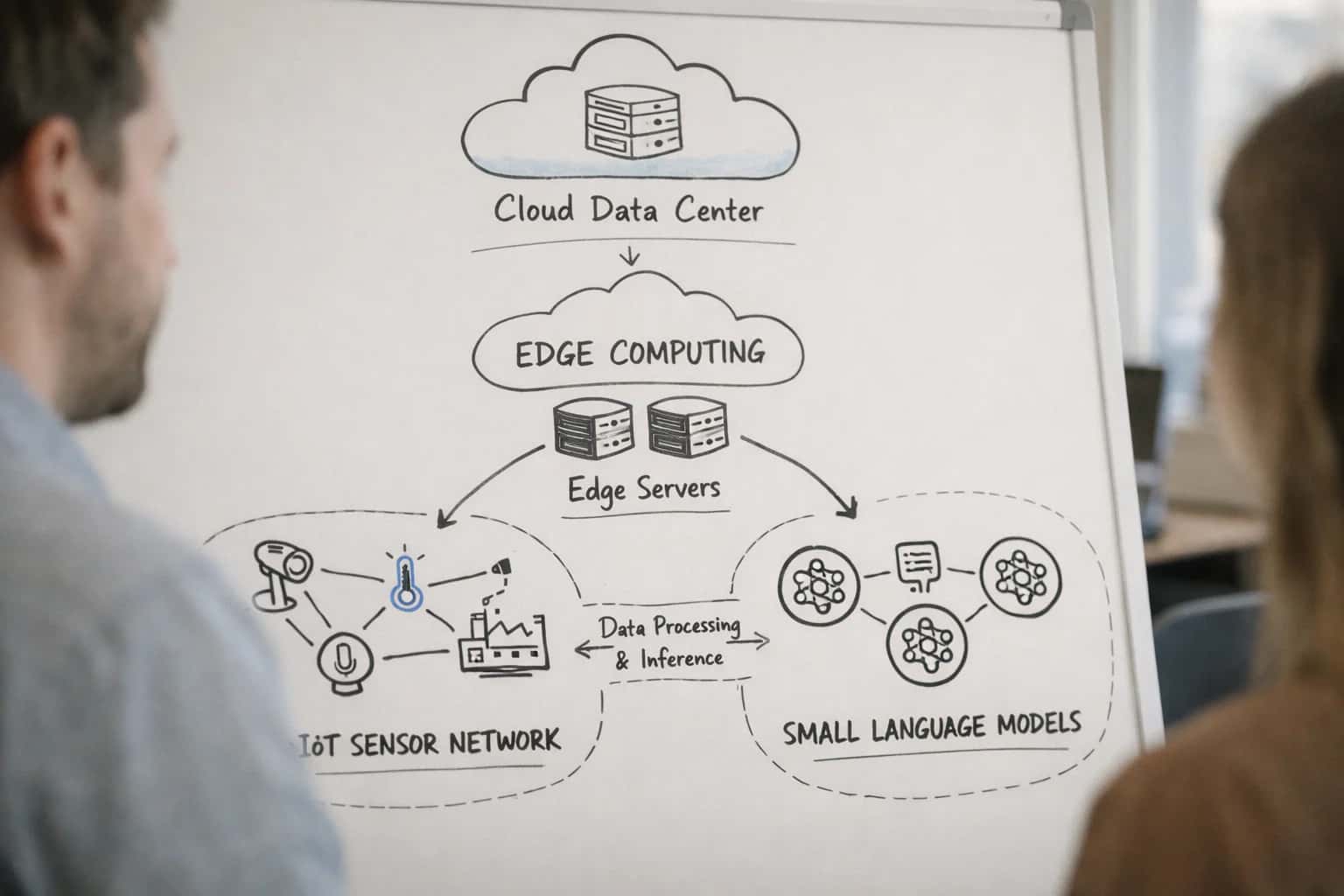
Engineer deploying small language model to edge device, IoT sensor visible on desk, technical hardware setup in bright workspace.
EDGE AI APPLICATIONS

What is Edge NLP?

Edge NLP (Natural Language Processing) is the execution of language understanding and generation tasks directly on local devices, such as smartphones, IoT sensors, or embedded systems, rather than relying on cloud servers.

Edge NLP enables low-latency, private, and reliable language interactions by processing data where it is generated. This architecture is critical for applications requiring immediate response—like voice assistants in cars or real-time speech-to-text on phones—and for scenarios where internet connectivity is unreliable or data privacy is paramount, such as in healthcare or defense. By avoiding cloud round-trips, it reduces bandwidth costs and ensures operational continuity.

Key technical challenges include adapting large language models to run within the strict memory, compute, and power constraints of edge hardware. This is achieved through techniques like model compression, quantization, and the development of efficient small language models (SLMs). Common applications extend beyond transcription to intent classification, sentiment analysis, keyword spotting, and on-device translation, forming the intelligence layer for private, responsive human-computer interfaces.

DEFINING FEATURES

Core Characteristics of Edge NLP

Edge NLP (Natural Language Processing) is defined by its execution constraints and operational goals. These core characteristics differentiate it from cloud-based NLP and dictate its architectural design.

01

Ultra-Low Latency

The primary technical driver for Edge NLP is the elimination of network round-trip time. By processing language data locally, systems achieve sub-100 millisecond response times, which is critical for real-time interactive applications. This is measured as end-to-end latency, encompassing audio capture (if applicable), model inference, and result generation.

  • Example: A voice assistant on a smart speaker responding to a command without a perceptible delay.
  • Contrast: Cloud-based NLP introduces variable latency due to internet connectivity, often ranging from 200ms to several seconds.
02

Data Privacy & Sovereignty

Edge NLP ensures sensitive audio or text data never leaves the user's device. This local processing is a fundamental architectural guarantee for privacy-sensitive domains.

  • Key Benefit: Compliance with regulations like GDPR and HIPAA by design, as no personal data is transmitted to external servers.
  • Use Case: Medical transcription apps on a clinician's tablet that process patient notes offline.
  • Mechanism: All model weights, vocabulary, and inference logic are stored and executed within the device's secure enclave or trusted execution environment.
03

Operational Resilience

Edge NLP systems function reliably in environments with intermittent or absent connectivity. This characteristic provides deterministic availability independent of external services.

  • Application: In-vehicle voice controls, industrial voice commands in remote facilities, or translation devices used offline.
  • Architecture: Requires fully self-contained model deployment packages and local fallback logic for all intended functions, eliminating single points of failure tied to the cloud.
04

Hardware-Constrained Optimization

Models must be engineered for severe resource limits typical of edge devices: limited CPU/GPU power, RAM (often <1GB), and storage. This necessitates aggressive model compression techniques.

  • Core Techniques: Post-training quantization (e.g., INT8), pruning of redundant neurons, and knowledge distillation to create smaller, faster student models.
  • Target Hardware: Mobile System-on-Chips (SoCs), microcontrollers, and specialized Neural Processing Units (NPUs). Performance is measured in milliwatts of power consumption and megabytes of model size.
05

Specialized, Narrow-Task Focus

Unlike large, general-purpose cloud LLMs, Edge NLP models are typically single-task models optimized for a specific, well-defined function. This specialization allows for extreme efficiency.

  • Common Tasks: Keyword spotting ("Hey Siri"), intent classification ("turn on the lights"), named entity recognition (extracting dates/times), and compact speech-to-text for constrained domains.
  • Trade-off: Sacrifices broad conversational ability for high accuracy, low latency, and minimal footprint on a specific task.
06

Context-Aware Personalization

Edge NLP enables on-device learning and adaptation to a user's unique patterns without exporting personal data. The model can fine-tune itself locally based on interaction history.

  • Mechanism: Techniques like federated learning (aggregating model updates, not data) or incremental learning allow the model to adapt to a user's accent, vocabulary, or preferences.
  • Example: A smartphone keyboard's next-word prediction model that improves based on local typing history, keeping all data on-device.
TECHNICAL OVERVIEW

How Edge NLP Works: Technical Foundations

Edge Natural Language Processing (NLP) executes language understanding and generation tasks directly on local hardware, such as smartphones, IoT devices, or embedded systems, eliminating the latency and privacy risks of cloud dependency.

The technical foundation of Edge NLP relies on deploying highly optimized, compact language models. These models undergo aggressive model compression techniques like quantization, pruning, and knowledge distillation to reduce their memory footprint and computational demands. This enables them to run efficiently on resource-constrained edge hardware like Neural Processing Units (NPUs) or mobile CPUs, performing tasks like speech-to-text (STT) and intent classification with minimal power consumption.

Execution is managed by specialized edge AI compilers and runtime engines that translate the compressed model into optimized instructions for the target silicon. This local processing ensures deterministic, low-latency inference and guarantees data privacy by keeping sensitive audio or text on-device. The architecture often integrates with sensor fusion pipelines and on-device learning systems for continuous model personalization without cloud connectivity.

EDGE NLP

Primary Use Cases & Applications

Edge NLP moves language understanding and generation tasks from the cloud to local devices, enabling real-time, private, and resilient applications. These are its defining operational domains.

01

Voice-First Interfaces & Wake-Word Detection

Enables always-on, low-latency voice control for smart devices without constant cloud dependency. Keyword spotting models, often using convolutional or recurrent neural networks, run continuously on microphones to detect wake words like "Hey Siri" or "Alexa" with minimal power consumption. This allows the main, more complex automatic speech recognition (ASR) pipeline to activate only when needed, preserving battery life and user privacy. Applications extend to in-car assistants, smart home hubs, and industrial voice commands where network connectivity is unreliable.

02

Real-Time Speech-to-Text Transcription

Provides instantaneous, offline transcription of spoken language to text, critical for applications where latency or connectivity are constraints. Edge-deployed speech-to-text (STT) models convert audio waveforms into text tokens directly on the device. This is essential for:

  • Live captioning in meetings, lectures, or broadcasts.
  • Clinical dictation where patient data must remain on-premises for HIPAA/GDPR compliance.
  • Real-time translation devices that process speech locally.
  • Law enforcement body cameras that generate searchable transcripts in the field. Models are heavily optimized via quantization and pruning to fit within device memory budgets.
03

On-Device Text Understanding & Intent Classification

Executes natural language understanding (NLU) tasks locally to parse user commands and extract structured meaning without data leaving the device. Lightweight models perform:

  • Intent classification: Determining the user's goal (e.g., "set a timer," "play music").
  • Entity recognition: Extracting key parameters (e.g., "timer for 10 minutes").
  • Sentiment analysis: Gauging emotion in text messages or reviews. This enables responsive, private interactions in chatbots on smartphones, customer service kiosks, and industrial HMIs (Human-Machine Interfaces). It reduces dependency on network latency for core interactive functions.
04

Private Text Generation & Predictive Text

Runs small, specialized language models on-device to generate text while keeping sensitive context private. Key applications include:

  • Smart reply and predictive text on mobile keyboards, where personal conversation history informs suggestions.
  • Document summarization for confidential business or legal documents.
  • Code completion in integrated development environments (IDEs) for proprietary software projects. These models, often distilled from larger foundation models, are optimized for a narrow domain. Techniques like speculative decoding can be used to improve generation speed on edge hardware.
05

Real-Time Content Moderation & Filtering

Scans and filters user-generated text, audio, or video content locally to enforce platform policies immediately, at scale. Edge NLP models perform:

  • Toxic speech detection in gaming voice chat or social media comments.
  • Inappropriate content flagging in uploaded video transcripts.
  • Compliance scanning for regulated information (e.g., PII, credit card numbers) in enterprise documents. By processing content at the point of creation—on a user's phone or a content gateway—it eliminates the bandwidth cost of uploading all data to the cloud and enables instant enforcement actions, such as blocking a message before it is sent.
06

Industrial & Embedded Command Systems

Brings robust, noise-resistant language interfaces to challenging physical environments where cloud connectivity is absent or prohibited. Deployed in:

  • Warehouse logistics: Voice-picking systems where workers use hands-free commands to navigate and confirm inventory tasks.
  • Field service & maintenance: Technicians using AR glasses with voice control to pull up manuals or log repairs in loud, hands-busy environments.
  • Defense and aerospace: Cockpit or vehicle systems that must operate in electronically denied or remote areas. These systems use acoustic models trained on specific noise profiles and domain-specific language models for technical vocabularies, all compiled to run on ruggedized edge compute modules.

ARCHITECTURAL COMPARISON

Edge NLP vs. Cloud NLP: Key Differences

A technical comparison of Natural Language Processing deployed on local devices versus in centralized cloud data centers, focusing on operational characteristics critical for system design.

FeatureEdge NLPCloud NLP

Primary Compute Location

Local device (e.g., smartphone, IoT gateway)

Remote data center servers

Network Dependency

End-to-End Latency

< 100 milliseconds

200 - 2000+ milliseconds

Data Privacy & Sovereignty

Raw data never leaves the device

Data transmitted to and processed by third-party infrastructure

Operational Cost Model

Higher upfront development; minimal marginal inference cost

Lower upfront development; pay-per-API-call or compute-hour

Scalability Model

Horizontal, limited by device fleet size

Virtually unlimited, elastic cloud scaling

Model Update & Deployment

Requires orchestrated over-the-air (OTA) updates to fleet

Instant, centralized model server update

Typical Model Size & Complexity

Highly optimized, compressed models (e.g., < 100MB)

Large, state-of-the-art models (e.g., multi-billion parameters)

Power Consumption Profile

Critical constraint (milliwatts to watts)

Not a primary constraint for the service consumer

Resilience to Network Outages

EDGE NATURAL LANGUAGE PROCESSING

Frequently Asked Questions

Edge NLP (Natural Language Processing) refers to the execution of language understanding and generation tasks directly on local devices, such as smartphones, IoT sensors, or embedded systems, rather than in the cloud. This approach prioritizes low latency, operational continuity without internet connectivity, and enhanced data privacy by processing sensitive audio and text locally.

Edge NLP is the deployment of natural language processing models to run inference directly on local, resource-constrained hardware, such as smartphones, smart speakers, or industrial gateways. The core difference from cloud-based NLP is the locus of computation: edge processing occurs on the device itself, eliminating the need to send audio or text data to a remote server.

This architectural shift delivers three primary advantages:

  • Ultra-Low Latency: Responses are generated in milliseconds, as there is no network round-trip delay, which is critical for real-time interactions like voice assistants.
  • Enhanced Privacy & Sovereignty: Sensitive data, such as private conversations or proprietary documents, never leaves the device, mitigating data breach risks and simplifying compliance with regulations like GDPR.
  • Offline Operation & Reliability: Functions remain available without an internet connection, ensuring continuity in remote locations or during network outages.

Cloud NLP, in contrast, leverages virtually unlimited compute and memory to run larger, more capable models but incurs latency, requires constant connectivity, and raises data privacy concerns.

Prasad Kumkar

About the author

Prasad Kumkar

CEO & MD, Inference Systems

Prasad Kumkar is the CEO & MD of Inference Systems and writes about AI systems architecture, LLM infrastructure, model serving, evaluation, and production deployment. Over 5+ years, he has worked across computer vision models, L5 autonomous vehicle systems, and LLM research, with a focus on taking complex AI ideas into real-world engineering systems.

His work and writing cover AI systems, large language models, AI agents, multimodal systems, autonomous systems, inference optimization, RAG, evaluation, and production AI engineering.



