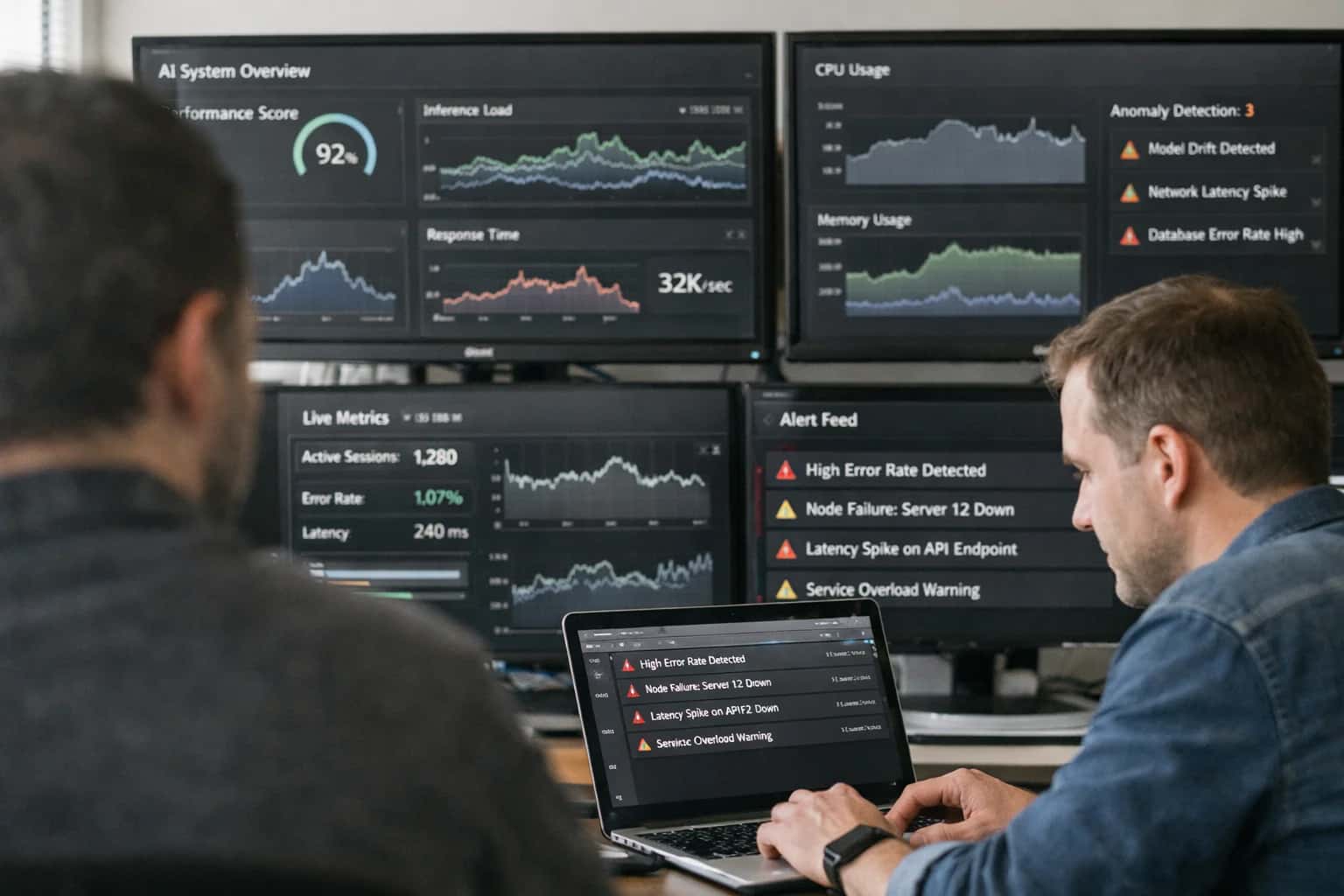
Real-Time Feedback Aggregation is a core component of Continuous Model Learning Systems, where live feedback signals—such as user ratings, corrections, or implicit behavioral data—are processed as they arrive. Using stream processing frameworks like Apache Flink or Kafka Streams, the system computes rolling metrics (e.g., accuracy, average reward, error rates) to power live dashboards and serve as triggers for automated actions, such as alerting on performance degradation or initiating a model update.

Glossary
Real-Time Feedback Aggregation
Real-time feedback aggregation is the continuous computation of summary statistics from live feedback streams to monitor model performance and trigger immediate system interventions.
PRODUCTION FEEDBACK LOOPS
What is Real-Time Feedback Aggregation?
Real-Time Feedback Aggregation is the continuous computation of summary statistics from a live stream of user or environmental feedback, enabling immediate system monitoring and intervention.
This process provides the low-latency observability required for Production Feedback Loops, allowing ML Platform Engineers and CTOs to monitor model health instantaneously. It differs from Batch Feedback Processing, which operates on periodic snapshots. Effective aggregation requires a robust Feedback Ingestion API and careful Feedback Validation to ensure metric fidelity, directly feeding into downstream systems like Drift Detection Triggers and Automated Retraining Systems.
PRODUCTION FEEDBACK LOOPS
Key Characteristics of Real-Time Feedback Aggregation
Real-time feedback aggregation is the continuous computation of summary statistics from live feedback streams to power dashboards or trigger immediate system intervention. Its defining characteristics center on low-latency processing, system resilience, and actionable outputs.
01
Low-Latency Stream Processing
Real-time aggregation operates on unbounded data streams using frameworks like Apache Flink, Apache Kafka Streams, or Apache Spark Structured Streaming. These systems compute rolling windows (e.g., tumbling, sliding, or session windows) over events with sub-second latency. This enables metrics like rolling accuracy or average reward to be updated continuously, not in daily batches. The architecture is designed for high-throughput ingestion and stateful computations (e.g., counting, summing, averaging) over the stream without requiring a batch storage step first.
02
Stateful Windowing & Summarization
The core computational pattern involves maintaining and updating stateful aggregates over defined time or count-based windows. Key techniques include:
- Tumbling Windows: Fixed, non-overlapping intervals (e.g., accuracy per minute).
- Sliding Windows: Overlapping intervals for smoother trends (e.g., 5-minute average updated every 10 seconds).
- Session Windows: Dynamic windows based on periods of activity, useful for aggregating per-user interaction sessions. Aggregators compute statistics like counts, sums, averages, percentiles (P95, P99 latency), and rates (error rate per second). This state must be managed efficiently and be fault-tolerant.
03
Triggering & Alerting Integration
Aggregated metrics serve as the primary triggers for automated system responses. This is a key differentiator from batch analytics. Examples include:
- Automated Rollback: Triggering a model version rollback if error rate exceeds 5% over a 2-minute window.
- Drift Alerting: Signaling a potential concept drift event when prediction confidence distribution shifts significantly.
- Resource Scaling: Dynamically scaling inference service replicas based on queries-per-second (QPS) aggregates. These triggers feed into orchestration systems (e.g., Kubernetes, model deployment controllers) or alerting platforms (e.g., PagerDuty, Slack) for immediate operational action.
04
Fault Tolerance & Exactly-Once Semantics
Production aggregation systems require strong guarantees to prevent data loss or double-counting during failures. This is achieved through:
- Checkpointing: Periodic snapshots of operator state to durable storage.
- Watermarks: Mechanisms to handle out-of-order and late-arriving data in event-time processing.
- Idempotent Sinks: Ensuring aggregated outputs (e.g., to a dashboard database) are written exactly once, even if parts of the pipeline recompute after a failure. Frameworks like Flink provide these semantics, which are critical for auditability and correctness of operational metrics and triggers.
05
Dimensionality & Drill-Down Capability
Effective aggregation is multi-dimensional, allowing metrics to be sliced by key attributes for root-cause analysis. Common dimensions include:
- Model Version: Comparing performance across canary and primary deployments.
- User Segment: Analyzing feedback by geography, tenant, or user cohort.
- Feature/Endpoint: Isolating issues to specific API routes or model functionalities. This requires the aggregation pipeline to include a dimensional enrichment step, joining raw feedback with contextual metadata, and systems capable of multi-dimensional OLAP queries on the resulting real-time data.
06
Integration with Observability Stacks
Real-time aggregates are not isolated; they feed directly into the broader ML observability and MLOps ecosystem. Standard integration points include:
- Metrics Export: Pushing aggregates as time-series data to platforms like Prometheus, Datadog, or Grafana for visualization.
- Log Generation: Creating structured log events for significant aggregate changes (e.g., "error rate threshold breached").
- Training Data Creation: Streaming high-value aggregated signals or sampled raw feedback into the feedback-to-dataset compilation pipeline for model retraining. This turns aggregation from a monitoring tool into a central nervous system for the continuous learning loop.
PRODUCTION FEEDBACK LOOPS
How Real-Time Feedback Aggregation Works
Real-time feedback aggregation is the continuous computation of summary statistics from a live stream of user or environmental signals to power operational dashboards and trigger immediate system interventions.
Real-time feedback aggregation is a core component of Continuous Model Learning Systems, where feedback streams from production applications are processed using stream processing frameworks like Apache Flink or Kafka Streams. This system computes rolling metrics—such as accuracy, average reward, or user satisfaction scores—within configurable time windows (e.g., last minute, last hour). These aggregated statistics are published to observability dashboards and monitoring systems, providing a live pulse on model performance. The primary technical challenge is maintaining low-latency computation and exactly-once processing semantics to ensure metric integrity despite network failures or duplicate events.
The aggregated metrics serve as the primary triggers for automated system responses. A significant drop in a rolling accuracy metric can automatically fire a drift detection alert or initiate a canary deployment of a fallback model. This closed-loop process minimizes the feedback loop latency between observing a performance issue and taking corrective action. Architecturally, this requires a feedback ingestion API, event sourcing, and a stream processing topology that performs windowed aggregations, joins feedback with inference context, and outputs to both time-series databases and message queues for downstream actuators.
REAL-TIME FEEDBACK AGGREGATION
Use Cases and Examples
Real-time feedback aggregation transforms raw user signals into actionable system intelligence. These examples illustrate its critical role in powering live dashboards, triggering immediate interventions, and maintaining model health in dynamic production environments.
01
Live Model Performance Dashboard
Aggregating feedback into rolling window statistics (e.g., 5-minute accuracy, precision, recall) to power executive and engineering dashboards. This provides a real-time pulse on model health, enabling teams to spot degradation the moment it occurs.
- Key Metrics: Rolling accuracy, error rate, and user satisfaction score.
- Example: A recommendation engine dashboard showing a sudden drop in click-through rate (CTR) for a specific user segment, triggering an immediate investigation into a potential concept drift event.
- Technology: Implemented using stream processors like Apache Flink or Apache Kafka Streams to compute aggregates over sliding time windows.
02
Automated Canary Release Trigger
Using aggregated feedback as a statistical gate for automated deployment. When a new model version is deployed in shadow mode or to a small canary group, its real-time performance metrics are continuously compared against the champion model.
- Mechanism: A performance metric streaming service calculates metrics like average reward or success rate for both models. A significant negative delta in the canary's aggregated feedback triggers an automatic rollback.
- Example: An NLP model for customer support sees a 15% increase in explicit "thumbs down" feedback in the first hour of canary release, triggering an automatic revert before the issue impacts a wider audience.
03
Dynamic Content & Ad Personalization
In high-velocity domains like digital advertising or content feeds, aggregated implicit feedback drives near-instant personalization.
- Process: Implicit feedback signals (dwell time, click-through, conversion) are aggregated per-user or per-content-cluster in real-time. These rolling engagement scores immediately influence the ranking or selection algorithms for subsequent impressions.
- Example: A news aggregator notices a user's average reading time for "technology" articles spikes. The real-time aggregation system immediately increases the weight of tech-related content in that user's personalized feed within the same session.
- Benefit: Reduces feedback loop latency from hours to seconds, creating a highly responsive user experience.
04
Fraud & Anomaly Detection System
Aggregating transactional feedback (e.g., user fraud reports, chargeback flags) to identify emerging attack patterns in real-time.
-
Implementation: A stream processing job aggregates fraud reports by transaction type, geographic region, and user device fingerprint. Sudden spikes in these aggregated signals serve as drift detection triggers for the underlying fraud detection model.
-
Key Action: Triggers an automated retraining system with newly labeled fraudulent patterns or updates a real-time rules engine to block similar transactions immediately.
-
Stat Example: A system might track "fraud reports per $100k transaction volume" with a threshold of < 0.5. A spike to 2.0 would trigger a high-priority alert.
05
Reinforcement Learning from Human Feedback (RLHF)
In RLHF pipelines, real-time aggregation is used to train and update the reward model. Preference pair logging generates a continuous stream of human judgments.
- Aggregation Role: The system aggregates these pairwise comparisons to compute a rolling win-rate for different model policies or response styles. This aggregated performance metric directly informs which model version is promoted to serve live traffic.
- Critical Function: It provides a stable, denoised signal from potentially noisy human preferences, enabling continuous training of the reward model and the policy model it guides.
06
A/B Testing & Multi-Armed Bandit Optimization
Real-time feedback aggregation is the computational engine for online experimentation. It continuously calculates the performance of different model variants ("arms") to dynamically allocate traffic.
- Process: For each arm (e.g., Model A, Model B), the system aggregates key business metrics like conversion rate or average order value from user interactions. A multi-armed bandit algorithm uses these real-time aggregates to shift traffic toward the better-performing model.
- Advantage over Batch A/B Testing: Enables automated adaptation; the system converges on the optimal model faster and minimizes opportunity cost during the experiment. Feedback-to-dataset compilation for the winning model happens concurrently.
ARCHITECTURAL COMPARISON
Real-Time vs. Batch Feedback Processing
A comparison of the two primary paradigms for handling user and environmental feedback within a Continuous Model Learning System, focusing on their operational characteristics and suitability for different use cases.
| Architectural Feature | Real-Time Stream Processing | Batch Processing |
|---|---|---|
Processing Latency | < 1 second | Minutes to hours |
Data Ingestion Pattern | Continuous event stream | Periodic bulk files (e.g., hourly/daily) |
Primary Frameworks | Apache Flink, Apache Kafka Streams, ksqlDB | Apache Spark, Hadoop MapReduce, Airflow DAGs |
State Management | In-memory, fault-tolerant keyed state | Disk-based, immutable datasets |
Update Trigger Mechanism | Immediate, event-driven (per record or micro-batch) | Scheduled (time-based or data-volume-based) |
Feedback-to-Model Latency | Seconds to minutes | Hours to days |
Computational Model | Incremental, record-at-a-time transformations | Full-scan, set-based transformations |
Fault Tolerance Guarantee | Exactly-once or at-least-once semantics per record | At-least-once semantics per job |
Resource Profile | Consistent, long-running compute clusters | Bursty, job-based compute clusters |
Use Case Primacy | Real-time dashboards, instant model patching, immediate anomaly alerts | Comprehensive analytics, full model retraining, bias audits |
Complex Event Processing | ||
Handles Late-Arriving Data | With watermarks & allowed lateness | Requires reprocessing of entire batch |
Cost Efficiency for High Volume | Lower for immediate actions | Higher for deep historical analysis |
REAL-TIME FEEDBACK AGGREGATION
Frequently Asked Questions
This FAQ addresses key technical questions about the continuous computation of summary statistics from live feedback streams, a critical component for monitoring and triggering interventions in continuous model learning systems.
Real-time feedback aggregation is the continuous, low-latency computation of summary statistics—such as rolling accuracy, average reward, or user satisfaction scores—from a live stream of user or environmental feedback signals. It works by processing feedback events through a stream processing engine (e.g., Apache Flink, Apache Kafka Streams) as they arrive, applying windowing functions (e.g., tumbling, sliding windows) to compute metrics over recent time intervals, and publishing these aggregates to dashboards or downstream triggering systems. This provides a live pulse on model performance, enabling immediate operational visibility and the potential for automated system interventions.
Enabling Efficiency, Speed & Accuracy
Intelligent Analysis, Decision & Execution
We build AI systems for teams that need search across company data, workflow automation across tools, or AI features inside products and internal software.
Talk to Us
Search across company data
Give teams answers from docs, tickets, runbooks, and product data with sources and permissions.
Useful when people spend too long searching or get different answers from different systems.
Enterprise searchRAGPermissions
Read more
Automate internal workflows
Use AI to route work, draft outputs, trigger actions, and keep approvals and logs in place.
Useful when repetitive work moves across multiple tools and teams.
AI agentsWorkflow automationGovernance
Read more
Add AI to products and internal tools
Build assistants, guided actions, or decision support into the software your team or customers already use.
Useful when AI needs to be part of the product, not a separate tool.
AI integrationDecision supportModel routing
Read more
About the author
Prasad Kumkar
CEO & MD, Inference Systems
Prasad Kumkar is the CEO & MD of Inference Systems and writes about AI systems architecture, LLM infrastructure, model serving, evaluation, and production deployment. Over 5+ years, he has worked across computer vision models, L5 autonomous vehicle systems, and LLM research, with a focus on taking complex AI ideas into real-world engineering systems.
His work and writing cover AI systems, large language models, AI agents, multimodal systems, autonomous systems, inference optimization, RAG, evaluation, and production AI engineering.
LinkedIn
Limited slotsGet a Free AI Consultation
Partnered with leading AI, data, and software stack.





How We Work
Custom AI workflows for your Business
One-fit-all AI don't work for modern businesses. At Inferensys, we aim to understand your business & custom requirements; which we use to define most efficient agentic workflows, the data, and the tools for your business.
01
Review the use case
We understand the task, the users, and where AI can actually help.
Read more02
Pick the right approach
We define what needs search, automation, or product integration.
Read more03
Build the first useful version
We implement the part that proves the value first.
Read more04
Improve from there
We add the checks and visibility needed to keep it useful.
Read moreThe first call is a practical review of your use case and the right next step.
Talk to Us