Feedback Stream Processing is the real-time or near-real-time computation and transformation of continuous feedback data streams using frameworks like Apache Flink, Apache Kafka Streams, or Apache Spark Streaming. Its primary function is to perform operations such as aggregation, enrichment, filtering, and windowing on raw feedback events—like user clicks, corrections, or preferences—as they are generated, preparing them for immediate model updates or analytical triggers. This architecture is foundational for low-latency production feedback loops.

Glossary
Feedback Stream Processing
Feedback stream processing is the real-time or near-real-time computation and transformation of continuous feedback data streams for aggregation, enrichment, or triggering model updates in production AI systems.
ARCHITECTURE
What is Feedback Stream Processing?
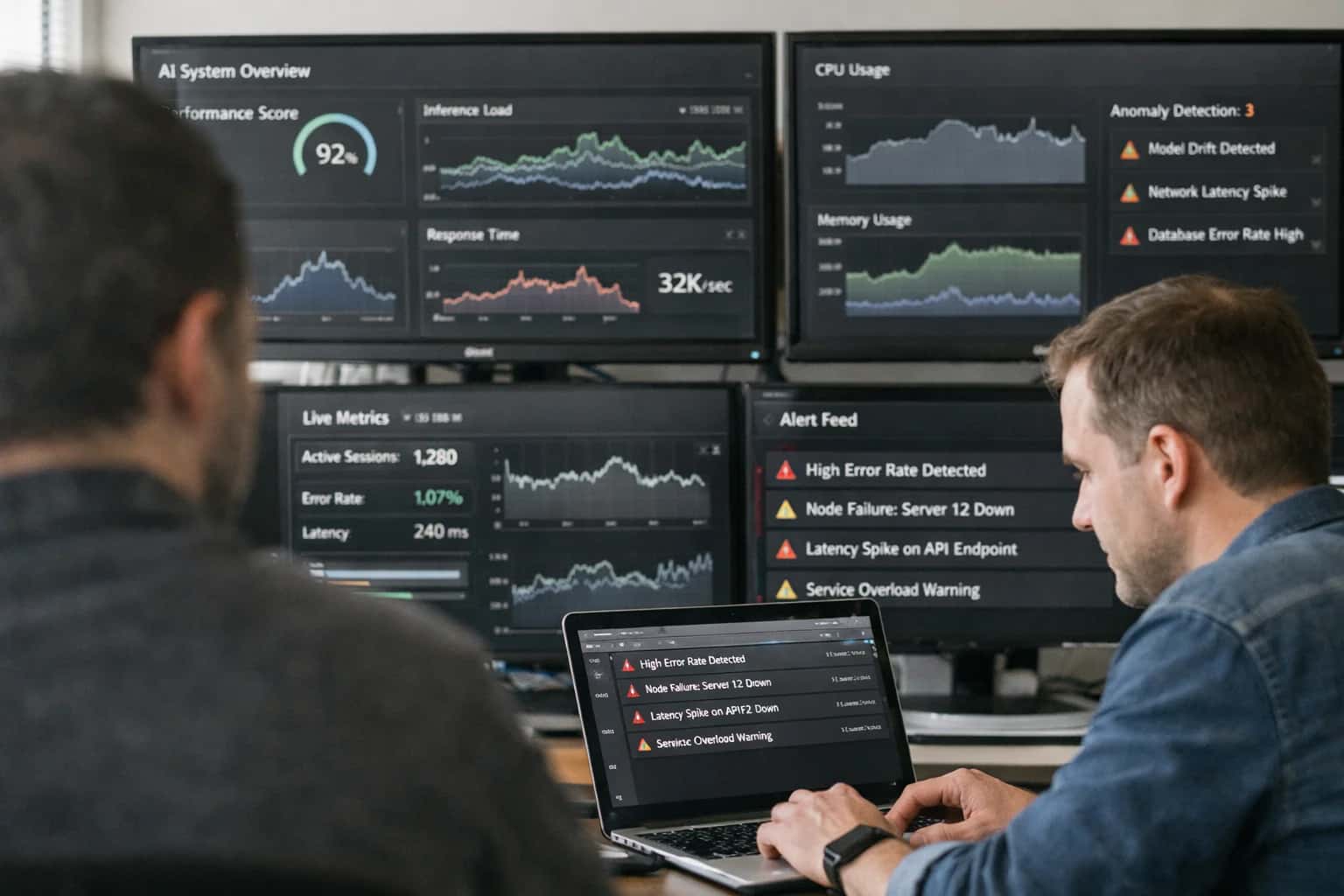
Feedback Stream Processing is the real-time computation layer within a continuous learning system that transforms raw user signals into actionable training data.
The processed stream feeds critical downstream functions, including real-time performance metric dashboards, drift detection triggers, and incremental learning jobs. By handling high-volume, low-latency events, it enables systems to react to user behavior and concept drift within minutes or seconds, rather than hours or days. This capability is a core differentiator for Continuous Model Learning Systems, allowing models to adapt iteratively without the delays of traditional batch-oriented pipelines.
ARCHITECTURAL PATTERNS
Core Characteristics of Feedback Stream Processing
Feedback Stream Processing involves the real-time computation and transformation of continuous user or environmental feedback signals. These systems are defined by several key architectural and operational characteristics that distinguish them from batch-oriented data pipelines.
01
Event-Driven & Real-Time
Feedback is processed as a continuous, unbounded sequence of immutable events. Systems use frameworks like Apache Flink, Apache Kafka Streams, or Apache Spark Streaming to apply transformations (e.g., filtering, aggregation, enrichment) with sub-second latency. This enables immediate triggers for model updates or system alerts.
- Example: A user's 'thumbs down' on a recommendation is aggregated into a rolling 5-minute accuracy score. If the score drops below a threshold, an alert is sent to the MLOps platform.
02
Stateful Computations Over Time
Unlike stateless request/response APIs, stream processors maintain internal state (e.g., in-memory hash tables or RocksDB) to perform operations across multiple events. This is essential for:
- Windowing: Calculating metrics (mean reward, error rate) over tumbling or sliding time windows.
- Sessionization: Grouping a user's feedback events within a single interaction session.
- Joining Streams: Enriching a feedback event with the original model inference context by joining it with a stream of logged inferences.
03
Exactly-Once Processing Semantics
A critical guarantee for financial or compliance-sensitive feedback. Systems ensure each feedback event is processed exactly once, despite failures, preventing double-counting of rewards or errors. This is achieved through:
- Distributed snapshots (Flink's checkpointing).
- Idempotent sinks that ensure duplicate writes have no effect.
- Transactional writes to downstream data stores.
Without this, aggregated metrics and training datasets become corrupted.
04
Decoupling via Pub/Sub Log
Feedback events are first written to a durable, append-only log (like Apache Kafka or Amazon Kinesis). This provides:
- Durability: Events are not lost if a processor crashes.
- Replayability: The entire feedback history can be re-processed to rebuild state or train new models.
- Decoupling: Multiple downstream consumers (real-time aggregator, batch training job, monitoring dashboard) can read the same stream at their own pace without interfering.
05
Handling Out-of-Order & Late Data
In real-world systems, feedback events can arrive late or out of sequence due to network delays or mobile device sync. Stream processors use watermarks—a mechanism that tracks event-time progress—to handle this gracefully.
- They define a maximum lateness tolerance.
- Windows are not immediately closed when the watermark passes; they are kept open for late-arriving data within the tolerance period.
- This ensures accuracy in temporal aggregations despite imperfect data flow.
06
Scalability & Elasticity
Feedback volume can be unpredictable. Processing frameworks are designed for horizontal scalability.
- Parallelism: A stream is partitioned into multiple shards, each processed by a separate task slot.
- Elastic Scaling: In cloud environments, the number of processing tasks can be automatically scaled up or down based on throughput (e.g., events per second).
- Backpressure Handling: If a downstream sink is slow, the system automatically slows the ingestion rate to prevent memory exhaustion, ensuring graceful degradation.
SYSTEM ARCHITECTURE
How Feedback Stream Processing Works
Feedback stream processing is the real-time computational engine of a continuous learning system, transforming raw user signals into actionable training data.
Feedback stream processing is the real-time computation and transformation of continuous feedback data using frameworks like Apache Flink or Apache Spark Streaming. It ingests raw events—such as user corrections, preferences, or implicit signals—from a Feedback Ingestion API, applies validation, enrichment, and aggregation, and outputs structured datasets or triggers for model updates. This low-latency pipeline is the core mechanism that closes the production feedback loop, enabling models to adapt to new information within minutes or seconds, not days.
The architecture typically involves a stateful stream processor that maintains counters and windows for real-time feedback aggregation, calculating metrics like rolling accuracy. It joins feedback with contextual inference-time logging to create complete training examples. Processed streams can trigger immediate actions, such as alerting on drift detection, or feed into a Continuous Training (CT) Pipeline. This ensures the feedback-to-dataset compilation is a continuous, automated process, minimizing feedback loop latency and maintaining feedback fidelity for reliable model evolution.
FEEDBACK STREAM PROCESSING
Frameworks & Technologies
Feedback stream processing is the real-time or near-real-time computation and transformation of continuous feedback data streams using specialized frameworks. It enables the aggregation, enrichment, and immediate utilization of user signals to trigger model updates or system alerts.
04
Real-Time Aggregation Patterns
Common computational patterns applied to feedback streams to generate actionable signals.
- Windowed Aggregates: Calculating metrics (e.g., average precision, user satisfaction score) over sliding time windows (last 5 minutes, last hour).
- Stateful Enrichment: Maintaining session state to correlate multiple feedback events from a single user interaction.
- Stream-Stream Joins: Merging a live feedback stream with a stream of model inference logs to attribute feedback to specific model versions and inputs.
- Trigger Generation: Applying rules or statistical tests on aggregated metrics to emit alerts for model degradation or drift.
05
Feedback Enrichment Pipeline
The process of augmenting raw feedback events with contextual metadata to increase their value for model training and analysis.
- Inference Context Join: Attaching the original model input, output, logits, and embeddings to the feedback event.
- User & Session Data: Adding anonymized user profile or session history to understand feedback bias.
- Feature Attribution Data: Appending SHAP or LIME values to highlight which input features influenced the contested output.
- Business Logic: Applying rules to flag feedback as an outlier or to assign a preliminary severity score.
06
Event Sourcing & CQRS
Architectural patterns that provide a robust foundation for feedback systems.
- Event Sourcing: Storing all changes to system state (e.g., feedback dataset) as an immutable sequence of events. This provides a complete audit trail for feedback, enabling replay and debugging.
- CQRS (Command Query Responsibility Segregation): Separating the write model (ingesting feedback commands) from the read model (serving aggregated metrics). This allows optimization of each path: high-throughput writes for feedback ingestion and denormalized, fast queries for monitoring dashboards.
ARCHITECTURAL COMPARISON
Feedback Stream Processing vs. Batch Processing
A technical comparison of two primary paradigms for handling feedback data in continuous model learning systems, focusing on latency, scalability, and system complexity.
| Architectural Feature | Feedback Stream Processing | Batch Processing |
|---|---|---|
Data Ingestion Pattern | Continuous, event-driven ingestion of individual feedback events. | Scheduled, periodic ingestion of accumulated feedback files or database dumps. |
Processing Latency | Sub-second to second latency for real-time aggregation and triggering. | Minutes to hours latency, depending on batch schedule and size. |
State Management | Requires sophisticated distributed state (e.g., Flink's keyed state) for windowed aggregations. | Stateless per job; state is managed externally in databases or object stores. |
Computational Model | Incremental, record-at-a-time processing with possible micro-batching. | Full-pass, set-at-a-time processing over the entire batch dataset. |
Fault Tolerance & Guarantees | Exactly-once or at-least-once semantics via distributed snapshots and checkpointing. | Achieved through job re-execution; typically at-least-once semantics. |
Resource Utilization | Long-running, stateful services requiring constant allocation of compute/memory. | Transient, high-burst resource usage during job execution, otherwise idle. |
Feedback Loop Latency Impact | Minimizes total feedback loop latency, enabling near-real-time model updates. | Introduces significant delay, as feedback must wait for the next batch cycle. |
Complexity of Event-Time Logic | Native support for event-time processing, watermarking, and handling out-of-order data. | Typically processes data in ingestion-time order; complex event-time logic must be manually implemented. |
Use Case Primary Driver | Real-time metrics, immediate anomaly detection, and triggering instant model interventions. | Comprehensive analytics, large-scale dataset curation, and full model retraining pipelines. |
Typical Frameworks | Apache Flink, Apache Kafka Streams, Apache Spark Streaming, RisingWave. | Apache Spark (batch mode), Apache Hive, Presto, scheduled Airflow DAGs. |
FEEDBACK STREAM PROCESSING
Frequently Asked Questions
Essential questions on the real-time computation and transformation of continuous feedback data for machine learning systems.
Feedback stream processing is the real-time or near-real-time computation and transformation of continuous feedback data streams using frameworks like Apache Flink, Apache Kafka Streams, or Apache Spark Streaming. It works by ingesting a high-velocity flow of feedback events—such as user ratings, corrections, or implicit signals—and applying operations like aggregation, enrichment, filtering, and windowing. The processed stream outputs actionable signals, such as rolling performance metrics or triggers for model updates, which are then consumed by downstream components like monitoring dashboards or continuous training (CT) pipelines. This enables low-latency adaptation of production AI systems.
Enabling Efficiency, Speed & Accuracy
Intelligent Analysis, Decision & Execution
We build AI systems for teams that need search across company data, workflow automation across tools, or AI features inside products and internal software.
Talk to Us
Search across company data
Give teams answers from docs, tickets, runbooks, and product data with sources and permissions.
Useful when people spend too long searching or get different answers from different systems.
Enterprise searchRAGPermissions
Read more
Automate internal workflows
Use AI to route work, draft outputs, trigger actions, and keep approvals and logs in place.
Useful when repetitive work moves across multiple tools and teams.
AI agentsWorkflow automationGovernance
Read more
Add AI to products and internal tools
Build assistants, guided actions, or decision support into the software your team or customers already use.
Useful when AI needs to be part of the product, not a separate tool.
AI integrationDecision supportModel routing
Read more
About the author
Prasad Kumkar
CEO & MD, Inference Systems
Prasad Kumkar is the CEO & MD of Inference Systems and writes about AI systems architecture, LLM infrastructure, model serving, evaluation, and production deployment. Over 5+ years, he has worked across computer vision models, L5 autonomous vehicle systems, and LLM research, with a focus on taking complex AI ideas into real-world engineering systems.
His work and writing cover AI systems, large language models, AI agents, multimodal systems, autonomous systems, inference optimization, RAG, evaluation, and production AI engineering.
LinkedIn
Limited slotsGet a Free AI Consultation
Partnered with leading AI, data, and software stack.





How We Work
Custom AI workflows for your Business
One-fit-all AI don't work for modern businesses. At Inferensys, we aim to understand your business & custom requirements; which we use to define most efficient agentic workflows, the data, and the tools for your business.
01
Review the use case
We understand the task, the users, and where AI can actually help.
Read more02
Pick the right approach
We define what needs search, automation, or product integration.
Read more03
Build the first useful version
We implement the part that proves the value first.
Read more04
Improve from there
We add the checks and visibility needed to keep it useful.
Read moreThe first call is a practical review of your use case and the right next step.
Talk to Us