A Supply Chain Twin is a precise, real-time digital model of an end-to-end physical supply chain, aggregating data from IoT sensors, ERP systems, and external partners to create a unified, living mirror. Unlike a static map, this virtual replica continuously updates to reflect current inventory positions, shipment statuses, and asset conditions, enabling complete network visibility.

Glossary
Supply Chain Twin
A virtual representation of the physical supply chain that uses real-time data to mirror assets, transactions, and flows for simulation and scenario analysis.
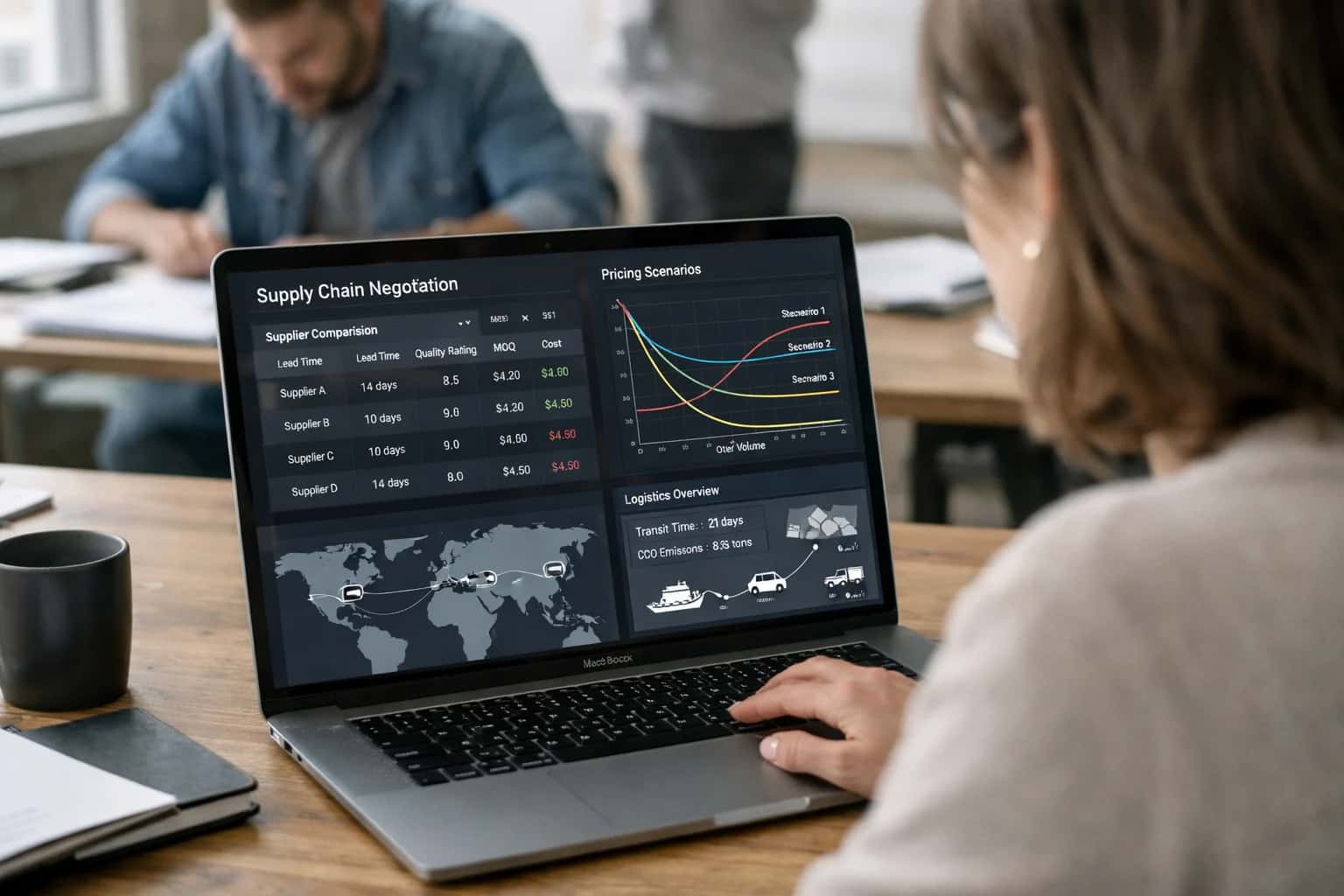
DIGITAL MIRROR
What is a Supply Chain Twin?
A Supply Chain Twin is a dynamic, virtual representation of a physical supply chain that uses real-time data to mirror assets, transactions, and material flows for simulation and scenario analysis.
This dynamic model serves as a risk-free sandbox for what-if simulation engines. Planners can stress-test the network against disruptions, model the cascading impact of a supplier failure, and optimize dynamic buffer management strategies before committing capital. The twin bridges the gap between planning and execution by providing a single source of truth for closed-loop remediation and autonomous decision-making.
DIGITAL MIRRORING
Core Characteristics of a Supply Chain Twin
A Supply Chain Twin is defined by its ability to create a living, breathing digital replica. These core characteristics distinguish it from a static model or a simple dashboard.
01
Real-Time Data Ingestion
The twin is connected to physical operations via IoT sensor fusion and API gateway federation. It ingests streaming telemetry on location, temperature, and transactional milestones instantly, ensuring the virtual state mirrors the physical world with sub-second latency.
02
End-to-End Entity Resolution
A unified data model relies on an entity resolution engine to merge disparate records. It understands that 'Supplier A' in the ERP and 'Vendor 001' in the TMS are the same node, creating a single source of truth across the supply chain graph.
03
Multi-Tier Visibility
Unlike linear track-and-trace, the twin maps deep n-tier interdependencies. It visualizes not just your direct suppliers, but their suppliers, exposing hidden concentration risks and bottlenecks deep in the multi-party network hub.
04
Physics-Based Simulation
The twin is a what-if simulation engine. It applies real-world constraints—lead times, capacity limits, and transportation physics—to stress-test scenarios. You can simulate a port closure and instantly see the disruption propagation modeling across the entire network.
05
Closed-Loop Remediation
An advanced twin doesn't just visualize problems; it fixes them. Through integration with an autonomous resolution agent, the twin can trigger automated playbook execution directly from the simulation environment, moving from insight to action without human latency.
06
Probabilistic Forecasting
The twin runs on causal inference, not just correlation. It generates probabilistic forecasts with ETA confidence scores, quantifying the likelihood of an on-time delivery based on dynamic variables like weather patterns and port congestion rather than static averages.
SUPPLY CHAIN TWIN FAQ
Frequently Asked Questions
Explore the core concepts behind supply chain twins, from their foundational architecture to their role in autonomous decision-making and scenario simulation.
A supply chain twin is a dynamic, real-time virtual representation of the physical supply chain that mirrors assets, transactions, and material flows to enable simulation and scenario analysis. It works by ingesting live data streams from IoT sensors, ERP systems, and transportation management platforms to create a synchronized digital model. Unlike a static snapshot, the twin continuously updates to reflect current inventory levels, shipment locations, and production statuses. This allows organizations to run what-if simulations—such as testing the impact of a port closure or a demand spike—without disrupting actual operations. The core mechanism involves a canonical data schema that normalizes heterogeneous inputs and a supply chain graph that maps the complex interdependencies between suppliers, sites, and logistics lanes.
Enabling Efficiency, Speed & Accuracy
Intelligent Analysis, Decision & Execution
We build AI systems for teams that need search across company data, workflow automation across tools, or AI features inside products and internal software.
Talk to Us
Search across company data
Give teams answers from docs, tickets, runbooks, and product data with sources and permissions.
Useful when people spend too long searching or get different answers from different systems.
Enterprise searchRAGPermissions
Read more
Automate internal workflows
Use AI to route work, draft outputs, trigger actions, and keep approvals and logs in place.
Useful when repetitive work moves across multiple tools and teams.
AI agentsWorkflow automationGovernance
Read more
Add AI to products and internal tools
Build assistants, guided actions, or decision support into the software your team or customers already use.
Useful when AI needs to be part of the product, not a separate tool.
AI integrationDecision supportModel routing
Read more
About the author
Prasad Kumkar
CEO & MD, Inference Systems
Prasad Kumkar is the CEO & MD of Inference Systems and writes about AI systems architecture, LLM infrastructure, model serving, evaluation, and production deployment. Over 5+ years, he has worked across computer vision models, L5 autonomous vehicle systems, and LLM research, with a focus on taking complex AI ideas into real-world engineering systems.
His work and writing cover AI systems, large language models, AI agents, multimodal systems, autonomous systems, inference optimization, RAG, evaluation, and production AI engineering.
LinkedIn
Limited slotsGet a Free AI Consultation
Partnered with leading AI, data, and software stack.





How We Work
Custom AI workflows for your Business
One-fit-all AI don't work for modern businesses. At Inferensys, we aim to understand your business & custom requirements; which we use to define most efficient agentic workflows, the data, and the tools for your business.
01
Review the use case
We understand the task, the users, and where AI can actually help.
Read more02
Pick the right approach
We define what needs search, automation, or product integration.
Read more03
Build the first useful version
We implement the part that proves the value first.
Read more04
Improve from there
We add the checks and visibility needed to keep it useful.
Read moreThe first call is a practical review of your use case and the right next step.
Talk to Us