A cognitive control tower is an advanced supply chain command center that leverages artificial intelligence and machine learning to ingest and correlate real-time data streams from internal systems, external partners, and IoT sensors. Unlike traditional control towers that provide reactive visibility, a cognitive control tower applies predictive analytics and prescriptive analytics to forecast disruptions, model their cascading impact via a supply chain twin, and recommend or autonomously execute optimal resolutions.

Glossary
Cognitive Control Tower
An AI-augmented command center that ingests real-time data streams to provide end-to-end supply chain visibility, predictive alerts, and automated decision-making capabilities.
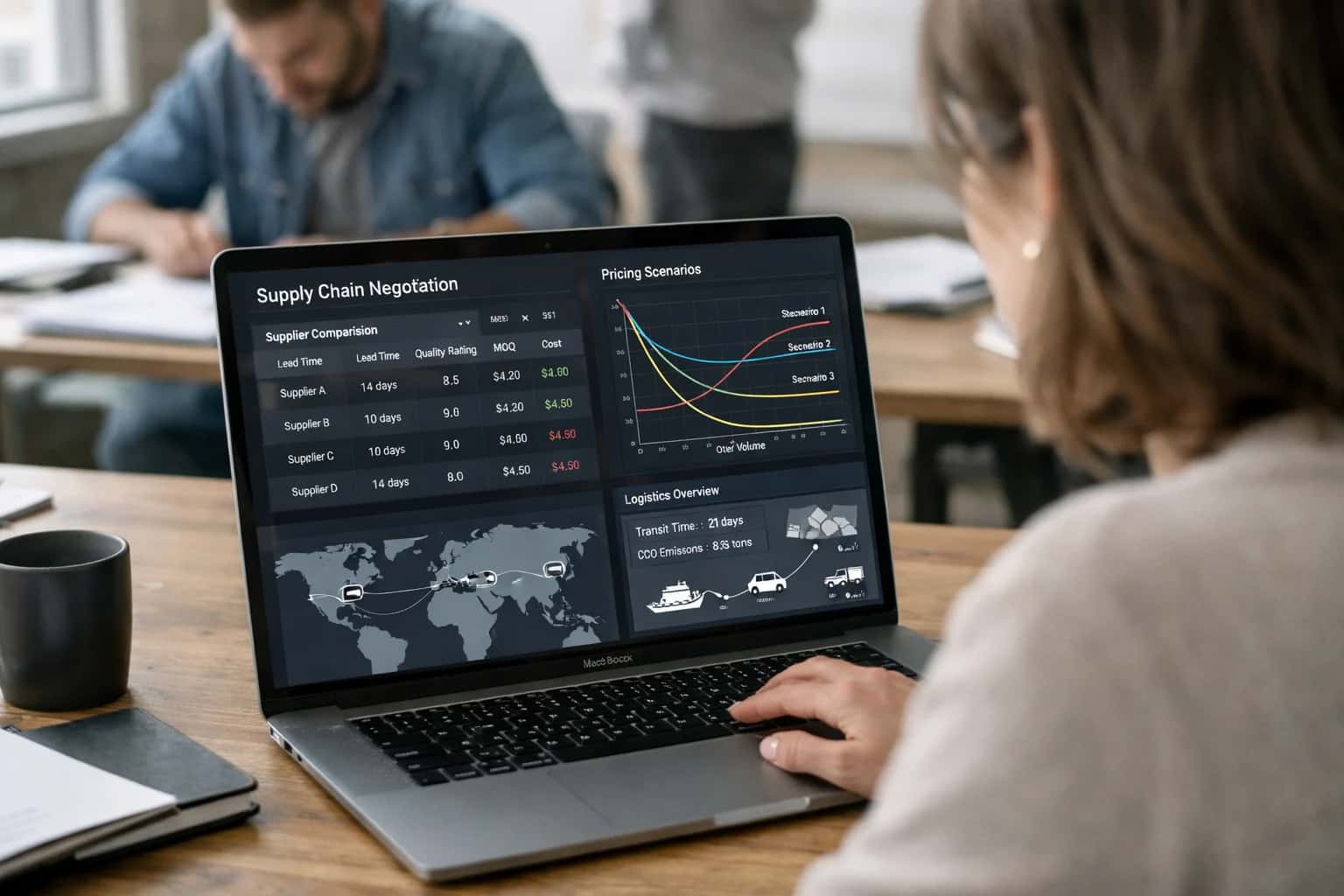
AUTONOMOUS SUPPLY CHAIN COMMAND CENTER
What is a Cognitive Control Tower?
A cognitive control tower is an AI-augmented command center that ingests real-time data streams to provide end-to-end supply chain visibility, predictive alerts, and automated decision-making capabilities, moving beyond traditional dashboards to autonomous orchestration.
The architecture integrates complex event processing (CEP) to detect patterns across millions of events and an anomaly detection engine to surface critical exceptions. When a SLA breach predictor identifies a shipment at risk, the system triggers an autonomous resolution agent to execute a predefined automated playbook or, for novel problems, queries a what-if simulation engine to evaluate corrective actions before implementation, achieving true closed-loop remediation.
AUGMENTED COMMAND CENTER
Core Capabilities of a Cognitive Control Tower
A Cognitive Control Tower transcends traditional visibility by integrating AI to predict disruptions, prescribe actions, and autonomously resolve exceptions across the end-to-end supply chain.
01
Real-Time Visibility & Digital Twin
Ingests streaming data from IoT sensors, API gateways, and multi-party networks to create a live, virtual representation of the physical supply chain. This Supply Chain Twin mirrors assets, inventory, and shipments in motion, providing a single source of truth.
- Unifies data via a Canonical Data Schema
- Tracks individual items through Track-and-Trace Hubs
- Visualizes risk with Value-at-Risk Visualization
< 1 sec
Data Latency
02
Predictive & Prescriptive Analytics
Employs machine learning models to forecast future states and recommend optimal actions. A Predictive Milestone Engine calculates ETA Confidence Scores, while Prescriptive Analytics suggest specific resolutions to mitigate predicted delays before they impact the customer.
- Forecasts service failures with an SLA Breach Predictor
- Identifies root causes via Causal Inference for Disruption Analysis
- Continuously adjusts stock levels through Dynamic Safety Stock Calculation
03
Intelligent Exception Management
Detects deviations from plans and orchestrates resolution workflows. An Anomaly Detection Engine uses Dynamic Threshold Tuning to surface real issues, while Intelligent Alert Suppression eliminates noise. Critical events trigger Automated Playbook Execution for standard exceptions.
- Detects route deviations via Geofence Violation Alerts
- Models cascading failures with Disruption Propagation Modeling
- Measures operational resilience by tracking Mean Time to Resolve (MTTR)
04
Autonomous Resolution & Closed-Loop Remediation
Moves beyond alerting to action. An Autonomous Resolution Agent independently executes corrective actions, such as re-routing a shipment or expediting a purchase order. Closed-Loop Remediation verifies that the action resolved the issue, ensuring a self-healing supply chain.
- Tests decisions safely in a What-If Simulation Engine
- Executes standard responses via Automated Playbook Execution
- Manages decentralized decisions with a Federated Control Architecture
05
Natural Language Interaction
Democratizes access to complex supply chain data through conversational interfaces. A Natural Language Query (NLQ) layer allows planners to ask questions like 'Show me all at-risk orders for Supplier X' without writing code, accelerating time-to-insight.
- Queries the Supply Chain Graph using plain English
- Surfaces insights from Business Activity Monitoring (BAM) dashboards
- Reduces reliance on specialized data analysts
06
Multi-Party Network Orchestration
Connects internal systems with external partners on a Multi-Party Network Hub to break down silos. API Gateway Federation normalizes data from carriers, suppliers, and manufacturers, enabling true end-to-end orchestration and collaborative disruption response.
- Resolves identity conflicts with an Entity Resolution Engine
- Monitors cross-company performance with On-Time In-Full (OTIF) metrics
- Assesses external risks via Supplier Risk Intelligence
OPERATIONAL MECHANISM
How a Cognitive Control Tower Works
A cognitive control tower functions as an AI-augmented command center that ingests real-time data streams to provide end-to-end supply chain visibility, predictive alerts, and automated decision-making capabilities.
A cognitive control tower operates by continuously ingesting and fusing heterogeneous data streams—from IoT sensor telemetry and API gateway federations to canonical data schemas—into a unified supply chain graph. This graph models entities like suppliers, shipments, and assets as interconnected nodes, enabling the system to map complex interdependencies. An anomaly detection engine with dynamic threshold tuning then monitors these streams, using complex event processing (CEP) to identify meaningful patterns and deviations from expected behavior in real time.
Upon detecting an exception, the tower's predictive milestone engine calculates an ETA confidence score to quantify disruption severity. The system then triggers an intelligent alert suppression layer to filter noise before executing a closed-loop remediation workflow. This may involve an autonomous resolution agent initiating an automated playbook execution, such as re-routing a shipment via a dynamic route optimization algorithm. The entire process is visualized through value-at-risk dashboards, allowing human operators to monitor mean time to resolve (MTTR) and audit the system's prescriptive actions.
COGNITIVE CONTROL TOWER INSIGHTS
Frequently Asked Questions
Explore the core concepts behind the AI-augmented command center that provides end-to-end supply chain visibility, predictive alerts, and automated decision-making.
A Cognitive Control Tower is an AI-augmented command center that ingests real-time data streams to provide end-to-end supply chain visibility, predictive alerts, and automated decision-making capabilities. Unlike a traditional control tower, which is primarily a descriptive analytics dashboard showing what happened, a cognitive tower is prescriptive and autonomous. It leverages machine learning, Complex Event Processing (CEP), and Digital Twin Simulation to not only visualize the current state but to predict future disruptions and autonomously trigger corrective actions through an Autonomous Resolution Agent. The key differentiator is the shift from human-driven monitoring to AI-driven orchestration, where the system identifies exceptions, models their impact via a What-If Simulation Engine, and executes a Closed-Loop Remediation workflow without manual intervention.
Enabling Efficiency, Speed & Accuracy
Intelligent Analysis, Decision & Execution
We build AI systems for teams that need search across company data, workflow automation across tools, or AI features inside products and internal software.
Talk to Us
Search across company data
Give teams answers from docs, tickets, runbooks, and product data with sources and permissions.
Useful when people spend too long searching or get different answers from different systems.
Enterprise searchRAGPermissions
Read more
Automate internal workflows
Use AI to route work, draft outputs, trigger actions, and keep approvals and logs in place.
Useful when repetitive work moves across multiple tools and teams.
AI agentsWorkflow automationGovernance
Read more
Add AI to products and internal tools
Build assistants, guided actions, or decision support into the software your team or customers already use.
Useful when AI needs to be part of the product, not a separate tool.
AI integrationDecision supportModel routing
Read more
About the author
Prasad Kumkar
CEO & MD, Inference Systems
Prasad Kumkar is the CEO & MD of Inference Systems and writes about AI systems architecture, LLM infrastructure, model serving, evaluation, and production deployment. Over 5+ years, he has worked across computer vision models, L5 autonomous vehicle systems, and LLM research, with a focus on taking complex AI ideas into real-world engineering systems.
His work and writing cover AI systems, large language models, AI agents, multimodal systems, autonomous systems, inference optimization, RAG, evaluation, and production AI engineering.
LinkedIn
Limited slotsGet a Free AI Consultation
Partnered with leading AI, data, and software stack.





How We Work
Custom AI workflows for your Business
One-fit-all AI don't work for modern businesses. At Inferensys, we aim to understand your business & custom requirements; which we use to define most efficient agentic workflows, the data, and the tools for your business.
01
Review the use case
We understand the task, the users, and where AI can actually help.
Read more02
Pick the right approach
We define what needs search, automation, or product integration.
Read more03
Build the first useful version
We implement the part that proves the value first.
Read more04
Improve from there
We add the checks and visibility needed to keep it useful.
Read moreThe first call is a practical review of your use case and the right next step.
Talk to Us