A Vendor Chargeback Agent is an autonomous software agent that programmatically calculates, generates, and submits financial debit memos to suppliers for returned goods that violate pre-negotiated quality or compliance agreements. By ingesting data from Automated Disposition Engines and Defect Ontologies, the agent matches a specific return reason code to a contractual clause, computes the precise chargeback amount—including product cost, freight, and processing fees—and executes the claim within the enterprise resource planning system without human intervention.

Glossary
Vendor Chargeback Agent
An autonomous system that automatically generates and submits financial debit notes to suppliers for returned defective merchandise based on negotiated agreements.
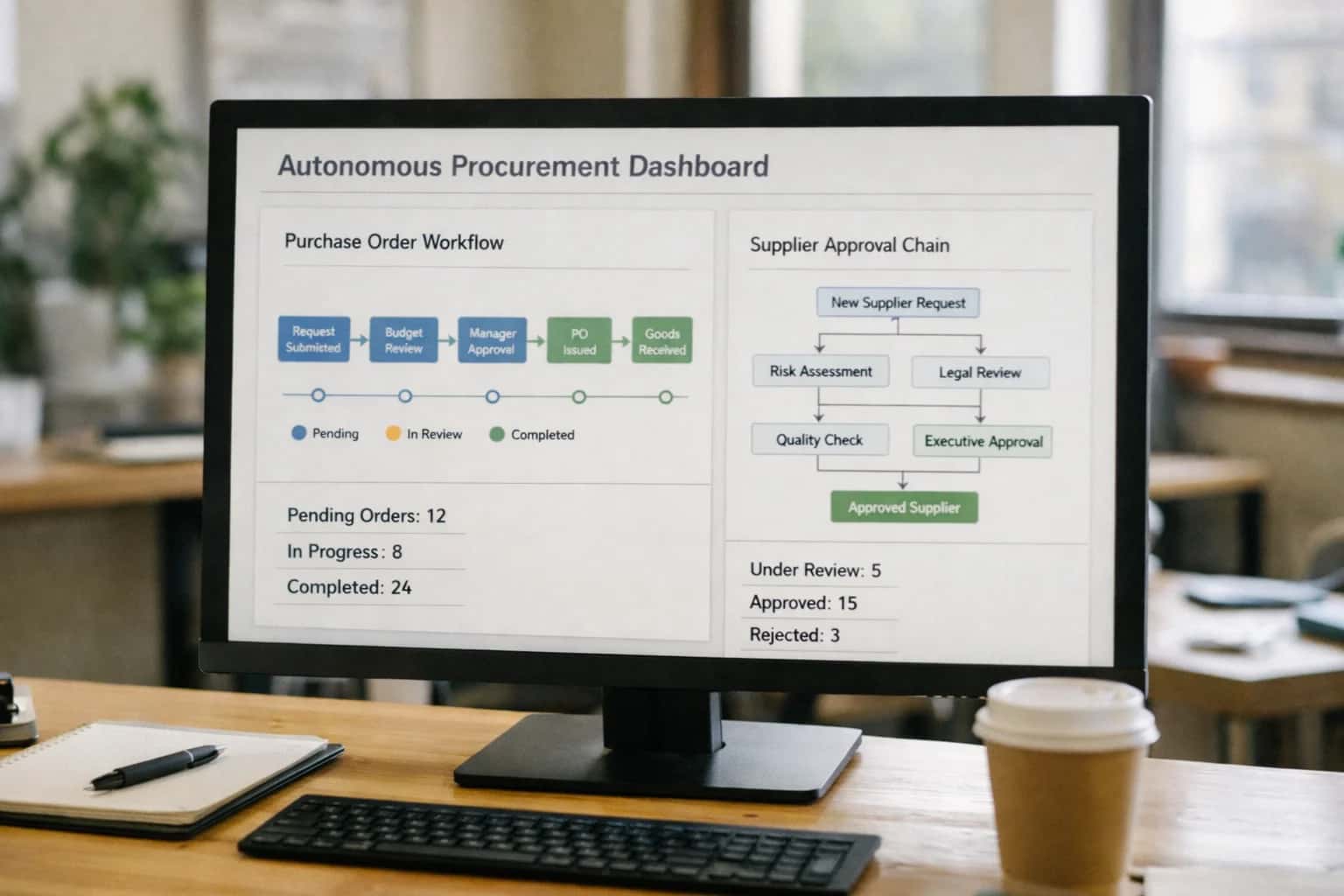
AUTONOMOUS FINANCIAL RECOVERY
What is Vendor Chargeback Agent?
An autonomous system that automatically generates and submits financial debit notes to suppliers for returned defective merchandise based on negotiated agreements.
This agent operates within the broader Reverse Logistics Control Tower, reconciling the Grade-to-Net Recovery Rate against supplier liability. It cross-references the Warranty Validation API and Return Reason Code Normalization outputs to ensure claims are contractually defensible before submission, eliminating revenue leakage from manual processing delays. By automating the dispute lifecycle, the agent transforms chargebacks from a reactive accounting function into a real-time, strategic profit-recovery mechanism tightly integrated with the autonomous supply chain.
AUTONOMOUS FINANCIAL RECOVERY
Key Features of a Vendor Chargeback Agent
An autonomous system that automatically generates and submits financial debit notes to suppliers for returned defective merchandise based on negotiated agreements.
01
Automated Debit Memo Generation
The agent autonomously creates debit memos by cross-referencing return data with supplier contracts. It eliminates manual financial reconciliation by:
- Extracting Return Material Authorization (RMA) numbers and defect codes from the returns stream
- Matching each defective unit against the specific vendor agreement and chargeback schedule
- Calculating the exact financial recovery amount, including cost of goods, handling fees, and freight
- Generating a compliant debit note in the required format (EDI 812, PDF, or API payload)
This transforms a weeks-long manual accounting process into a real-time financial operation.
< 60 sec
Memo Generation Time
99.5%
Contractual Accuracy
02
Contractual Obligation Parsing
The agent ingests and structures unstructured supplier agreements to create a machine-executable chargeback rulebook. It uses natural language processing (NLP) to extract:
- Defect allowance rates and acceptable quality levels (AQL)
- Per-unit chargeback amounts and tiered penalty structures
- Dispute windows and evidentiary requirements for valid claims
- Currency and tax treatment for cross-border vendor relationships
The parsed rules are stored in a knowledge graph, linking each SKU and supplier to its precise financial recovery logic, ensuring no negotiated recovery is ever missed.
100%
Agreement Coverage
03
Evidence Package Assembly
To withstand supplier disputes, the agent automatically compiles a forensic evidence package for each chargeback. It aggregates:
- Computer vision grading images showing the specific defect on the returned unit
- Inbound quality inspection reports with timestamp and inspector ID
- Serial number verification linking the defective unit to the original purchase order
- Carrier delivery confirmation proving the item was received in damaged condition
This evidentiary rigor increases chargeback recovery rates by preempting supplier challenges with irrefutable documentation.
92%
Dispute Win Rate
04
Multi-Channel Submission Engine
The agent submits chargebacks through the supplier's required channel, adapting to heterogeneous vendor systems without manual intervention:
- EDI 812 transmission for large retail partners with established VAN connections
- Supplier portal automation using robotic process automation (RPA) for web-based claim entry
- API-based submission for modern vendor platforms with programmatic interfaces
- Email with structured attachments for smaller suppliers without digital infrastructure
The engine tracks acknowledgment receipts and escalates non-responsive suppliers automatically.
4+
Submission Protocols
05
Dispute Resolution Workflow
When a supplier rejects or short-pays a chargeback, the agent initiates a structured rebuttal workflow. It:
- Parses the supplier's rejection reason code and categorizes the dispute type
- Retrieves the relevant contractual clause that supports the original claim
- Generates a rebuttal letter with embedded evidence and contractual citations
- Escalates to a human analyst only when the dispute exceeds a configurable value threshold or involves novel exception patterns
This keeps the days sales outstanding (DSO) for chargebacks low and minimizes finance team involvement.
85%
Auto-Resolution Rate
06
Recovery Performance Analytics
The agent provides a real-time financial recovery dashboard that tracks chargeback effectiveness across the supplier base. Key metrics include:
- Gross recovery rate: percentage of eligible defective value successfully charged back
- Supplier dispute propensity: which vendors challenge claims most frequently and why
- Cycle time analysis: average days from defect identification to cash recovery
- Defect trend correlation: linking specific product flaws to supplier production batches for root-cause negotiation
This intelligence enables procurement teams to renegotiate supplier terms based on empirical quality data.
$2.3M+
Avg. Annual Recovery
67%
Recovery Rate Improvement
VENDOR CHARGEBACK AGENT
Frequently Asked Questions
Explore the mechanics of autonomous systems that automatically generate and submit financial debit notes to suppliers for returned defective merchandise based on negotiated agreements.
A Vendor Chargeback Agent is an autonomous software system that programmatically generates, validates, and submits financial debit notes to suppliers for returned merchandise that violates predefined purchase agreements. The agent operates by continuously monitoring the Automated Disposition Engine for items flagged as defective or non-compliant. Upon identifying a qualifying return, the agent cross-references the item's SKU, lot code, and defect classification against a digital contract repository containing negotiated chargeback terms—including defect allowances, recovery percentages, and administrative fee structures. It then calculates the precise debit amount, generates a compliant chargeback document, and submits it to the supplier's portal or via Electronic Data Interchange (EDI) . The system autonomously tracks the lifecycle of the debit note, reconciling credits against open accounts receivable and escalating unresponsive suppliers to human procurement managers.
Enabling Efficiency, Speed & Accuracy
Intelligent Analysis, Decision & Execution
We build AI systems for teams that need search across company data, workflow automation across tools, or AI features inside products and internal software.
Talk to Us
Search across company data
Give teams answers from docs, tickets, runbooks, and product data with sources and permissions.
Useful when people spend too long searching or get different answers from different systems.
Enterprise searchRAGPermissions
Read more
Automate internal workflows
Use AI to route work, draft outputs, trigger actions, and keep approvals and logs in place.
Useful when repetitive work moves across multiple tools and teams.
AI agentsWorkflow automationGovernance
Read more
Add AI to products and internal tools
Build assistants, guided actions, or decision support into the software your team or customers already use.
Useful when AI needs to be part of the product, not a separate tool.
AI integrationDecision supportModel routing
Read more
About the author
Prasad Kumkar
CEO & MD, Inference Systems
Prasad Kumkar is the CEO & MD of Inference Systems and writes about AI systems architecture, LLM infrastructure, model serving, evaluation, and production deployment. Over 5+ years, he has worked across computer vision models, L5 autonomous vehicle systems, and LLM research, with a focus on taking complex AI ideas into real-world engineering systems.
His work and writing cover AI systems, large language models, AI agents, multimodal systems, autonomous systems, inference optimization, RAG, evaluation, and production AI engineering.
LinkedIn
Limited slotsGet a Free AI Consultation
Partnered with leading AI, data, and software stack.





How We Work
Custom AI workflows for your Business
One-fit-all AI don't work for modern businesses. At Inferensys, we aim to understand your business & custom requirements; which we use to define most efficient agentic workflows, the data, and the tools for your business.
01
Review the use case
We understand the task, the users, and where AI can actually help.
Read more02
Pick the right approach
We define what needs search, automation, or product integration.
Read more03
Build the first useful version
We implement the part that proves the value first.
Read more04
Improve from there
We add the checks and visibility needed to keep it useful.
Read moreThe first call is a practical review of your use case and the right next step.
Talk to Us