The Order-Up-To Level is a critical decision variable in periodic review inventory systems, defining the maximum inventory position a planner aims to achieve at each review moment. Unlike continuous review policies that trigger orders at a reorder point, this approach places orders at fixed time intervals, with the order quantity dynamically calculated as the difference between the target level and the current inventory position (on-hand plus on-order minus backorders).

Glossary
Order-Up-To Level
The maximum target inventory position used in periodic review policies, where a replenishment order is placed at each review interval to raise the inventory position back up to this specified level.
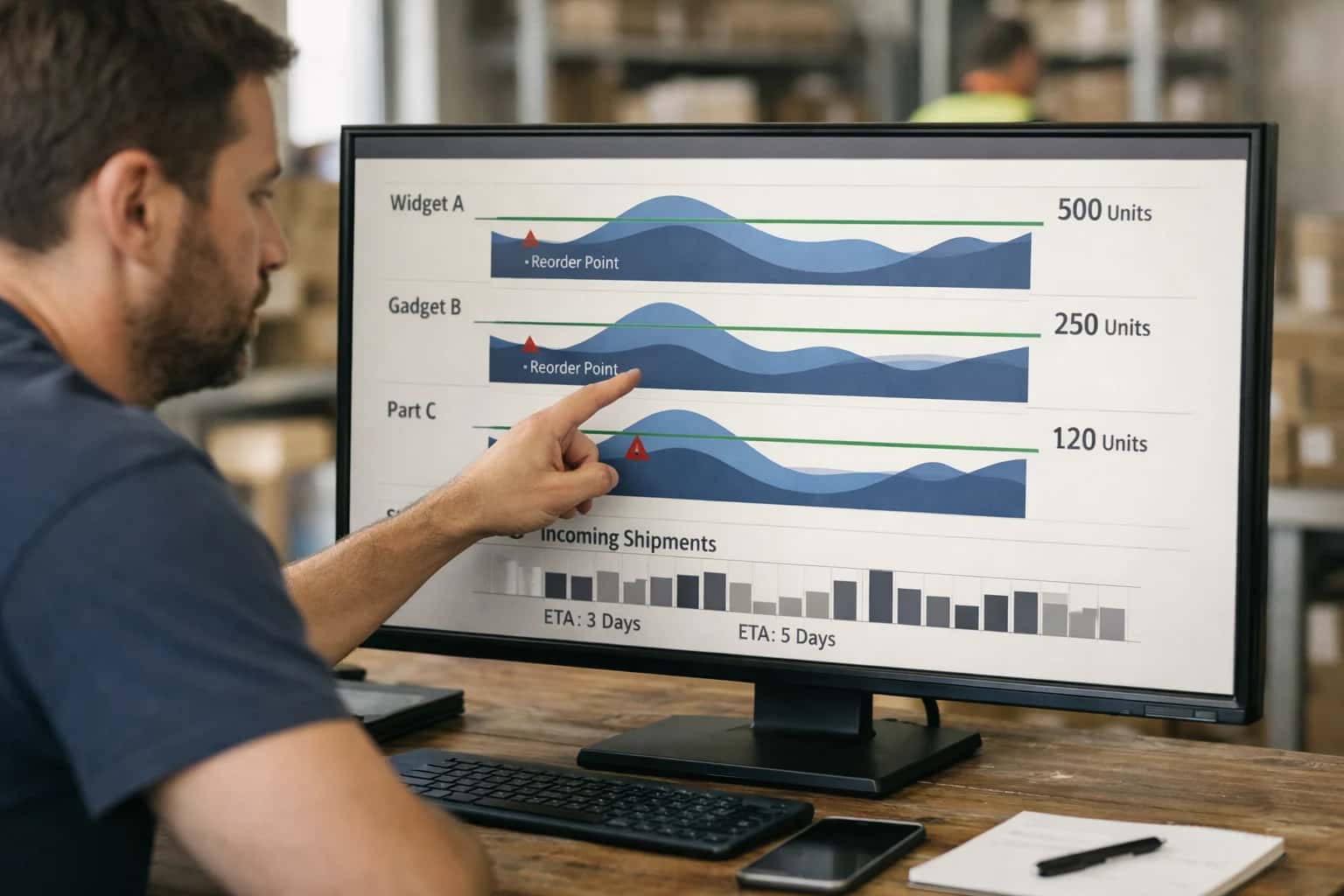
INVENTORY CONTROL PARAMETER
What is Order-Up-To Level?
The Order-Up-To Level is the maximum target inventory position used in periodic review policies, where a replenishment order is placed at each review interval to raise the inventory position back up to this specified level.
This parameter directly absorbs demand variability over the protection interval, which spans the review period plus the replenishment lead time. Setting the level too low increases stockout risk and compromises cycle service level, while setting it too high inflates inventory carrying cost. Multi-echelon systems, such as Guaranteed Service Models, use this logic at each node to propagate service time guarantees through the supply network.
PERIODIC REVIEW POLICY MECHANICS
Key Characteristics of the Order-Up-To Level
The Order-Up-To Level (S) is the target inventory position in a periodic review system. At each review interval, a replenishment order is placed to raise the inventory position back to this predetermined maximum, absorbing all demand variability since the last review.
01
Inventory Position Calculation
The inventory position is the key metric monitored, not just on-hand stock. It is calculated as:
- On-hand inventory: Physical units in the warehouse
- + On-order units: Quantities already requested from suppliers but not yet received
- - Backorders: Customer demand that is committed but unfilled
The order quantity is simply S minus current inventory position, ensuring the position returns to the target level regardless of demand spikes.
02
Protection Interval Coverage
Unlike a reorder point system that only covers lead time demand, the Order-Up-To Level must protect against variability over the protection interval:
- Review Period (R): The fixed time between inventory checks
- Lead Time (L): The supplier's delivery time after order placement
- Total Exposure: R + L
This means the system must absorb demand uncertainty for the entire review cycle plus replenishment lag, requiring a higher safety stock than continuous review systems for the same service level.
03
Demand Distribution Modeling
The optimal Order-Up-To Level is derived from the probability distribution of demand over the protection interval:
- Mean demand: Expected consumption during R + L
- Standard deviation: Variability of demand during R + L
- Target service level: Desired probability of no stockout (e.g., 95% cycle service level)
The formula S = μ + z × σ uses the z-score from the standard normal distribution corresponding to the target service level, ensuring the safety stock component is statistically calibrated.
04
Order Quantity Variability
A defining characteristic of the Order-Up-To policy is that order sizes are inherently variable:
- In high-demand periods, large orders are placed to restore the position to S
- In low-demand periods, small orders or even no orders are generated
- This variability can create the bullwhip effect upstream if suppliers are not prepared
This contrasts with fixed-order-quantity policies like EOQ, where batch sizes remain constant but the timing between orders fluctuates.
05
Multi-Echelon Coordination
In a multi-echelon inventory optimization (MEIO) context, the Order-Up-To Level at each node is not calculated in isolation:
- A retail store's S level directly impacts the demand pattern seen by the regional distribution center
- The distribution center's S level must account for the aggregated variability of all downstream locations
- Guaranteed Service Models (GSM) and Stochastic Service Models (SSM) use different assumptions about how upstream stockouts propagate to determine optimal S levels across the network
06
Practical Implementation Triggers
Real-world deployment requires defining the review rhythm and exception handling:
- Review frequency: Daily, weekly, or monthly cycles aligned with supplier order windows
- Min-max constraints: Business rules that override the calculated S level for shelf-life limits or warehouse capacity
- Demand sensing integration: Short-term POS data can dynamically adjust S levels between formal review cycles
- Promotional overrides: Planned marketing events require temporary S level increases to avoid stockouts during demand surges
Enabling Efficiency, Speed & Accuracy
Intelligent Analysis, Decision & Execution
We build AI systems for teams that need search across company data, workflow automation across tools, or AI features inside products and internal software.
Talk to Us
Search across company data
Give teams answers from docs, tickets, runbooks, and product data with sources and permissions.
Useful when people spend too long searching or get different answers from different systems.
Enterprise searchRAGPermissions
Read more
Automate internal workflows
Use AI to route work, draft outputs, trigger actions, and keep approvals and logs in place.
Useful when repetitive work moves across multiple tools and teams.
AI agentsWorkflow automationGovernance
Read more
Add AI to products and internal tools
Build assistants, guided actions, or decision support into the software your team or customers already use.
Useful when AI needs to be part of the product, not a separate tool.
AI integrationDecision supportModel routing
Read moreORDER-UP-TO LEVEL CLARIFIED
Frequently Asked Questions
Precise answers to the most common technical questions about the Order-Up-To Level inventory policy, its calculation, and its role within periodic review systems.
The Order-Up-To Level (S) is the maximum target inventory position used in a periodic review replenishment policy. At the end of each fixed review interval (R), the system calculates the current inventory position—defined as on-hand stock plus on-order quantity minus backorders—and places a replenishment order for exactly the amount required to raise the inventory position back up to the target level S. The order quantity is therefore variable: Q = S − (Current Inventory Position). This mechanism absorbs all demand variability that occurred during the review period and the subsequent replenishment lead time (L), making the protection interval equal to R + L. The policy is formally designated as a (R, S) system, where R is the fixed time between reviews and S is the order-up-to ceiling.

About the author
Prasad Kumkar
CEO & MD, Inference Systems
Prasad Kumkar is the CEO & MD of Inference Systems and writes about AI systems architecture, LLM infrastructure, model serving, evaluation, and production deployment. Over 5+ years, he has worked across computer vision models, L5 autonomous vehicle systems, and LLM research, with a focus on taking complex AI ideas into real-world engineering systems.
His work and writing cover AI systems, large language models, AI agents, multimodal systems, autonomous systems, inference optimization, RAG, evaluation, and production AI engineering.
LinkedIn
Limited slotsGet a Free AI Consultation
Partnered with leading AI, data, and software stack.





How We Work
Custom AI workflows for your Business
One-fit-all AI don't work for modern businesses. At Inferensys, we aim to understand your business & custom requirements; which we use to define most efficient agentic workflows, the data, and the tools for your business.
01
Review the use case
We understand the task, the users, and where AI can actually help.
Read more02
Pick the right approach
We define what needs search, automation, or product integration.
Read more03
Build the first useful version
We implement the part that proves the value first.
Read more04
Improve from there
We add the checks and visibility needed to keep it useful.
Read moreThe first call is a practical review of your use case and the right next step.
Talk to Us