Cycle service level is the probability that all customer demand occurring within a single replenishment cycle is satisfied immediately from on-hand stock. Unlike fill rate, which measures the fraction of units fulfilled, this metric evaluates the binary outcome of whether a stockout event occurred at any point during the cycle, making it a critical parameter for setting safety stock levels in periodic review systems.

Glossary
Cycle Service Level
The probability that no stockout will occur during a single replenishment cycle, measuring the likelihood of having sufficient inventory to cover demand from order placement to order receipt.
INVENTORY PERFORMANCE METRIC
What is Cycle Service Level?
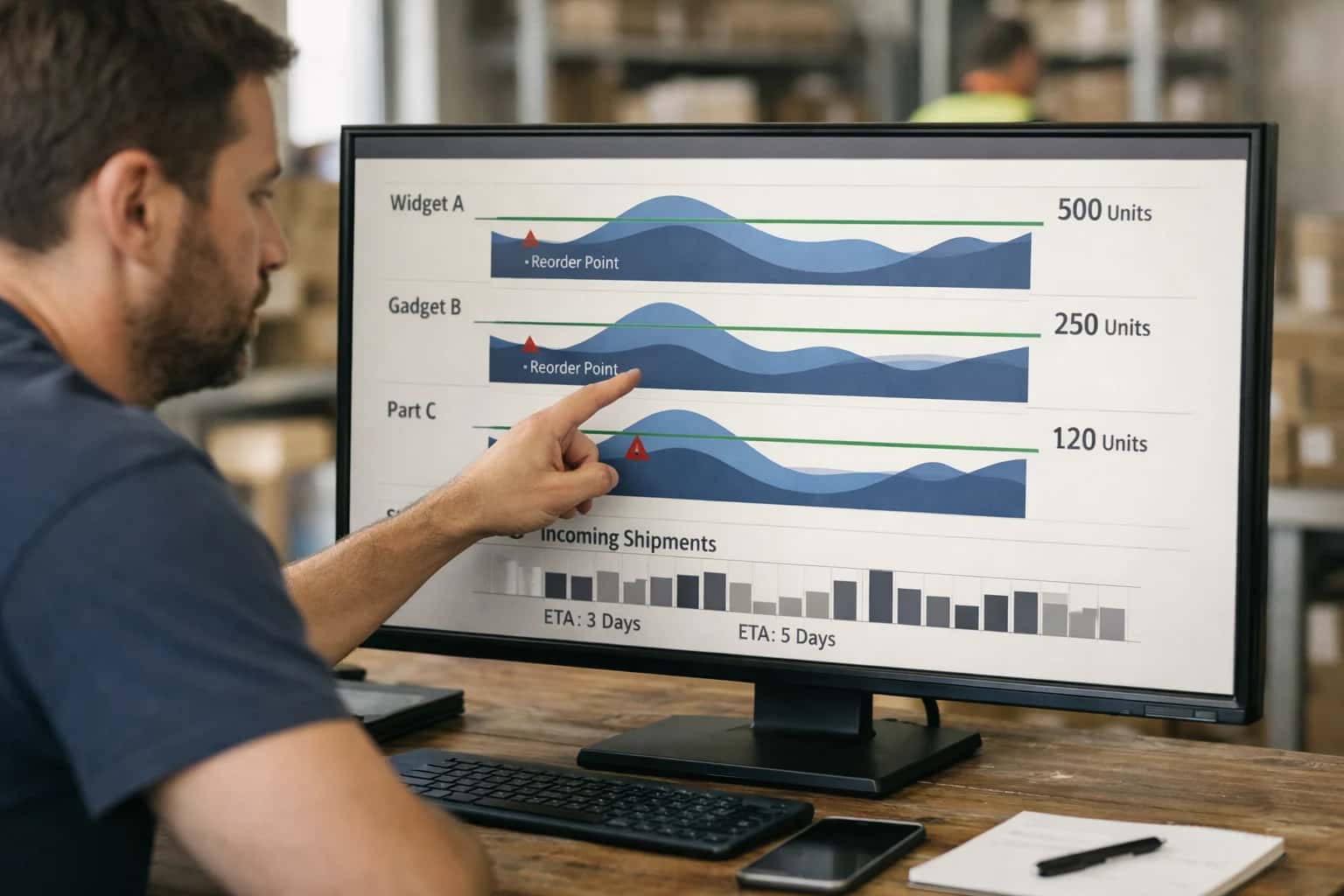
Cycle service level measures the probability of not encountering a stockout during a single replenishment cycle, providing a focused metric for evaluating inventory policy effectiveness from order placement to receipt.
A 95% cycle service level implies that stockouts are expected in only 5 out of every 100 replenishment cycles, regardless of the magnitude of the shortage. This metric directly informs the calculation of the reorder point and is preferred when the primary business objective is to minimize the frequency of backorder occurrences rather than the total quantity of units shorted.
SERVICE METRIC COMPARISON
Cycle Service Level vs. Fill Rate
A technical comparison of the two primary inventory service level metrics, distinguishing their measurement focus, calculation methodology, and operational application in multi-echelon optimization.
| Feature | Cycle Service Level (CSL) | Fill Rate (FR) | Practical Guidance |
|---|---|---|---|
Definition | Probability of zero stockouts during a single replenishment cycle | Fraction of total demand units immediately fulfilled from on-hand stock | CSL measures event risk; FR measures volume impact |
Unit of Measurement | Probability (0-100%) | Percentage of units (0-100%) | CSL is dimensionless; FR is volume-weighted |
Calculation Basis | Number of replenishment cycles without a stockout divided by total cycles | Total units fulfilled immediately divided by total units demanded | CSL ignores magnitude of shortage; FR penalizes large shortages |
Sensitivity to Shortage Size | Insensitive — a 1-unit shortage counts the same as a 1,000-unit shortage | Highly sensitive — larger shortages reduce FR proportionally more | Use CSL when shortage size is irrelevant; use FR when customer impact scales with volume |
Typical Target Range | 90-99% for high-service items | 95-99.9% for consumer-facing SKUs | A 99% CSL can correspond to a 95% FR if shortage magnitudes are large |
Mathematical Relationship | CSL = P(Demand during lead time ≤ Reorder Point) | FR = 1 - (Expected Shortage per Cycle / Expected Demand per Cycle) | FR is always ≤ CSL for the same inventory policy |
Primary Use Case | Setting reorder points and safety stock for discrete, high-value items | Measuring customer-facing performance and contractual service agreements | CSL for internal planning; FR for external commitments and OTIF metrics |
Optimization Context | Used in Guaranteed Service Models (GSM) for deterministic multi-echelon safety stock placement | Used in Stochastic Service Models (SSM) to capture real-time shortage propagation | MEIO frameworks select the appropriate metric based on network modeling assumptions |
CYCLE SERVICE LEVEL EXPLAINED
Frequently Asked Questions
Clear, technically precise answers to the most common questions about cycle service level, its calculation, and its role in multi-echelon inventory optimization.
Cycle service level (CSL) is the probability that no stockout will occur during a single replenishment cycle, measuring the likelihood of having sufficient on-hand inventory to cover all demand from the moment a replenishment order is placed until the moment it is received. Unlike fill rate, which measures the fraction of demand units satisfied, CSL measures the fraction of replenishment cycles that complete without a stockout event. A 95% CSL means that, statistically, 19 out of 20 replenishment cycles will end without running out of stock. This metric is foundational in safety stock optimization and is the primary input for calculating buffer stock levels in both single-echelon and multi-echelon inventory optimization (MEIO) models. CSL is particularly relevant for items where a stockout during any cycle has severe operational consequences, such as assembly line components or critical spare parts.
Enabling Efficiency, Speed & Accuracy
Intelligent Analysis, Decision & Execution
We build AI systems for teams that need search across company data, workflow automation across tools, or AI features inside products and internal software.
Talk to Us
Search across company data
Give teams answers from docs, tickets, runbooks, and product data with sources and permissions.
Useful when people spend too long searching or get different answers from different systems.
Enterprise searchRAGPermissions
Read more
Automate internal workflows
Use AI to route work, draft outputs, trigger actions, and keep approvals and logs in place.
Useful when repetitive work moves across multiple tools and teams.
AI agentsWorkflow automationGovernance
Read more
Add AI to products and internal tools
Build assistants, guided actions, or decision support into the software your team or customers already use.
Useful when AI needs to be part of the product, not a separate tool.
AI integrationDecision supportModel routing
Read more
About the author
Prasad Kumkar
CEO & MD, Inference Systems
Prasad Kumkar is the CEO & MD of Inference Systems and writes about AI systems architecture, LLM infrastructure, model serving, evaluation, and production deployment. Over 5+ years, he has worked across computer vision models, L5 autonomous vehicle systems, and LLM research, with a focus on taking complex AI ideas into real-world engineering systems.
His work and writing cover AI systems, large language models, AI agents, multimodal systems, autonomous systems, inference optimization, RAG, evaluation, and production AI engineering.
LinkedIn
Limited slotsGet a Free AI Consultation
Partnered with leading AI, data, and software stack.





How We Work
Custom AI workflows for your Business
One-fit-all AI don't work for modern businesses. At Inferensys, we aim to understand your business & custom requirements; which we use to define most efficient agentic workflows, the data, and the tools for your business.
01
Review the use case
We understand the task, the users, and where AI can actually help.
Read more02
Pick the right approach
We define what needs search, automation, or product integration.
Read more03
Build the first useful version
We implement the part that proves the value first.
Read more04
Improve from there
We add the checks and visibility needed to keep it useful.
Read moreThe first call is a practical review of your use case and the right next step.
Talk to Us