Safety time is a buffer expressed in units of time rather than quantity, where replenishment orders are released earlier than theoretically required to absorb lead time variability. Unlike safety stock, which hedges against demand uncertainty with extra physical inventory, safety time hedges against supply-side uncertainty by shifting the order release date backward. This ensures that materials arrive before the expected consumption date even when suppliers experience delays, making it critical for items with reliable demand but unpredictable delivery schedules.

Glossary
Safety Time
Safety time is a temporal buffer where replenishment orders are released earlier than theoretically required to absorb variability in supplier lead times, ensuring material availability despite delivery delays.
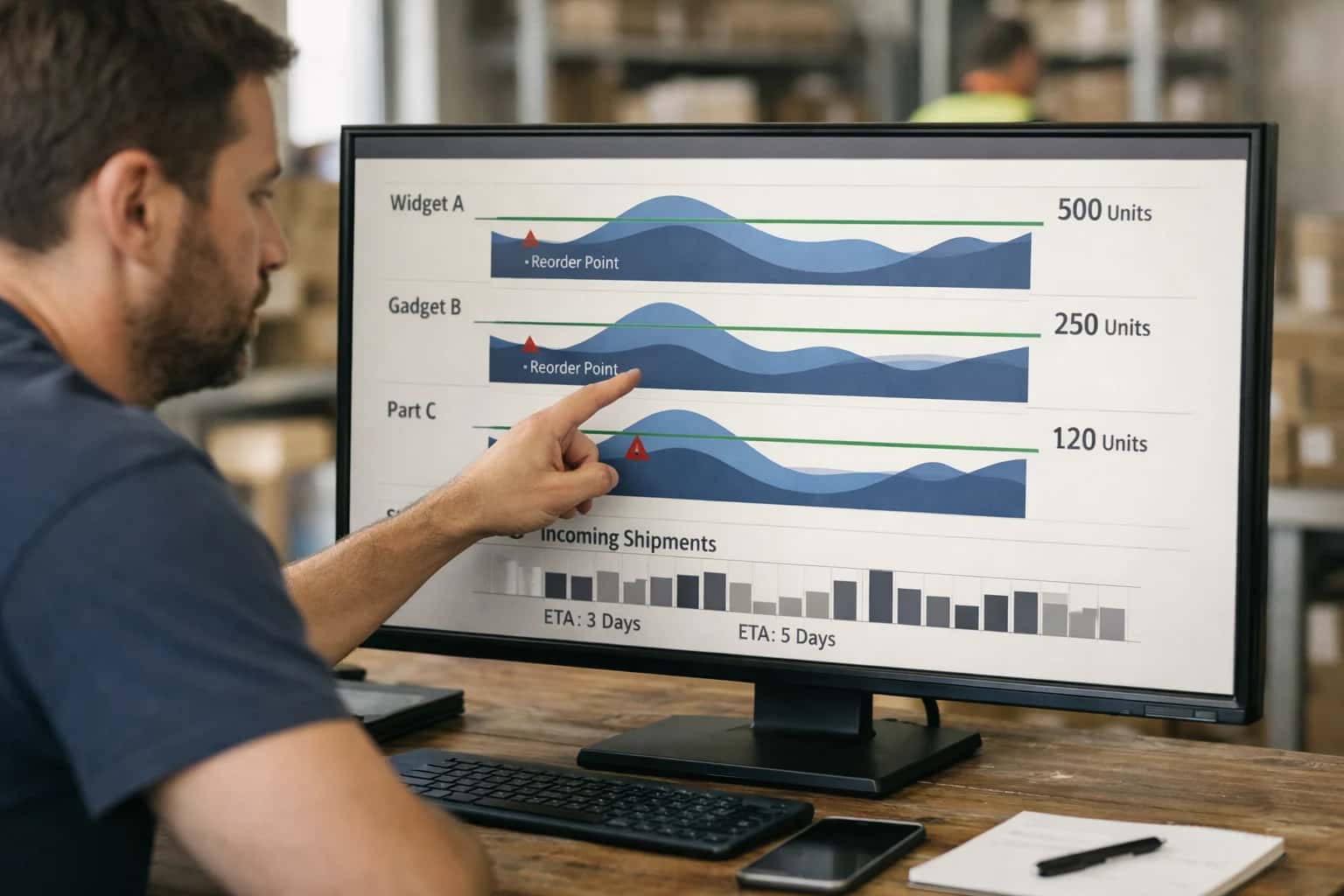
INVENTORY BUFFERING STRATEGY
What is Safety Time?
Safety time is a temporal buffer added to the planned lead time of a replenishment order to absorb variability in supply delivery, ensuring material availability despite unpredictable delays.
The mechanism directly addresses the gap between a supplier's quoted lead time and their actual, often longer, delivery performance. By analyzing the lead time distribution and its standard deviation, planners set a safety time that covers a target percentage of historical delay scenarios. This approach is particularly effective in make-to-order environments or when managing raw materials with long transportation legs, where holding physical safety stock would be prohibitively expensive or impractical due to shelf-life constraints.
BUFFER STRATEGY COMPARISON
Safety Time vs. Safety Stock: Key Differences
A structural comparison of the two primary methods for absorbing supply chain variability: adding time buffers to replenishment schedules versus holding physical quantity buffers in inventory.
| Feature | Safety Time | Safety Stock | Hybrid Approach |
|---|---|---|---|
Buffer Unit | Time (days/hours) | Quantity (units) | Both time and quantity |
Primary Protection Against | Lead time variability | Demand variability | Combined demand and lead time uncertainty |
Inventory Carrying Cost Impact | Lower (no physical stock held) | Higher (capital tied up in stock) | Moderate |
Replenishment Trigger Mechanism | Order released earlier than theoretically required | Order released when stock hits dynamic reorder point | Time-advanced order with quantity-adjusted buffer |
Effectiveness for Intermittent Demand | High (avoids holding stock during zero-demand periods) | Low (stock sits idle for extended periods) | High (time buffer with minimal quantity reserve) |
Responsiveness to Demand Volatility Clustering | Limited (does not directly address quantity spikes) | Strong (buffer scales with demand magnitude) | Strong (dual adjustment mechanisms) |
Integration with DDMRP Buffers | Not directly compatible | Core component (green/yellow/red zones) | Compatible (time-adjusted buffer zones) |
Computational Complexity | Low (simple lead time offset) | Moderate (requires demand distribution fitting) | High (requires joint probability modeling) |
TEMPORAL BUFFER MECHANICS
Core Characteristics of Safety Time
Safety time decouples the physical flow of goods from the information flow of orders by advancing the release signal. It is a critical parameter in time-phased planning systems where lead time variability, not demand variability, is the dominant source of supply risk.
01
Lead Time Variability Absorption
Safety time directly compensates for the stochastic nature of supplier delivery. While safety stock buffers against quantity uncertainty, safety time buffers against temporal uncertainty. If a supplier's historical lead time has a standard deviation of 3 days, adding 3 days of safety time ensures the order arrives before the stockout point with a predictable probability. This mechanism is essential when the coefficient of variation of lead time exceeds that of demand.
02
Order Release Advancement
The core mechanism is the forward shift of the planned order release date. In an MRP system, the planned lead time is artificially inflated. The system calculates the requirement date, subtracts the nominal lead time, and then subtracts the safety time to determine the release date. This creates a temporal decoupling point where the order is launched earlier than strictly necessary, building a time-based reserve in the pipeline.
03
Distinction from Safety Stock
Safety stock and safety time are distinct, non-interchangeable buffers:
- Safety Stock: Absorbs demand variability and forecast error. Increases average on-hand inventory and carrying costs.
- Safety Time: Absorbs supply lead time variability. Increases pipeline inventory and the risk of obsolescence for short-lifecycle products. Using safety time when demand is stable but supply is unreliable prevents unnecessary physical inventory buildup.
04
MRP and DDMRP Integration
In traditional Material Requirements Planning (MRP), safety time is a static master data field applied uniformly. In Demand Driven MRP (DDMRP), the concept evolves into the decoupled lead time, which includes a buffer factor. The system dynamically adjusts the release timing based on the net flow equation and current buffer status, making the temporal buffer adaptive rather than fixed.
05
Pipeline Inventory Impact
Implementing safety time directly increases pipeline inventory—goods in transit or on order but not yet received. The financial impact is calculated as: Average Daily Demand × Safety Time Days × Unit Cost. While this increases working capital, it is often cheaper than holding physical safety stock for bulky or expensive items where storage costs are prohibitive.
06
Service Level Calibration
The duration of safety time is calibrated against the lead time distribution. To achieve a 95% service level against supply variability, the safety time is set at 1.645 standard deviations of the historical lead time, assuming a normal distribution. For non-normal distributions, quantile analysis is used to set the safety time to cover the worst-case lead time at the desired confidence interval.
Enabling Efficiency, Speed & Accuracy
Intelligent Analysis, Decision & Execution
We build AI systems for teams that need search across company data, workflow automation across tools, or AI features inside products and internal software.
Talk to Us
Search across company data
Give teams answers from docs, tickets, runbooks, and product data with sources and permissions.
Useful when people spend too long searching or get different answers from different systems.
Enterprise searchRAGPermissions
Read more
Automate internal workflows
Use AI to route work, draft outputs, trigger actions, and keep approvals and logs in place.
Useful when repetitive work moves across multiple tools and teams.
AI agentsWorkflow automationGovernance
Read more
Add AI to products and internal tools
Build assistants, guided actions, or decision support into the software your team or customers already use.
Useful when AI needs to be part of the product, not a separate tool.
AI integrationDecision supportModel routing
Read moreSAFETY TIME CLARIFIED
Frequently Asked Questions
Explore the mechanics of time-based inventory buffers, a critical strategy for absorbing lead time variability without inflating physical stock levels.
Safety Time is a buffer expressed in units of time rather than quantity, where replenishment orders are released earlier than theoretically required to absorb lead time variability. Instead of holding extra physical inventory (Safety Stock), the system artificially brings the order release date forward by a predetermined number of days. This creates a temporal cushion: if the supplier delivers late, the early release ensures the goods still arrive before the projected stockout. It is particularly effective when demand is relatively stable but supplier lead times are highly variable. The mechanism relies on shifting the Order Release Horizon—the point at which a planned order becomes a firm requisition—to account for the worst-case historical delivery delay. Unlike quantity buffers, Safety Time does not increase average on-hand inventory but does increase the frequency of inventory in transit, making it a preferred strategy for high-value, bulky, or perishable items where physical holding costs are prohibitive.

About the author
Prasad Kumkar
CEO & MD, Inference Systems
Prasad Kumkar is the CEO & MD of Inference Systems and writes about AI systems architecture, LLM infrastructure, model serving, evaluation, and production deployment. Over 5+ years, he has worked across computer vision models, L5 autonomous vehicle systems, and LLM research, with a focus on taking complex AI ideas into real-world engineering systems.
His work and writing cover AI systems, large language models, AI agents, multimodal systems, autonomous systems, inference optimization, RAG, evaluation, and production AI engineering.
LinkedIn
Limited slotsGet a Free AI Consultation
Partnered with leading AI, data, and software stack.





How We Work
Custom AI workflows for your Business
One-fit-all AI don't work for modern businesses. At Inferensys, we aim to understand your business & custom requirements; which we use to define most efficient agentic workflows, the data, and the tools for your business.
01
Review the use case
We understand the task, the users, and where AI can actually help.
Read more02
Pick the right approach
We define what needs search, automation, or product integration.
Read more03
Build the first useful version
We implement the part that proves the value first.
Read more04
Improve from there
We add the checks and visibility needed to keep it useful.
Read moreThe first call is a practical review of your use case and the right next step.
Talk to Us