A Three-Way Matching Bot is an autonomous software agent that algorithmically validates the consistency of a purchase order (PO), goods received note (GRN), and supplier invoice to approve payment without manual review. By cross-referencing quantity, price, and terms across these three documents, the bot ensures that payment is only released for goods actually ordered and received, enforcing strict financial controls.

Glossary
Three-Way Matching Bot
An autonomous agent that validates the consistency of the purchase order, the goods received note, and the supplier invoice to approve payment without manual review.
AUTONOMOUS FINANCIAL CONTROLS
What is Three-Way Matching Bot?
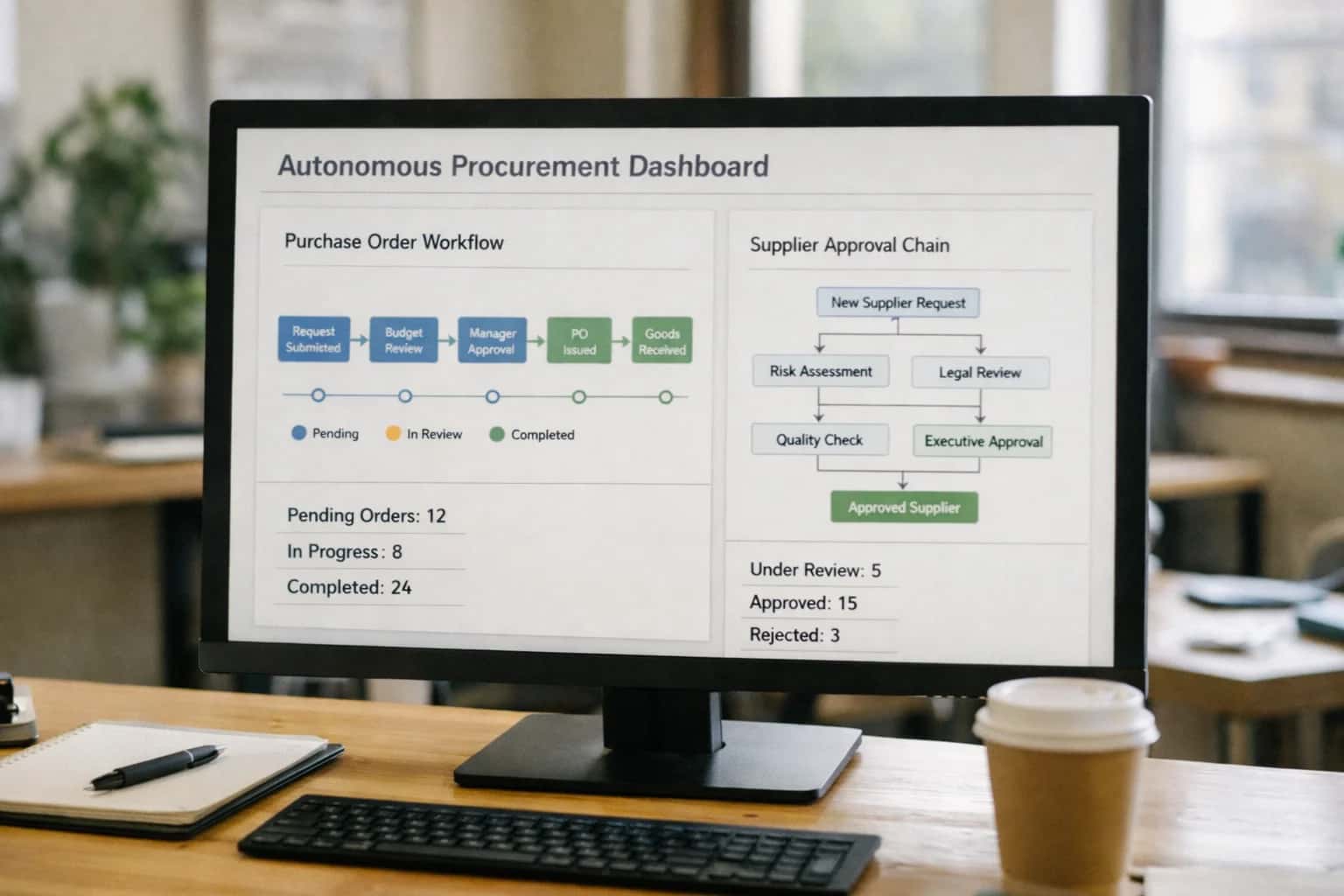
A foundational agent in autonomous procure-to-pay automation that eliminates manual invoice verification by algorithmically validating transactional consistency.
Operating within an autonomous supply chain intelligence framework, the bot leverages intelligent document processing to extract line-item data from unstructured invoices and flags discrepancies—such as price variances or quantity shortages—for automated resolution or human exception handling. This eliminates the bottleneck of manual accounts payable verification, accelerates the procure-to-pay cycle, and prevents duplicate or fraudulent payments.
AUTONOMOUS FINANCIAL CONTROLS
Core Capabilities of a Three-Way Matching Bot
An autonomous agent that validates the consistency of the purchase order, the goods received note, and the supplier invoice to approve payment without manual review.
01
Document Digitization & Extraction
Ingests unstructured and structured invoice formats (PDF, EDI, XML, paper scans) and extracts critical line-item data. Optical Character Recognition (OCR) combined with Natural Language Processing (NLP) identifies supplier identity, quantities, unit prices, and total amounts. The bot normalizes disparate data schemas into a unified digital record for comparison, eliminating manual data entry errors.
- Extracts header and line-item details
- Classifies document type (Invoice vs. Credit Memo)
- Maps supplier data to the master vendor record
02
Three-Way Tolerance Matching
Executes a rule-based comparison of the Purchase Order (PO) , the Goods Received Note (GRN) , and the Supplier Invoice. The bot validates that what was ordered matches what was received and what is being billed. It applies configurable tolerance thresholds for quantity and price variances to automatically approve or flag transactions.
- Quantity Matching: Invoice qty ≤ GRN qty ≤ PO qty
- Price Matching: Invoice unit price ≤ PO unit price
- Tolerance Logic: Auto-approves if variance is within ±2% or $50
03
Exception Handling & Routing
When a mismatch exceeds defined tolerances, the bot does not simply fail. It classifies the exception type—price variance, quantity overage, or missing receipt—and routes the transaction to a specific human workflow queue with a pre-populated audit trail. This ensures that only true anomalies require manual intervention.
- Categorizes mismatches by root cause
- Attaches relevant PO, GRN, and Invoice evidence
- Routes to the specific category manager or warehouse lead
04
Fraud & Duplicate Detection
Before matching, the bot cross-references the invoice against historical transactions to detect duplicate invoices or synthetic fraud. It hashes key data points (supplier tax ID, invoice number, amount) to identify exact or near-duplicate submissions, preventing erroneous double payments.
- Fuzzy matching on invoice numbers
- Cross-checking bank account changes against vendor master
- Flagging round-amount invoices for review
05
Autonomous Payment Approval
For transactions that pass all matching and fraud checks, the bot updates the Enterprise Resource Planning (ERP) system status from 'Received' to 'Approved for Payment'. It triggers the payment run file directly, bypassing the manual approval queue entirely to capture early payment discounts.
- Updates ERP status codes via API
- Triggers payment batch processing
- Logs full audit trail for SOX compliance
06
Continuous Learning & Reconciliation
Monitors resolution patterns from the exception queue to refine matching logic. If a specific supplier consistently ships 5% over the PO quantity and it is always accepted, the bot can propose a dynamic tolerance adjustment for that vendor relationship, reducing future false positives.
- Tracks acceptance rates of exceptions by vendor
- Recommends tolerance rule updates
- Builds a behavioral profile for strategic suppliers
THREE-WAY MATCHING BOT
Frequently Asked Questions
Explore the mechanics, benefits, and implementation considerations of autonomous agents designed to validate procurement transactions by reconciling purchase orders, goods receipts, and supplier invoices without human intervention.
A Three-Way Matching Bot is an autonomous software agent that algorithmically validates the consistency of three critical procurement documents—the Purchase Order (PO) , the Goods Received Note (GRN) , and the Supplier Invoice—to authorize payment without manual review. The bot operates by extracting structured and unstructured data from these documents using optical character recognition (OCR) and natural language processing (NLP). It then executes a rule-based or machine learning-driven comparison engine that checks for exact matches and tolerable variances across three axes: quantity (units ordered vs. received vs. billed), price (agreed unit cost vs. invoiced cost), and terms (payment conditions and line-item descriptions). If discrepancies fall within predefined tolerance thresholds—such as a 2% price variance or a minor quantity shortfall—the bot auto-approves the invoice for payment. Exceptions outside these guardrails are escalated to a human exception queue with a detailed discrepancy report, effectively decoupling procurement officers from high-volume, low-value clerical reconciliation tasks.
Enabling Efficiency, Speed & Accuracy
Intelligent Analysis, Decision & Execution
We build AI systems for teams that need search across company data, workflow automation across tools, or AI features inside products and internal software.
Talk to Us
Search across company data
Give teams answers from docs, tickets, runbooks, and product data with sources and permissions.
Useful when people spend too long searching or get different answers from different systems.
Enterprise searchRAGPermissions
Read more
Automate internal workflows
Use AI to route work, draft outputs, trigger actions, and keep approvals and logs in place.
Useful when repetitive work moves across multiple tools and teams.
AI agentsWorkflow automationGovernance
Read more
Add AI to products and internal tools
Build assistants, guided actions, or decision support into the software your team or customers already use.
Useful when AI needs to be part of the product, not a separate tool.
AI integrationDecision supportModel routing
Read more
About the author
Prasad Kumkar
CEO & MD, Inference Systems
Prasad Kumkar is the CEO & MD of Inference Systems and writes about AI systems architecture, LLM infrastructure, model serving, evaluation, and production deployment. Over 5+ years, he has worked across computer vision models, L5 autonomous vehicle systems, and LLM research, with a focus on taking complex AI ideas into real-world engineering systems.
His work and writing cover AI systems, large language models, AI agents, multimodal systems, autonomous systems, inference optimization, RAG, evaluation, and production AI engineering.
LinkedIn
Limited slotsGet a Free AI Consultation
Partnered with leading AI, data, and software stack.





How We Work
Custom AI workflows for your Business
One-fit-all AI don't work for modern businesses. At Inferensys, we aim to understand your business & custom requirements; which we use to define most efficient agentic workflows, the data, and the tools for your business.
01
Review the use case
We understand the task, the users, and where AI can actually help.
Read more02
Pick the right approach
We define what needs search, automation, or product integration.
Read more03
Build the first useful version
We implement the part that proves the value first.
Read more04
Improve from there
We add the checks and visibility needed to keep it useful.
Read moreThe first call is a practical review of your use case and the right next step.
Talk to Us