Procure-to-Pay Automation refers to the seamless, touchless integration of the entire procurement lifecycle—from initial requisitioning and supplier selection to purchase order generation, goods receipt, invoice reconciliation, and final payment settlement. It leverages autonomous AI agents and machine learning models to execute and validate each sequential step, transforming a traditionally document-heavy, manual process into a straight-through digital workflow without human intervention.

Glossary
Procure-to-Pay Automation
The seamless, touchless integration of the entire procurement lifecycle from requisitioning through to final payment settlement, orchestrated by AI agents.
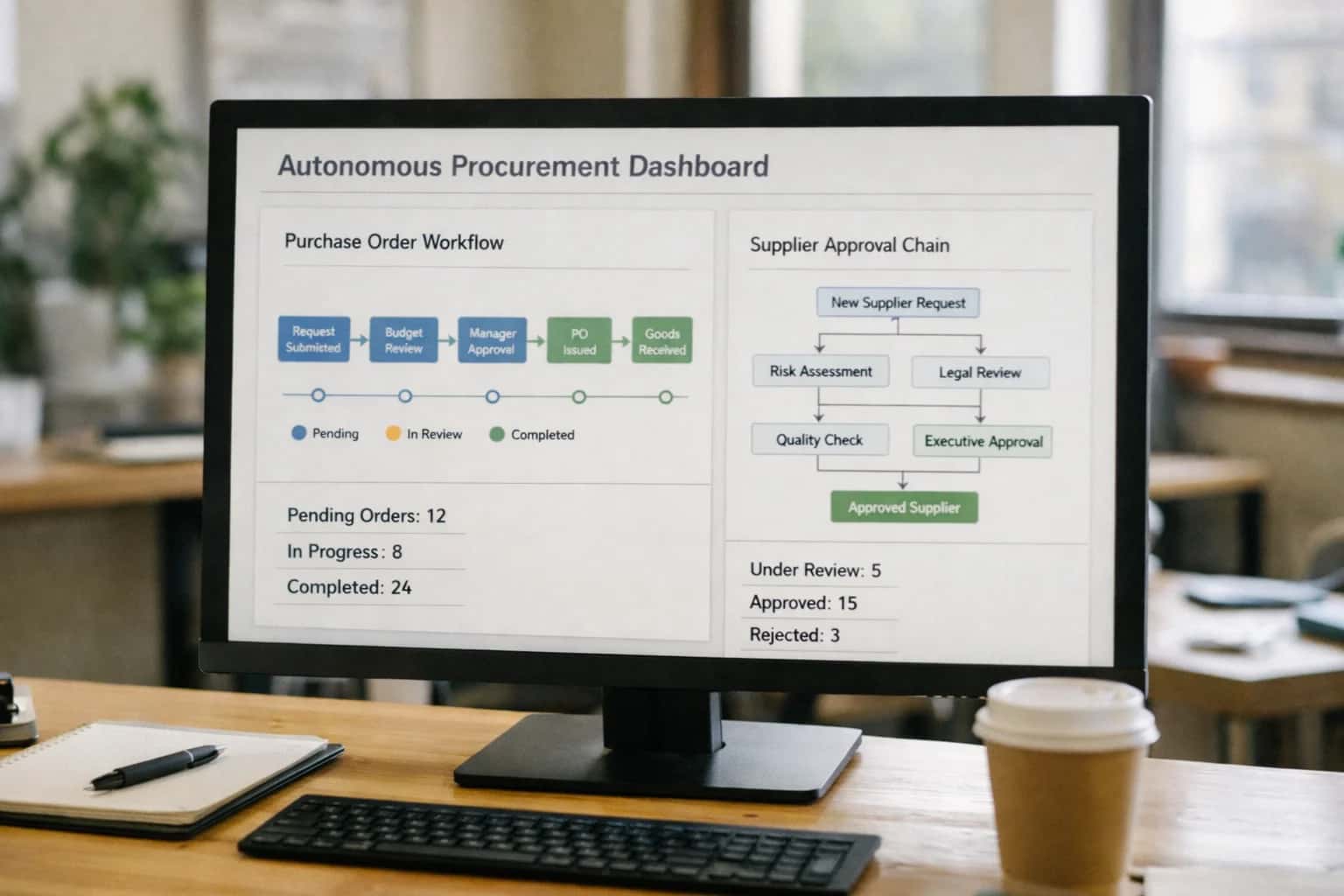
TOUCHLESS PROCUREMENT
What is Procure-to-Pay Automation?
Procure-to-Pay (P2P) automation is the end-to-end digitization and integration of the procurement lifecycle, from requisitioning through to final payment settlement, orchestrated by AI agents to eliminate manual touchpoints.
The core technical objective is to enforce contractual compliance and eliminate process friction by automating the three-way matching of purchase orders, goods received notes, and supplier invoices. By orchestrating data flow between enterprise resource planning (ERP) systems, supplier networks, and banking gateways, P2P automation ensures that only validated, exception-free transactions proceed to payment, thereby capturing early payment discounts and preventing maverick spend.
TOUCHLESS TRANSACTION LIFECYCLE
Key Features of Procure-to-Pay Automation
The core architectural components that enable a seamless, AI-orchestrated flow from initial requisition through to final payment settlement, eliminating manual intervention and accelerating cash cycles.
01
Autonomous Requisition Capture
The entry point for touchless procurement. Natural Language Processing (NLP) models interpret free-text requests from emails, chat interfaces, or forms. The system performs autonomous requisition matching by instantly linking vague user descriptions to specific catalog items or approved suppliers. This eliminates manual searching and ensures policy compliance at the moment of request creation, not after the fact.
< 5 seconds
Average Requisition-to-Cart Time
02
Intelligent Approval Workflow
A dynamic routing engine that replaces static approval chains. The system evaluates the requisition against delegation of authority rules, budget availability, and risk scores. Low-risk, low-value items are auto-approved. Exceptions are routed to the correct authority with a summary of the decision context. This compliance checking agent screens against sanctions lists and internal policies in real-time before any commitment is made.
90%+
Touchless Approval Rate
03
Automated Purchase Order Execution
The purchase order automation engine converts approved requisitions into legally compliant POs without human touch. It pulls supplier data from the vendor master, applies contracted terms, and transmits the PO directly via EDI or API. The system handles complex scenarios including:
- Multi-line item consolidation across different suppliers
- Dynamic currency conversion based on spot rates
- Blanket order releases against long-term agreements
100%
PO Accuracy Rate
04
Three-Way Matching Engine
The three-way matching bot autonomously validates the consistency of three documents before authorizing payment:
- Purchase Order – What was ordered
- Goods Received Note – What was delivered
- Supplier Invoice – What is being billed The invoice reconciliation AI resolves discrepancies in quantity, price, or quality by referencing tolerance thresholds. Matched invoices proceed directly to the payment schedule. Exceptions are flagged with a detailed variance report for human resolution.
95%+
Straight-Through Processing
05
Dynamic Discounting & Payment Optimization
An algorithm that optimizes working capital by calculating the real-time value of early payment. The dynamic discounting engine proposes a sliding scale of discounts based on the buyer's cost of capital and the supplier's liquidity needs. The system can autonomously execute payments on the optimal date to capture the highest risk-free return on cash, turning Accounts Payable from a cost center into a value generator.
12-18%
Annualized ROI on Early Payments
06
Continuous Spend Analytics & Audit Trail
Every touchless transaction feeds a unified data model. Spend classification AI automatically categorizes line-item data into taxonomies like UNSPSC. This provides a complete, immutable audit trail from requisition to payment. The system continuously monitors for maverick spend and identifies consolidation opportunities, providing procurement leaders with a real-time, granular view of organizational cash outflow without manual reporting.
100%
Transaction Visibility
PROCURE-TO-PAY AUTOMATION
Frequently Asked Questions
Clear, technically precise answers to the most common questions about the AI-driven integration of requisitioning, purchasing, receiving, invoicing, and payment processes.
Procure-to-Pay (P2P) automation is the touchless, end-to-end integration of the entire procurement lifecycle—from requisitioning through to final payment settlement—orchestrated by AI agents and workflow engines. It works by connecting discrete processes (sourcing, purchase order generation, goods receipt, invoice reconciliation, and payment) into a single, continuous digital thread. An autonomous agent ingests a requisition, validates it against budget and catalog policies, triggers a purchase order directly to the supplier, matches the incoming invoice against the PO and goods receipt note (three-way matching), and authorizes payment—all without human intervention. The system relies on a unified data model, typically anchored by a clean vendor master, and uses machine learning for tasks like spend classification and exception handling to resolve discrepancies in real-time.
Enabling Efficiency, Speed & Accuracy
Intelligent Analysis, Decision & Execution
We build AI systems for teams that need search across company data, workflow automation across tools, or AI features inside products and internal software.
Talk to Us
Search across company data
Give teams answers from docs, tickets, runbooks, and product data with sources and permissions.
Useful when people spend too long searching or get different answers from different systems.
Enterprise searchRAGPermissions
Read more
Automate internal workflows
Use AI to route work, draft outputs, trigger actions, and keep approvals and logs in place.
Useful when repetitive work moves across multiple tools and teams.
AI agentsWorkflow automationGovernance
Read more
Add AI to products and internal tools
Build assistants, guided actions, or decision support into the software your team or customers already use.
Useful when AI needs to be part of the product, not a separate tool.
AI integrationDecision supportModel routing
Read more
About the author
Prasad Kumkar
CEO & MD, Inference Systems
Prasad Kumkar is the CEO & MD of Inference Systems and writes about AI systems architecture, LLM infrastructure, model serving, evaluation, and production deployment. Over 5+ years, he has worked across computer vision models, L5 autonomous vehicle systems, and LLM research, with a focus on taking complex AI ideas into real-world engineering systems.
His work and writing cover AI systems, large language models, AI agents, multimodal systems, autonomous systems, inference optimization, RAG, evaluation, and production AI engineering.
LinkedIn
Limited slotsGet a Free AI Consultation
Partnered with leading AI, data, and software stack.





How We Work
Custom AI workflows for your Business
One-fit-all AI don't work for modern businesses. At Inferensys, we aim to understand your business & custom requirements; which we use to define most efficient agentic workflows, the data, and the tools for your business.
01
Review the use case
We understand the task, the users, and where AI can actually help.
Read more02
Pick the right approach
We define what needs search, automation, or product integration.
Read more03
Build the first useful version
We implement the part that proves the value first.
Read more04
Improve from there
We add the checks and visibility needed to keep it useful.
Read moreThe first call is a practical review of your use case and the right next step.
Talk to Us