The Intent Lifecycle is the end-to-end management process governing a network intent from declaration to retirement. It encompasses distinct, automated stages including intent validation, where the policy is checked for conflicts and feasibility, followed by intent translation and fulfillment, which synthesizes and deploys the required device-level configurations across the infrastructure.

Glossary
Intent Lifecycle
The end-to-end management process for a network intent, encompassing its initial declaration, translation, activation, continuous monitoring, modification, and eventual retirement from the network.
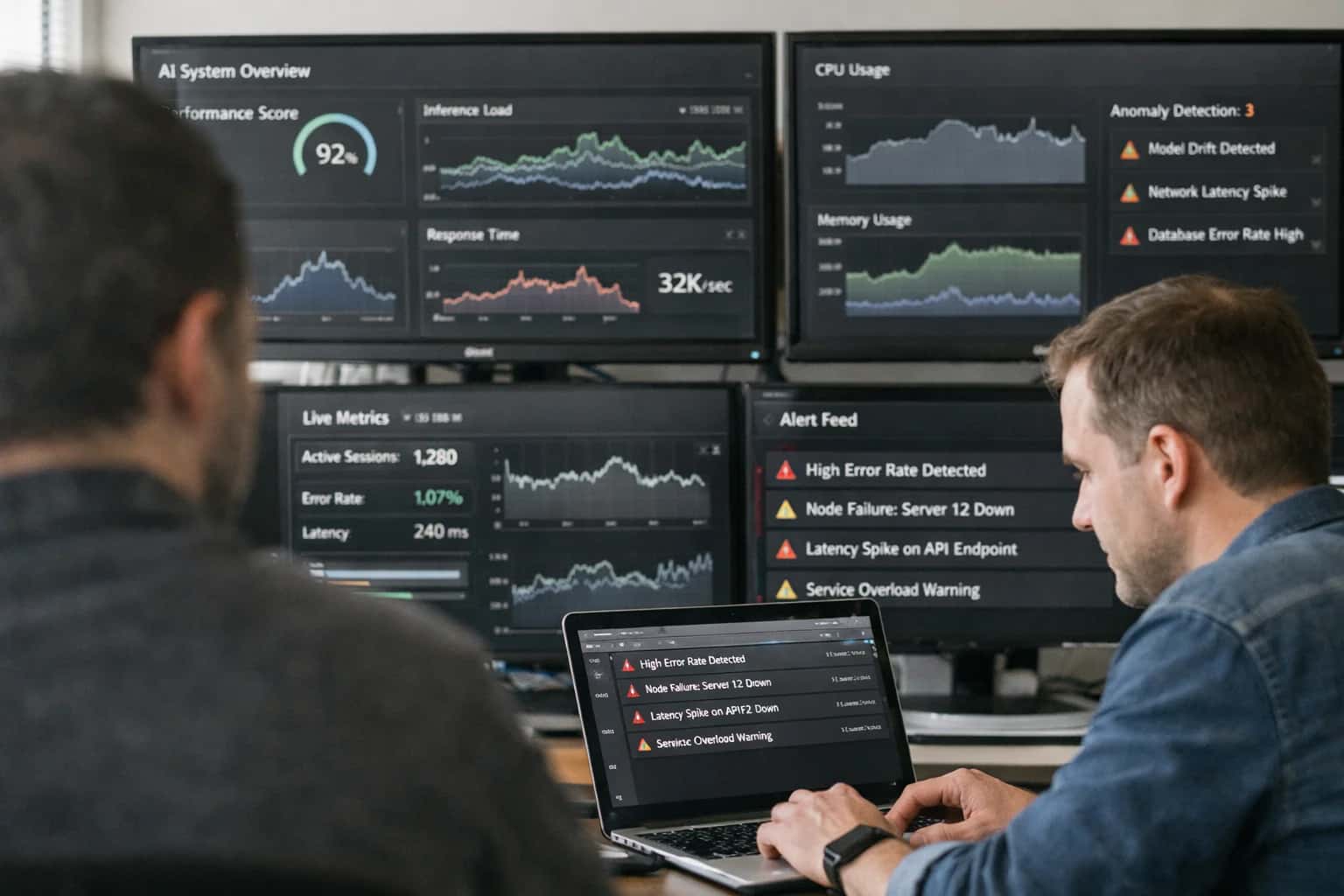
LIFECYCLE MANAGEMENT
What is Intent Lifecycle?
The intent lifecycle defines the structured, closed-loop management process that governs a network intent from its initial declaration through to its eventual decommissioning, ensuring continuous alignment between business policy and network state.
Once active, the lifecycle enters a continuous intent assurance loop, where real-time telemetry is compared against the declared Service-Level Objective (SLO) to detect intent drift. If a violation occurs, a remediation workflow is triggered to restore compliance. The lifecycle concludes with a formal decommissioning stage, removing the policy cleanly from the network.
CLOSED-LOOP GOVERNANCE
Key Characteristics of the Intent Lifecycle
The intent lifecycle defines the structured, automated journey of a business policy from its high-level declaration to its eventual retirement. Each phase ensures the network continuously aligns with operational objectives.
01
Declarative Creation
The lifecycle begins with a business intent expressed in natural language or structured templates, specifying what outcome is desired—such as 'gold-level latency for trading apps'—without defining how to implement it. This phase leverages intent-based APIs to abstract vendor-specific complexity.
02
Formal Validation
Before deployment, the intent engine performs pre-deployment checks for logical consistency, resource feasibility, and intent conflict resolution. This formal verification step ensures the declared state won't violate existing policies or exhaust network capacity, preventing misconfigurations.
03
Algorithmic Translation
The validated intent undergoes network configuration synthesis, where a high-level policy is decomposed into device-specific, low-level configurations. This policy abstraction layer generates correct-by-construction CLI commands, API calls, or YANG models for heterogeneous hardware.
04
Orchestrated Fulfillment
The intent fulfillment phase pushes synthesized configurations to physical and virtual infrastructure via network service orchestration. The system activates the desired state, provisioning resources like QoS policies, VLANs, and security groups without manual, element-by-element setup.
05
Continuous Assurance
A closed-loop assurance loop ingests streaming telemetry collection data to monitor the operational state. It continuously compares real-time metrics against defined service-level objectives (SLOs) , detecting intent drift and triggering alerts or automated remediation upon any deviation.
sub-10ms
Typical Telemetry Interval
06
Automated Remediation
When assurance detects a violation, a pre-defined remediation workflow executes automatically. This closed-loop action restores intent compliance by adjusting parameters, rerouting traffic, or scaling resources, ensuring the network self-heals to maintain the original business objective.
INTENT LIFECYCLE MANAGEMENT
Frequently Asked Questions
Explore the end-to-end management process for a network intent, from initial declaration and translation through continuous assurance and eventual retirement.
The Intent Lifecycle is the end-to-end management process governing a network intent from its initial declaration to its eventual decommissioning. It provides a structured, closed-loop framework that transforms high-level business objectives into automated network operations. The lifecycle is critical because it introduces deterministic state management to intent-based networking (IBN), ensuring that every intent is validated, fulfilled, continuously assured, and gracefully retired without leaving orphaned configurations. Without a formal lifecycle, intents become static, unmonitored configurations that drift over time, defeating the purpose of autonomous networking. The lifecycle typically encompasses stages such as creation, validation, translation, fulfillment, assurance, optimization, and decommissioning, each governed by an Intent State Machine that defines valid transitions and triggers automated workflows.
Enabling Efficiency, Speed & Accuracy
Intelligent Analysis, Decision & Execution
We build AI systems for teams that need search across company data, workflow automation across tools, or AI features inside products and internal software.
Talk to Us
Search across company data
Give teams answers from docs, tickets, runbooks, and product data with sources and permissions.
Useful when people spend too long searching or get different answers from different systems.
Enterprise searchRAGPermissions
Read more
Automate internal workflows
Use AI to route work, draft outputs, trigger actions, and keep approvals and logs in place.
Useful when repetitive work moves across multiple tools and teams.
AI agentsWorkflow automationGovernance
Read more
Add AI to products and internal tools
Build assistants, guided actions, or decision support into the software your team or customers already use.
Useful when AI needs to be part of the product, not a separate tool.
AI integrationDecision supportModel routing
Read more
About the author
Prasad Kumkar
CEO & MD, Inference Systems
Prasad Kumkar is the CEO & MD of Inference Systems and writes about AI systems architecture, LLM infrastructure, model serving, evaluation, and production deployment. Over 5+ years, he has worked across computer vision models, L5 autonomous vehicle systems, and LLM research, with a focus on taking complex AI ideas into real-world engineering systems.
His work and writing cover AI systems, large language models, AI agents, multimodal systems, autonomous systems, inference optimization, RAG, evaluation, and production AI engineering.
LinkedIn
Limited slotsGet a Free AI Consultation
Partnered with leading AI, data, and software stack.





How We Work
Custom AI workflows for your Business
One-fit-all AI don't work for modern businesses. At Inferensys, we aim to understand your business & custom requirements; which we use to define most efficient agentic workflows, the data, and the tools for your business.
01
Review the use case
We understand the task, the users, and where AI can actually help.
Read more02
Pick the right approach
We define what needs search, automation, or product integration.
Read more03
Build the first useful version
We implement the part that proves the value first.
Read more04
Improve from there
We add the checks and visibility needed to keep it useful.
Read moreThe first call is a practical review of your use case and the right next step.
Talk to Us