Intent Compliance is the verified state where the network's actual behavior continuously matches its declared network intent. It is the output of the intent assurance loop, which ingests streaming telemetry collection data and compares it against defined service-level objectives (SLOs). A compliant state confirms that the intent translation and intent fulfillment phases successfully instantiated the correct policy abstraction across the infrastructure.

Glossary
Intent Compliance
The state in which the network's operational configuration and performance continuously adhere to the specific security, regulatory, and business policy requirements encoded within the declared intent.
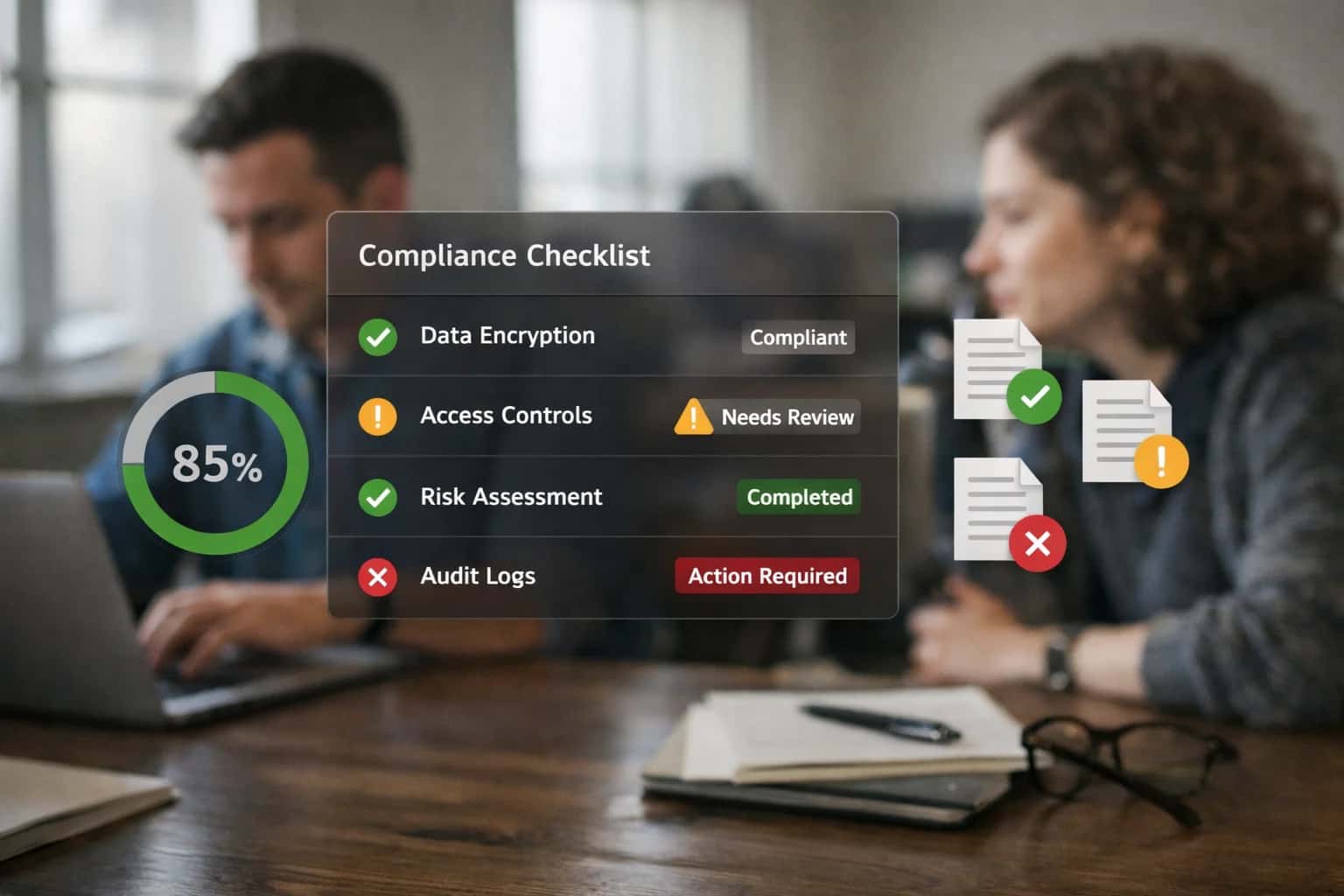
CONTINUOUS STATE VERIFICATION
What is Intent Compliance?
Intent Compliance is the continuous state in which a network's operational configuration and real-time performance adhere to the specific security, regulatory, and business policy requirements encoded within a declared intent.
A violation of compliance, known as intent drift, triggers an automated remediation workflow within the closed-loop automation system. Maintaining compliance requires constant validation of the policy continuum, from abstract business intent down to synthesized device configurations. This process relies on intent-based analytics to predict potential deviations and intent conflict resolution logic to ensure that overlapping policies do not force the network into a non-compliant state.
Continuous State Verification
Core Characteristics of Intent Compliance
Intent compliance is the continuous, measurable state where the network's operational configuration and performance adhere to the declared business, security, and regulatory policies. It moves beyond static configuration to dynamic, closed-loop verification.
01
Continuous Closed-Loop Validation
Intent compliance is not a one-time audit but a continuous closed-loop process. The system constantly compares real-time network telemetry against the formalized intent model. Any deviation, known as intent drift, triggers an automated reconciliation workflow. This loop operates on streaming data, ensuring the network state is validated against policy on a second-by-second basis rather than through periodic manual checks.
02
Declarative State vs. Operational Reality
The core mechanism relies on maintaining a strict equivalence between two states:
- Declarative State: The desired outcome defined in the intent (e.g., 'VLAN 100 must be isolated from all external traffic').
- Operational State: The actual, observed configuration and performance metrics pulled from devices via streaming telemetry. Compliance is achieved only when the operational state is a mathematically valid subset of the declarative state.
03
Policy-Based Remediation Triggers
When a compliance violation is detected, the system does not merely alert an administrator. It executes a pre-defined remediation workflow. These triggers are policy-driven:
- Soft Violation: A performance threshold is nearing breach (e.g., latency approaching 10ms SLO). The system may proactively scale resources.
- Hard Violation: A security policy is broken (e.g., an unauthorized ACL entry appears). The system immediately reverts the configuration to the last known compliant state.
04
Formal Verification of Intent
Advanced intent compliance systems use formal verification methods to mathematically prove that the translated low-level configurations will not violate the high-level intent before they are pushed to the network. This pre-deployment check analyzes the entire configuration set for logical conflicts, ensuring that fulfilling one intent does not inherently break another, a process known as intent conflict resolution.
05
Telemetry as the Source of Truth
Compliance is entirely dependent on the fidelity of the data. Modern systems rely on streaming telemetry—a high-frequency, push-based model—rather than traditional polling (SNMP). This provides the granular, real-time visibility needed to validate micro-bursts and transient states. The telemetry data must be time-stamped and sourced from diverse points, including physical sensors, virtual switches, and application logs, to build a holistic compliance picture.
06
Immutable Audit Trail
A critical characteristic of a compliant system is the generation of an immutable audit trail. Every state transition, validation check, and remediation action is cryptographically logged. This provides non-repudiable evidence for regulatory frameworks like GDPR or HIPAA, proving that the network's security posture was continuously maintained and that any drift was automatically corrected within a specific timeframe.
Enabling Efficiency, Speed & Accuracy
Intelligent Analysis, Decision & Execution
We build AI systems for teams that need search across company data, workflow automation across tools, or AI features inside products and internal software.
Talk to Us
Search across company data
Give teams answers from docs, tickets, runbooks, and product data with sources and permissions.
Useful when people spend too long searching or get different answers from different systems.
Enterprise searchRAGPermissions
Read more
Automate internal workflows
Use AI to route work, draft outputs, trigger actions, and keep approvals and logs in place.
Useful when repetitive work moves across multiple tools and teams.
AI agentsWorkflow automationGovernance
Read more
Add AI to products and internal tools
Build assistants, guided actions, or decision support into the software your team or customers already use.
Useful when AI needs to be part of the product, not a separate tool.
AI integrationDecision supportModel routing
Read moreINTENT COMPLIANCE
Frequently Asked Questions
Explore the core concepts of intent compliance, the continuous verification mechanism that ensures a self-driving network adheres to its declared business and security policies.
Intent compliance is the continuous, closed-loop state in which the network's operational configuration and real-time performance verifiably adhere to the specific security, regulatory, and business policy requirements encoded within a declared network intent. Unlike traditional network monitoring, which typically relies on static, threshold-based alerts for individual device metrics (like CPU or interface errors), intent compliance operates at a higher level of abstraction. It validates the outcome against the service-level objective (SLO). For example, traditional monitoring might alert on packet loss on a specific link, whereas an intent compliance system validates that 'all voice traffic traverses a path with sub-10ms latency and zero packet loss,' automatically correlating telemetry across multiple devices and paths to confirm the holistic business outcome is met.

About the author
Prasad Kumkar
CEO & MD, Inference Systems
Prasad Kumkar is the CEO & MD of Inference Systems and writes about AI systems architecture, LLM infrastructure, model serving, evaluation, and production deployment. Over 5+ years, he has worked across computer vision models, L5 autonomous vehicle systems, and LLM research, with a focus on taking complex AI ideas into real-world engineering systems.
His work and writing cover AI systems, large language models, AI agents, multimodal systems, autonomous systems, inference optimization, RAG, evaluation, and production AI engineering.
LinkedIn
Limited slotsGet a Free AI Consultation
Partnered with leading AI, data, and software stack.





How We Work
Custom AI workflows for your Business
One-fit-all AI don't work for modern businesses. At Inferensys, we aim to understand your business & custom requirements; which we use to define most efficient agentic workflows, the data, and the tools for your business.
01
Review the use case
We understand the task, the users, and where AI can actually help.
Read more02
Pick the right approach
We define what needs search, automation, or product integration.
Read more03
Build the first useful version
We implement the part that proves the value first.
Read more04
Improve from there
We add the checks and visibility needed to keep it useful.
Read moreThe first call is a practical review of your use case and the right next step.
Talk to Us