A MEC Server is a specialized compute node deployed at the network edge, typically co-located with a cellular base station or aggregation point, that provides an IT service environment and cloud-computing capabilities within the Radio Access Network (RAN). By moving computational resources physically closer to end-users, it circumvents the inherent latency of traversing the core network and internet to reach a centralized cloud data center.

Glossary
MEC Server
A Multi-access Edge Computing server is an IT infrastructure deployed at the radio access network edge, providing cloud-computing capabilities to enable ultra-low latency inference and real-time processing for connected devices.
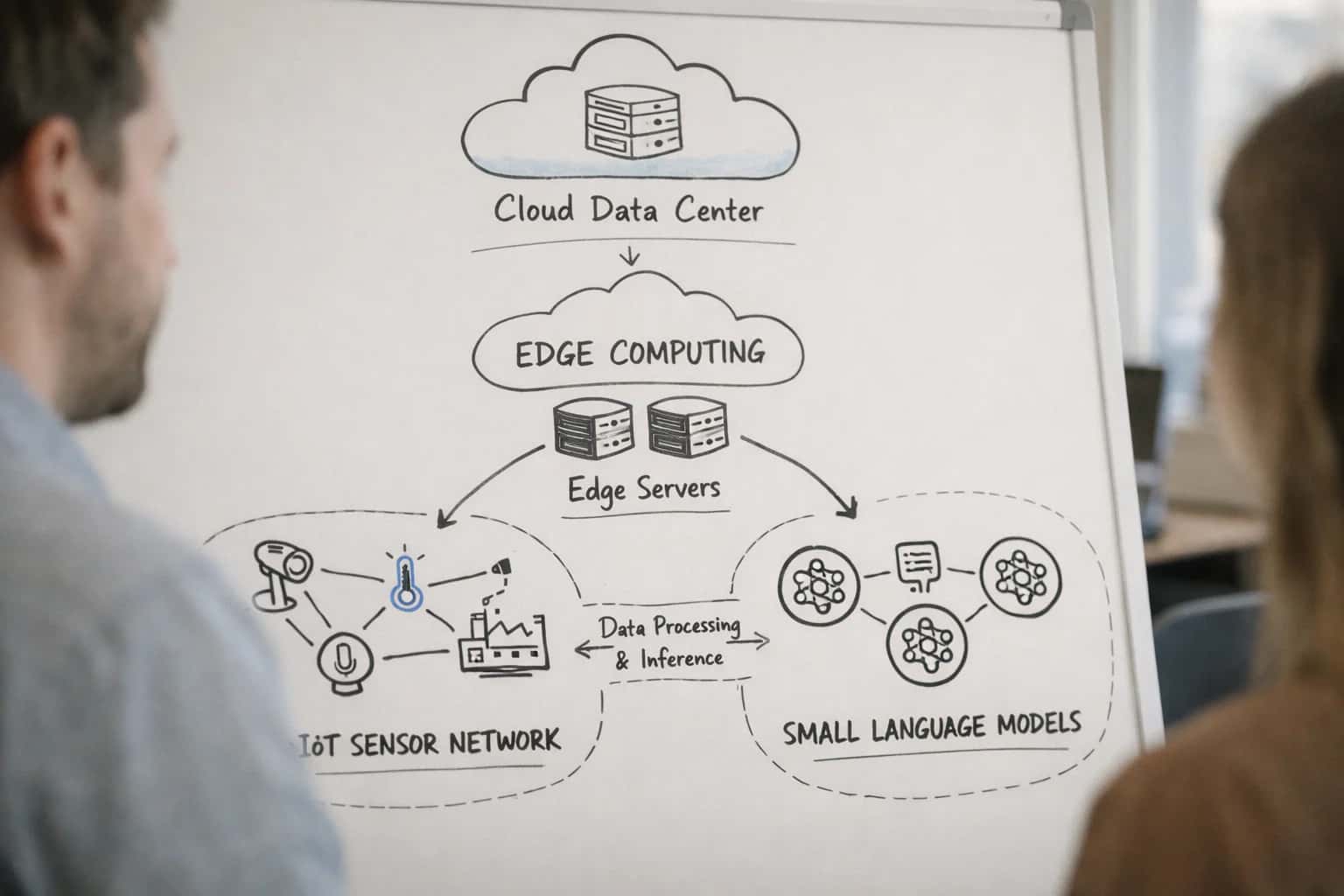
MULTI-ACCESS EDGE COMPUTING
What is MEC Server?
A Multi-access Edge Computing (MEC) server is a network architecture concept that brings cloud-computing capabilities and an IT service environment to the edge of the radio access network, enabling ultra-low latency and high-bandwidth inference for connected devices.
This architecture is the foundational enabler for edge inference offloading, where a resource-constrained device, such as an augmented reality headset or an autonomous mobile robot, can dynamically partition a deep neural network. The MEC server executes the computationally intensive tail of the model, processing raw sensor data or intermediate features transmitted over the local device-edge-cloud continuum to meet strict, sub-10ms latency budgets that are unattainable via traditional cloud architectures.
Architectural Pillars
Key Characteristics of a MEC Server
A Multi-access Edge Computing server is defined by a set of core architectural characteristics that distinguish it from centralized cloud infrastructure and enable ultra-low latency, context-aware services.
01
Proximity and Ultra-Low Latency
The defining characteristic is physical deployment at the network edge, co-located with the Radio Access Network (RAN) or aggregation points. This eliminates the propagation delay to a distant central cloud, enabling round-trip times of < 10 milliseconds. This proximity is non-negotiable for applications like autonomous vehicle collision avoidance or augmented reality frame rendering, where a delay exceeding a human's perception threshold renders the service useless.
< 10 ms
Target Round-Trip Latency
1-10 km
Distance to User Equipment
02
Contextual Awareness
MEC servers can access real-time Radio Network Information Services (RNIS) through standardized APIs. This allows applications to make decisions based on precise, instantaneous network context that is invisible to a cloud server:
- User Location: Cell ID, beam direction, or GPS-level coordinates.
- Radio Conditions: Real-time throughput, packet loss, and signal-to-noise ratio.
- Network Load: Current cell congestion and available bandwidth. This enables intelligent traffic shaping, dynamic content adaptation, and location-based service delivery.
03
Distributed Compute and Storage
A MEC server provides a fully virtualized Infrastructure as a Service (IaaS) or Platform as a Service (PaaS) environment at the edge. It hosts lightweight, containerized workloads using technologies like Docker and Kubernetes. This distributed architecture is critical for:
- Local Data Processing: Filtering and aggregating massive volumes of IoT sensor data before sending only actionable insights to the cloud, drastically reducing backhaul costs.
- Service Continuity: Maintaining application functionality even during intermittent backhaul connectivity to the central cloud.
04
High Throughput and Bandwidth Efficiency
By processing data locally, a MEC server avoids sending raw, high-volume data streams over the backhaul network. A single high-definition video camera can generate gigabits per second of data. A MEC application can analyze this video feed locally and transmit only a metadata event, such as 'anomaly detected,' consuming mere kilobits. This data reduction function is essential for scaling IoT deployments without saturating the operator's transport network.
05
Multi-Tenancy and Open Standards
MEC servers are built on Network Functions Virtualization (NFV) principles, allowing multiple independent tenants—the mobile operator, third-party application developers, and enterprise customers—to run their applications on the same physical hardware in isolated slices. This is governed by open standards from ETSI ISG MEC, which define the APIs for service registry, traffic rules control, and DNS handling, preventing vendor lock-in and fostering a competitive application ecosystem.
06
Hardware Heterogeneity and Acceleration
To meet demanding performance-per-watt requirements, a MEC server integrates specialized hardware accelerators beyond standard CPUs:
- GPUs: For parallel processing of video analytics and neural network inference.
- FPGAs and ASICs: For hardware-accelerated encryption, forward error correction, and low-latency signal processing.
- SmartNICs: For offloading virtual switching and packet processing, freeing up host CPU cores for application workloads.
MEC SERVER ESSENTIALS
Frequently Asked Questions
Clear, technical answers to the most common questions about Multi-access Edge Computing servers and their role in enabling ultra-low latency inference at the network edge.
A Multi-access Edge Computing (MEC) server is a standardized, cloud-computing-capable hardware platform deployed at the network edge—typically co-located with a cellular base station or aggregation point—that provides an IT service environment and compute resources within the radio access network. It works by hosting virtualized applications and services on a hypervisor-based infrastructure, allowing data processing to occur physically close to the end user rather than traversing a backhaul network to a distant centralized cloud. The MEC server intercepts user-plane traffic via a data plane breakout mechanism, processes it locally using onboard CPUs, GPUs, or NPUs, and returns results with single-digit millisecond latency. Key architectural components include the MEC platform, which provides service registry, DNS, and traffic rules control, and the MEC host, which encompasses the virtualization infrastructure and the data plane forwarding element. This architecture is standardized by ETSI ISG MEC to ensure interoperability across vendors and network operators.
Enabling Efficiency, Speed & Accuracy
Intelligent Analysis, Decision & Execution
We build AI systems for teams that need search across company data, workflow automation across tools, or AI features inside products and internal software.
Talk to Us
Search across company data
Give teams answers from docs, tickets, runbooks, and product data with sources and permissions.
Useful when people spend too long searching or get different answers from different systems.
Enterprise searchRAGPermissions
Read more
Automate internal workflows
Use AI to route work, draft outputs, trigger actions, and keep approvals and logs in place.
Useful when repetitive work moves across multiple tools and teams.
AI agentsWorkflow automationGovernance
Read more
Add AI to products and internal tools
Build assistants, guided actions, or decision support into the software your team or customers already use.
Useful when AI needs to be part of the product, not a separate tool.
AI integrationDecision supportModel routing
Read moreINFERENCE DEPLOYMENT ARCHITECTURE COMPARISON
MEC Server vs. Centralized Cloud vs. On-Device Compute
A technical comparison of the three primary deployment targets for AI inference workloads across latency, bandwidth, compute capacity, and privacy dimensions.
| Feature | MEC Server | Centralized Cloud | On-Device Compute |
|---|---|---|---|
Round-Trip Latency | 1-10 ms | 50-200 ms | < 1 ms |
Compute Capacity | Moderate (GPU/NPU clusters) | Massive (elastic scaling) | Severely constrained |
Bandwidth Dependency | Low (local fiber backhaul) | High (internet-dependent) | None (fully local) |
Model Size Support | Large models (100M-10B params) | Very large models (100B+ params) | Compact models (< 50M params) |
Data Privacy Posture | High (data stays in operator domain) | Lower (data transits public internet) | Maximum (data never leaves device) |
Dynamic Offloading Support | |||
Power Consumption (Device) | Low (offloads compute) | Low (offloads compute) | High (local processing) |
Operational Continuity (Offline) |
EDGE COMPUTING DEPLOYMENTS
Real-World MEC Server Use Cases
Multi-access Edge Computing servers are the foundational infrastructure enabling a new class of latency-critical applications. By moving cloud-computing capabilities to the network edge, MEC servers process data within the operator's network, bypassing the public internet to deliver deterministic, sub-10ms response times for connected devices.
01
Augmented Reality for Industrial Maintenance
MEC servers enable real-time object detection and pose estimation for AR headsets used by field technicians. The heavy 3D rendering and computer vision inference is offloaded from the headset to a nearby MEC node, which overlays digital schematics onto physical machinery with sub-20ms motion-to-photon latency. This eliminates the nausea-inducing lag of cloud processing.
- Key Metric: < 5 ms network latency between device and MEC server.
- Example: A technician views a live engine, and the MEC server instantly highlights the specific bolts to remove, driven by a DNN splitting architecture.
< 20 ms
Motion-to-Photon Latency
40%
Reduction in Repair Time
02
Autonomous Mobile Robot Fleet Coordination
In a smart warehouse, MEC servers act as the central nervous system for heterogeneous fleet orchestration. Instead of each robot processing SLAM and obstacle avoidance locally, raw sensor data is streamed to the MEC server. The server fuses data from all robots and infrastructure cameras to build a global, real-time occupancy map.
- Mechanism: The MEC server performs collaborative inference across the fleet, resolving path conflicts and rerouting robots in milliseconds.
- Benefit: This allows for cheaper, lighter robots with smaller batteries, as the compute burden is centralized at the edge.
< 10 ms
Path Recalculation
99.999%
Collision Avoidance Rate
03
Real-Time Video Analytics for Public Safety
MEC servers process high-definition video feeds from city-wide camera networks locally, without streaming petabytes of data to a central cloud. This enables anomaly detection and object tracking with guaranteed low latency.
- Application: A MEC server running a conditional computation model can identify a specific vehicle's license plate across multiple camera feeds in real-time, triggering an alert.
- Privacy: By processing data at the edge, raw video is never stored or transmitted, only anonymized metadata events are forwarded, ensuring GDPR compliance.
1000+
Concurrent Video Streams
< 50 ms
Detection Latency
04
Connected Vehicle V2X Hazard Warnings
MEC servers deployed at cellular base stations enable direct Vehicle-to-Everything (V2X) communication. A MEC server receives Cooperative Awareness Messages from vehicles and uses a predictive load balancing model to forecast collision risks.
- Workflow: If a car brakes hard, its telemetry is processed by the MEC server, which instantly broadcasts a hazard warning to all other connected vehicles in the area.
- Requirement: This use case demands ultra-reliable low-latency communication (URLLC) , which is only achievable by bypassing the core network and processing data directly on the MEC server at the cell site.
< 5 ms
End-to-End V2X Latency
500m
Hazard Notification Radius
05
Cloud Gaming and Immersive XR Streaming
MEC servers bring console-quality gaming to any device by rendering graphics at the edge and streaming them as a low-latency video feed. Unlike centralized cloud gaming, a MEC-based architecture minimizes the tail latency caused by network congestion.
- Technology: The MEC server uses Multi-Instance GPU (MIG) partitioning to serve multiple concurrent users with guaranteed quality of service from a single physical GPU.
- Optimization: An inference offloading decision engine dynamically splits the rendering pipeline, keeping head-tracking on-device while the MEC server handles the heavy scene rendering, ensuring a seamless experience.
< 10 ms
Render-to-Display Latency
8K
Max Stream Resolution
06
Private 5G for Industry 4.0 Quality Control
In a smart factory, a MEC server hosts a tiny machine learning model for visual defect detection on a high-speed assembly line. Cameras scan products, and the MEC server performs anytime inference to classify defects within a strict time budget synchronized with the conveyor belt speed.
- Integration: The MEC server is part of a Device-Edge-Cloud Continuum. It handles real-time rejection of defective items, while non-urgent telemetry for long-term model retraining is batched and sent to the cloud.
- Result: This closed-loop control is impossible with cloud latency, making the MEC server essential for software-defined manufacturing automation.
< 1 ms
Inference Time per Item
99.98%
Defect Detection Accuracy

About the author
Prasad Kumkar
CEO & MD, Inference Systems
Prasad Kumkar is the CEO & MD of Inference Systems and writes about AI systems architecture, LLM infrastructure, model serving, evaluation, and production deployment. Over 5+ years, he has worked across computer vision models, L5 autonomous vehicle systems, and LLM research, with a focus on taking complex AI ideas into real-world engineering systems.
His work and writing cover AI systems, large language models, AI agents, multimodal systems, autonomous systems, inference optimization, RAG, evaluation, and production AI engineering.
LinkedIn
Limited slotsGet a Free AI Consultation
Partnered with leading AI, data, and software stack.





How We Work
Custom AI workflows for your Business
One-fit-all AI don't work for modern businesses. At Inferensys, we aim to understand your business & custom requirements; which we use to define most efficient agentic workflows, the data, and the tools for your business.
01
Review the use case
We understand the task, the users, and where AI can actually help.
Read more02
Pick the right approach
We define what needs search, automation, or product integration.
Read more03
Build the first useful version
We implement the part that proves the value first.
Read more04
Improve from there
We add the checks and visibility needed to keep it useful.
Read moreThe first call is a practical review of your use case and the right next step.
Talk to Us