The Device-Edge-Cloud Continuum is a seamless, multi-tier computing architecture that enables the dynamic migration of workloads across on-device processors, edge nodes, and centralized cloud data centers. It abstracts away the physical boundaries between these tiers, allowing a single application or inference task to be executed at the optimal location based on real-time constraints such as latency budgets, available bandwidth, and energy consumption. This paradigm is fundamental to edge inference offloading, where a neural network can be partitioned to run partially on a sensor and partially on a Multi-access Edge Computing (MEC) server.

Glossary
Device-Edge-Cloud Continuum
A seamless, multi-tier computing architecture that enables dynamic workload migration across on-device processors, edge nodes, and centralized cloud data centers based on latency and resource requirements.
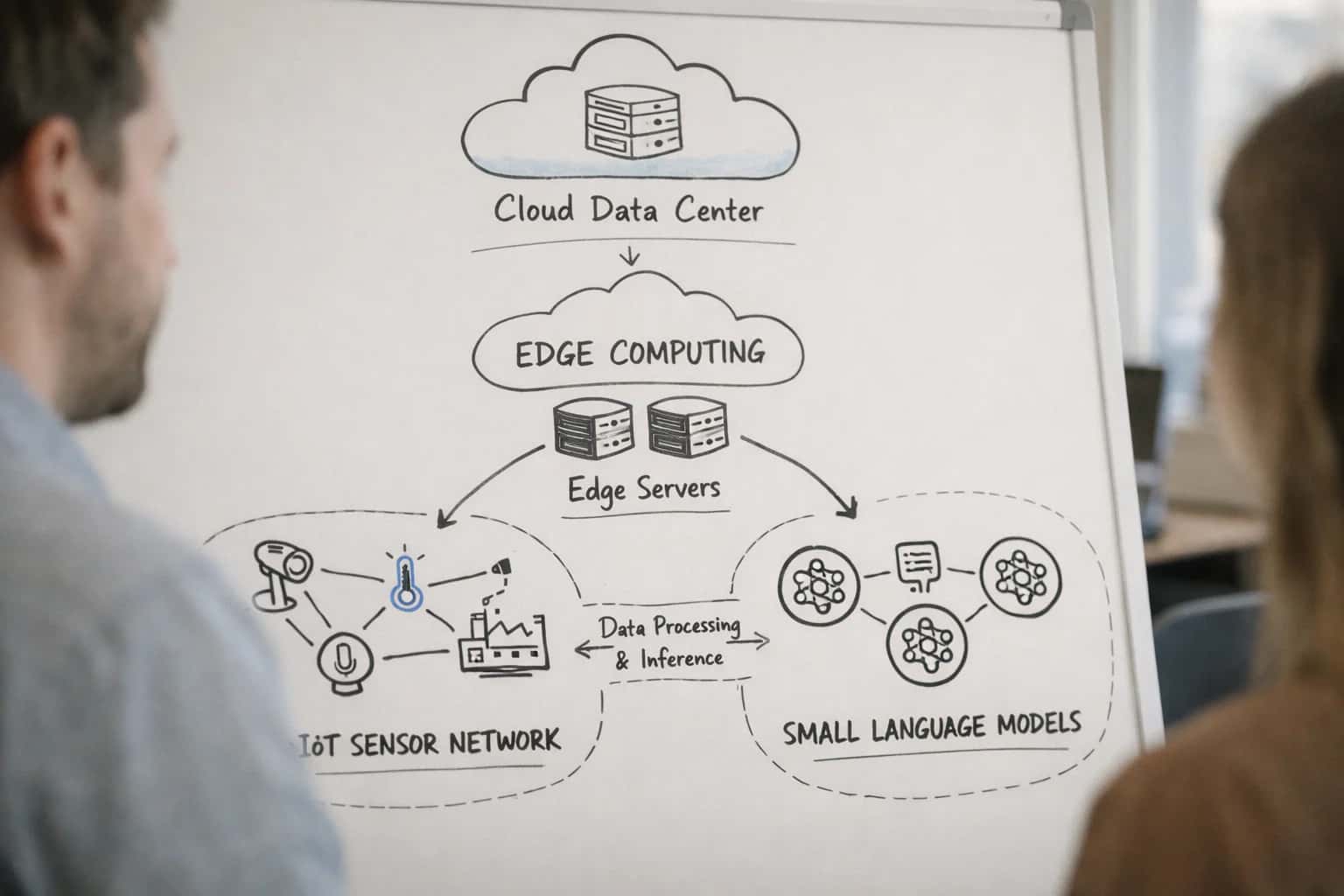
DISTRIBUTED COMPUTING ARCHITECTURE
What is Device-Edge-Cloud Continuum?
A unified computing fabric spanning on-device processors, edge servers, and centralized cloud data centers, enabling dynamic workload migration based on latency, bandwidth, and resource availability.
Unlike traditional siloed architectures, the continuum treats compute resources as a fluid pool, leveraging heterogeneous compute units—CPUs, GPUs, and NPUs—across the entire network topology. The decision of where to execute is governed by an inference offloading decision engine that analyzes network telemetry and device state. This ensures that ultra-low-latency tasks, such as autonomous control loops, execute locally, while computationally intensive batch processing is seamlessly routed to the cloud, optimizing for both performance and power efficiency.
ARCHITECTURAL FOUNDATIONS
Core Characteristics
The Device-Edge-Cloud Continuum is defined by its ability to abstract physical distance into a single logical compute fabric. These characteristics enable deterministic latency and dynamic resource allocation.
01
Hierarchical Compute Topology
A structured, multi-tier architecture that organizes compute resources by physical proximity and latency. Device Layer handles microsecond-level sensor fusion. Edge Layer provides sub-millisecond inference for campus-wide applications. Cloud Layer delivers massive parallelism for model training. This hierarchy ensures data is processed at the most efficient tier, minimizing unnecessary data movement and backhaul congestion.
02
Dynamic Workload Migration
The ability to seamlessly transfer computational tasks between tiers without service interruption. This relies on stateful container orchestration and model partitioning to move inference workloads mid-execution. Key triggers include:
- Degraded wireless channel conditions
- Thermal throttling on the device
- Sudden spikes in computational demand This ensures the application consistently meets its latency budget regardless of environmental volatility.
03
Unified Control Plane
A software-defined management layer that abstracts the underlying hardware heterogeneity. It provides a single API for deploying, scaling, and monitoring workloads across ARM-based devices, x86 edge servers, and cloud GPUs. This plane handles service discovery, TLS termination, and load balancing, allowing developers to target a logical endpoint rather than specific hardware silos.
04
Data Locality Optimization
A policy engine that enforces data sovereignty and reduces latency by processing data near its origin. Sensitive telemetry can be anonymized at the edge before transmission. High-volume video streams are analyzed locally, with only structured metadata sent to the cloud. This characteristic is critical for GDPR compliance and applications where bandwidth is constrained or expensive.
05
Resilient Disconnected Operation
The capability for edge and device layers to operate autonomously during cloud connectivity loss. Local models and rule engines maintain full functionality using cached state and local knowledge graphs. Upon reconnection, a conflict-free replicated data type (CRDT) merge process synchronizes state deltas, ensuring the system is tolerant to network partitions.
06
Heterogeneous Acceleration
Leveraging diverse silicon architectures across the continuum to maximize performance-per-watt. This includes NPUs for on-device keyword spotting, GPUs for edge video transcoding, and TPUs for cloud-scale training. A unified compiler stack targets these backends, applying post-training quantization for constrained devices and mixed-precision for server-class hardware.
DEVICE-EDGE-CLOUD CONTINUUM
Frequently Asked Questions
Clear, technical answers to the most common questions about architecting and managing a seamless, multi-tier computing fabric that spans on-device processors, edge nodes, and centralized cloud data centers.
The Device-Edge-Cloud Continuum is a seamless, multi-tier computing architecture that enables dynamic workload migration across on-device processors, edge nodes, and centralized cloud data centers based on latency and resource requirements. It functions by abstracting the underlying physical infrastructure into a single logical compute fabric. A continuum orchestrator continuously monitors key telemetry—such as network latency, available compute cycles, and battery status—to make real-time scheduling decisions. For example, a complex augmented reality application might execute pose estimation on a device's Neural Processing Unit (NPU) for sub-millisecond response, offload scene understanding to a Multi-access Edge Computing (MEC) server at the 5G base station for a 10ms latency budget, and send a high-fidelity 3D map reconstruction task to a cloud data center for non-real-time processing. This dynamic partitioning ensures that each computational task is executed at the optimal tier to meet its specific Quality of Service (QoS) contract.
Enabling Efficiency, Speed & Accuracy
Intelligent Analysis, Decision & Execution
We build AI systems for teams that need search across company data, workflow automation across tools, or AI features inside products and internal software.
Talk to Us
Search across company data
Give teams answers from docs, tickets, runbooks, and product data with sources and permissions.
Useful when people spend too long searching or get different answers from different systems.
Enterprise searchRAGPermissions
Read more
Automate internal workflows
Use AI to route work, draft outputs, trigger actions, and keep approvals and logs in place.
Useful when repetitive work moves across multiple tools and teams.
AI agentsWorkflow automationGovernance
Read more
Add AI to products and internal tools
Build assistants, guided actions, or decision support into the software your team or customers already use.
Useful when AI needs to be part of the product, not a separate tool.
AI integrationDecision supportModel routing
Read more
About the author
Prasad Kumkar
CEO & MD, Inference Systems
Prasad Kumkar is the CEO & MD of Inference Systems and writes about AI systems architecture, LLM infrastructure, model serving, evaluation, and production deployment. Over 5+ years, he has worked across computer vision models, L5 autonomous vehicle systems, and LLM research, with a focus on taking complex AI ideas into real-world engineering systems.
His work and writing cover AI systems, large language models, AI agents, multimodal systems, autonomous systems, inference optimization, RAG, evaluation, and production AI engineering.
LinkedIn
Limited slotsGet a Free AI Consultation
Partnered with leading AI, data, and software stack.





How We Work
Custom AI workflows for your Business
One-fit-all AI don't work for modern businesses. At Inferensys, we aim to understand your business & custom requirements; which we use to define most efficient agentic workflows, the data, and the tools for your business.
01
Review the use case
We understand the task, the users, and where AI can actually help.
Read more02
Pick the right approach
We define what needs search, automation, or product integration.
Read more03
Build the first useful version
We implement the part that proves the value first.
Read more04
Improve from there
We add the checks and visibility needed to keep it useful.
Read moreThe first call is a practical review of your use case and the right next step.
Talk to Us