A token limit is the maximum number of tokens—the basic units of text like words or subwords—that a language model can accept as input and output within a single inference call, defined by its fixed context window. This hard constraint acts as the model's working memory, forcing engineering trade-offs between retaining historical conversation, incorporating new instructions, and generating lengthy responses. Exceeding this limit typically results in an error or automatic context truncation, where tokens are discarded from the sequence.

Glossary
Token Limit
A token limit is the maximum number of tokens (the basic units of text processed by a language model) that can be contained within a model's context window for a single inference call.
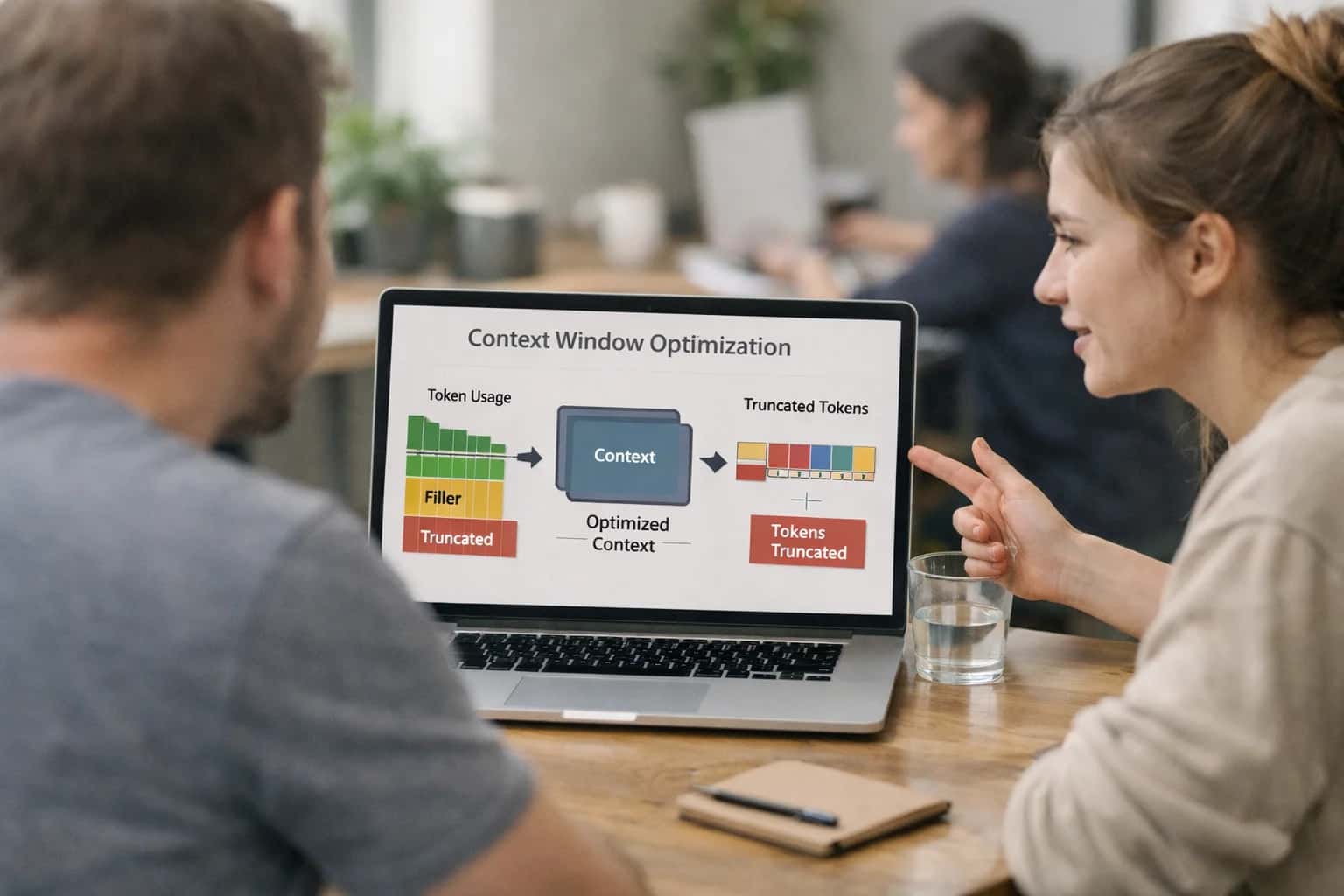
CONTEXT WINDOW MANAGEMENT
What is Token Limit?
A fundamental constraint in transformer-based language models that dictates the maximum amount of information an AI can process in a single operation.
Managing the token limit is a core challenge in agentic workflows, where autonomous systems must maintain state over extended interactions. Engineers employ strategies like context summarization, semantic chunking, and cache eviction to optimize the utility of this bounded space. The limit is intrinsically linked to the model's attention mechanism and positional encoding scheme, with advanced techniques like YaRN and NTK-aware scaling developed to extend it without full model retraining.
ENGINEERING CONSTRAINTS
Key Characteristics of Token Limits
A token limit is the maximum number of tokens—the basic units of text processed by a language model—that can be contained within a model's context window for a single inference call. This fundamental constraint drives core engineering decisions in agentic systems.
01
Fixed Architectural Constraint
The token limit is a hard architectural boundary determined by a transformer model's pre-training. It is defined by the maximum sequence length the model's attention mechanism was trained to handle. Exceeding this limit requires specialized techniques like position interpolation or sliding window attention.
- Example: OpenAI's GPT-4 Turbo has a 128k token limit; Anthropic's Claude 3 Opus has a 200k limit.
- Consequence: Input sequences longer than the limit must be truncated, summarized, or otherwise compressed, risking information loss.
02
Impact on Memory & State
For autonomous agents, the token limit defines the working memory capacity. The agent's current state—including conversation history, tool outputs, and retrieved knowledge—must fit within this window.
- State Management Challenge: Agents must implement eviction policies (e.g., LRU) and summarization to maintain coherent long-term operation.
- Multi-Turn Dialogue: Entire conversation history must be managed within the limit, often requiring context summarization or semantic caching to preserve key details across long sessions.
03
Direct Cost & Latency Driver
Token processing is the primary unit of billing for most commercial LLM APIs and a major factor in inference latency. Longer contexts increase cost and slow response times.
- Pricing Model: APIs typically charge per input token and per output token.
- Computational Cost: The transformer's attention mechanism has quadratic complexity (O(n²)) with respect to context length, making long contexts computationally expensive.
- Engineering Trade-off: Teams must balance context richness against budget and latency Service Level Agreements.
04
Retrieval-Augmented Generation (RAG) Boundary
In RAG architectures, the token limit defines the maximum capacity for grounding data. When a user query triggers a search, only the top-k most relevant document chunks that can collectively fit within the remaining context window are injected.
- Chunking Strategy: Documents must be pre-processed into chunks smaller than the limit, using semantic chunking to preserve coherence.
- Optimization Challenge: Engineers must optimize chunk size, retrieval count, and compression to maximize informational utility within the fixed token budget.
05
KV Cache & Memory Footprint
During autoregressive generation, the Key-Value (KV) Cache stores intermediate computations for all tokens in the context to avoid recomputation. The token limit directly determines the maximum memory footprint of this cache.
- Memory Scaling: KV Cache size scales linearly with batch size, context length, and model dimensions.
- Hardware Limitation: Long contexts can exhaust GPU VRAM, forcing techniques like paged attention or cache eviction.
- Streaming Inference: Frameworks like StreamingLLM manage the KV Cache for infinite-length streams by retaining attention sinks and a sliding window.
06
Prompt Engineering Constraint
The token limit constrains prompt architecture. System instructions, few-shot examples, and user queries must be designed concisely.
- In-Context Learning (ICL): The number of few-shot examples is limited by available tokens.
- Dynamic Context Management: Sophisticated prompts use conditional inclusion, prioritizing the most relevant instructions or examples based on the current query.
- Compression Techniques: Methods like context distillation or selective token retention are used to fit more semantic content into the limited space.
TOKEN LIMIT
Technical Implications and Engineering Impact
A token limit is the maximum number of tokens (the basic units of text processed by a language model) that can be contained within a model's context window for a single inference call. This fixed constraint is a primary engineering bottleneck for agentic systems.
The token limit imposes a hard architectural boundary, forcing engineers to implement sophisticated context management strategies. Core challenges include context window saturation, where no new information can be added, and the need for context compression, truncation, or summarization to fit essential data. This directly impacts system design, dictating the complexity of tasks an agent can handle in one reasoning cycle and necessitating efficient memory retrieval and state management protocols to work around the limitation.
Engineering responses to the token limit are foundational to agentic memory architectures. Techniques like sliding window attention, KV cache management with eviction policies, and context chunking are employed to maximize information utility within the constraint. Furthermore, the limit drives the adoption of hierarchical memory structures, where a small, fast context window is supported by larger, slower external stores like vector databases, creating a tiered system for short-term and long-term context.
TOKEN LIMIT
Frequently Asked Questions
A token limit is the maximum number of tokens that can be processed by a language model in a single inference call. This fundamental constraint drives the engineering of context window management for agentic systems.
A token limit is the maximum number of tokens—the basic units of text processed by a language model—that can be contained within a model's context window for a single inference call. It exists due to the quadratic computational complexity of the transformer's attention mechanism. Processing N tokens requires attention over N^2 token pairs, making longer sequences prohibitively expensive in terms of memory (for the KV Cache) and compute. Limits are set by model architecture (e.g., 128K for Claude 3, 8K for GPT-3.5-Turbo) and enforce practical bounds on a model's "working memory."
Enabling Efficiency, Speed & Accuracy
Intelligent Analysis, Decision & Execution
We build AI systems for teams that need search across company data, workflow automation across tools, or AI features inside products and internal software.
Talk to Us
Search across company data
Give teams answers from docs, tickets, runbooks, and product data with sources and permissions.
Useful when people spend too long searching or get different answers from different systems.
Enterprise searchRAGPermissions
Read more
Automate internal workflows
Use AI to route work, draft outputs, trigger actions, and keep approvals and logs in place.
Useful when repetitive work moves across multiple tools and teams.
AI agentsWorkflow automationGovernance
Read more
Add AI to products and internal tools
Build assistants, guided actions, or decision support into the software your team or customers already use.
Useful when AI needs to be part of the product, not a separate tool.
AI integrationDecision supportModel routing
Read more
About the author
Prasad Kumkar
CEO & MD, Inference Systems
Prasad Kumkar is the CEO & MD of Inference Systems and writes about AI systems architecture, LLM infrastructure, model serving, evaluation, and production deployment. Over 5+ years, he has worked across computer vision models, L5 autonomous vehicle systems, and LLM research, with a focus on taking complex AI ideas into real-world engineering systems.
His work and writing cover AI systems, large language models, AI agents, multimodal systems, autonomous systems, inference optimization, RAG, evaluation, and production AI engineering.
LinkedIn
Limited slotsGet a Free AI Consultation
Partnered with leading AI, data, and software stack.





How We Work
Custom AI workflows for your Business
One-fit-all AI don't work for modern businesses. At Inferensys, we aim to understand your business & custom requirements; which we use to define most efficient agentic workflows, the data, and the tools for your business.
01
Review the use case
We understand the task, the users, and where AI can actually help.
Read more02
Pick the right approach
We define what needs search, automation, or product integration.
Read more03
Build the first useful version
We implement the part that proves the value first.
Read more04
Improve from there
We add the checks and visibility needed to keep it useful.
Read moreThe first call is a practical review of your use case and the right next step.
Talk to Us