A context window is the fixed-size, sequential block of tokens—representing text, images, or other data—that a transformer-based language model can attend to and process in a single forward pass, establishing its absolute working memory limit. This architectural constraint, determined by the model's positional encoding scheme and training data, forces all relevant information for a task—prompts, conversation history, and retrieved documents—to fit within this finite token limit. Exceeding it triggers context truncation or requires context compression techniques.

Glossary
Context Window
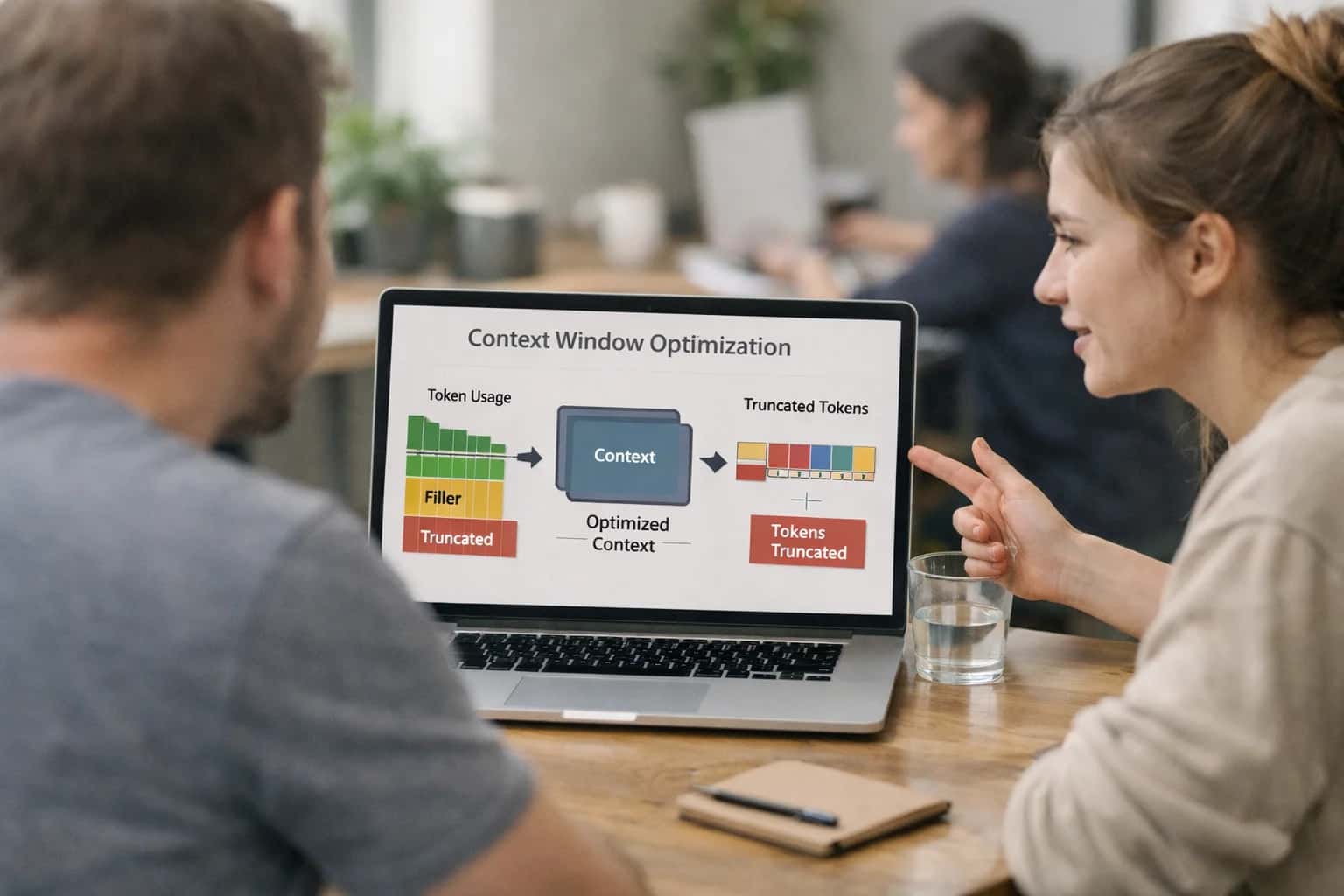
A context window is the fixed-size, sequential block of tokens that a transformer-based language model can attend to and process in a single forward pass, defining its working memory.
FOUNDATIONAL CONCEPT
What is a Context Window?
The context window is the fundamental architectural constraint defining a transformer model's working memory, directly impacting the design of agentic systems.
In agentic workflows, effective context window management is critical, as agents must maintain state over extended operations. Engineers optimize this limited resource through strategies like context retrieval from vector stores, context summarization, and KV Cache management. Techniques such as sliding window attention and frameworks like StreamingLLM enable models to handle streaming data, while methods like YaRN and position interpolation allow for context length extrapolation beyond original training limits.
ARCHITECTURAL PRIMER
Key Characteristics of a Context Window
A context window is the transformer's fundamental memory constraint. These cards detail its core operational properties and their engineering implications for building agentic systems.
01
Fixed Token Capacity
The context window has a hard, immutable limit on the number of tokens it can process in a single forward pass, defined by the model's architecture (e.g., 128K tokens). This limit is a primary engineering constraint, forcing trade-offs between:
- Historical depth (how much past conversation or document content is retained).
- Instruction/System prompt size (the foundational rules for the agent).
- Retrieved knowledge (facts pulled from a vector database).
- Generated output length. Exceeding this limit triggers an error or requires proactive context management.
02
Sequential & Positional
The context window is not a bag-of-words; it is a sequential block where the order of tokens matters profoundly. The model uses positional encodings (like RoPE) to understand token order. Key implications:
- Information location affects model attention; recent tokens often have stronger influence.
- Long-range dependencies can degrade if relevant tokens are too far apart.
- Architectural techniques like sliding window attention or StreamingLLM are needed to handle sequences longer than the base window. This sequential nature makes context windowing strategies (e.g., FIFO eviction) non-trivial, as discarding early tokens can break co-reference.
03
Working Memory, Not Storage
The context window is a volatile, working memory buffer for the duration of an inference call, analogous to a CPU's L1/L2 cache. It is distinct from long-term agentic memory (e.g., vector databases). Core distinctions:
- Ephemeral: Content is typically discarded after the API call unless explicitly cached.
- Computational Substrate: It is the active data the model's attention mechanisms operate on.
- Bottleneck: All relevant information for a reasoning step must pass through this bottleneck. Effective agent design involves sophisticated retrieval-augmented generation (RAG) to populate this window with precise, task-relevant data from persistent stores.
04
Governs In-Context Learning
The context window is the substrate for in-context learning (ICL), the model's ability to learn from examples provided in the prompt. Its characteristics directly determine ICL efficacy:
- Few-shot capacity: The number of demonstration examples is limited by available tokens.
- Example ordering: The sequence of examples can impact performance.
- Instruction following: System prompts and detailed task specifications consume the same budget as data. Engineers perform context window optimization to strategically pack the most informative examples, instructions, and retrieved context into the limited space to maximize task performance.
05
Performance vs. Length Trade-off
As the context window fills, model performance often degrades non-linearly, even before hitting the hard token limit. This is due to several factors:
- Attention dilution: The model must distribute attention over more tokens, potentially reducing focus on critical information.
- Mid-context "lost-in-the-middle" problem: Information placed in the middle of a long context can be harder to recall.
- Increased latency & cost: Computational requirements for attention scale, often quadratically, with context length. Therefore, the goal is not to maximize context usage, but to optimize for utility-per-token, using techniques like semantic retrieval and compression to keep context concise and relevant.
06
Managed via KV Cache
During autoregressive generation (token-by-token output), the context window's state is efficiently maintained through the Key-Value (KV) Cache. This cache stores computed intermediate states for previous tokens, avoiding redundant computation.
- Memory Footprint: The KV Cache is the primary consumer of GPU memory during inference, scaling linearly with batch size and context length.
- Eviction Policies: When the context window is full, cache eviction policies (LRU, FIFO) determine which cached states to discard to make room for new tokens.
- Optimization Target: Techniques like quantized caching or paged attention are used to optimize KV Cache memory usage, directly enabling longer practical context windows.
MECHANICAL FOUNDATION
How the Context Window Works: A Technical View
The context window is the fundamental architectural constraint of transformer-based language models, defining their instantaneous working memory. This section details its internal mechanics and operational impact.
A context window is the fixed-size, sequential block of tokens—the basic units of text, images, or other data—that a transformer model can attend to in a single forward pass. This limit is defined by the model's pre-training and is enforced by the self-attention mechanism, which computes relationships between all token pairs within the window. Exceeding this bound is impossible without algorithmic intervention, as the computational cost of attention scales quadratically with sequence length, making the window a hard bottleneck on in-context learning and multi-turn reasoning.
During autoregressive generation, the model processes the entire context window to predict the next token, maintaining a KV Cache of computed attention states to avoid redundant computation for previous tokens. When the sequence length reaches the token limit, cache eviction policies determine which parts of the history to discard. Techniques like sliding window attention or frameworks like StreamingLLM manage this by focusing on a recent token subset and leveraging attention sinks to handle infinitely long streams without retraining, thus optimizing the use of this constrained working memory.
CONTEXT WINDOW
Frequently Asked Questions
A context window is the fixed-size, sequential block of tokens that a transformer-based language model can process in a single forward pass, acting as its fundamental working memory. These questions address the core engineering challenges and optimization techniques for managing this critical constraint.
A context window is the fixed-size, sequential block of tokens (text, images, or other encoded data) that a transformer-based language model can attend to and process in a single forward pass, fundamentally limiting its working memory. It is a hard limit because the self-attention mechanism at the transformer's core has a computational complexity that scales quadratically (O(n²)) with the number of input tokens. This makes processing arbitrarily long sequences computationally prohibitive. The window size is typically determined during pre-training and defines the maximum contiguous sequence length the model can handle for any given prompt, response, and system instruction combination.
Enabling Efficiency, Speed & Accuracy
Intelligent Analysis, Decision & Execution
We build AI systems for teams that need search across company data, workflow automation across tools, or AI features inside products and internal software.
Talk to Us
Search across company data
Give teams answers from docs, tickets, runbooks, and product data with sources and permissions.
Useful when people spend too long searching or get different answers from different systems.
Enterprise searchRAGPermissions
Read more
Automate internal workflows
Use AI to route work, draft outputs, trigger actions, and keep approvals and logs in place.
Useful when repetitive work moves across multiple tools and teams.
AI agentsWorkflow automationGovernance
Read more
Add AI to products and internal tools
Build assistants, guided actions, or decision support into the software your team or customers already use.
Useful when AI needs to be part of the product, not a separate tool.
AI integrationDecision supportModel routing
Read more
About the author
Prasad Kumkar
CEO & MD, Inference Systems
Prasad Kumkar is the CEO & MD of Inference Systems and writes about AI systems architecture, LLM infrastructure, model serving, evaluation, and production deployment. Over 5+ years, he has worked across computer vision models, L5 autonomous vehicle systems, and LLM research, with a focus on taking complex AI ideas into real-world engineering systems.
His work and writing cover AI systems, large language models, AI agents, multimodal systems, autonomous systems, inference optimization, RAG, evaluation, and production AI engineering.
LinkedIn
Limited slotsGet a Free AI Consultation
Partnered with leading AI, data, and software stack.





How We Work
Custom AI workflows for your Business
One-fit-all AI don't work for modern businesses. At Inferensys, we aim to understand your business & custom requirements; which we use to define most efficient agentic workflows, the data, and the tools for your business.
01
Review the use case
We understand the task, the users, and where AI can actually help.
Read more02
Pick the right approach
We define what needs search, automation, or product integration.
Read more03
Build the first useful version
We implement the part that proves the value first.
Read more04
Improve from there
We add the checks and visibility needed to keep it useful.
Read moreThe first call is a practical review of your use case and the right next step.
Talk to Us