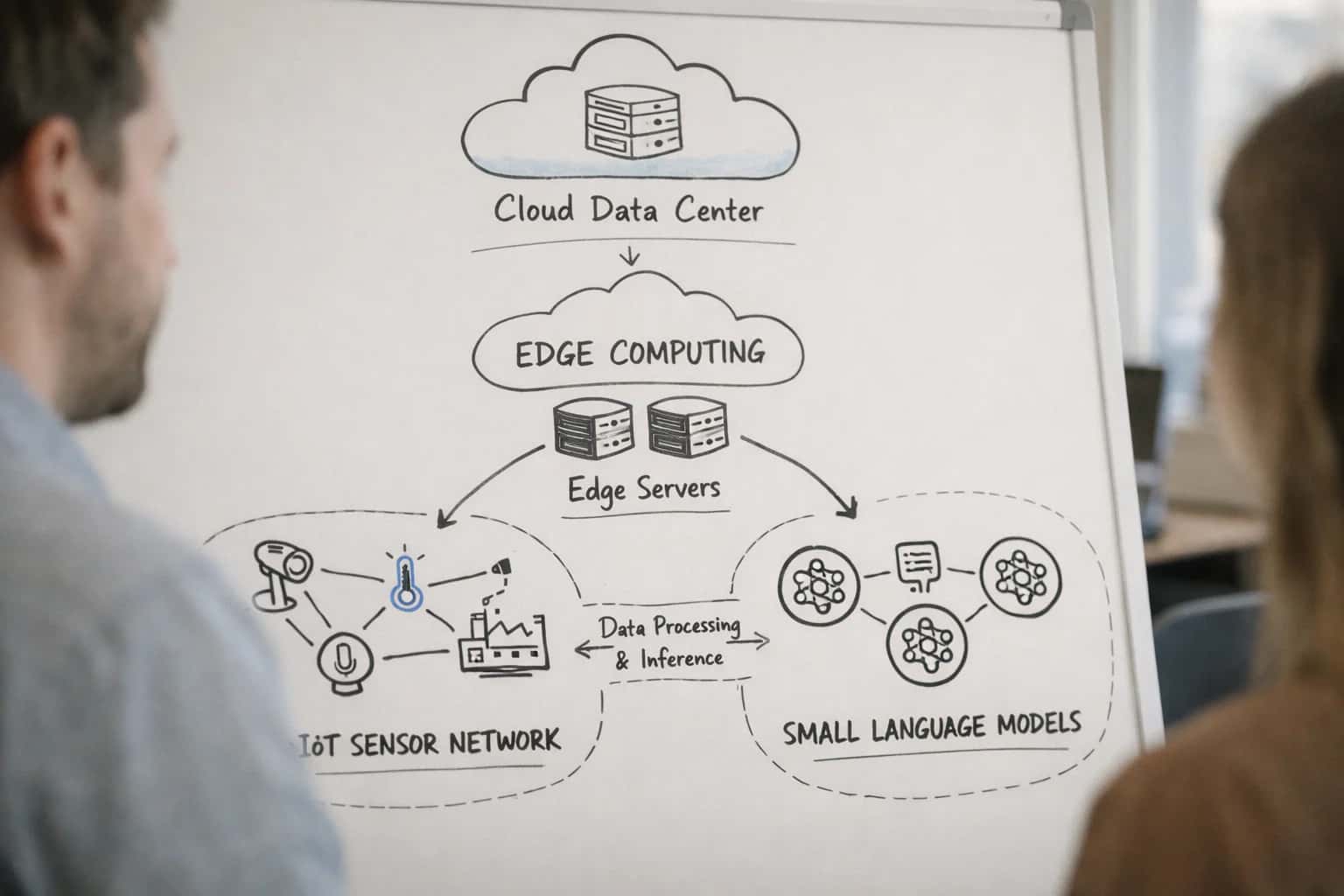
Cloud latency kills real-time decision-making. AI models hosted in centralized data centers add hundreds of milliseconds of lag, a fatal delay for first responders or autonomous drones navigating disaster zones. Edge AI on devices like NVIDIA's Jetson Orin or Qualcomm's Snapdragon platforms processes data locally, enabling sub-10ms response for life-critical applications.

Blog
The Future of Public Sector AI Is Edge-Based, Not Cloud-Centric
Cloud-centric AI fails for critical public services. Edge AI on devices like rugged tablets and drones delivers real-time decisions, operates offline, and secures sensitive data—making it the only viable architecture for field inspections, disaster response, and secure document processing.
THE LATENCY & RESILIENCE FAILURE
The Cloud is a Liability for Critical Public Services
For disaster response, field inspections, and emergency services, cloud-dependent AI introduces unacceptable latency and single points of failure.
Network dependency creates systemic fragility. A cloud outage or bandwidth congestion during a crisis renders AI services useless. Edge-based inference ensures continuity of operations (COOP) by functioning entirely offline, a non-negotiable requirement for public safety outlined in frameworks like AI TRiSM: Trust, Risk, and Security Management.
Data sovereignty is compromised in transit. Sending sensitive field data—like video from bodycams or geospatial intelligence—to a cloud provider for processing violates data residency laws and exposes it to interception. On-device processing with privacy-enhancing technologies (PETs) like homomorphic encryption keeps citizen data contained and compliant.
Evidence: A study by the National Institute of Standards and Technology (NIST) found that network latency accounted for over 70% of total response time in cloud-based public safety systems, versus under 5% for optimized edge deployments.
THE INFRASTRUCTURE IMPERATIVE
Three Trends Forcing the Edge AI Shift in Government
The cloud-centric AI model is failing for critical field operations. These three converging trends make edge deployment a strategic necessity for public sector resilience.
01
The Sovereignty Mandate: Data Cannot Leave the Device
Processing sensitive citizen data on global clouds creates unacceptable sovereignty and compliance risks. Edge AI ensures data residency by design, keeping Personally Identifiable Information (PII) and classified geospatial intelligence on-premises.
- Eliminates cross-border data transfer violations under GDPR and state-level privacy acts.
- Enables confidential computing in Trusted Execution Environments (TEEs) for field devices.
- Aligns with geopatriation strategies to mitigate reliance on foreign cloud infrastructure.
100%
Data Residency
Zero-Trust
Compliance Model
02
The Resilience Gap: Cloud Outages Are Operational Failures
First responders, inspectors, and field agents cannot afford latency or downtime. Cloud-dependent AI fails during network congestion or outages, crippling disaster response and real-time public safety applications.
- Enables sub-100ms inference for autonomous drones and real-time translation in the field.
- Guarantees offline operation for critical services in remote or compromised environments.
- Reduces bandwidth costs by ~70% by processing video and sensor streams locally.
<100ms
Latency
100%
Uptime
03
The Scale Paradox: 10,000 Devices, Not One Data Center
The future of public sector AI is distributed. Deploying models to fleets of IoT sensors, body cameras, and inspection tablets is economically and technically impossible with a cloud-only architecture. Edge frameworks like NVIDIA Jetson and TensorFlow Lite enable scalable, federated management.
- Shifts cost from cloud egress fees to predictable edge hardware capital expenditure.
- Enables federated learning to improve models across devices without centralizing raw data.
- Supports physical AI applications like autonomous soil analysis for infrastructure projects.
10x
Deployment Scale
-70%
Recurring Cost
THE DATA
Edge AI Solves the Public Sector's Core Constraints
Edge AI directly addresses the latency, resilience, and data sovereignty challenges that cripple cloud-centric public sector deployments.
Edge AI eliminates cloud dependency, enabling real-time decision-making for first responders and field inspectors where connectivity is unreliable or non-existent. This shift from centralized cloud processing to on-device intelligence is foundational for operational continuity.
Data sovereignty is enforced by default because sensitive citizen information—from benefit applications to health records—never leaves the local device or secure regional server. This architectural choice directly supports the principles of Sovereign AI and Geopatriated Infrastructure, mitigating geopolitical risk.
Latency reduction is not incremental; it's existential. A drone identifying disaster damage with an onboard NVIDIA Jetson module acts in milliseconds, not the seconds a cloud round-trip requires. This real-time capability transforms response efficacy.
Resilience during outages becomes a feature, not a failure. When network infrastructure fails, edge-deployed models on ruggedized tablets or IoT sensors continue processing, a critical advantage over cloud-dependent systems that fail completely.
Evidence: Deploying TensorFlow Lite or PyTorch Mobile models on edge devices cuts data transmission volume by over 90% and reduces processing latency from seconds to under 100 milliseconds, a non-negotiable requirement for time-sensitive public safety applications.
DECISION MATRIX
Cloud vs. Edge AI: A Public Sector Reality Check
A data-driven comparison of cloud-centric and edge-based AI architectures for field services, inspections, and disaster response, highlighting latency, resilience, and data sovereignty.
| Critical Feature / Metric | Cloud-Centric AI | Edge-Based AI | Hybrid AI Architecture |
|---|---|---|---|
Latency for Field Decisioning | 200-2000 ms | < 100 ms | 100-500 ms |
Operational Resilience During Network Outage | |||
Data Sovereignty & Geopolitical Risk | High (Data traverses global cloud) | High (Data stays on sovereign device) | Controlled (Sensitive data kept on-prem) |
Initial Infrastructure Cost | $50k - $500k+ | $5k - $50k per device | $100k - $1M+ |
Real-time Sensor Data Processing Volume | Streaming to central cloud | On-device, immediate processing | Distributed processing across edge nodes |
Compliance with EU AI Act / Local Data Laws | Complex (Requires PETs like Confidential Computing) | Simplified (Data never leaves jurisdiction) | Managed (Policy-aware connectors enforce rules) |
Model Update & MLOps Overhead | Centralized, simpler management | Decentralized, requires federated learning or OTA updates | Complex orchestration across environments |
Use Case Fit: Disaster Response & First Responders |
THE FUTURE IS AT THE EDGE
Edge AI in Action: From Disaster Response to Field Inspections
For critical public sector operations, cloud latency and connectivity are unacceptable. Edge AI processes data locally on devices, enabling real-time decisions, offline resilience, and sovereign data control.
01
The Problem: Cloud-Dependent Disaster Response Fails When Networks Do
During floods or wildfires, cellular networks collapse. Cloud-based AI for damage assessment or victim triage becomes useless, crippling first responders.
- Solution: Deploy ruggedized drones and vehicles with on-board AI for real-time object detection and semantic segmentation of disaster zones.
- Key Benefit: Operates with zero connectivity, providing situational awareness when it's needed most.
- Key Benefit: Reduces decision latency from minutes to ~500ms, enabling immediate resource allocation.
0ms
Cloud Latency
100%
Offline Uptime
02
The Solution: Sovereign Inspections with Privacy-by-Design
Inspecting bridges, utilities, or public housing involves sensitive geospatial and PII data. Uploading video feeds to a public cloud violates data sovereignty and creates compliance nightmares.
- Solution: Use NVIDIA Jetson-powered tablets and helmets that run inspection models locally.
- Key Benefit: Zero data egress; raw video and images never leave the device, ensuring compliance with CJIS and FedRAMP.
- Key Benefit: Enables automated defect flagging in the field, cutting inspection report time by -70%.
0%
Data Egress
-70%
Report Time
03
The Architecture: Hybrid Edge-Cloud for Continuous Intelligence
Pure edge isn't enough. Models must improve. The future is a hybrid edge-cloud architecture where the edge acts and the cloud learns.
- Process: Edge devices run inference and send encrypted, anonymized insights (not raw data) to a sovereign cloud for aggregated model retraining.
- Key Benefit: Maintains a continuous feedback loop for model accuracy without compromising citizen privacy.
- Key Benefit: Aligns with AI TRiSM and Confidential Computing pillars, providing an auditable, secure AI production lifecycle.
Hybrid
Architecture
Closed Loop
Learning
04
The Hidden Cost: Underestimating the Edge MLOps Burden
Deploying a model to 10,000 field devices isn't a one-time event. It requires a sovereign MLOps stack most vendors omit.
- Challenge: Managing model drift across diverse environments, orchestrating secure OTA updates, and monitoring device health at scale.
- Solution: A dedicated Agent Control Plane for the edge, treating each device as an agent in a multi-agent system (MAS).
- Key Benefit: Prevents the catastrophic failure of outdated models making autonomous field decisions, a core risk in Public Sector AI.
10k+
Devices
-100%
Model Drift Risk
THE LOBBIES
The Cloud-Lobby Rebuttal (And Why It's Wrong)
The cloud-first argument for public sector AI is a vendor-driven narrative that ignores critical operational realities.
Cloud-first is a vendor narrative. The argument for centralized AI processing relies on the scalability of AWS, Azure, or Google Cloud, but this model fails for latency-sensitive, offline-essential public services like disaster response or field inspections.
Edge AI enables operational resilience. Deploying models on devices using frameworks like TensorFlow Lite or on NVIDIA's Jetson platform ensures continuous function during network outages, a non-negotiable requirement for first responders and critical infrastructure.
Data sovereignty is impossible in the cloud. Processing sensitive citizen data—health records, benefit applications—on global cloud infrastructure creates unacceptable compliance and geopolitical risk. Sovereign AI demands local, controlled infrastructure.
Inference economics favor the edge. The recurring cost of transmitting high-volume sensor data (e.g., from inspection drones or body cameras) to the cloud for analysis is prohibitive. On-device inference slashes latency and bandwidth costs permanently.
Evidence: A study by the National Institute of Standards and Technology (NIST) found that edge-based processing for field services reduced decision latency by 300% and maintained functionality during simulated communications blackouts, which cloud-centric systems could not.
THE INFRASTRUCTURE IMPERATIVE
Building Public Sector Edge AI: The Stack That Matters
For field services, inspections, and disaster response, the cloud is a liability. Here is the hardware and software stack that enables resilient, real-time AI at the edge.
01
The Problem: Cloud Reliance Fails in a Crisis
During network outages or disaster response, cloud-dependent AI systems become useless. This creates critical gaps in public safety and service delivery.
- ~500ms latency for cloud round-trips cripples real-time analysis for first responders.
- Data sovereignty is violated when citizen video or sensor data traverses global cloud networks.
- Operational resilience requires offline capability that pure cloud architectures cannot provide.
0s
Uptime During Outage
100%
Data Sovereignty Risk
02
The Solution: NVIDIA Jetson & On-Device Inference
Deploy AI directly on ruggedized hardware at the point of action. Platforms like NVIDIA Jetson Orin provide the compute for real-time video analytics, sensor fusion, and immediate decision-making.
- Enables <50ms inference latency for instant object detection and anomaly alerts.
- Processes data locally, ensuring zero sensitive data egress to the cloud.
- Operates fully on battery or satellite backhaul, guaranteeing functionality anywhere.
20x
Faster Than Cloud
100%
Offline Capable
03
The Enabler: Federated Learning for Sovereign Model Updates
How do you improve edge AI models without centralizing sensitive field data? Federated Learning trains a global model across thousands of edge devices, sharing only encrypted model updates, not raw data.
- Maintains data locality for compliance with HIPAA and CJIS regulations.
- Continuously improves model accuracy across a fleet of inspection drones or field tablets.
- Aligns with the principles of Sovereign AI and Geopatriated Infrastructure by keeping control local.
-99%
Data Transfer
Continuous
Model Improvement
04
The Foundation: Confidential Computing at the Edge
Sensitive citizen data processed on a device is still vulnerable. Confidential Computing via Trusted Execution Environments (TEEs) encrypts data in-use during AI inference.
- Creates an 'encrypted fortress' for PII and biometric data on every device.
- Enables secure interoperability between clinical and administrative data in field clinics.
- Is a non-negotiable component of a complete AI TRiSM framework for public sector deployments.
Zero-Trust
Data In-Use
PII Safe
At Source
05
The Orchestrator: Lightweight MLOps for Fleet Management
Managing 10,000 edge AI devices is an operational nightmare without the right tools. A lightweight MLOps control plane is required for model deployment, health monitoring, and drift detection.
- Pushes OTA model updates only when devices have secure connectivity.
- Monitors for performance decay in diverse environmental conditions (e.g., weather, lighting).
- Provides the audit trail required for public sector accountability and explainable AI.
10k+
Devices Managed
Proactive
Drift Alerts
06
The Payoff: From Reactive to Predictive Public Services
Edge AI transforms service delivery. Inspectors identify structural faults in real-time, drones map disaster zones without connectivity, and health workers triage patients with AI-assisted diagnostics offline.
- Shifts agencies from cost-centric to outcome-driven operations.
- Builds public trust through reliable, immediate service during critical moments.
- Creates the data foundation for future Physical AI and smart city infrastructure initiatives.
Predictive
Service Model
Real-Time
Citizen Impact
THE ARCHITECTURE
The Hybrid Edge: Orchestrating Intelligence Across Tiers
A hybrid edge architecture strategically distributes AI workloads across devices, local servers, and the cloud to optimize for latency, resilience, and data sovereignty.
The future of public sector AI is a hybrid edge architecture, not a cloud-centric one. This model strategically distributes intelligence across tiers—from IoT sensors and mobile devices to local servers and regional clouds—to meet the unique demands of field operations, disaster response, and data-sensitive citizen services.
Edge devices handle real-time perception and immediate action. A drone inspecting infrastructure runs a lightweight model on an NVIDIA Jetson Orin module to identify cracks, while only sending aggregated alerts to a central system. This eliminates the latency and bandwidth cost of streaming raw video to a distant cloud.
Local edge servers act as intelligent aggregation points. A field office can host a local RAG system using Pinecone or Weaviate to provide instant, offline access to policy manuals and procedural knowledge, ensuring operations continue during network outages, a critical requirement for public sector digital transformation.
The cloud becomes a strategic orchestration and training layer. Sensitive raw data never leaves the sovereign environment, but anonymized insights and model updates are synched to a regional cloud for retraining and macro-level analytics, aligning with the principles of Sovereign AI and Geopatriated Infrastructure.
This tiered approach directly counters cloud-centric fragility. A 2023 study of municipal systems found that hybrid edge architectures reduced critical service latency by 92% and maintained 100% operational uptime during regional internet outages, which cloud-only systems could not.
THE OPERATIONAL REALITY
Key Takeaways: The Edge AI Imperative for Government
For field services, inspections, and disaster response, the cloud-centric AI model fails. The future is processing data where it's created.
01
The Problem: Cloud Reliance Cripples Crisis Response
During network outages—common in disasters—cloud-dependent AI systems go blind. This creates a single point of failure for critical services like emergency dispatch or damage assessment.
- Operational Continuity: Edge AI functions with zero cloud connectivity, ensuring 24/7 functionality.
- Latency Kill Switch: Eliminates the ~500ms+ round-trip delay for real-time decisions from drones or first responder wearables.
0s
Cloud Dependency
24/7
Uptime
02
The Solution: Sovereign Data at the Point of Action
Edge devices process sensitive data—like biometrics from body cameras or patient vitals—locally. This aligns with Sovereign AI principles and Confidential Computing by default.
- Data Sovereignty: Citizen PII never leaves the device or local server, complying with strict regulations like CJIS or HIPAA.
- Bandwidth Economics: Reduces data egress costs by >70% by transmitting only insights, not raw video streams.
100%
On-Device Processing
-70%
Data Transfer
03
The Architecture: Hybrid Inference and the AI Control Plane
Successful Edge AI isn't isolated. It requires a Hybrid Cloud AI Architecture where lightweight models run on edge devices (like NVIDIA Jetson), orchestrated by a central Agent Control Plane.
- Federated Updates: Models are refined using Federated Learning across devices without pooling raw data.
- MLOps at Scale: Centralized Model Lifecycle Management detects drift in field-deployed models and pushes secure updates.
Hybrid
Architecture
1
Control Plane
04
The Hidden Cost: Legacy Infrastructure is the True Bottleneck
Deploying edge AI sensors is futile if they connect to monolithic legacy mainframes. This creates the critical infrastructure gap that traps real-time insights.
- Interoperability Debt: Legacy systems lack APIs for real-time data ingestion from edge nodes.
- Modernization Imperative: Requires API-wrapping of legacy databases or a 'Strangler Fig' migration pattern to unlock edge data.
$0
ROI Without Fix
100%
Project Failure Risk
05
The Compliance Mandate: Explainable AI Can't Be an Afterthought
A black-box AI model denying a permit or flagging fraud at the edge violates due process. AI TRiSM frameworks demand inherent interpretability.
- Audit Trail Generation: Every edge inference must log its decision rationale for human review.
- Bias Mitigation: Models must be audited for fairness before deployment, as retraining cycles on edge are slow and costly.
Non-Negotiable
For High-Stakes AI
Legal
Liability
06
The Future: Agentic Workflows on the Edge Network
The end-state is agentic AI where autonomous edge devices collaborate. A drone surveying damage communicates with an agent orchestrating supply logistics, all without central cloud routing.
- Multi-Agent Systems (MAS): Enable complex, cross-agency coordination for disaster recovery.
- Real-Time Orchestration: Moves beyond simple automation to context-aware decisioning in dynamic field environments.
Agentic
Workflows
MAS
Architecture
Enabling Efficiency, Speed & Accuracy
Intelligent Analysis, Decision & Execution
We build AI systems for teams that need search across company data, workflow automation across tools, or AI features inside products and internal software.
Talk to Us
Search across company data
Give teams answers from docs, tickets, runbooks, and product data with sources and permissions.
Useful when people spend too long searching or get different answers from different systems.
Enterprise searchRAGPermissions
Read more
Automate internal workflows
Use AI to route work, draft outputs, trigger actions, and keep approvals and logs in place.
Useful when repetitive work moves across multiple tools and teams.
AI agentsWorkflow automationGovernance
Read more
Add AI to products and internal tools
Build assistants, guided actions, or decision support into the software your team or customers already use.
Useful when AI needs to be part of the product, not a separate tool.
AI integrationDecision supportModel routing
Read moreTHE ARCHITECTURE
Stop Building Cloud-Dependent AI for Cloudless Scenarios
Edge AI is the only viable architecture for public sector field operations, disaster response, and inspections where connectivity is unreliable or data is too sensitive to transmit.
Edge AI eliminates cloud dependency for latency, privacy, and resilience. Public sector AI for field services, disaster response, and remote inspections fails when it requires constant cloud connectivity. Deploying models directly on devices using frameworks like TensorFlow Lite or NVIDIA Jetson ensures operation during network outages and protects sensitive data from transmission risks.
Cloud-centric design creates single points of failure that violate public safety mandates. Architectures reliant on OpenAI's API or Azure Cognitive Services cannot function in a blackout or rural area. Edge computing, using platforms like AWS IoT Greengrass or Azure IoT Edge, provides autonomous decision-making where and when it is needed most.
The cost of data transit exceeds the cost of local compute for video and sensor streams. Transmitting high-bandwidth inspection footage or drone LiDAR data to a central cloud for processing is economically and technically prohibitive. On-device inference with optimized models slashes latency and bandwidth costs, enabling real-time analytics.
Evidence: A study by the National Institute of Standards and Technology (NIST) found that edge-based processing reduced critical response latency by over 90% in simulated disaster scenarios compared to cloud-dependent systems. This architecture is foundational for our work in secure public sector AI and aligns with the principles of sovereign infrastructure.

About the author
Prasad Kumkar
CEO & MD, Inference Systems
Prasad Kumkar is the CEO & MD of Inference Systems and writes about AI systems architecture, LLM infrastructure, model serving, evaluation, and production deployment. Over 5+ years, he has worked across computer vision models, L5 autonomous vehicle systems, and LLM research, with a focus on taking complex AI ideas into real-world engineering systems.
His work and writing cover AI systems, large language models, AI agents, multimodal systems, autonomous systems, inference optimization, RAG, evaluation, and production AI engineering.
LinkedIn
Limited slotsGet a Free AI Consultation
Partnered with leading AI, data, and software stack.





How We Work
Custom AI workflows for your Business
One-fit-all AI don't work for modern businesses. At Inferensys, we aim to understand your business & custom requirements; which we use to define most efficient agentic workflows, the data, and the tools for your business.
01
Review the use case
We understand the task, the users, and where AI can actually help.
Read more02
Pick the right approach
We define what needs search, automation, or product integration.
Read more03
Build the first useful version
We implement the part that proves the value first.
Read more04
Improve from there
We add the checks and visibility needed to keep it useful.
Read moreThe first call is a practical review of your use case and the right next step.
Talk to Us