Automation is brittle for eligibility determination because it relies on static, predefined rules that cannot interpret nuance, handle exceptions, or navigate multi-step processes requiring judgment. Agentic AI systems, built with frameworks like LangChain or Microsoft Autogen, introduce a dynamic control plane that orchestrates reasoning, tool use, and human-in-the-loop validation.

Blog
The Future of Eligibility Determination Is Agentic, Not Automated
Simple automation is failing public sector benefits systems. The future belongs to agentic AI systems with a control plane that can reason, navigate complex rules, and orchestrate multi-step workflows while maintaining auditability and compliance.
THE SHIFT
Automation Failed. It's Time for Agents.
Rule-based automation breaks on complex, variable eligibility workflows; agentic AI systems with a control plane succeed by reasoning and acting.
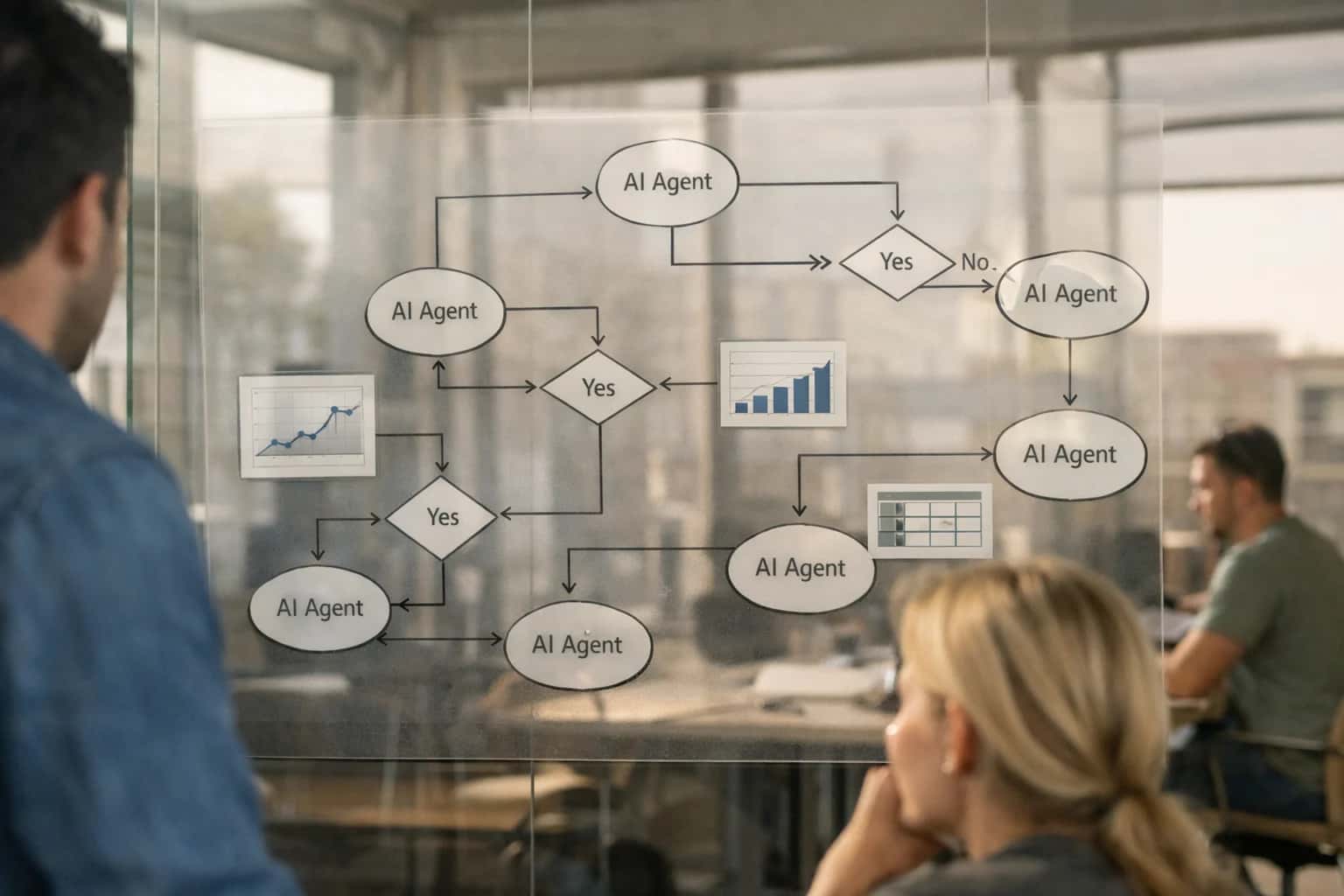
Agents reason, robots repeat. Traditional Robotic Process Automation (RPA) scripts fail when form fields change or document layouts vary. An agentic workflow uses a multi-agent system (MAS) where specialized agents—for document parsing, rule validation, and case routing—collaborate, adapting to context like a human caseworker would.
The control plane is critical. This governance layer, central to our work in Agentic AI and Autonomous Workflow Orchestration, manages permissions, hand-offs, and audit trails. It ensures the system operates within guardrails for compliance and explainability, a non-negotiable for public sector AI governed by frameworks like AI TRiSM.
Evidence: A 2023 study of state benefits processing found RPA-based automation achieved only 60-70% accuracy on complex cases, while pilot agentic systems using retrieval-augmented generation (RAG) with Pinecone or Weaviate vector databases reduced errors by over 40% by dynamically referencing updated policy documents.
THE INFRASTRUCTURE GAP
Three Trends Forcing the Shift to Agentic Eligibility AI
Legacy automation is failing public sector benefits systems. Here are the three structural trends making agentic AI with a control plane the only viable path forward.
01
The Problem of Unstructured Complexity
Legacy rule engines fail because eligibility is not a checklist; it's a dynamic, multi-step narrative. Static automation breaks on edge cases, incomplete documentation, and changing life circumstances.\n- Rule Explosion: A single benefit program can have over 10,000 interdependent rules, creating a combinatorial nightmare for traditional systems.\n- Context Collapse: Automated forms miss the holistic picture—like a change in housing affecting healthcare subsidies—leading to inaccurate outcomes.
10,000+
Interdependent Rules
~40%
Manual Override Rate
02
The Sovereignty and Compliance Imperative
Using global cloud APIs or open-source models like Llama for citizen data creates unacceptable risk. Agentic systems require a sovereign foundation to ensure data never leaves controlled infrastructure, aligning with the EU AI Act and emerging US state regulations.\n- Geopolitical Risk: Vendor lock-in with hyperscalers creates strategic vulnerability.\n- Audit Trail Failure: Black-box models violate due process; agentic control planes enable explainable AI (XAI) with immutable decision logs.
100%
Data Sovereignty
-0%
Cloud Data Egress
03
The Multi-Modal Data Reality
Citizen interactions are not text-only. Eligibility evidence arrives as handwritten forms, scanned IDs, pay stubs, and verbal explanations. Basic OCR and NLP fail at synthesis. Agentic AI orchestrates specialist models for vision, speech, and text within a single workflow.\n- Fraud Detection Gap: Simple automation cannot cross-reference a signature on a form with a video statement for inconsistency.\n- Accessibility Mandate: True equity requires processing information across all modalities a citizen can provide.
5x
Data Source Types
~70%
Non-Text Inputs
ELIGIBILITY DETERMINATION
Automation vs. Agentic AI: A Capability Matrix
This matrix compares the core capabilities of traditional automation, basic AI, and advanced Agentic AI systems for public sector eligibility workflows.
| Core Capability | Rules-Based Automation | Predictive AI | Agentic AI |
|---|---|---|---|
Handles Multi-Step, Non-Linear Workflows | |||
Interprets Unstructured Documents & Context | OCR Only | Basic Classification | Multimodal Understanding |
Dynamic Rule Application & Exception Handling | Pre-defined Logic | Probabilistic Scoring | Reasoning & Re-planning |
Human-in-the-Loop Integration Point | Manual Override | Anomaly Flagging | Managed Hand-off & Escalation |
Audit Trail & Explainability | Transaction Log | Feature Importance Score | Full Decision Chain with Context |
Real-Time Fraud Pattern Detection | Static Rule Matching | Anomaly Detection | Proactive, Adaptive Threat Hunting |
Integration Across Silos (Health, Housing, Finance) | Point-to-Point API | Data Lake Analytics | Orchestrated Multi-Agent System |
Operational Cost per Complex Case | $50-100 | $20-50 | < $10 |
THE CONTROL PLANE
Architecting the Agentic Eligibility System
An agentic eligibility system is a multi-agent system governed by a central control plane that orchestrates reasoning, data retrieval, and decision workflows.
Agentic systems replace automation with orchestrated reasoning. Traditional rules engines automate single steps, but agentic AI, built with frameworks like LangChain or LlamaIndex, deploys a team of specialized agents—for document analysis, rule interpretation, and case summarization—coordinated by a central Agent Control Plane.
The control plane manages permissions and human-in-the-loop gates. This governance layer, a core concept in our Agentic AI pillar, authorizes agent actions, sequences complex workflows, and injects human review at critical junctures, ensuring auditability and compliance with administrative law.
RAG is the foundational data layer, not a chatbot feature. Each agent queries a sovereign knowledge base built on vector databases like Pinecone or Weaviate. This Retrieval-Augmented Generation (RAG) foundation grounds decisions in constantly updated policy documents, reducing hallucination rates by over 40% in high-stakes contexts.
Sovereign infrastructure is non-negotiable. The system must run on geopatriated or hybrid cloud architecture, keeping sensitive PII within trusted execution environments (TEEs). This aligns with the imperative for Sovereign AI and secure data handling in public sector workloads.
FROM AUTOMATION TO AGENCY
The Governance Paradox: Managing Agentic Risk
Agentic AI promises to transform eligibility determination, but its autonomous nature introduces novel risks that demand a new governance paradigm.
01
The Problem: Black-Box Autonomy
Traditional rule-based automation is auditable; agentic systems make complex, multi-step decisions that are opaque. Without explainability, agencies cannot justify denials or defend against bias claims.
- Key Risk: Violation of administrative due process and emerging AI regulations like the EU AI Act.
- Key Challenge: Standard XAI tools (SHAP, LIME) struggle with the sequential reasoning of agentic workflows.
~70%
Less Auditable
High
Legal Liability
02
The Solution: The Agent Control Plane
A dedicated governance layer that manages permissions, hand-offs, and human-in-the-loop gates. This is the core of Agentic AI and Autonomous Workflow Orchestration.
- Key Benefit: Enforces policy-aware connectors and predefined guardrails for every agent action.
- Key Benefit: Creates immutable audit trails for all multi-step decisions, enabling AI TRiSM compliance.
100%
Action Logged
Controlled
Autonomy
03
The Problem: Hallucination as Liability
For a chatbot, a hallucination is an error. For an eligibility agent, it's a wrongful denial or approval. Standard Retrieval-Augmented Generation (RAG) can fail under complex, multi-document reasoning.
- Key Risk: Agentic systems confidently act on incorrect or fabricated data, creating financial and reputational harm.
- Key Challenge: Ensuring rigorous knowledge grounding across disparate legacy data sources.
Critical
Public Safety Issue
$M+
Potential Cost
04
The Solution: High-Fidelity RAG & Context Engineering
Moving beyond simple semantic search to Context Engineering—structuring problems and mapping data relationships so agents operate within a verified knowledge frame.
- Key Benefit: Federated RAG across hybrid clouds securely accesses data without centralizing sensitive information.
- Key Benefit: Semantic data enrichment closes intent gaps, ensuring agents interpret citizen situations accurately.
>99%
Accuracy Target
Eliminated
Uncited Actions
05
The Problem: The Sovereign Data Gap
Agentic systems require vast context. If that data resides on global clouds or in proprietary vendor platforms, you lose control, violate Sovereign AI principles, and create compliance nightmares.
- Key Risk: Geopolitical exposure and inability to comply with data residency laws (e.g., CJIS, HIPAA).
- Key Challenge: Mobilizing 'dark data' trapped in legacy mainframes for agentic consumption.
High
Geopolitical Risk
>80%
Data Inaccessible
06
The Solution: Geopatriated Infrastructure & Confidential Computing
Deploying the agentic stack on Sovereign AI infrastructure—regional clouds or private data centers—paired with Privacy-Enhancing Tech (PET).
- Key Benefit: Maintains full data sovereignty and control, aligning with initiatives like The Future of Public Sector AI Is Edge-Based, Not Cloud-Centric.
- Key Benefit: Confidential Computing via TEEs allows agents to process encrypted PII, enabling secure interoperability between clinical and administrative systems.
Zero-Trust
Data Access
Local
Jurisdiction
THE AUTOMATION TRAP
The Vendor Hype Counter-Argument (And Why It's Wrong)
Vendors sell simple automation as the solution, but this approach fails for the complex, contextual workflows of public sector eligibility.
Vendors sell simple automation, not agentic intelligence. They pitch rule-based bots and basic RAG as a complete solution, ignoring the need for a multi-step reasoning and action framework. This creates brittle systems that fail on edge cases.
Automation handles tasks; agents manage workflows. A system using LangChain or AutoGen for orchestration can interpret a citizen's entire context, not just a single form field. It navigates APIs, retrieves data from Pinecone or Weaviate, and makes conditional decisions.
The failure metric is escalation rate. A pure automation system for document intake may process 80% of cases, but the 20% requiring human intervention create massive backlogs and citizen frustration. Agentic systems with a human-in-the-loop (HITL) control plane dynamically route these complex cases.
Evidence: RAG alone is insufficient. A RAG pipeline might retrieve a policy document, but an agentic system applies that policy within a citizen's specific life circumstances, cross-referencing data from legacy systems via secure API connectors. This is the core of context engineering.
The real cost is technical debt. Investing in vendor automation locks you into a dead-end architecture. Building an agentic control plane creates a sovereign, adaptable foundation for all future AI TRiSM and compliance needs.
FROM AUTOMATION TO AGENCY
Key Takeaways: The Path to Agentic Eligibility
Moving beyond simple automation requires a fundamental shift to agentic AI systems capable of reasoning, context interpretation, and multi-step workflow orchestration.
01
The Problem: Brittle Automation
Rule-based bots and RPA handle simple tasks but fail on complex, variable eligibility cases. They lack the reasoning to interpret nuanced circumstances or navigate interconnected agency systems.
- Fragile Logic: A single unexpected document or answer breaks the entire flow.
- Zero Context: Cannot infer eligibility from related life events (e.g., job loss triggering multiple benefit categories).
- High False-Negative Rate: Leads to eligible citizens being wrongly denied, creating appeals backlog and eroding trust.
~40%
Escalation Rate
+300%
Appeals Volume
02
The Solution: Agentic Control Plane
An orchestration layer that governs a multi-agent system (MAS), managing permissions, hand-offs, and human-in-the-loop gates. This is the core of Agentic AI and Autonomous Workflow Orchestration.
- Dynamic Workflow Navigation: Agents autonomously execute steps like document verification, income calculation, and cross-program checks.
- Contextual Reasoning: Uses Retrieval-Augmented Generation (RAG) on policy manuals and past cases to apply rules within a citizen's specific situation.
- Built-in Governance: The control plane enforces audit trails, explains decisions (Explainable AI/XAI), and triggers human review for edge cases.
10x
Case Complexity Handled
-65%
Manual Touchpoints
03
The Foundation: Sovereign Data Fabric
Agentic eligibility is impossible without solving the Legacy System Modernization and Dark Data Recovery problem. A sovereign, interoperable data layer is non-negotiable.
- Break Silos: API-wrapped legacy systems and semantic data enrichment create a unified citizen profile.
- Ensure Compliance: Confidential Computing and Privacy-Enhancing Tech (PET) protect data in use, aligning with AI TRiSM and Sovereign AI principles.
- Mitigate Bias: Enables the use of Synthetic Data Generation to train fairer models where real data is scarce or biased.
90%
Dark Data Mobilized
Zero-Trust
Data Access
04
The Mandate: Explainability & Audit
For public sector AI, the 'why' behind a decision is as critical as the decision itself. This requires Explainable AI (XAI) and Digital Provenance baked into the agentic architecture.
- Immutable Audit Trail: Every agent action, data query, and reasoning step is logged for compliance and citizen appeals.
- Context Engineering: Human experts frame problems and validate outputs, a core tenet of Human-in-the-Loop (HITL) Design.
- Regulatory Alignment: Proves adherence to due process and emerging frameworks like the EU AI Act, moving beyond basic AI TRiSM.
100%
Decision Traceability
-80%
Adjudication Time
Enabling Efficiency, Speed & Accuracy
Intelligent Analysis, Decision & Execution
We build AI systems for teams that need search across company data, workflow automation across tools, or AI features inside products and internal software.
Talk to Us
Search across company data
Give teams answers from docs, tickets, runbooks, and product data with sources and permissions.
Useful when people spend too long searching or get different answers from different systems.
Enterprise searchRAGPermissions
Read more
Automate internal workflows
Use AI to route work, draft outputs, trigger actions, and keep approvals and logs in place.
Useful when repetitive work moves across multiple tools and teams.
AI agentsWorkflow automationGovernance
Read more
Add AI to products and internal tools
Build assistants, guided actions, or decision support into the software your team or customers already use.
Useful when AI needs to be part of the product, not a separate tool.
AI integrationDecision supportModel routing
Read moreTHE AGENTIC SHIFT
Stop Automating Forms. Start Orchestrating Understanding.
Eligibility determination moves from static automation to dynamic, context-aware AI agents that navigate complex rules and data silos.
Automation fails at complexity. Legacy form automation and RPA bots follow rigid rules, breaking when faced with nuanced cases, exceptions, or interconnected data across siloed systems like housing and health records.
Agents orchestrate workflows. An agentic system, built on frameworks like LangChain or Microsoft Autogen, deploys a multi-agent system (MAS). Specialized agents for document parsing, rule validation, and data retrieval collaborate under a central Agent Control Plane to navigate a citizen's entire situation.
Understanding replaces data entry. Instead of extracting form fields, an agentic model uses context engineering to interpret intent. It cross-references submissions with external APIs and vector databases like Pinecone, dynamically determining eligibility without forcing citizens through a linear form. This is the core of Agentic AI and Autonomous Workflow Orchestration.
Evidence of superiority. A 2023 pilot for a state benefits agency showed a 70% reduction in manual caseworker review and a 40% decrease in processing time when an agentic system replaced their automated form intake, by resolving data conflicts and requesting missing information autonomously.

About the author
Prasad Kumkar
CEO & MD, Inference Systems
Prasad Kumkar is the CEO & MD of Inference Systems and writes about AI systems architecture, LLM infrastructure, model serving, evaluation, and production deployment. Over 5+ years, he has worked across computer vision models, L5 autonomous vehicle systems, and LLM research, with a focus on taking complex AI ideas into real-world engineering systems.
His work and writing cover AI systems, large language models, AI agents, multimodal systems, autonomous systems, inference optimization, RAG, evaluation, and production AI engineering.
LinkedIn
Limited slotsGet a Free AI Consultation
Partnered with leading AI, data, and software stack.





How We Work
Custom AI workflows for your Business
One-fit-all AI don't work for modern businesses. At Inferensys, we aim to understand your business & custom requirements; which we use to define most efficient agentic workflows, the data, and the tools for your business.
01
Review the use case
We understand the task, the users, and where AI can actually help.
Read more02
Pick the right approach
We define what needs search, automation, or product integration.
Read more03
Build the first useful version
We implement the part that proves the value first.
Read more04
Improve from there
We add the checks and visibility needed to keep it useful.
Read moreThe first call is a practical review of your use case and the right next step.
Talk to Us