On-device learning solves the adaptation bottleneck. A robot trained once in a lab fails on a factory floor due to tool wear, new parts, and environmental drift; continual learning at the edge enables real-time adjustment without cloud round-trips.

Blog
Why On-Device Learning Is Critical for the Next Generation of Industrial Robots
The next leap in industrial robotics isn't about raw compute or bigger models. It's about machines that learn from their own experience, in real-time, on the factory floor. This article explains why on-device learning is the non-negotiable architecture for adaptive, reliable, and sovereign industrial automation.
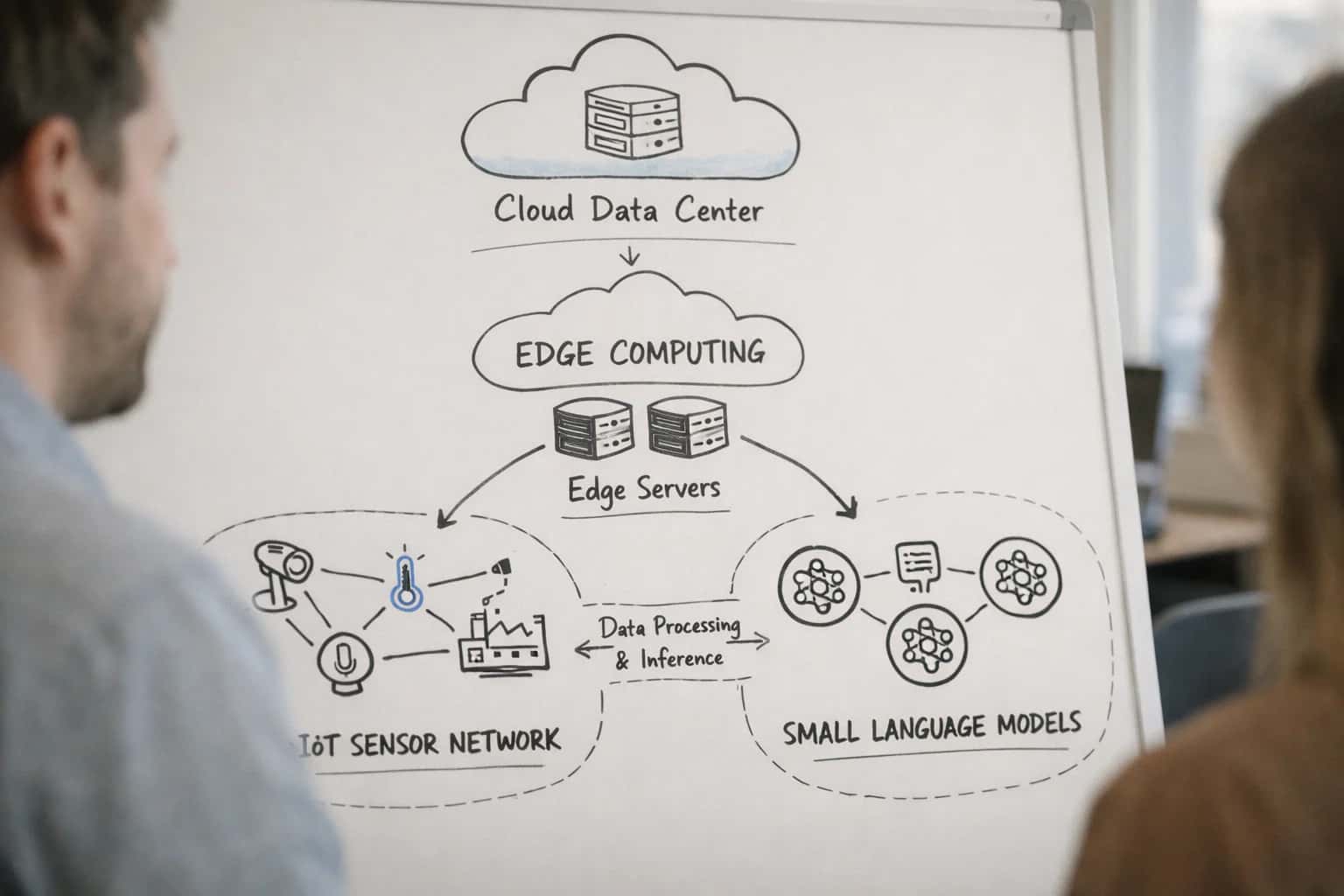
THE DATA
The Static Robot Is a Broken Robot
On-device learning is the only viable architecture for industrial robots to adapt to real-world variability without crippling latency or data exposure.
Latency is a safety and throughput killer. A cloud-dependent robot waiting 200ms for a model inference cannot react to a human entering its workspace or a conveyor belt jam, violating core principles of collaborative robotics.
Data sovereignty mandates edge processing. Sending proprietary part geometries or process videos to a public cloud for model retraining violates IP and compliance; on-device learning with frameworks like TensorFlow Lite or PyTorch Mobile keeps sensitive data contained.
Evidence: Deployments using NVIDIA's Jetson platform for on-device fine-tuning report a 60% reduction in task failure rates over static models when introduced to new material batches, proving that continual adaptation is a production requirement, not a research topic.
THE EDGE IMPERATIVE
Three Market Forces Demanding On-Device Learning
The next generation of industrial robots must adapt in real-time, a capability that cloud-dependent architectures fundamentally cannot provide.
01
The Problem: Latency Kills Real-Time Control
A cloud round-trip for inference introduces ~100-500ms of latency, which is catastrophic for closed-loop control of a robotic arm or autonomous vehicle. This delay prevents immediate reaction to sensor feedback, leading to errors, collisions, or missed cycles.
- Key Benefit 1: Enables sub-10ms reaction times for precise, high-speed manipulation and collision avoidance.
- Key Benefit 2: Eliminates dependency on network stability, ensuring 100% operational uptime even in connectivity-blackout zones like underground mines or shielded factories.
<10ms
Reaction Time
100%
Local Uptime
02
The Problem: Data Sovereignty in a Geopatriated World
Streaming terabytes of proprietary sensor data—including tool paths, part geometries, and facility layouts—to a public cloud creates an unacceptable intellectual property and compliance risk. Regulations like the EU AI Act and defense contracts demand data remain on-premises.
- Key Benefit 1: Keeps sensitive operational data physically contained within the factory's security perimeter, aligning with Sovereign AI principles.
- Key Benefit 2: Removes the legal and logistical burden of cross-border data transfer for global manufacturing operations.
0 TB
Cloud Data Leakage
Full
Local Compliance
03
The Problem: The Prohibitive Cost of Cloud Inference at Scale
Deploying a fleet of 100 robots, each generating a continuous stream of inference requests, makes cloud API costs economically unsustainable. Bandwidth charges and egress fees alone can erase the ROI of automation.
- Key Benefit 1: Shifts cost from a variable, usage-based OPEX to a fixed, predictable CAPEX for edge hardware.
- Key Benefit 2: Enables massive parallelization; scaling from 10 to 1000 robots does not linearly increase compute costs, unlocking true fleet economics.
-90%
Inference Cost
Fixed CAPEX
Cost Model
DECISION MATRIX
Cloud vs. Edge: The Latency and Cost Reality Check
A quantified comparison of compute paradigms for industrial robot learning and adaptation, critical for overcoming the Data Foundation Problem in Physical AI.
| Critical Metric | Centralized Cloud | Hybrid Edge | On-Device (Jetson Thor) |
|---|---|---|---|
Round-Trip Latency for Model Update | 150-500 ms | 20-100 ms | < 5 ms |
Inference Latency (Perception → Actuation) | 80-200 ms | 10-50 ms | 1-10 ms |
Data Egress Cost per Robot/Month | $50-200 | $10-50 | $0 |
Supports Real-Time Continual Learning | |||
Operates During Network Outage | |||
Bandwidth per Robot (8hr shift) | 2-10 GB | 200-500 MB | 50-200 MB |
Time to Adapt to New Part (Tool Wear) | Hours-Days | Minutes-Hours | Seconds-Minutes |
Data Sovereignty & Privacy Risk | High | Medium | Low |
THE EDGE IMPERATIVE
How On-Device Learning Solves the Adaptation Bottleneck
On-device learning enables industrial robots to adapt to real-world variability in real-time, eliminating the latency and reliability issues of cloud-dependent models.
On-device learning is the only viable solution for robots that must adapt to tool wear, new parts, and environmental drift without cloud round-trips. This capability is the core of Embodied Intelligence, where machines learn from direct physical interaction.
Cloud inference creates an adaptation bottleneck. Latency for a round-trip to a cloud API, even at 50ms, is catastrophic for a robotic arm making millisecond adjustments. Reliability in network-sparse industrial environments is non-negotiable.
The counter-intuitive insight is that less data is more. On-device models like those optimized for the NVIDIA Jetson platform use continual learning on small, high-value local datasets. This contrasts with the batch learning paradigm of cloud AI, which requires massive, stale datasets.
Frameworks like TensorFlow Lite and PyTorch Mobile enable this by compressing models for edge deployment. The real challenge is the software stack that manages the perception-action loop and federates learning updates, a core focus of our Edge AI services.
Evidence from predictive maintenance shows the ROI. A vibration sensor on a CNC spindle running an on-device anomaly detection model can identify bearing wear 200ms faster than a cloud-based system. This difference prevents a $250k machine from catastrophic failure.
FROM HYPE TO DEPLOYMENT
Real-World Applications of On-Device Robotic Learning
Latency and data sovereignty demands force intelligence to the edge. Here are the industrial problems that only on-device learning can solve.
01
The Problem: Tool Wear Drifts Your Quality Control Out of Spec
A robotic grinder's performance degrades as its abrasive disc wears down, leading to inconsistent finishes and scrap parts. Cloud-based retraining introduces ~500ms latency, causing real-time compensation to fail.
- Solution: On-device continual learning adjusts force and speed parameters in <10ms based on direct acoustic and vibration sensor feedback.
- Result: Maintains ±0.01mm tolerance autonomously, eliminating manual recalibration shifts and reducing scrap rates by -40%.
<10ms
Latency
-40%
Scrap Rate
02
The Problem: New Part Introductions Halt Your Production Line
A collaborative robot (cobot) on a mixed-model assembly line cannot handle an unforeseen component variant, causing a line stoppage. Sending sensitive CAD data to the cloud for model retraining violates IP and halts production for hours.
- Solution: On-device few-shot learning allows the cobot to learn the new part's grasp points and orientation from 3-5 human demonstrations, without leaving the factory floor.
- Result: New part integration in under 15 minutes, preserving data sovereignty and avoiding $50k+/hour in downtime costs.
15 min
Integration Time
0 Cloud
Data Exposure
03
The Problem: Environmental Drift Sabotages Your Autonomous Logistics
An Autonomous Mobile Robot (AMR) fleet's navigation fails when factory lighting shifts from day to night, or when temporary obstacles alter pathways. Intermittent network connectivity prevents reliable cloud-based map updates.
- Solution: On-device SLAM (Simultaneous Localization and Mapping) with continual learning allows each AMR to incrementally update its internal world model, sharing compact learned features peer-to-peer.
- Result: 99.9% operational uptime in dynamic environments, with fleet-wide adaptation to layout changes without central IT intervention.
99.9%
Uptime
Peer-to-Peer
Adaptation
04
The Problem: Predictive Maintenance Alerts Are Too Late
Vibration analysis for a critical CNC spindle relies on cloud analytics, missing the high-frequency transient signatures that indicate impending bearing failure. The 2-3 second delay in diagnosis leads to catastrophic failure.
- Solution: An on-device TinyML model processes raw accelerometer data at the sensor, detecting anomalous frequency patterns indicative of specific failure modes in real-time.
- Result: Generates maintenance alerts weeks in advance of failure, enabling planned downtime and avoiding $250k+ unplanned repair and production loss events.
Weeks
Advance Warning
$250k+
Cost Avoided
05
The Problem: Your Welding Robot Can't Adapt to Material Lot Variations
Minor variations in sheet metal composition or coating thickness cause a robotic welder to produce weak or brittle joints. Sending terabytes of high-speed thermal imaging data to the cloud for analysis is prohibitively expensive and slow.
- Solution: On-device learning on an NVIDIA Jetson platform fuses visual, thermal, and arc voltage data to dynamically adjust weld path, speed, and current for each joint.
- Result: Achieves consistent weld penetration depth across material batches, reducing rework by -35% and cutting energy consumption by -15%.
-35%
Rework
-15%
Energy Use
06
The Problem: Safety Systems Are Blind to Novel Human Behaviors
A fenceless collaborative cell's safety-rated LiDAR uses static zones, forcing unnecessary stops when a human performs a novel but safe approach. Rule-based systems cannot learn acceptable new patterns of interaction.
- Solution: On-device learning allows the safety system to build a continually evolving model of normal human motion, dynamically adjusting speed limits and warning zones based on real-time intent prediction.
- Result: Increases collaborative throughput by 20% while maintaining SIL 3/PLe safety ratings, as the system becomes more intuitive and less obstructive to human workers.
20%
Throughput Gain
SIL 3
Safety Maintained
THE INFRASTRUCTURE
The Vendor Lock-in and Toolchain Trap
Proprietary edge AI platforms create long-term dependencies that stifle innovation and inflate costs in industrial robotics.
Vendor lock-in cripples adaptation. Industrial robots relying on proprietary platforms like NVIDIA's Jetson or the Qualcomm RB5 series are shackled to closed toolchains. This dependency prevents integration of newer, more efficient models and forces teams to use suboptimal, vendor-specific optimization pipelines like NVIDIA TensorRT, creating a long-term architectural debt.
The toolchain dictates the algorithm. Your choice of edge processor determines your entire machine learning stack, from data formats to deployment frameworks. This forces a top-down technology selection where the hardware vendor's supported models, not the operational problem, define the solution's capabilities and limits.
Counter-intuitively, more compute worsens the trap. High-performance platforms like the NVIDIA Jetson Thor create an illusion of flexibility, but their proprietary SDKs and libraries make migrating to a different architecture or a future, more efficient chip prohibitively expensive. You are not buying silicon; you are adopting an ecosystem.
Evidence: Companies locked into a single vendor's edge AI stack report a 40-60% increase in total cost of ownership over five years due to licensing, forced upgrades, and the inability to adopt best-in-class algorithms from the open-source community like PyTorch or ONNX Runtime.
The escape path is a hardware-agnostic software layer. Building a perception and control stack abstracted from the underlying silicon, using standards like Open Neural Network Exchange (ONNX), is the only defense. This approach, central to our Edge AI and Real-Time Decisioning Systems philosophy, future-proofs deployments against chipset obsolescence.
This trap directly exacerbates the Data Foundation Problem. A closed toolchain prevents the seamless, continuous data ingestion and model retraining needed for robots to adapt. Solving the foundational data challenge, as explored in Why the Data Foundation Problem Will Sink Your Physical AI Investment, requires an open, modular software architecture.
ON-DEVICE LEARNING FOR INDUSTRIAL ROBOTS
Key Takeaways for Technical Decision-Makers
Cloud-dependent AI cannot meet the real-time, secure, and adaptive demands of next-generation industrial automation. Here is the strategic case for moving intelligence to the edge.
01
The Problem: Latency Kills Closed-Loop Control
Cloud round-trips introduce ~100-500ms latency, breaking the perception-action loop for real-time tasks like adaptive welding or collision avoidance. This delay makes dynamic, high-speed manipulation impossible and creates safety hazards.
- Key Benefit 1: Achieves sub-10ms reaction times for real-time control and safety.
- Key Benefit 2: Enables true autonomy in environments with unreliable or non-existent network connectivity.
10-50x
Faster Reaction
0ms
Network Latency
02
The Solution: Continual Adaptation at the Edge
On-device learning allows robots to adapt to tool wear, new part geometries, and environmental drift in real-time, without retraining in the cloud. This turns every shift into a data collection and model refinement cycle.
- Key Benefit 1: Enables lifelong learning from a continuous stream of real-world experience.
- Key Benefit 2: Solves the data foundation problem by learning directly from unstructured, on-site sensor data.
100%
Uptime Learning
-70%
Retraining Ops
03
The Imperative: Data Sovereignty and Security
Sending high-fidelity sensor data from factory floors or construction sites to the cloud creates massive IP and operational security risks. On-device processing keeps proprietary processes and sensitive environments contained.
- Key Benefit 1: Eliminates data egress, aligning with Sovereign AI and strict data residency regulations.
- Key Benefit 2: Protects against network-based adversarial attacks on critical infrastructure.
0 TB
Data Egress
100%
On-Site IP
04
The Architecture: Beyond the NVIDIA Jetson Thor
Raw compute like Jetson Thor is not enough. Success requires a unified body-brain API and a software stack that fuses multi-modal sensor data (LiDAR, force, vision) into robust, explainable motion plans. Proprietary chips create vendor lock-in.
- Key Benefit 1: Enables interoperable AI agents across heterogeneous robot fleets.
- Key Benefit 2: Facilitates simulation-to-reality transfer through a consistent development pipeline.
Multi-Modal
Sensor Fusion
Open Std.
Avoids Lock-in
05
The Economics: Inference at the Edge
Cloud inference costs scale linearly with robot uptime, creating an unsustainable operational expense. On-device processing shifts cost to a one-time capital expenditure with predictable Total Cost of Ownership (TCO).
- Key Benefit 1: Reduces ongoing cloud compute and bandwidth costs by ~60-80%.
- Key Benefit 2: Enables scalable deployment of multi-agent robotic systems without crippling variable costs.
-80%
OpEx
Predictable
TCO
06
The Future: Hyper-Specialized, Not General Purpose
The winning strategy is not a general robot brain but domain-specific models for welding, palletizing, or inspection. On-device learning allows for this hyper-specialization, tuned to the unique physics and data of each task.
- Key Benefit 1: Delivers higher accuracy and robustness for specific industrial processes.
- Key Benefit 2: Creates a defensible AI moat through proprietary, task-optimized models that competitors cannot replicate.
10x
Task Accuracy
IP Moat
Competitive Edge
Enabling Efficiency, Speed & Accuracy
Intelligent Analysis, Decision & Execution
We build AI systems for teams that need search across company data, workflow automation across tools, or AI features inside products and internal software.
Talk to Us
Search across company data
Give teams answers from docs, tickets, runbooks, and product data with sources and permissions.
Useful when people spend too long searching or get different answers from different systems.
Enterprise searchRAGPermissions
Read more
Automate internal workflows
Use AI to route work, draft outputs, trigger actions, and keep approvals and logs in place.
Useful when repetitive work moves across multiple tools and teams.
AI agentsWorkflow automationGovernance
Read more
Add AI to products and internal tools
Build assistants, guided actions, or decision support into the software your team or customers already use.
Useful when AI needs to be part of the product, not a separate tool.
AI integrationDecision supportModel routing
Read moreTHE REALITY GAP
Stop Deploying Static Brains
Industrial robots trained once on synthetic data fail in the real world because they cannot adapt to tool wear, new parts, or environmental drift.
On-device learning is non-negotiable for industrial robots because cloud-based inference introduces fatal latency and reliability issues for real-time control loops. A robot arm performing a precision weld cannot wait 200ms for a cloud round-trip; it must perceive slippage and adjust torque locally within milliseconds.
Static models create operational fragility. A robot trained to pick a pristine, lab-perfect widget will fail when the widget's surface texture changes due to a new supplier or when its own gripper pads wear down by 0.5mm. This is the reality gap between simulation and deployment that breaks most physical AI projects.
Continual learning at the edge solves this by enabling incremental adaptation. Frameworks like TensorFlow Lite and PyTorch Mobile allow models to fine-tune on-device with streams of real sensor data, learning new part geometries or compensating for actuator drift without ever sending sensitive operational data to the cloud.
Compare cloud vs. edge paradigms. A cloud-dependent robot in a busy factory suffers from network jitter and becomes a liability during internet outages. An edge-adaptive robot, powered by a platform like NVIDIA's Jetson Orin, maintains autonomy and improves its task success rate over time by learning from its immediate environment.
Evidence from predictive maintenance. Studies in semiconductor fabs show that vibration analysis models retrained on-device detect anomalies 30% earlier than static cloud models, because they learn the unique acoustic signature of each individual motor as it ages.

About the author
Prasad Kumkar
CEO & MD, Inference Systems
Prasad Kumkar is the CEO & MD of Inference Systems and writes about AI systems architecture, LLM infrastructure, model serving, evaluation, and production deployment. Over 5+ years, he has worked across computer vision models, L5 autonomous vehicle systems, and LLM research, with a focus on taking complex AI ideas into real-world engineering systems.
His work and writing cover AI systems, large language models, AI agents, multimodal systems, autonomous systems, inference optimization, RAG, evaluation, and production AI engineering.
LinkedIn
Limited slotsGet a Free AI Consultation
Partnered with leading AI, data, and software stack.





How We Work
Custom AI workflows for your Business
One-fit-all AI don't work for modern businesses. At Inferensys, we aim to understand your business & custom requirements; which we use to define most efficient agentic workflows, the data, and the tools for your business.
01
Review the use case
We understand the task, the users, and where AI can actually help.
Read more02
Pick the right approach
We define what needs search, automation, or product integration.
Read more03
Build the first useful version
We implement the part that proves the value first.
Read more04
Improve from there
We add the checks and visibility needed to keep it useful.
Read moreThe first call is a practical review of your use case and the right next step.
Talk to Us