Model performance decays immediately upon deployment because the static training data no longer matches the dynamic, live data stream. This is not a failure of the algorithm but a fundamental law of production AI systems.

Blog
The Future of Model Monitoring is Multi-Dimensional
Accuracy is a vanity metric. Real-world AI success depends on a holistic monitoring stack that tracks data drift, concept drift, system performance, cost, and business impact simultaneously. This guide explains the five critical dimensions of modern model monitoring and how to implement them.
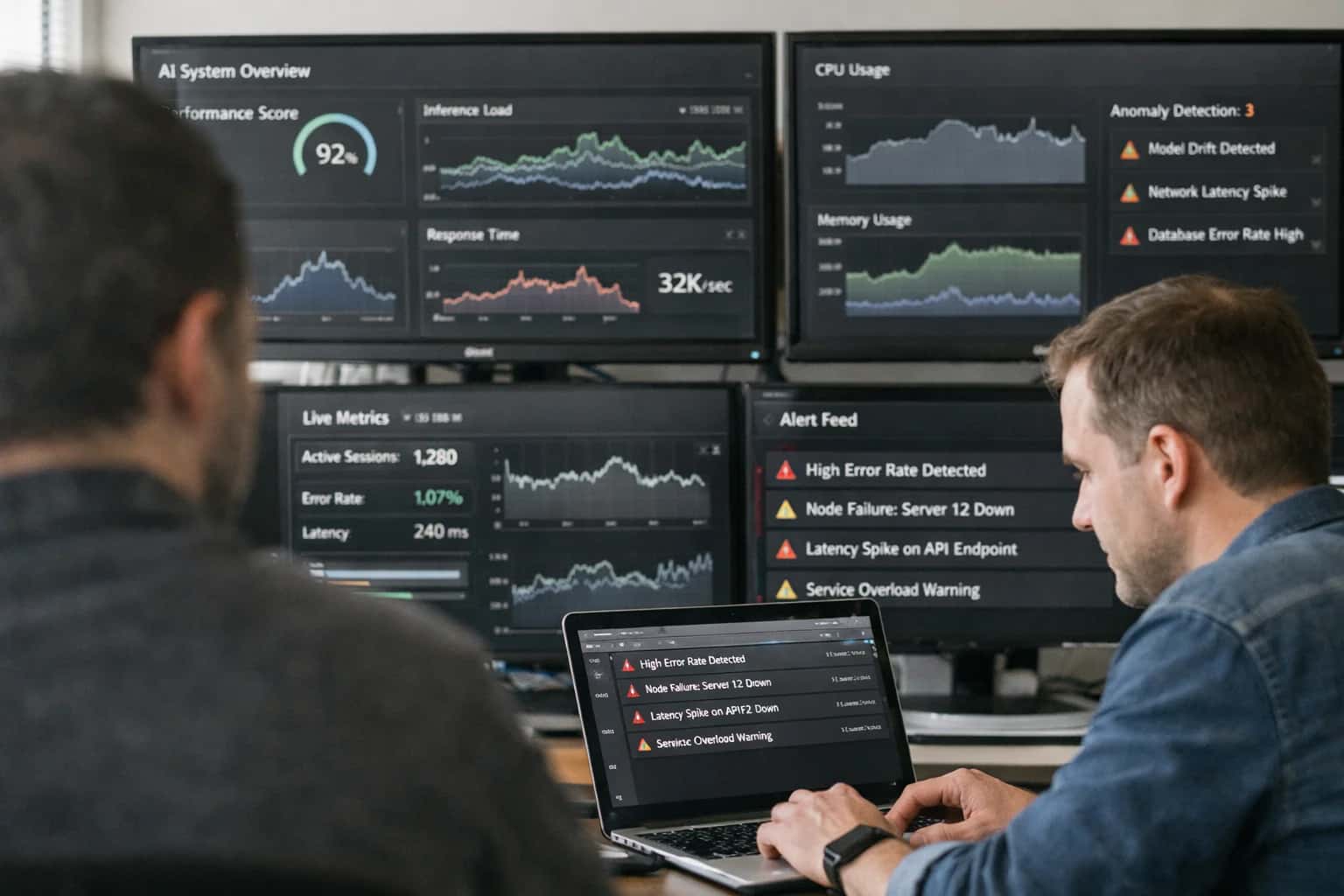
THE REALITY
Your Model is Already Broken
Production AI models degrade from the moment of deployment due to inevitable shifts in real-world data.
Accuracy is a vanity metric that fails to capture critical failures like data drift, concept drift, and prediction latency. Monitoring tools like Weights & Biases or Arize AI track these multi-dimensional signals, revealing that a model with 95% accuracy can still be making costly, business-critical errors.
The future of monitoring is multi-dimensional, requiring simultaneous tracking of data distributions, inference costs, and business KPIs. A model's latency on AWS SageMaker or cost-per-query on Azure OpenAI directly impacts ROI as much as its F1 score.
Evidence: Unchecked model drift in a recommendation system can silently reduce click-through rates by over 20% within months, directly eroding revenue. Proactive monitoring and a robust model lifecycle management strategy are the only defenses against this inevitable decay.
BEYOND ACCURACY
The Five Pillars of Multi-Dimensional Monitoring
Modern model monitoring must track data drift, concept drift, latency, cost, and business KPIs simultaneously to prevent silent failures.
01
The Problem: Your Model is Right but Your Business is Wrong
High accuracy masks failure. A model can be 99% accurate on stale validation data while its predictions actively harm key business outcomes like customer lifetime value (LTV) or conversion rates.
- Key Benefit 1: Correlate model outputs directly with business KPIs (e.g., churn rate, average order value) to detect value erosion.
- Key Benefit 2: Move from technical metrics to a business performance dashboard, enabling C-suite visibility into AI ROI.
~30%
Revenue Impact
Real-Time
KPI Alignment
02
The Solution: Unified Observability Across the AI Stack
Siloed tools for data, model, and infra monitoring create blind spots. You need a single pane of glass integrating metrics from data pipelines, inference endpoints, and cloud cost dashboards.
- Key Benefit 1: Trace a latency spike (~500ms) back to a specific feature drift or infrastructure autoscaling failure.
- Key Benefit 2: Implement cost attribution per model version, turning AI spend from an overhead into a managed variable.
70%
Faster Root Cause
-40%
Waste Reduction
03
The Problem: Silent Drift Erodes Trust
Concept drift and data drift are inevitable. Without proactive detection, model performance decays silently, leading to inaccurate credit decisions, flawed inventory forecasts, and broken customer experiences.
- Key Benefit 1: Deploy statistical tests (e.g., PSI, KS) to automatically flag distribution shifts in input data and prediction targets.
- Key Benefit 2: Establish automated alerts that trigger retraining pipelines or rollbacks before SLA breaches occur.
10x
Earlier Detection
-50%
Incident Volume
04
The Solution: Proactive Drift Detection with Automated Remediation
Monitoring must be closed-loop. Detecting drift is useless without a predefined action. Integrate with MLOps platforms like Weights & Biases or MLflow to automate the response.
- Key Benefit 1: Automatically trigger shadow mode testing of a new model candidate when drift thresholds are exceeded.
- Key Benefit 2: Enforce model versioning and lineage tracking to ensure auditable, reproducible rollbacks and promotions.
80%
Auto-Remediated
Hours
MTTR
05
The Problem: The Black Box is a Compliance Liability
Regulations like the EU AI Act demand explainability and audit trails. Without monitoring model decisions and data lineage, you cannot demonstrate compliance or debug biased outcomes.
- Key Benefit 1: Generate explainability reports (SHAP, LIME) for high-stakes predictions to satisfy regulatory auditors.
- Key Benefit 2: Maintain a complete lineage from training data to inference output, creating a defensible position for model governance.
100%
Audit Ready
-90%
Manual Effort
06
The Solution: Explainability as a Core Monitoring Dimension
Bake explainability metrics directly into your monitoring suite. Track shifts in feature importance and prediction confidence distributions alongside accuracy and latency.
- Key Benefit 1: Detect adversarial attacks or bias amplification by monitoring for anomalous explainability patterns.
- Key Benefit 2: Empower product and compliance teams with self-service dashboards showing why a model made a decision, bridging the gap between AI developers and business stakeholders.
Real-Time
Bias Detection
Integrated
AI TRiSM
THE MULTI-DIMENSIONAL LENS
Monitoring Metrics by Model Type
A feature and metric comparison of monitoring requirements across different AI model architectures, moving beyond simple accuracy to track drift, performance, and business impact.
| Core Monitoring Dimension | Traditional ML (e.g., XGBoost) | Deep Learning (e.g., CNN/RNN) | Large Language Model (LLM) |
|---|---|---|---|
Primary Drift Signal | Data/Feature Drift (PSI < 0.1) | Latent Space Drift | Semantic/Embedding Drift |
Key Performance Metric | F1 Score / AUC-ROC | Per-Class Precision/Recall | RAGAS Score / Faithfulness |
Critical Latency Threshold | < 100 ms | < 500 ms | < 2 sec (for 1k tokens) |
Cost-Per-Inference Focus | Compute (vCPU-seconds) | GPU Memory (GB-hours) | Token Count & Context Window |
Explainability Requirement | Feature Importance (SHAP) | Activation Maps / Grad-CAM | Attribution Scores (e.g., LIME for LLMs) |
Retraining Trigger | PSI > 0.25 | Validation Loss Increase > 10% | Retrieval Relevance Drop > 15% |
Business KPI Linkage | Direct (e.g., Conversion Rate) | Indirect (e.g., Defect Reduction) | Composite (e.g., Support Ticket Resolution) |
Hallucination Detection | Not Applicable | Not Applicable | Required (Contradiction, Fabrication) |
THE BUSINESS IMPACT
Connecting Model Drift to Business KPIs
Model drift directly erodes core business metrics like revenue and customer retention, making technical monitoring a financial imperative.
Model drift is a revenue leak. A 5% drop in prediction accuracy for a recommendation engine translates directly into a measurable decline in average order value and conversion rate. Monitoring must connect technical metrics like data drift to financial KPIs.
Accuracy is a vanity metric. A model can maintain high accuracy scores while its predictions become commercially useless due to concept drift. The real signal is in downstream metrics like customer churn or support ticket volume, which tools like Arize or WhyLabs track.
Latency and cost are business variables. A 100ms increase in inference latency can crater user engagement, while uncontrolled cloud costs from inefficient models destroy ROI. Platforms like Databricks Lakehouse AI unify performance and cost monitoring.
Evidence: A retail client saw a 12% monthly revenue decline traced to silent feature drift in their pricing model. Implementing a multi-dimensional monitor with Fiddler AI restored accuracy and identified a new high-value customer segment. For a deeper framework, see our guide on Model Lifecycle Management.
The control plane is the connector. A centralized MLOps control plane does not just track model versions; it maps prediction errors to SLA breaches and P&L impact. This turns model monitoring from an engineering task into a board-level business intelligence function.
BEYOND ACCURACY
The Silent Killers of Single-Dimensional Monitoring
Monitoring only for prediction accuracy is a recipe for silent failure. Real-world degradation happens across multiple, interdependent dimensions.
01
The Problem: Latency Creep
A model can be 99% accurate but useless if inference time balloons from ~100ms to 2+ seconds. This kills user experience and erodes trust.\n- Silent Impact: Degradation is gradual, often missed by accuracy-only dashboards.\n- Cascading Cost: Slower inference increases cloud compute costs and reduces system throughput.
20x
Slower Response
+300%
Compute Cost
02
The Problem: Concept Drift
The real-world meaning of your data changes. A fraud detection model trained on 2022 transaction patterns is blind to 2026 attack vectors.\n- Business Impact: Model makes correct but irrelevant predictions, missing new fraud patterns.\n- Detection Gap: Requires monitoring feature distributions and prediction confidence scores, not just labels.
-40%
Recall
$10M+
Exposure Risk
03
The Problem: Data Pipeline Poisoning
Upstream ETL jobs fail silently. Missing values are filled with zeros, or a sensor calibration drifts, corrupting your feature space.\n- Root Cause Obfuscation: The model is blamed, but the failure is in the data foundation.\n- Requires Lineage: Multi-dimensional monitoring must trace issues back to source systems and data contracts.
50%
Invalid Features
48hrs
Mean Time to Detect
04
The Solution: Multi-Dimensional Observability
Deploy a unified dashboard tracking accuracy, latency, data drift, cost, and business KPIs in real-time. Tools like Weights & Biases or Arize AI provide this lens.\n- Proactive Alerts: Set thresholds on cost-per-inference and P95 latency.\n- Causal Linking: Correlate model performance drops with specific data pipeline events.
90%
Faster Root Cause
-60%
Outage Time
05
The Solution: Automated Feedback Loops
Integrate monitoring directly with retraining pipelines. When concept drift exceeds a threshold, automatically trigger model retraining with fresh data.\n- Closed-Loop MLOps: This creates a self-healing production system.\n- Lifecycle Velocity: Reduces the model iteration cycle from weeks to hours, a core competitive advantage.
10x
Iteration Speed
Auto
Retraining Trigger
06
The Solution: Business KPI Instrumentation
Stop measuring the model; measure its impact. Instrument your monitoring to track downstream metrics like conversion rate, cart abandonment, or customer churn.\n- Truth Source: This aligns AI performance with board-level revenue goals.\n- Explains 'Why': A drop in a business KPI, with stable accuracy, signals a need for model recalibration or a new objective.
Direct
ROI Link
+15%
Uplift Captured
THE EVOLUTION
From Monitoring to Autonomous Remediation
The next phase of model monitoring is a closed-loop system that automatically diagnoses and fixes performance issues without human intervention.
Autonomous remediation is the logical endpoint of multi-dimensional monitoring. When a system like Arize or WhyLabs detects a performance anomaly—be it data drift, concept drift, or a spike in inference cost—the next step is not a Jira ticket, but an automated workflow. This workflow diagnoses the root cause using the observability data already being collected and triggers a predefined corrective action, such as rolling back a model version, switching traffic to a more stable model variant, or initiating a retraining pipeline. This transforms MLOps from a reactive to a proactive discipline, directly addressing the core challenge of model decay in production.
The control plane becomes the remediation engine. Modern platforms like Weights & Biases or Domino Data Lab are evolving beyond experiment tracking to become orchestration hubs. They integrate monitoring signals with CI/CD pipelines and Kubernetes-native model servers like KServe or Seldon Core. This integration enables policy-based automation: if prediction latency exceeds a service-level objective (SLO), the system can automatically scale up inference replicas; if business KPIs like conversion rate drop, it can trigger an A/B test with a new model candidate. This is the essence of a governance-first MLOps approach.
Evidence shows automation reduces mean-time-to-repair (MTTR) by over 80%. A financial services firm using Databricks Lakehouse AI and MLflow reported that automating the retraining pipeline for a credit scoring model—triggered by monitored concept drift—cut the remediation cycle from days to hours. This velocity is the new competitive moat, turning model lifecycle management from a cost center into a reliability and agility engine.
THE FUTURE OF MODEL MONITORING
Key Takeaways
Modern AI systems require a monitoring stack that tracks more than just prediction accuracy to ensure reliability and business impact.
01
The Problem: Silent Revenue Erosion from Model Drift
Unchecked data drift and concept drift degrade prediction quality, directly impacting KPIs like conversion and retention. Monitoring only accuracy misses the root cause.
- Key Benefit: Pinpoint whether performance drops are due to changing input data or evolving user behavior.
- Key Benefit: Trigger automated retraining pipelines before business metrics are affected, preventing silent revenue loss.
-15%
Accuracy Drop
$10M+
Revenue Risk
02
The Solution: Unified Observability Across Five Dimensions
Effective monitoring must simultaneously track data quality, model performance, system health, business KPIs, and cost efficiency. This multi-dimensional view is non-negotiable.
- Key Benefit: Correlate infrastructure latency spikes with drops in user engagement scores.
- Key Benefit: Optimize inference economics by identifying underperforming, costly models for retirement or optimization.
5x
Faster Root Cause
-40%
Waste Reduced
03
The Imperative: Proactive Governance, Not Reactive Firefighting
A Model Control Plane with integrated monitoring shifts the paradigm from fixing failures to preventing them. This is the core of mature MLOps.
- Key Benefit: Enforce access controls and audit trails for model queries, turning monitoring into a security layer.
- Key Benefit: Automate governance workflows for continuous retraining and shadow mode deployments, de-risking updates.
90%
Fewer Incidents
2x
Deployment Velocity
04
The Architecture: Integrated Feedback Loops for Autonomous Iteration
The future of reliable AI is closed-loop systems. Monitoring must feed directly into retraining pipelines and human-in-the-loop validation gates.
- Key Benefit: Create a self-healing AI lifecycle where performance degradation automatically triggers investigation and remediation.
- Key Benefit: Build a reproducible model lineage, linking every prediction to its training data and hyperparameters for auditability under frameworks like the EU AI Act.
24/7
Iteration
100%
Audit Trail
05
The Metric: Lifecycle Velocity as the True ROI
The speed of your model iteration loop—from monitoring alert to validated redeployment—becomes the ultimate competitive metric. This is MLOps as a competitive moat.
- Key Benefit: Reduce mean time to repair (MTTR) for model issues from weeks to hours.
- Key Benefit: Accelerate A/B testing and canary releases, allowing safer, faster innovation based on real-world performance data.
10x
Faster Iteration
+30%
ROI Uplift
06
The Foundation: A 'Model-First' Observability Stack
Bolt-on monitoring tools fail. Infrastructure must be designed from the ground up to serve, observe, and iterate models. This requires tools like Weights & Biases and purpose-built ML pipelines.
- Key Benefit: Gain deep visibility into model internals (e.g., feature attribution, confidence scores) not just black-box outputs.
- Key Benefit: Eliminate single points of failure by monitoring the entire pipeline—data ingestion, preprocessing, inference, and business impact—as one integrated system.
-99%
Pipeline Downtime
360°
Visibility
Enabling Efficiency, Speed & Accuracy
Intelligent Analysis, Decision & Execution
We build AI systems for teams that need search across company data, workflow automation across tools, or AI features inside products and internal software.
Talk to Us
Search across company data
Give teams answers from docs, tickets, runbooks, and product data with sources and permissions.
Useful when people spend too long searching or get different answers from different systems.
Enterprise searchRAGPermissions
Read more
Automate internal workflows
Use AI to route work, draft outputs, trigger actions, and keep approvals and logs in place.
Useful when repetitive work moves across multiple tools and teams.
AI agentsWorkflow automationGovernance
Read more
Add AI to products and internal tools
Build assistants, guided actions, or decision support into the software your team or customers already use.
Useful when AI needs to be part of the product, not a separate tool.
AI integrationDecision supportModel routing
Read moreTHE DATA
Audit Your Monitoring Stack Today
A single-metric monitoring stack is obsolete; modern AI requires tracking data drift, concept drift, latency, cost, and business KPIs simultaneously.
Accuracy is a lagging indicator. A model can maintain high accuracy while its underlying data distribution shifts, a phenomenon known as data drift. By the time accuracy drops, business impact has already occurred.
Your stack needs multi-dimensional observability. Tools like Weights & Biases or Aporia track model performance across vectors like prediction latency, infrastructure cost, and input feature distributions. This moves monitoring from reactive to proactive.
Concept drift is more dangerous than data drift. The statistical relationship between your inputs and the target variable changes. A credit scoring model trained pre-recession will fail post-recession, even with identical data formats. This requires business KPI correlation.
Evidence: RAG systems using vector databases like Pinecone or Weaviate require monitoring for retrieval relevance decay, not just answer quality. A 20% drop in top-5 retrieval hit rate directly increases hallucination risk before final output metrics shift.
Integrate monitoring with your MLOps control plane. Effective Model Lifecycle Management requires automated triggers. A spike in prediction uncertainty should initiate a shadow mode deployment for validation, not just send an alert.

About the author
Prasad Kumkar
CEO & MD, Inference Systems
Prasad Kumkar is the CEO & MD of Inference Systems and writes about AI systems architecture, LLM infrastructure, model serving, evaluation, and production deployment. Over 5+ years, he has worked across computer vision models, L5 autonomous vehicle systems, and LLM research, with a focus on taking complex AI ideas into real-world engineering systems.
His work and writing cover AI systems, large language models, AI agents, multimodal systems, autonomous systems, inference optimization, RAG, evaluation, and production AI engineering.
LinkedIn
Limited slotsGet a Free AI Consultation
Partnered with leading AI, data, and software stack.





How We Work
Custom AI workflows for your Business
One-fit-all AI don't work for modern businesses. At Inferensys, we aim to understand your business & custom requirements; which we use to define most efficient agentic workflows, the data, and the tools for your business.
01
Review the use case
We understand the task, the users, and where AI can actually help.
Read more02
Pick the right approach
We define what needs search, automation, or product integration.
Read more03
Build the first useful version
We implement the part that proves the value first.
Read more04
Improve from there
We add the checks and visibility needed to keep it useful.
Read moreThe first call is a practical review of your use case and the right next step.
Talk to Us