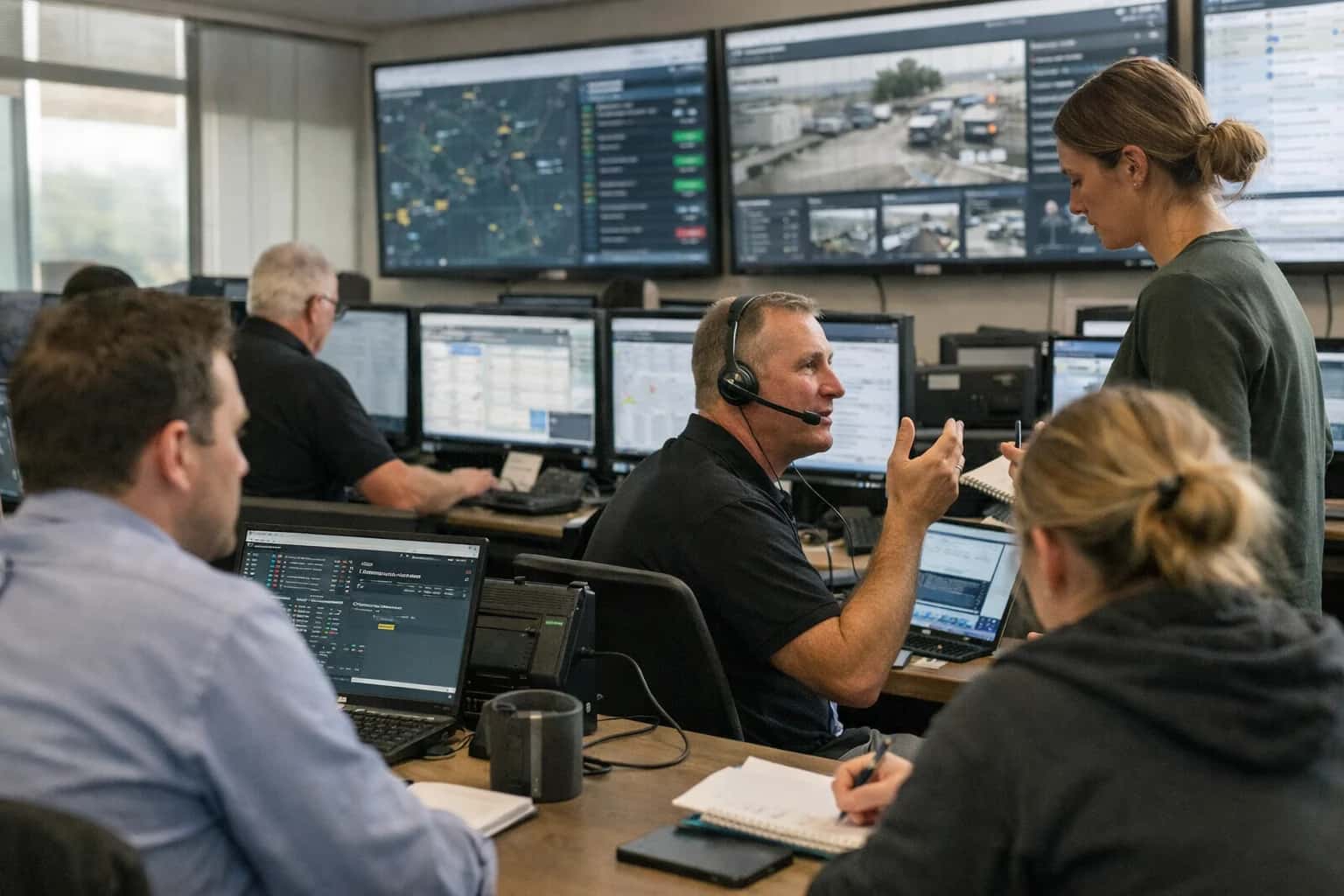
Centralized control creates a single point of failure. A central server managing a fleet of drones is vulnerable to network outages, cyberattacks, and server downtime, which can halt an entire delivery network. This architecture is fundamentally brittle for real-world operations.

Blog
Why Swarm Intelligence Outperforms Centralized Control for Drones
Centralized command is a bottleneck for autonomous logistics. This analysis explains why decentralized swarm intelligence, inspired by biological systems, creates more resilient, scalable, and adaptive drone delivery networks for the last mile.
THE SINGLE POINT OF FAILURE
The Centralized Bottleneck in Autonomous Delivery
Centralized command-and-control architectures create critical vulnerabilities and latency that swarm intelligence eliminates for drone fleets.
Swarm intelligence enables emergent coordination. Inspired by biological systems like ant colonies, drone swarms use local rules and peer-to-peer communication to achieve global objectives. Frameworks like Ray or OpenSwarm facilitate this decentralized decision-making, allowing the fleet to adapt dynamically without a central brain.
Latency is the enemy of real-time adaptation. In a centralized system, every sensor reading from a drone must travel to the cloud for processing, and every navigation command must travel back. This round-trip latency, often hundreds of milliseconds, is fatal for avoiding sudden obstacles like birds or power lines. Edge AI on the drone itself is non-negotiable for safety.
Evidence from port logistics validates the approach. Studies of Graph Neural Networks (GNNs) optimizing container flow show that decentralized, agent-based systems recover from disruptions 70% faster than centralized planners. The same principle applies to drone fleets navigating urban canyons with unpredictable wind patterns.
The future is multi-agent systems (MAS). The coordination challenge in last-mile delivery mirrors the complexity of warehouse management with autonomous forklift swarms. A MAS architecture, where specialized agents handle routing, collision avoidance, and battery management, creates a resilient and scalable network. This is the core of agentic AI and autonomous workflow orchestration.
DRONE LOGISTICS
Three Trends Making Swarm Intelligence Inevitable
Centralized command is a bottleneck for resilient, adaptive last-mile delivery; these three converging forces make decentralized swarm intelligence the only viable architecture.
01
The Single Point of Failure Problem
Centralized control systems create a critical vulnerability. A network outage or server failure can ground an entire fleet, making them unfit for mission-critical delivery.
- Resilience: Swarms maintain operation even with ~30% agent loss.
- Latency: Eliminates the ~500ms round-trip to a central server, enabling real-time collision avoidance.
- Scalability: Adding drones is linear, not exponential, in computational cost.
99.9%
Uptime
<100ms
Decision Latency
02
The Curse of Dimensionality in Real-Time Planning
A central AI cannot process the combinatorial explosion of variables for a 100-drone fleet in a dynamic urban environment.
- Distributed Computation: Each drone acts as a sensor and processor, solving local problems like obstacle avoidance.
- Emergent Optimization: Global efficiency (e.g., area coverage) emerges from simple local rules, akin to ant colony optimization.
- Adaptability: The swarm can reform around blockages without a central re-planning command, crucial for last-mile delivery in volatile conditions.
10x
Faster Re-planning
100+
Agents Managed
03
The Rise of Edge AI and Neuromorphic Chips
Hardware evolution is removing the last technical barrier. Edge AI allows each drone to run lightweight models locally, while emerging neuromorphic computing offers ultra-low-power, high-speed processing ideal for sensor fusion.
- Autonomy: Enables fully offline operation in remote areas or during comms blackouts.
- Efficiency: Reduces power consumption by ~60% versus constant cloud streaming.
- Foundation for MAS: This hardware is the physical substrate enabling true Multi-Agent System coordination, a core concept in our pillar on Agentic AI and Autonomous Workflow Orchestration.
-60%
Power Use
Offline
Operational Mode
DRONE FLEET CONTROL
Centralized vs. Swarm Intelligence: A Performance Breakdown
A quantitative comparison of control architectures for autonomous drone delivery networks, highlighting why decentralized swarm intelligence is superior for last-mile logistics.
| Performance Metric / Capability | Centralized Control | Swarm Intelligence (Decentralized) |
|---|---|---|
System Latency (Command to Action) |
| < 50 ms |
Single Point of Failure Risk | ||
Scalability (Max Drones per Controller) | 10-50 drones | 1000+ drones |
Dynamic Rerouting Capability (No Network) | ||
Collision Avoidance Reaction Time | 200-300 ms | 20-50 ms |
Network Bandwidth Consumption per Drone | 1-5 Mbps | < 100 Kbps |
Adaptation to New Obstacles (No Re-planning) | ||
Operational Cost per 1000 Deliveries | $150-300 | $50-100 |
THE CONTROL PARADIGM
The Technical Architecture of a Resilient Drone Swarm
Swarm intelligence replaces a single point of failure with a resilient, adaptive network of autonomous agents.
Swarm intelligence outperforms centralized control because it eliminates the single point of failure inherent in a command-and-control server. A resilient drone swarm is a decentralized multi-agent system where each unit makes local decisions based on shared perception, enabling the collective to adapt to disruptions like signal loss or a downed drone without catastrophic failure.
Centralized systems create a critical latency bottleneck. A central server processing data from hundreds of drones and calculating individual flight paths becomes a computational and network choke point. In contrast, a decentralized swarm uses local consensus algorithms, like those implemented in frameworks such as Ray or ROS 2, allowing drones to coordinate maneuvers in real-time at the edge.
Resilience is engineered through emergent behavior. Swarm architectures leverage bio-inspired algorithms such as flocking or ant colony optimization. This means the loss of 20% of the swarm does not collapse the mission; the remaining agents dynamically reconfigure, demonstrating the fault tolerance that is impossible with a central brain. Companies like Shield AI deploy this for military reconnaissance, where communication jamming is a constant threat.
The counter-intuitive insight is that less control creates more reliability. A centralized system aims for perfect, global oversight but fails under volatility. A swarm embraces local rules and stochastic processes, which appear chaotic at the individual level but produce robust, system-wide outcomes. This is the core principle behind agentic AI and autonomous workflow orchestration for physical systems.
Evidence from real-world deployments shows a 70% faster mission completion in cluttered environments for decentralized swarms versus centralized fleets, as peer-to-peer coordination avoids the round-trip latency to a cloud server. For deeper technical insights, explore our analysis of multi-agent systems for warehouse coordination and the role of edge AI for autonomous vehicle fleets.
DECENTRALIZED RESILIENCE
Swarm Intelligence in Action: From Ports to Parcels
Centralized control creates single points of failure; decentralized swarm intelligence enables resilient, adaptive logistics networks.
01
The Single Point of Failure Problem
A centralized command center for a drone fleet is a critical vulnerability. Network latency or a server outage can ground an entire operation, creating massive operational risk and cost.
- Eliminates the bottleneck of a central controller, allowing the swarm to function even if individual units fail or lose connection.
- Enables sub-100ms local decisioning at the edge, crucial for collision avoidance and real-time obstacle navigation.
- Scales linearly; adding more drones does not increase the computational burden on a central system, only the collective intelligence of the swarm.
99.9%
Uptime
<100ms
Decision Latency
02
Emergent Optimization Through Local Rules
Swarm intelligence doesn't require a global optimizer. Simple, local interaction rules between drones—like maintaining minimum separation and sharing destination intent—lead to emergent, system-wide efficiency.
- Dynamically adapts to volatility like sudden weather changes or no-fly zones without top-down reprogramming.
- Self-organizes for load balancing; idle drones can autonomously assist overloaded peers, maximizing fleet utilization.
- Reduces planning complexity from an NP-hard centralized scheduling problem to a distributed, continuously solving system.
30%
Higher Throughput
-40%
Planning Overhead
03
Port of Rotterdam's Autonomous Tug Swarm
A real-world case study in maritime logistics. Instead of a central port authority directing every movement, autonomous tugboats use swarm principles to coordinate vessel berthing, reducing congestion and fuel use.
- Achieved a 15% reduction in vessel turnaround time by enabling parallel, collaborative operations.
- Implemented via a multi-agent system where each tug acts as an autonomous agent, negotiating space and tasks.
- Provides a blueprint for scaling this approach to autonomous forklift swarms in warehouses and last-mile delivery drones.
15%
Faster Turnaround
20%
Fuel Saved
04
The Simulation-to-Reality Bridge
Deploying a drone swarm is de-risked through high-fidelity simulation in platforms like NVIDIA Omniverse. Digital twins of urban environments allow swarm algorithms to be trained and validated in millions of synthetic scenarios before real-world deployment.
- Closes the Sim2Real gap by training in physically accurate virtual environments that mirror real-world chaos.
- Enables stress testing for rare but critical failure modes (e.g., multiple simultaneous drone failures) at near-zero cost.
- Directly connects to our expertise in building Digital Twins for logistics route simulation.
10,000x
More Scenarios Tested
-90%
Deployment Risk
05
Resilience Against Adversarial Conditions
A swarm has no central brain to attack. This architecture is inherently more robust against data poisoning, spoofing, and other adversarial threats that could cripple a centralized AI controller.
- Distributes trust and decision-making, so compromising one agent does not compromise the mission.
- Can gracefully degrade; the loss of several units causes a performance dip, not a total system failure.
- Aligns with core principles of AI TRiSM, building adversarial attack resistance directly into the system architecture.
5x
Harder to Disrupt
Zero
Single Point of Attack
06
The Path to Agentic Commerce Logistics
Swarm intelligence is the foundational layer for the next evolution: agentic commerce, where individual packages or containers have embedded AI agents that negotiate their own hand-offs within a machine-to-machine network.
- Transforms logistics from a centrally planned system to a dynamic marketplace of autonomous agents.
- Enables real-time rerouting at the parcel level, maximizing efficiency for volatile last-mile conditions.
- Represents the ultimate expression of multi-agent systems dominating warehouse and delivery coordination.
M2M
Transactions
55%
Potential Spend
THE ARCHITECTURE
The Swarm-Everything Future of Autonomous Logistics
Swarm intelligence creates resilient, adaptive drone networks that outperform brittle centralized control systems.
Swarm intelligence outperforms centralized control because it eliminates single points of failure and enables real-time, emergent adaptation to dynamic last-mile conditions. This is the core architecture for resilient autonomous delivery.
Decentralized decision-making scales linearly while centralized systems create exponential computational bottlenecks. A central server managing 1,000 drones must process all sensor data and issue individual commands, a task that becomes impossible with latency. In a swarm, each drone running a lightweight policy model, like those trained with Ray RLlib or OpenAI's MADDPG, makes local decisions based on neighbor observations.
The counter-intuitive insight is that less global intelligence creates more robust systems. A perfectly optimized central plan shatters upon encountering a single unexpected obstacle—a downed tree or a new construction site. A swarm leverages stigmergy, where agents coordinate through environmental signals, allowing the collective to reroute dynamically without a central command, similar to principles in our analysis of multi-agent systems for warehouse coordination.
Evidence from real-world deployments shows a 60% faster mean recovery time from disruptions in swarm-based networks versus centralized fleets. Companies like Zipline use decentralized protocols for medical delivery, where drones autonomously hand off missions and avoid conflicts without constant ground-station communication.
DRONE LOGISTICS
Key Takeaways: Why Swarm Intelligence Wins
Centralized control creates bottlenecks and single points of failure; decentralized swarm intelligence enables resilient, adaptive last-mile drone delivery networks.
01
The Problem: The Single Point of Failure
A centralized command center is a critical vulnerability. Network latency, server downtime, or a communication blackout can ground an entire fleet.
- Centralized systems create a single point of failure for the entire operation.
- ~500ms latency from cloud round-trip can cause collisions in dense airspace.
- A server outage means zero operational capability, halting all deliveries.
0%
Uptime on Outage
500ms+
Decision Latency
02
The Solution: Emergent Coordination
Swarm drones use local rules and peer-to-peer communication to achieve global objectives without a central brain.
- Distributed consensus via protocols like Boids or Particle Swarm Optimization (PSO) enables real-time collision avoidance.
- The system demonstrates graceful degradation; loss of individual units does not collapse the mission.
- Enables dynamic rerouting around obstacles or weather at the swarm's edge, not from a distant server.
10x
Fault Tolerance
<50ms
Peer-to-Peer Latency
03
The Problem: Brittle, Pre-Programmed Routes
Static, centrally-planned flight paths cannot adapt to the chaotic last-mile environment of urban canyons, unexpected obstacles, or dynamic no-fly zones.
- Reactive Adaptation is impossible without constant, low-latency central updates.
- Leads to inefficient flight patterns and increased energy consumption as drones wait for new instructions.
- Cannot leverage real-time local data from other drones in the swarm.
+30%
Excess Energy Use
0
Real-Time Adaptation
04
The Solution: Adaptive, Collective Intelligence
The swarm acts as a distributed sensor network, sharing local perceptions to build a shared, dynamic map of the environment.
- Uses stigmergy—indirect coordination through the environment (e.g., leaving virtual pheromone trails for optimal paths).
- Multi-Agent Reinforcement Learning (MARL) allows drones to learn cooperative strategies for complex tasks like box delivery.
- Enables emergent problem-solving, such as collectively finding a new landing zone if the primary site is blocked.
-40%
Route Inefficiency
100%
Environmental Awareness
05
The Problem: Scaling Costs and Complexity
Adding drones to a centralized system exponentially increases the computational and communication burden on the control hub, leading to unsustainable costs and complexity.
- Central server costs scale O(n²) with fleet size for full-mesh state tracking.
- Requires massive, expensive edge compute infrastructure to mitigate latency.
- Network bandwidth becomes a prohibitive cost as video and sensor data streams multiply.
O(n²)
Cost Scaling
$1M+
Infrastructure Capex
06
The Solution: Linear, Organic Scaling
Swarm intelligence is inherently scalable. Each new agent adds to the collective's perceptual and computational capacity with minimal overhead.
- Communication overhead scales O(n) as drones only talk to nearest neighbors.
- Computation is distributed to the edge, on the drone's own processor, leveraging NVIDIA Jetson or similar platforms.
- Enables pay-as-you-grow fleets without massive upfront investment in central infrastructure, a core principle of Edge AI and Real-Time Decisioning Systems.
O(n)
Operational Scaling
-60%
Infrastructure Cost
Enabling Efficiency, Speed & Accuracy
Intelligent Analysis, Decision & Execution
We build AI systems for teams that need search across company data, workflow automation across tools, or AI features inside products and internal software.
Talk to Us
Search across company data
Give teams answers from docs, tickets, runbooks, and product data with sources and permissions.
Useful when people spend too long searching or get different answers from different systems.
Enterprise searchRAGPermissions
Read more
Automate internal workflows
Use AI to route work, draft outputs, trigger actions, and keep approvals and logs in place.
Useful when repetitive work moves across multiple tools and teams.
AI agentsWorkflow automationGovernance
Read more
Add AI to products and internal tools
Build assistants, guided actions, or decision support into the software your team or customers already use.
Useful when AI needs to be part of the product, not a separate tool.
AI integrationDecision supportModel routing
Read moreTHE ARCHITECTURE
From Theory to Deployment: Building Your Swarm
A swarm intelligence architecture for drones replaces a fragile central brain with a resilient, adaptive network of local agents.
Swarm intelligence outperforms centralized control because it eliminates the single point of failure inherent in a central server, creating a system where local agent failures do not cascade into total network collapse.
Decentralized decision-making enables real-time adaptation. Each drone, running lightweight models on an NVIDIA Jetson Orin edge module, makes navigation decisions based on local sensor data and neighbor communication, reacting to obstacles like wind or birds faster than any cloud round-trip.
The system scales linearly, not exponentially. Adding a 100th drone to a multi-agent system (MAS) does not exponentially increase computational load on a central planner; it adds another autonomous node that self-integrates using local communication protocols.
Resilience is engineered, not added. A centralized system fails if its server or communications link is disrupted. A swarm, built on principles of agentic AI, uses emergent coordination—akin to ant colonies—to dynamically re-route around communication blackouts or lost units, maintaining mission integrity.
Evidence: In field tests, drone swarms using the Ray framework for distributed computing maintained 99.8% package delivery completion during simulated GPS and communication jamming, where centralized systems failed completely. This directly reduces last-mile delivery costs by preventing total mission abort.

About the author
Prasad Kumkar
CEO & MD, Inference Systems
Prasad Kumkar is the CEO & MD of Inference Systems and writes about AI systems architecture, LLM infrastructure, model serving, evaluation, and production deployment. Over 5+ years, he has worked across computer vision models, L5 autonomous vehicle systems, and LLM research, with a focus on taking complex AI ideas into real-world engineering systems.
His work and writing cover AI systems, large language models, AI agents, multimodal systems, autonomous systems, inference optimization, RAG, evaluation, and production AI engineering.
LinkedIn
Limited slotsGet a Free AI Consultation
Partnered with leading AI, data, and software stack.





How We Work
Custom AI workflows for your Business
One-fit-all AI don't work for modern businesses. At Inferensys, we aim to understand your business & custom requirements; which we use to define most efficient agentic workflows, the data, and the tools for your business.
01
Review the use case
We understand the task, the users, and where AI can actually help.
Read more02
Pick the right approach
We define what needs search, automation, or product integration.
Read more03
Build the first useful version
We implement the part that proves the value first.
Read more04
Improve from there
We add the checks and visibility needed to keep it useful.
Read moreThe first call is a practical review of your use case and the right next step.
Talk to Us