A one-time audit is obsolete at deployment. Models trained on static, historical data operate in a dynamic world where user behavior, societal norms, and input data distributions shift, a phenomenon known as concept drift. A snapshot audit provides a false sense of security.

Blog
Why Auditing AI for Fairness is a Continuous Process
Treating AI fairness as a one-time pre-deployment audit is a critical failure. This post explains why fairness decays, how model drift and data shifts create new biases, and why continuous monitoring integrated into MLOps is the only defensible strategy for ethical, compliant AI.
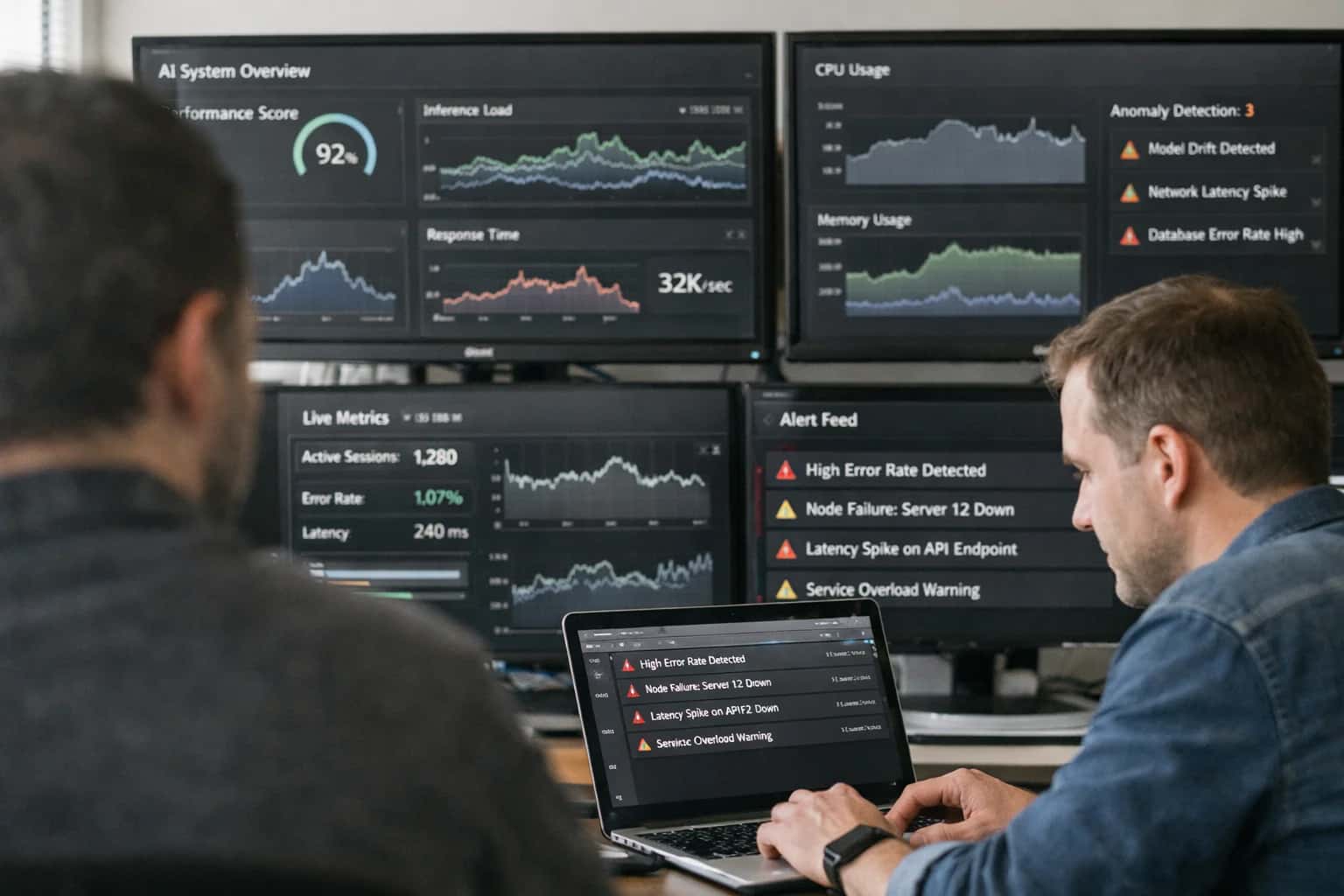
THE CONTINUOUS PROCESS
The Pre-Deployment Audit is a Dangerous Illusion
A single fairness audit before launch fails because models and data drift, making continuous monitoring the only viable strategy.
Fairness is a performance metric, not a feature. Like accuracy or latency, a model's fairness score decays over time. Continuous monitoring tools within an MLOps pipeline, such as Fiddler AI or Arize, track this drift by comparing production inference data against the original training set baselines.
Static audits ignore adversarial adaptation. Bad actors learn to exploit model weaknesses post-deployment. A pre-launch red-teaming exercise cannot anticipate novel attack vectors that emerge in live environments, requiring ongoing adversarial testing integrated into the development lifecycle.
Evidence: Model performance can degrade by 20% in months. Research from major cloud platforms shows that without active monitoring and retraining, model accuracy and fairness metrics deteriorate rapidly as real-world data diverges from the training corpus, invalidating any pre-deployment certification.
CONTINUOUS MONITORING
Key Takeaways: Why Fairness Isn't Static
Model fairness degrades in production due to data drift, shifting societal norms, and adversarial feedback loops; a one-time audit is a snapshot of a moving target.
01
The Problem: Concept Drift in Society
Societal definitions of fairness evolve faster than your model's training data. A hiring algorithm deemed fair in 2023 may be discriminatory by 2026 standards.
- Key Benefit 1: Continuous monitoring aligns AI outputs with current legal and ethical benchmarks.
- Key Benefit 2: Proactive adaptation prevents costly retroactive fixes and reputational crises.
~18-24 mo.
Fairness Decay Cycle
02
The Solution: Integrated MLOps for Fairness
Fairness metrics must be baked into the ModelOps pipeline alongside performance KPIs, enabling automated alerts and rollbacks.
- Key Benefit 1: Real-time detection of disparate impact across protected classes.
- Key Benefit 2: Automated governance gates prevent unfair models from being promoted to production.
-70%
Bias Remediation Time
03
The Problem: Feedback Loop Poisoning
Biased model outputs influence user behavior, which generates new, even more biased training data—a self-reinforcing cycle of discrimination.
- Key Benefit 1: Breaking the loop requires monitoring input data distributions for skew.
- Key Benefit 2: Isolating and correcting poisoned feedback preserves model integrity over the long term.
10x
Amplification Risk
04
The Solution: Dynamic Benchmarking & Red-Teaming
Static test sets are obsolete. Continuous fairness auditing requires dynamic adversarial benchmarks and scheduled red-team exercises.
- Key Benefit 1: Uncovers novel edge-case failures before they cause harm.
- Key Benefit 2: Creates an immutable audit trail for regulatory compliance and legal defensibility.
100%
Audit Coverage
05
The Problem: The Governance Paradox
Organizations plan for agentic AI but lack the mature governance models to oversee it, creating unchecked operational and ethical risk.
- Key Benefit 1: Integrating fairness into the AI TRiSM framework centralizes risk management.
- Key Benefit 2: Establishes clear accountability lines from data scientists to the C-suite.
$10M+
Potential Liability
06
The Solution: Context Engineering for Fairness
Fairness is contextual. Context Engineering defines the specific operational and ethical boundaries for each model deployment.
- Key Benefit 1: Moves fairness from abstract principle to concrete, measurable business rules.
- Key Benefit 2: Enables precise human-in-the-loop interventions where automated fairness checks are insufficient.
90%
Stakeholder Alignment
THE CONTINUOUS AUDIT
Why AI Fairness Inevitably Decays in Production
Model fairness is not a static property; it degrades in production due to data, concept, and population drift.
AI fairness decays because production models operate on dynamic, real-world data that inevitably diverges from the static training set. A single pre-deployment audit is a snapshot of a moving target.
Data drift and concept drift erode fairness metrics. The statistical properties of input data (data drift) and the relationships between inputs and outputs (concept drift) change, causing models to perform unequally across protected groups over time. Tools like Arize or Fiddler monitor this drift.
Population shifts and feedback loops introduce new biases. The user base evolves, and model predictions influence future training data, creating self-reinforcing loops of discrimination. This is a core challenge in MLOps and production lifecycle management.
Evidence: Research shows model performance can degrade by over 10% in fairness metrics within months of deployment without continuous monitoring. Integrating fairness checks into a CI/CD pipeline with tools like TensorFlow Model Analysis is non-negotiable. For a deeper dive on operationalizing this, see our guide on MLOps and the AI Production Lifecycle.
The solution is continuous auditing. Fairness must be treated as a Key Performance Indicator (KPI), tracked alongside accuracy and latency. This requires the same rigor applied to AI TRiSM: Trust, Risk, and Security Management.
CONTINUOUS MONITORING REQUIRED
The Three Drivers of AI Fairness Decay
Fairness is not a static property. This table compares the three primary mechanisms that cause AI model fairness to degrade over time, necessitating ongoing audits integrated into production MLOps pipelines.
| Decay Driver | Concept Drift | Data Drift | Feedback Loops |
|---|---|---|---|
Primary Cause | Changing real-world relationships between input variables and the target outcome. | Changing statistical properties of the input data distribution. | Model predictions directly influence the future data it receives. |
Typical Onset Timeline | 6-18 months post-deployment | 3-12 months post-deployment | Immediate and compounding |
Example in Credit Scoring | Relationship between 'zip code' and 'default risk' evolves due to economic shifts. | Demographic distribution of applicants changes from training set. | Model denies loans to a group, depriving them of credit history, reinforcing future denials. |
Detection Method | Monitoring for degradation in model performance metrics (e.g., AUC-ROC) on fresh data. | Monitoring for statistical divergence (e.g., PSI, KL Divergence) in input features. | Monitoring for prediction distribution skew and correlation with protected attributes over time. |
Mitigation Strategy | Periodic model retraining with updated data and labels. | Data pipeline monitoring and drift-aware retraining triggers. | Implementing fairness-aware reinforcement learning or randomized control groups. |
Link to AI TRiSM Pillar | ModelOps & Explainability | Data Anomaly Detection | Adversarial Attack Resistance & Explainability |
Audit Frequency Required | Quarterly performance review | Continuous statistical monitoring | Real-time bias dashboard with alerting |
THE PROCESS
Building a Continuous Fairness Auditing Pipeline
Fairness is not a static property; it requires continuous monitoring integrated into the MLOps lifecycle to detect and correct model drift.
Fairness is not static. A single pre-deployment audit is insufficient because model performance and fairness decay over time as real-world data shifts, a phenomenon known as concept drift. Continuous auditing is the only method to detect these changes before they cause harm.
Auditing is an MLOps function. Effective fairness monitoring requires integrating specialized tools like Aequitas or Fairlearn into your CI/CD pipeline. This moves fairness from a compliance checklist to a core engineering metric, tracked alongside standard performance KPIs like accuracy and latency.
Static metrics fail in production. A model deemed fair during training can become biased in deployment due to feedback loops or skewed sampling. Continuous auditing compares model outputs against demographic parity and equalized odds metrics on live inference data, not just historical test sets.
Evidence: Research from Google's Model Cards initiative shows that model behavior can diverge by over 30% for protected subgroups within six months of deployment without retraining. This decay necessitates the continuous monitoring frameworks discussed in our guide to AI TRiSM: Trust, Risk, and Security Management.
Automation is non-negotiable. Manual audits do not scale. A robust pipeline uses automated triggers in platforms like MLflow or Kubeflow to retrain or alert when fairness thresholds are breached. This operationalizes the principles outlined in our analysis of MLOps and the AI Production Lifecycle.
FAIRNESS IN PRODUCTION
The Regulatory Hammer: Continuous Auditing is Now Law
Model fairness decays post-deployment; a one-time audit is a compliance checkbox that fails to protect against real-world drift and legal liability.
01
The Problem: Static Audits Create False Security
A pre-launch fairness audit is a snapshot of a moving target. Real-world data shifts, user behavior evolves, and model performance degrades, rendering that initial certification obsolete in ~3-6 months. This creates a dangerous liability gap where your legally defensible 'fair' model is now generating biased, non-compliant outputs.
- Legal Exposure: A static audit report is weak evidence in court when a real-world discrimination claim arises.
- Performance Decay: Models experience concept drift and data drift, silently altering decision boundaries.
- Regulatory Failure: The EU AI Act and similar frameworks mandate ongoing monitoring, not one-off checks.
3-6 mo.
Audit Validity
High
Liability Risk
02
The Solution: Integrate Auditing into MLOps
Fairness metrics must be tracked as core KPIs within your ModelOps pipeline, alongside accuracy and latency. This requires automated, continuous monitoring tools that trigger alerts and retraining pipelines when bias thresholds are breached.
- Automated Monitoring: Deploy tools like Aequitas or Fairlearn to track disparity metrics in real-time.
- Trigger-Based Retraining: Automate model retraining or rollback when fairness KPIs degrade beyond a <5% disparity threshold.
- Audit Trail Integration: Every fairness check and model iteration is logged, creating an immutable lineage for regulators. Learn more about building this governance layer in our guide to AI TRiSM: Trust, Risk, and Security Management.
Real-Time
Monitoring
<5%
Disparity Threshold
03
The Enforcement: Algorithmic Impact Assessments (AIAs)
Regulators are institutionalizing continuous auditing through mandatory Algorithmic Impact Assessments. These are living documents, not static reports, requiring periodic updates that demonstrate ongoing fairness, explainability, and risk mitigation.
- Dynamic Documentation: The AIA must be updated with each significant model change or retraining cycle.
- Stakeholder Transparency: Findings must be communicated to affected user groups and oversight bodies.
- Remediation Proof: You must document not just the discovery of bias, but the steps taken to correct it. This process is foundational to a Responsible AI Framework.
Mandatory
For High-Risk AI
Continuous
Updates Required
04
The Architecture: Explainability as an API
To enable continuous auditing, you need to architect for explainability by design. This means deploying model explanation services (e.g., SHAP, LIME) as scalable APIs that can be called on-demand to audit individual decisions or aggregate patterns.
- On-Demand Audits: Any decision can be explained and justified post-hoc for internal review or regulatory inquiry.
- Aggregate Trend Analysis: Explanation data is aggregated to identify emerging bias patterns across user segments.
- Performance Cost: High-fidelity explanation generation adds ~100-300ms of inference latency, a necessary trade-off for high-stakes applications. This is a core component of building Explainable AI for Enterprise.
100-300ms
Latency Add
API-First
Design
05
The Liability: Your Decision Log is Your Defense
In a dispute, your primary legal evidence is the immutable audit trail—the decision log. This log must capture the input data, model version, explanation, fairness score, and contextual metadata for every significant inference.
- Immutable Ledger: Logs must be tamper-proof and time-stamped, potentially using blockchain-like hashing for integrity.
- Context is Key: Logging must include the business rule or human override that accompanied the AI decision.
- Storage Overhead: Maintaining comprehensive logs can increase data storage needs by 20-40%, a critical infrastructure consideration. Understand the full importance in our analysis of AI Audit Trails.
20-40%
Storage Increase
Legal Asset
Primary Defense
06
The Bottom Line: Fairness as a Running Cost
Continuous auditing transforms fairness from a project cost into an operational line item. Budget for the ongoing compute, storage, and specialized personnel (e.g., Ethics Ops Engineers) required to maintain compliance.
- OPEX, Not CAPEX: Allocate budget for continuous monitoring tools, explanation APIs, and log management.
- Specialized Roles: Hire or train for roles like Fairness Auditor and Model Risk Manager.
- Competitive Advantage: Robust, auditable AI systems build stakeholder trust and mitigate existential regulatory risk. This strategic imperative is detailed in our pillar on Intellectual Property and AI Ethics Policy.
OPEX
Budget Model
Critical
Trust Factor
THE CONTINUOUS FEEDBACK LOOP
Operational Blueprint: From Theory to MLOps Reality
Fairness auditing is a continuous MLOps process, not a one-time pre-deployment check, due to dynamic data and model drift.
Fairness auditing is a continuous MLOps process. A single pre-deployment audit is a snapshot that becomes obsolete as real-world data evolves, user behavior shifts, and the model itself drifts. Continuous integration into the production pipeline is the only effective defense against fairness decay.
Model performance and fairness metrics drift independently. Accuracy can remain high while fairness degrades catastrophically for protected subgroups. Tools like Aequitas or Fairlearn must monitor for this divergence in real-time, triggering alerts when bias thresholds are breached, a core tenet of AI TRiSM.
Static audits create a false sense of security. They treat bias as a static software bug to be patched, not a systemic, emergent property of a live system interacting with a dynamic world. This mindset guarantees compliance failures and reputational damage.
Evidence: Deployed models can exhibit a 15-20% increase in disparate impact across demographic groups within six months without continuous monitoring, as training data skew fails to match evolving production data distributions.
FREQUENTLY ASKED QUESTIONS
Continuous AI Fairness Auditing: FAQ
Common questions about why auditing AI for fairness is a continuous process, not a one-time check.
AI fairness is continuous because models and the world they operate in constantly change. A single pre-deployment audit is a snapshot; it cannot account for model drift, shifting user demographics, or evolving societal norms. Continuous monitoring via MLOps pipelines with tools like Fiddler AI or Arthur AI is essential to detect and correct bias as it emerges.
Enabling Efficiency, Speed & Accuracy
Intelligent Analysis, Decision & Execution
We build AI systems for teams that need search across company data, workflow automation across tools, or AI features inside products and internal software.
Talk to Us
Search across company data
Give teams answers from docs, tickets, runbooks, and product data with sources and permissions.
Useful when people spend too long searching or get different answers from different systems.
Enterprise searchRAGPermissions
Read more
Automate internal workflows
Use AI to route work, draft outputs, trigger actions, and keep approvals and logs in place.
Useful when repetitive work moves across multiple tools and teams.
AI agentsWorkflow automationGovernance
Read more
Add AI to products and internal tools
Build assistants, guided actions, or decision support into the software your team or customers already use.
Useful when AI needs to be part of the product, not a separate tool.
AI integrationDecision supportModel routing
Read moreTHE SHIFT
Stop Auditing, Start Monitoring
Fairness in AI is a dynamic property that decays over time, requiring continuous monitoring, not a one-time audit.
AI fairness is not static. A single pre-deployment audit is a snapshot of a model's behavior on a static dataset, but real-world data and societal contexts evolve continuously, causing model performance and fairness to decay.
Auditing is retrospective, monitoring is proactive. An audit is a point-in-time check; integrated monitoring with tools like Fiddler AI or Arthur AI provides real-time detection of model drift and bias emergence as new data flows in.
Continuous monitoring integrates with MLOps. This process embeds fairness metrics into the production pipeline, using frameworks like TensorFlow Data Validation (TFDV) and MLflow to track metrics alongside performance, turning ethics into an engineering discipline. For more on operationalizing this, see our guide on MLOps and the AI Production Lifecycle.
Evidence: Performance decay is measurable. Research shows that without monitoring, model accuracy can drop by 20% within months as data distributions shift, and hidden biases can amplify, leading to regulatory action and reputational damage. This is a core component of a mature AI TRiSM: Trust, Risk, and Security Management framework.

About the author
Prasad Kumkar
CEO & MD, Inference Systems
Prasad Kumkar is the CEO & MD of Inference Systems and writes about AI systems architecture, LLM infrastructure, model serving, evaluation, and production deployment. Over 5+ years, he has worked across computer vision models, L5 autonomous vehicle systems, and LLM research, with a focus on taking complex AI ideas into real-world engineering systems.
His work and writing cover AI systems, large language models, AI agents, multimodal systems, autonomous systems, inference optimization, RAG, evaluation, and production AI engineering.
LinkedIn
Limited slotsGet a Free AI Consultation
Partnered with leading AI, data, and software stack.





How We Work
Custom AI workflows for your Business
One-fit-all AI don't work for modern businesses. At Inferensys, we aim to understand your business & custom requirements; which we use to define most efficient agentic workflows, the data, and the tools for your business.
01
Review the use case
We understand the task, the users, and where AI can actually help.
Read more02
Pick the right approach
We define what needs search, automation, or product integration.
Read more03
Build the first useful version
We implement the part that proves the value first.
Read more04
Improve from there
We add the checks and visibility needed to keep it useful.
Read moreThe first call is a practical review of your use case and the right next step.
Talk to Us