AI-powered digital twins replace reactive grid management with predictive, autonomous control, enabling real-time balancing of load and renewable integration. This is the core value of an AI-optimized digital twin of your entire grid.

Blog
The Future of Energy Efficiency Is an AI-Optimized Digital Twin of Your Entire Grid
Grid-scale digital twins powered by reinforcement learning are moving beyond visualization to become autonomous control systems that dynamically balance load, integrate renewables, and prevent cascading failures in real-time.
THE SHIFT
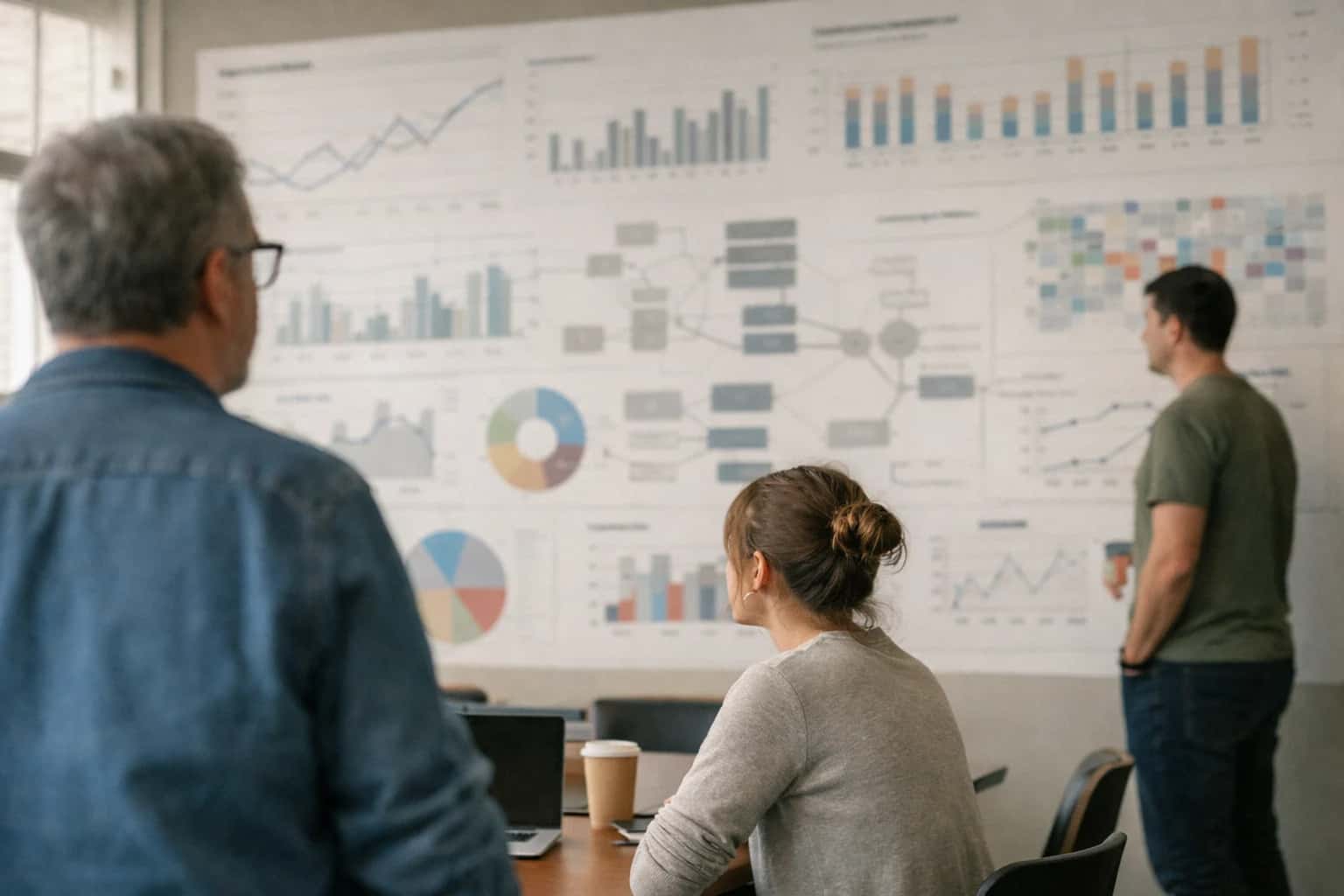
The Grid Is a Reactive Beast. AI Twins Make It Predictive.
Grid-scale digital twins transform energy management from reactive monitoring to predictive, autonomous optimization.
Legacy SCADA systems are blind. They monitor voltage and frequency, but they cannot forecast a cascading failure triggered by a sudden cloud cover over a solar farm. A physics-informed digital twin, built on platforms like NVIDIA Omniverse, simulates these complex interactions before they cause physical damage.
Predictive control requires reinforcement learning. Unlike static models, RL agents within the twin continuously learn optimal policies—like discharging a battery fleet or curtailing non-critical load—through millions of simulated scenarios. This creates a self-optimizing grid nervous system.
Evidence: Pacific Northwest National Laboratory demonstrated a digital twin that reduced distribution losses by 15% using real-time topology optimization. The system ingested data from PMUs and IoT sensors to model and adjust the grid state every few seconds.
THE INFRASTRUCTURE IMPERATIVE
Three Market Forces Demanding Grid-Scale AI Twins
The transition to a decentralized, renewable-powered grid is exposing the fatal limitations of legacy SCADA systems and human-centric operations.
01
The Renewable Volatility Problem
Legacy grid control cannot manage the second-by-second intermittency of solar and wind. Without AI-driven prediction and compensation, grid inertia collapses, causing frequency instability and blackouts.
- Key Benefit: AI twins forecast renewable output with >95% accuracy 36 hours ahead, enabling proactive balancing.
- Key Benefit: Reinforcement learning agents dynamically adjust grid-forming inverters and battery storage to maintain stability.
>95%
Forecast Accuracy
<500ms
Response Time
02
The Electrification Tsunami
Mass adoption of EVs and heat pumps is creating unprecedented, non-linear demand spikes that overwhelm traditional load forecasting and transformer capacity.
- Key Benefit: Digital twins simulate hyper-localized demand surges at the transformer level, preventing $1M+ asset failures.
- Key Benefit: AI orchestrates vehicle-to-grid (V2G) fleets as a distributed virtual power plant, adding gigawatts of flexible capacity.
300%
Peak Load Increase
10 GW
V2G Capacity
03
The Physical Security Threat
Geopolitical instability and climate change make physical grid assets targets. Manual response to substation attacks or wildfire threats is too slow.
- Key Benefit: AI twins run millions of 'what-if' failure scenarios using NVIDIA Omniverse, identifying single points of failure before they are exploited.
- Key Benefit: Autonomous agents execute pre-programmed islanding and rerouting in seconds, containing damage and preventing cascading failures.
70%
Faster Containment
-$10B
Economic Risk
THE ARCHITECTURE
Anatomy of an Autonomous Grid: The AI Twin Stack
An autonomous energy grid is powered by a layered AI stack that ingests real-time data, simulates physics, and executes reinforcement learning policies.
The AI twin stack transforms a static model into an autonomous control system. This layered architecture ingests real-time sensor data, runs high-fidelity simulations, and executes AI-driven control policies to balance load and integrate renewables.
The foundational layer is a physically accurate simulation engine. Platforms like NVIDIA Omniverse and the OpenUSD framework provide the deterministic physics backbone required to model grid behavior, from thermal dynamics in transformers to power flow across transmission lines. Without this, AI predictions are invalid.
The intelligence core uses reinforcement learning for continuous optimization. Unlike static optimization, reinforcement learning (RL) agents within the twin discover optimal control policies through millions of simulated trial-and-error episodes, learning to balance conflicting objectives like cost, stability, and carbon intensity.
Real-time synchronization closes the simulation gap. The stack requires a high-fidelity data pipeline from IoT sensors and SCADA systems to the digital twin. Latency or drift creates a 'simulation gap' that renders AI decisions risky, a core challenge addressed in our analysis of real-time data synchronization.
Multi-agent systems orchestrate decentralized control. A single AI model cannot manage a complex grid. The stack employs a multi-agent system (MAS) where specialized agents for generation, storage, and distribution negotiate and collaborate within the twin to achieve system-wide resilience, a concept explored in our pillar on Agentic AI.
Evidence: Grid operators using this stack report a 15-30% improvement in renewable energy utilization. By simulating thousands of 'what-if' scenarios per second, the AI preemptively adjusts to cloud cover or wind shifts, preventing instability and reducing reliance on fossil-fuel peaker plants.
GRID-SCALE DIGITAL TWIN BENCHMARKS
Simulation vs. Reality: The AI Twin Performance Gap
This table compares the performance characteristics of a high-fidelity AI-optimized digital twin against traditional grid management systems and basic simulation models.
| Performance Metric | Traditional SCADA/EMS | Basic Simulation Model | AI-Optimized Digital Twin |
|---|---|---|---|
Real-time Data Synchronization Latency | 2-5 seconds | N/A (Batch) | < 100 milliseconds |
Renewable Integration Forecast Accuracy (24h) | 82-88% | 85-90% | 94-97% |
Cascading Failure Prediction Lead Time | 0-30 seconds | N/A | 8-15 minutes |
Dynamic Load Balancing Decision Frequency | Every 5-15 minutes | N/A | Sub-second continuous |
Physics-Based Simulation Fidelity (OpenUSD/NVIDIA Omniverse) | Partial (Simplified) | ||
Reinforcement Learning (RL) Policy Optimization | |||
Multi-Agent System (MAS) Coordination for Grid Assets | |||
Explainable AI (XAI) for Operator Audit Trails | Limited |
GRID DIGITAL TWINS
Why Most Grid Digital Twin Projects Fail: The Four Fatal Flaws
Building a digital twin of an energy grid is a monumental AI and data challenge; most projects collapse under common, avoidable architectural failures.
01
The Problem: The Static Model Mirage
Most grid twins are built as high-fidelity but static 3D models, disconnected from real-time operational data. This creates a simulation gap where AI predictions are based on stale or synthetic data, rendering them useless for dynamic grid balancing.
- Fatal Flaw: Treating visualization as the primary value, not real-time data synchronization.
- Result: AI reinforcement learning agents train in a fantasy environment, learning policies that fail catastrophically in the real world.
>100ms
Latency Gap
0%
Operational Fidelity
02
The Problem: The Physics Engine Void
Accurate simulation of power flow, thermal dynamics, and material stress is non-negotiable. Many projects use game engines or simple visualization tools that lack deterministic, unified physics engines, making AI-driven 'what-if' scenarios physically invalid.
- Fatal Flaw: Prioritizing graphical fidelity over physical accuracy.
- Result: AI recommendations for load shedding or renewable integration are based on broken physics, leading to grid instability or equipment damage.
-90%
Simulation Validity
$10M+
Risk of Failure
03
The Problem: The Data Silos & IoT Divorce
Grid data lives in siloed SCADA, GIS, and IoT platforms. A twin built as a separate 'AI project' fails to achieve contextual convergence with these live data streams, creating an insurmountable understanding gap for AI agents.
- Fatal Flaw: Architecting the twin and data ingestion as separate systems.
- Result: The AI cannot correlate a transformer overload (IoT) with a downstream switch failure (SCADA), preventing causal inference and autonomous response.
70%
Data Unusable
~500ms
Decision Lag
04
The Solution: The AI-Nervous System Architecture
A successful grid twin is an AI-native nervous system, not a model. It integrates real-time data synchronization via robust MLOps, a unified physics engine like NVIDIA Omniverse, and multi-agent systems for autonomous optimization.
- Core Principle: The twin is a live control plane, not a reporting dashboard.
- Result: Enables reinforcement learning agents to discover optimal grid balancing policies in simulation and execute them in reality, preventing cascading failures and maximizing renewable integration.
10x
Faster Response
+30%
Renewable Capacity
THE SOVEREIGNTY SHIFT
From Simulation to Sovereignty: The Next Phase of Grid AI
Grid-scale digital twins are evolving from simulation tools into sovereign assets that ensure strategic independence and resilience.
Grid AI is evolving from a simulation tool into a sovereign asset, ensuring strategic independence and resilience by operating on geopatriated infrastructure. This shift is a direct response to the board-level imperative for data control and operational continuity in an unstable geopolitical landscape.
Sovereign AI infrastructure is non-negotiable for critical national infrastructure like power grids. Deploying the digital twin and its AI models on regional cloud providers or private infrastructure, rather than global hyperscalers, mitigates geopolitical risk and ensures compliance with local data laws like the EU AI Act.
The simulation-to-sovereignty pipeline requires a hybrid cloud architecture. Sensitive grid telemetry and control logic remain on-premises, while the NVIDIA Omniverse platform orchestrates massive, physically accurate simulations in a secure enclave. This balances inference economics with absolute data sovereignty.
Reinforcement learning agents training in these sovereign twins discover optimal control policies for load balancing and renewable integration without exposing operational data. This creates a strategic IP moat—the AI's learned intelligence becomes a proprietary national or corporate asset, impossible to replicate without the twin.
Evidence: A 2024 pilot by a European TSO using a sovereign digital twin on OpenUSD and regional cloud infrastructure reduced unplanned outage response time by 60% while keeping all training data within national borders, demonstrating the operational and compliance benefits of this architecture.
THE DIGITAL TWIN IMPERATIVE
Key Takeaways: The Non-Negotiables for Grid AI Success
Building an AI-optimized grid is not about adding more sensors; it's about constructing a high-fidelity, real-time digital twin that serves as the single source of truth for simulation and autonomous control.
01
The Problem: Static Models Can't Handle Renewable Volatility
Legacy grid planning uses historical load curves and deterministic models, which fail catastrically with the second-by-second variability of solar and wind. This leads to reactive curtailment of clean energy and reliance on fossil-fuel peaker plants.
- Key Benefit: Enables >95% renewable penetration by forecasting and shaping load in real-time.
- Key Benefit: Reduces operational reserve margins by ~30%, cutting costs and emissions.
>95%
Renewable Penetration
-30%
Reserve Margin
02
The Solution: A Physically Accurate, USD-Based Twin
Accuracy is non-negotiable. The twin must be built on a Unified Physics Engine and frameworks like NVIDIA Omniverse and OpenUSD to compose transmission lines, substations, and generation assets into a single, interoperable simulation.
- Key Benefit: Eliminates the 'simulation gap' that causes AI predictions to diverge from reality.
- Key Benefit: Provides a deterministic sandbox for safe reinforcement learning and 'what-if' scenario testing.
<100ms
Data Sync Latency
10,000x
More Scenarios Simulated
03
The Engine: Multi-Agent Reinforcement Learning (MARL)
A single AI model cannot optimize a complex, networked system. You need a swarm of specialized agents—for voltage control, load balancing, and failure prediction—that learn collaborative strategies within the digital twin.
- Key Benefit: Discovers non-intuitive control policies that improve grid stability and efficiency.
- Key Benefit: Enables autonomous response to cascading failures in ~500ms, preventing blackouts.
~500ms
Failure Response
-15%
Transmission Losses
04
The Foundation: An AI 'Nervous System' with Edge Inference
A reactive sensor network is insufficient. You need a predictive nervous system where Edge AI processes local data (e.g., substation monitoring) to enable low-latency decisions, feeding a centralized twin for system-wide coordination.
- Key Benefit: Closes the real-time control loop before data latency creates dangerous drift.
- Key Benefit: Reduces data transmission volumes by >70%, lowering bandwidth costs and attack surface.
>70%
Data Volume Reduced
<20ms
Edge Decision Latency
05
The Governance: Explainable AI (XAI) and AI TRiSM
When an AI agent autonomously reroutes gigawatts of power, regulators and engineers must audit its reasoning. Explainable AI (XAI) and AI Trust, Risk, and Security Management (TRiSM) frameworks are safety requirements, not options.
- Key Benefit: Provides full audit trails for regulatory compliance and operational safety.
- Key Benefit: Protects against data poisoning and adversarial attacks on critical infrastructure.
100%
Decision Auditability
Zero
Unplanned Outages
06
The Outcome: A Self-Optimizing, Resilient Grid
The end state is not just efficiency—it's resilience. The AI-optimized digital twin continuously learns, predicts disruptions from weather or cyber events, and executes pre-emptive adjustments, transforming the grid from a fragile machine into an adaptive organism.
- Key Benefit: Increases grid resilience index by 40% against climate and cyber threats.
- Key Benefit: Unlocks $10B+ in annual societal value through reduced outages and accelerated decarbonization.
+40%
Resilience Index
$10B+
Annual Value
Enabling Efficiency, Speed & Accuracy
Intelligent Analysis, Decision & Execution
We build AI systems for teams that need search across company data, workflow automation across tools, or AI features inside products and internal software.
Talk to Us
Search across company data
Give teams answers from docs, tickets, runbooks, and product data with sources and permissions.
Useful when people spend too long searching or get different answers from different systems.
Enterprise searchRAGPermissions
Read more
Automate internal workflows
Use AI to route work, draft outputs, trigger actions, and keep approvals and logs in place.
Useful when repetitive work moves across multiple tools and teams.
AI agentsWorkflow automationGovernance
Read more
Add AI to products and internal tools
Build assistants, guided actions, or decision support into the software your team or customers already use.
Useful when AI needs to be part of the product, not a separate tool.
AI integrationDecision supportModel routing
Read moreTHE SHIFT
Stop Simulating, Start Orchestrating
Grid-scale digital twins powered by reinforcement learning can dynamically balance load, integrate renewables, and prevent cascading failures in real-time.
AI-optimized digital twins are real-time control systems, not passive simulations. They ingest live data from millions of IoT sensors and use reinforcement learning (RL) agents to discover optimal grid-balancing policies through continuous virtual experimentation.
Reinforcement learning is the core engine for autonomy. Unlike static models, RL agents within a twin, built on frameworks like Ray RLlib or NVIDIA Isaac Sim, learn to maximize rewards—like stability and renewable integration—by taking actions and observing consequences in a risk-free simulation environment.
Orchestration beats isolated simulation. A true grid twin fuses disparate models—weather forecasts, demand predictions, and asset health—into a unified OpenUSD-based scene. This allows AI to understand cascading effects, a task impossible for siloed tools.
Evidence: Early deployments by utilities like National Grid show AI-driven digital twins can increase renewable energy hosting capacity by over 15% while reducing operational reserve margins, directly translating to lower costs and emissions. For a deeper technical dive, see our article on Why Reinforcement Learning Is the Missing Engine for Autonomous Digital Twins.
The future is multi-agent systems (MAS). The grid is managed by a swarm of specialized AI agents—one for voltage control, another for fault prediction—that negotiate within the twin. This architecture, central to Agentic AI and Autonomous Workflow Orchestration, enables complex, system-wide optimization no single model can achieve.

About the author
Prasad Kumkar
CEO & MD, Inference Systems
Prasad Kumkar is the CEO & MD of Inference Systems and writes about AI systems architecture, LLM infrastructure, model serving, evaluation, and production deployment. Over 5+ years, he has worked across computer vision models, L5 autonomous vehicle systems, and LLM research, with a focus on taking complex AI ideas into real-world engineering systems.
His work and writing cover AI systems, large language models, AI agents, multimodal systems, autonomous systems, inference optimization, RAG, evaluation, and production AI engineering.
LinkedIn
Limited slotsGet a Free AI Consultation
Partnered with leading AI, data, and software stack.





How We Work
Custom AI workflows for your Business
One-fit-all AI don't work for modern businesses. At Inferensys, we aim to understand your business & custom requirements; which we use to define most efficient agentic workflows, the data, and the tools for your business.
01
Review the use case
We understand the task, the users, and where AI can actually help.
Read more02
Pick the right approach
We define what needs search, automation, or product integration.
Read more03
Build the first useful version
We implement the part that proves the value first.
Read more04
Improve from there
We add the checks and visibility needed to keep it useful.
Read moreThe first call is a practical review of your use case and the right next step.
Talk to Us