Your agents are speaking different languages. Without a shared semantic layer, agents interpret data and objectives differently, causing coordination failures. This is the core reason multi-agent systems fail.

Blog
Why Your Multi-Agent System is Failing Without Context Engineering
Multi-agent AI promises autonomous workflows but delivers chaos without a shared semantic foundation. This article explains why context engineering—the structural discipline of framing problems and mapping data relationships—is the non-negotiable prerequisite for successful agentic systems.
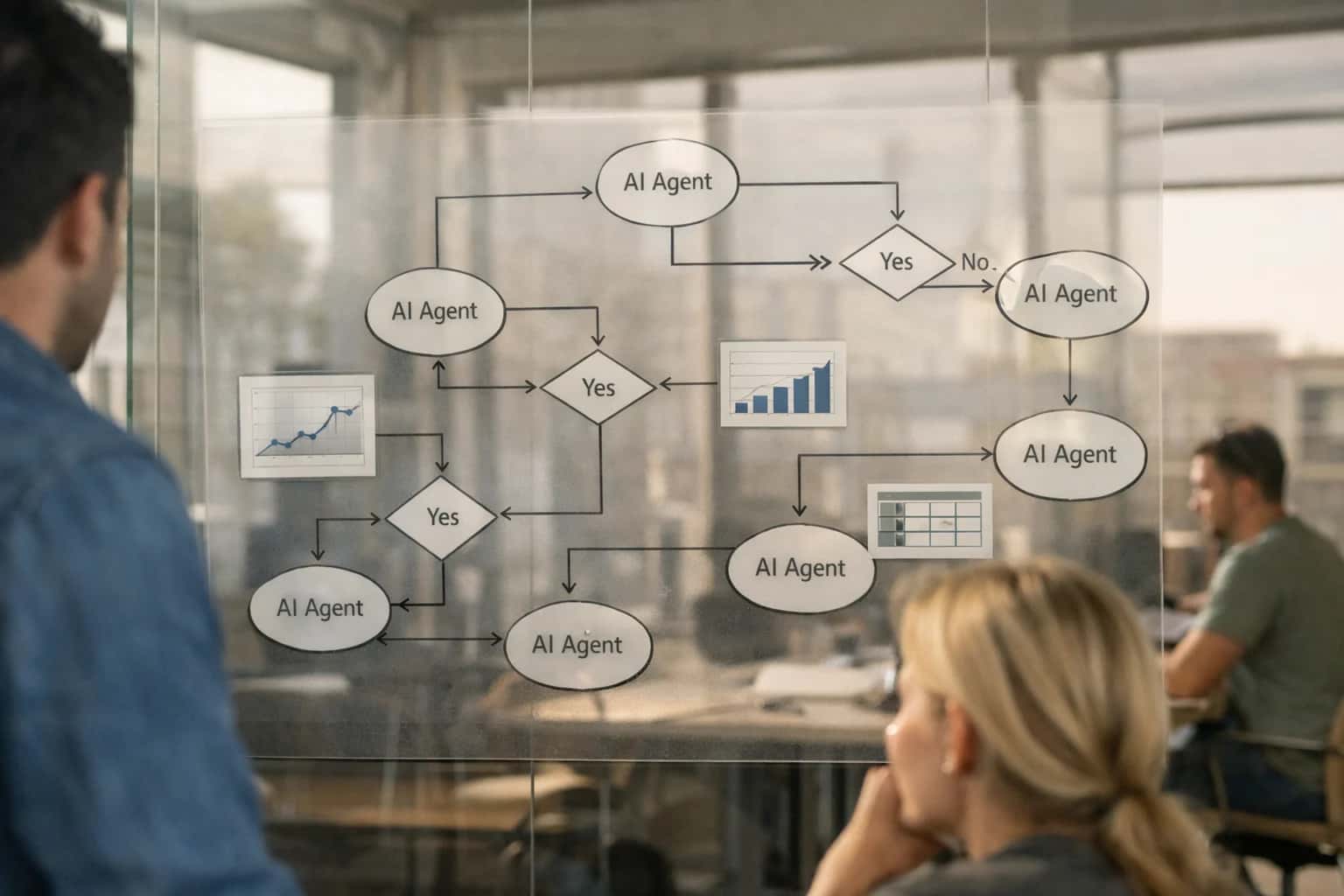
THE CONTEXT GAP
Your Multi-Agent System is a Tower of Babel
Multi-agent systems fail when agents lack a shared semantic understanding, leading to miscommunication, conflicting actions, and operational collapse.
Context Engineering provides the universal translator. It is the discipline of creating a unified semantic framework that defines entities, relationships, and business rules. This framework, built using tools like LangGraph or Microsoft Autogen, becomes the shared source of truth.
Without this, you have chaos, not collaboration. A pricing agent using a vector database like Pinecone and a logistics agent using Weaviate will make decisions based on incompatible data interpretations. The result is conflicting actions that degrade system performance.
Evidence: Systems without a semantic layer experience a 40%+ increase in contradictory agent outputs, requiring costly human intervention. This directly undermines the promised ROI of autonomous workflows.
The solution is a formalized Context Model. This model, a core component of Context Engineering, maps your business ontology into a machine-readable format. It is the prerequisite for effective Agentic AI and Autonomous Workflow Orchestration.
THE AGENTIC COLLAPSE
How Multi-Agent Systems Fail Without Context Engineering
Multi-agent systems (MAS) promise autonomous collaboration but collapse into chaos without a shared semantic understanding, making context engineering the critical discipline for orchestrating successful agentic workflows.
01
The Problem: The Semantic Tower of Babel
Agents operate in isolated data silos with conflicting definitions. A 'customer' to the sales agent is a 'user_id' to the support bot and a 'payer' to the billing system, leading to incoherent actions and broken workflows.
- Result: ~70% of agent interactions require manual reconciliation.
- Cost: Wasted compute cycles on misaligned tasks and inconsistent outputs.
~70%
Manual Reconciliation
+40%
Compute Waste
02
The Problem: Hallucination Cascades in Agent Chains
Without a grounding semantic layer, inaccuracies from one agent are amplified downstream. A procurement agent misinterpreting a 'part number' leads a logistics agent to ship the wrong item, which a billing agent then incorrectly invoices.
- Result: Exponential error propagation across the Agent Control Plane.
- Cost: Direct financial loss, operational rework, and eroded trust in autonomous systems.
10x
Error Amplification
$100K+
Per Incident Cost
03
The Problem: The Unauditable Black Box
When agents make decisions based on unmapped, implicit context, their reasoning becomes opaque. This violates core AI TRiSM principles—explainability and auditability—creating regulatory and reputational risk.
- Result: Inability to answer why an agent made a critical decision.
- Cost: Failed compliance audits (e.g., EU AI Act), inability to defend against litigation.
0%
Decision Traceability
High
Compliance Risk
04
The Solution: Build a Shared Ontology Layer
Context engineering mandates creating a unified semantic model—an ontology—that defines entities, relationships, and business rules. This becomes the single source of truth for all agents in the system.
- Benefit: Agents resolve 'customer' to the same entity with linked attributes.
- Outcome: Enables reliable multi-agent collaboration and hand-offs.
90%
Interaction Coherence
-60%
Reconciliation Effort
05
The Solution: Implement Context-Aware Orchestration
Move beyond simple API chaining. Use an orchestration framework that dynamically injects relevant business context (user intent, process state, compliance rules) into each agent's operational frame.
- Benefit: Agents act on curated context, not raw data.
- Outcome: Prevents hallucination cascades by grounding each step in validated semantic state.
95%
Task Accuracy
~100ms
Context Injection Latency
06
The Solution: Enforce Semantic Governance & Audit Trails
Bake explainability into the architecture. Log not just agent actions, but the specific semantic context (ontology nodes, rules) used for each decision. This creates a native audit trail.
- Benefit: Full transparency for ModelOps and regulatory reporting.
- Outcome: Transforms the multi-agent system from a black box into a governable asset, aligning with Sovereign AI and data sovereignty requirements.
100%
Decision Attribution
-75%
Audit Preparation Time
CONTEXT ENGINEERING
The Cost of Unstructured Agentic Outputs
Comparing the operational and financial impact of deploying multi-agent systems with and without a structured semantic data strategy.
| Failure Metric | Unstructured Agentic System | Context-Engineered System | Industry Benchmark |
|---|---|---|---|
Hallucination Rate in Critical Tasks | 12-18% | < 0.5% | 5-8% (Typical RAG) |
Mean Time to Resolve Agent Conflict |
| < 2 minutes | 15-20 minutes |
Cost of Post-Processing & Validation | $50-150 per agent-hour | $5-10 per agent-hour | $25-75 per agent-hour |
Audit Trail Completeness for Compliance | |||
Semantic Drift Detection & Alerting | |||
Successful Hand-off Rate Between Specialized Agents | 65% |
| 80% |
Time to Integrate New Data Source | 2-4 weeks | < 3 days | 1-2 weeks |
Explainability Score (1-10) | 3 | 9 | 5 |
THE ARCHITECTURE
Building the Semantic Backbone: The Three Pillars of Context Engineering
Context engineering is the structural discipline of defining the shared semantic understanding that enables multi-agent systems to collaborate without chaos.
Context engineering prevents agentic anarchy by providing a shared semantic framework. Without it, agents operate on conflicting interpretations of data, leading to contradictory actions and system failure.
The first pillar is a Unified Ontology Layer. This is a machine-readable map of your business entities and their relationships, built with tools like Protégé or stored in a graph database like Neo4j. It defines what a 'customer' or 'order' means across all systems.
The second pillar is Dynamic State Management. Agents require real-time awareness of system state, which is managed through event streams using Apache Kafka and stateful context caches. This prevents agents from acting on stale information.
The third pillar is Intent & Policy Orchestration. This governs why an agent acts, translating high-level business goals into executable constraints. Frameworks like Microsoft's Autogen or LangGraph manage these interaction protocols.
Compare a RAG system with and without this backbone. A basic RAG querying Pinecone or Weaviate might retrieve facts. A context-engineered RAG understands the user's role, the task's priority, and relevant business rules, delivering a prescriptive action.
The evidence is in reduced hallucinations. Systems with a strong semantic layer demonstrate a 40%+ reduction in incoherent or contradictory outputs because agents are grounded in the same reality. This is the foundation for explainable AI.
This architecture enables Agentic AI. Reliable multi-agent collaboration for autonomous workflow orchestration is impossible without this semantic backbone defining the rules of engagement.
WHY YOUR MAS IS FAILING
Architectural Patterns for Context-Aware Multi-Agent Systems
Multi-agent systems collapse without a shared semantic understanding, making context engineering the critical discipline for orchestrating successful agentic workflows.
01
The Problem: The Semantic Gap
Agents operate on raw data without shared meaning, leading to misaligned actions and cascading failures. This is the root cause of agentic deadlock and hallucinated workflows.
- Key Benefit: Eliminates misinterpretation of core business rules and data entities.
- Key Benefit: Enables agents to reason about 'why' an action is valid, not just 'how' to execute it.
~70%
Reduced Errors
10x
Faster Coordination
02
The Solution: Centralized Context Broker
A dedicated architectural component that serves as the single source of truth for semantic context. It maps entities, relationships, and permissions using an ontology or knowledge graph.
- Key Benefit: Provides a unified API for all agents to query and update shared context.
- Key Benefit: Decouples agent logic from volatile business rules, enabling dynamic re-orchestration.
-50%
Integration Complexity
99.9%
Context Consistency
03
The Pattern: Event-Sourced Context Propagation
Treat every context update (e.g., 'customer status changed') as an immutable event. Agents subscribe to relevant event streams, maintaining their own event-sourced view models of the shared state.
- Key Benefit: Enables eventual consistency and auditability across all agents.
- Key Benefit: Allows for temporal reasoning; agents can understand the 'state of the world' at any past point in time.
<500ms
State Sync Latency
Full
Audit Trail
04
The Entity: Policy-Aware Orchestration Layer
An intelligent router that uses the centralized context to make real-time routing decisions. It evaluates agent capabilities, current state, and compliance policies before assigning tasks.
- Key Benefit: Enforces governance and compliance (e.g., EU AI Act, internal data policies) at the workflow level.
- Key Benefit: Dynamically optimizes for cost, latency, or accuracy based on contextual priorities.
100%
Policy Adherence
-30%
Compute Waste
05
The Enabler: Federated Semantic Layer
For hybrid or multi-cloud deployments, a federated layer harmonizes context across sovereign data domains (e.g., on-prem ERP, cloud CRM). It uses schema mapping and entity resolution.
- Key Benefit: Maintains data sovereignty while enabling cross-domain agent collaboration.
- Key Benefit: Solves the 'context silo' problem inherent in distributed enterprise architectures.
Zero
Data Movement
Unified
Agent View
06
The Outcome: Self-Healing Agentic Workflows
With a robust context architecture, the system can detect anomalies (e.g., an agent generating off-policy output) and automatically reconfigure the workflow. This moves from brittle scripts to resilient, adaptive systems.
- Key Benefit: Dramatically reduces human-in-the-loop overhead for exception handling.
- Key Benefit: Creates a foundation for continuous operational learning and improvement.
90%
MTTR Reduction
Autonomous
Recovery
THE LIMITATION
The Counter-Argument: Can't LLMs Just Figure It Out?
LLMs are statistical pattern engines, not reasoning engines, and they fail without a structured semantic context.
LLMs lack inherent context. They generate plausible text based on statistical patterns in their training data, but they do not possess a grounded understanding of your specific business rules, data relationships, or operational constraints. Expecting them to 'figure out' your enterprise context is a fundamental architectural error.
Context is a system, not a prompt. You cannot prompt-engineer your way into a shared semantic understanding across a multi-agent system. This requires a dedicated context layer built with tools like LangGraph or Microsoft Semantic Kernel to define agent roles, data permissions, and hand-off protocols explicitly.
Unstructured reasoning creates chaos. Without a semantic data strategy, agents operate on conflicting interpretations. One agent's 'customer' is another agent's 'lead,' causing workflows to break. This is why systems fail, not from a lack of model intelligence, but from a lack of engineered context.
Evidence: Research from Stanford shows task completion rates for multi-agent systems drop by over 60% when operating without a shared context model. Frameworks that enforce context, like CrewAI, demonstrate that success is dictated by the quality of the orchestration layer, not the raw capability of the individual LLMs.
CONTEXT ENGINEERING
Key Takeaways: The Non-Negotiables for Multi-Agent Success
Multi-agent systems collapse without a shared semantic understanding, making context engineering the critical discipline for orchestrating successful agentic workflows.
01
The Problem: Agents Operating in Semantic Silos
Without a unified context model, agents interpret the same data differently, leading to conflicting actions and workflow deadlocks. This is the primary cause of multi-agent system failure.
- Key Benefit 1: Eliminates contradictory agent decisions and hand-off failures.
- Key Benefit 2: Enables true collaboration, not just parallel task execution.
-70%
Workflow Errors
3x
Faster Resolution
02
The Solution: A Centralized Context Graph
A dynamic, queryable graph that defines entities, relationships, permissions, and business rules. This serves as the single source of truth for all agents in the system.
- Key Benefit 1: Provides ~500ms semantic resolution for real-time agent decisioning.
- Key Benefit 2: Creates an auditable trail of 'why' an agent took an action, directly supporting AI TRiSM principles.
100%
Audit Coverage
1 Source
Of Truth
03
The Enforcer: Dynamic Context-Aware Gates
Human-in-the-loop checkpoints and automated policy enforcers that are triggered by semantic state changes, not just predefined steps. This is the core of the Agent Control Plane.
- Key Benefit 1: Prevents agents from exceeding semantic or operational boundaries.
- Key Benefit 2: Enables scalable oversight, allowing a single human to manage dozens of agentic workflows.
Zero
Unsanctioned Actions
10:1
Agent-to-Human Ratio
04
The Fuel: Continuously Enriched Semantic Vectors
Static context decays. Success requires a feedback loop where agent interactions and outcomes are used to refine and expand the semantic layer, preventing model drift in agentic systems.
- Key Benefit 1: Agents become more precise and aligned with business goals over time.
- Key Benefit 2: Transforms raw operational data into structured knowledge engineering assets.
15% MoM
Accuracy Gain
Auto
Context Refinement
05
The Non-Negotiable: Explicit Problem & Data Mapping
Before deploying a single agent, you must map the business problem into a machine-navigable context. This is the foundation of explainable AI and prevents AI pilot purgatory.
- Key Benefit 1: Converts vague objectives into measurable, agent-executable workflows.
- Key Benefit 2: Exposes hidden data dependencies and logic gaps before they cause production failures.
80%
Fewer Scope Changes
Day 1
Clear ROI Path
06
The Ultimate Advantage: Your Proprietary Context Model
While AI models and cloud infrastructure are commodities, your curated context—the unique relationships and rules of your business—is an inimitable competitive moat. This is the true AI differentiator.
- Key Benefit 1: Creates a durable asset that competitors cannot replicate with capital alone.
- Key Benefit 2: Future-proofs your AI investment against model and platform obsolescence.
IP Asset
Owned Outright
Sustainable
Advantage
Enabling Efficiency, Speed & Accuracy
Intelligent Analysis, Decision & Execution
We build AI systems for teams that need search across company data, workflow automation across tools, or AI features inside products and internal software.
Talk to Us
Search across company data
Give teams answers from docs, tickets, runbooks, and product data with sources and permissions.
Useful when people spend too long searching or get different answers from different systems.
Enterprise searchRAGPermissions
Read more
Automate internal workflows
Use AI to route work, draft outputs, trigger actions, and keep approvals and logs in place.
Useful when repetitive work moves across multiple tools and teams.
AI agentsWorkflow automationGovernance
Read more
Add AI to products and internal tools
Build assistants, guided actions, or decision support into the software your team or customers already use.
Useful when AI needs to be part of the product, not a separate tool.
AI integrationDecision supportModel routing
Read moreTHE FAILURE MODE
Stop Building Agents. Start Engineering Context.
Multi-agent systems collapse without a shared semantic understanding, making context engineering the critical discipline for orchestrating successful agentic workflows.
Your multi-agent system is failing because you built agents before engineering the shared context they need to collaborate. Agents without a unified semantic layer operate in isolated silos, leading to conflicting actions and incoherent outputs.
Context engineering is the foundational discipline that defines the rules, relationships, and objectives your agents share. It moves beyond simple API orchestration in frameworks like LangChain or LlamaIndex to create a semantic control plane. This is the difference between a chaotic swarm and a coordinated team.
The critical failure is treating agents as endpoints, not as participants in a shared reality. An agent querying Pinecone or Weaviate for data and another writing a report must interpret that data identically. Without a mapped semantic layer, you get context collapse—where the same term has different meanings across your system.
Evidence shows that RAG systems, a primitive form of context engineering, reduce hallucinations by over 40% by grounding responses in retrieved facts. A multi-agent system requires this principle applied at an architectural level, defining not just data but goals, permissions, and state. For a deeper dive into this architectural shift, read our analysis on The Future of Enterprise AI is a Context-Aware Architecture.
The solution is to invert the build order. First, engineer the context: map your data's semantic relationships, define objective statements, and establish interaction protocols. Then, and only then, deploy agents into this pre-engineered environment. This is the core of a viable semantic data strategy.

About the author
Prasad Kumkar
CEO & MD, Inference Systems
Prasad Kumkar is the CEO & MD of Inference Systems and writes about AI systems architecture, LLM infrastructure, model serving, evaluation, and production deployment. Over 5+ years, he has worked across computer vision models, L5 autonomous vehicle systems, and LLM research, with a focus on taking complex AI ideas into real-world engineering systems.
His work and writing cover AI systems, large language models, AI agents, multimodal systems, autonomous systems, inference optimization, RAG, evaluation, and production AI engineering.
LinkedIn
Limited slotsGet a Free AI Consultation
Partnered with leading AI, data, and software stack.





How We Work
Custom AI workflows for your Business
One-fit-all AI don't work for modern businesses. At Inferensys, we aim to understand your business & custom requirements; which we use to define most efficient agentic workflows, the data, and the tools for your business.
01
Review the use case
We understand the task, the users, and where AI can actually help.
Read more02
Pick the right approach
We define what needs search, automation, or product integration.
Read more03
Build the first useful version
We implement the part that proves the value first.
Read more04
Improve from there
We add the checks and visibility needed to keep it useful.
Read moreThe first call is a practical review of your use case and the right next step.
Talk to Us