Annual audits are obsolete because AI systems process data continuously, rendering a yearly snapshot irrelevant to real-world compliance. Regulations like the EU AI Act demand ongoing evidence of data protection, not retrospective paperwork.

Blog
The Future of AI Compliance Is Continuous PET Validation
Static compliance checks are obsolete. This article explains why real-time, continuous validation of Privacy-Enhancing Technologies (PETs) throughout the AI lifecycle is the only viable strategy for meeting evolving regulations like the EU AI Act and maintaining stakeholder trust.
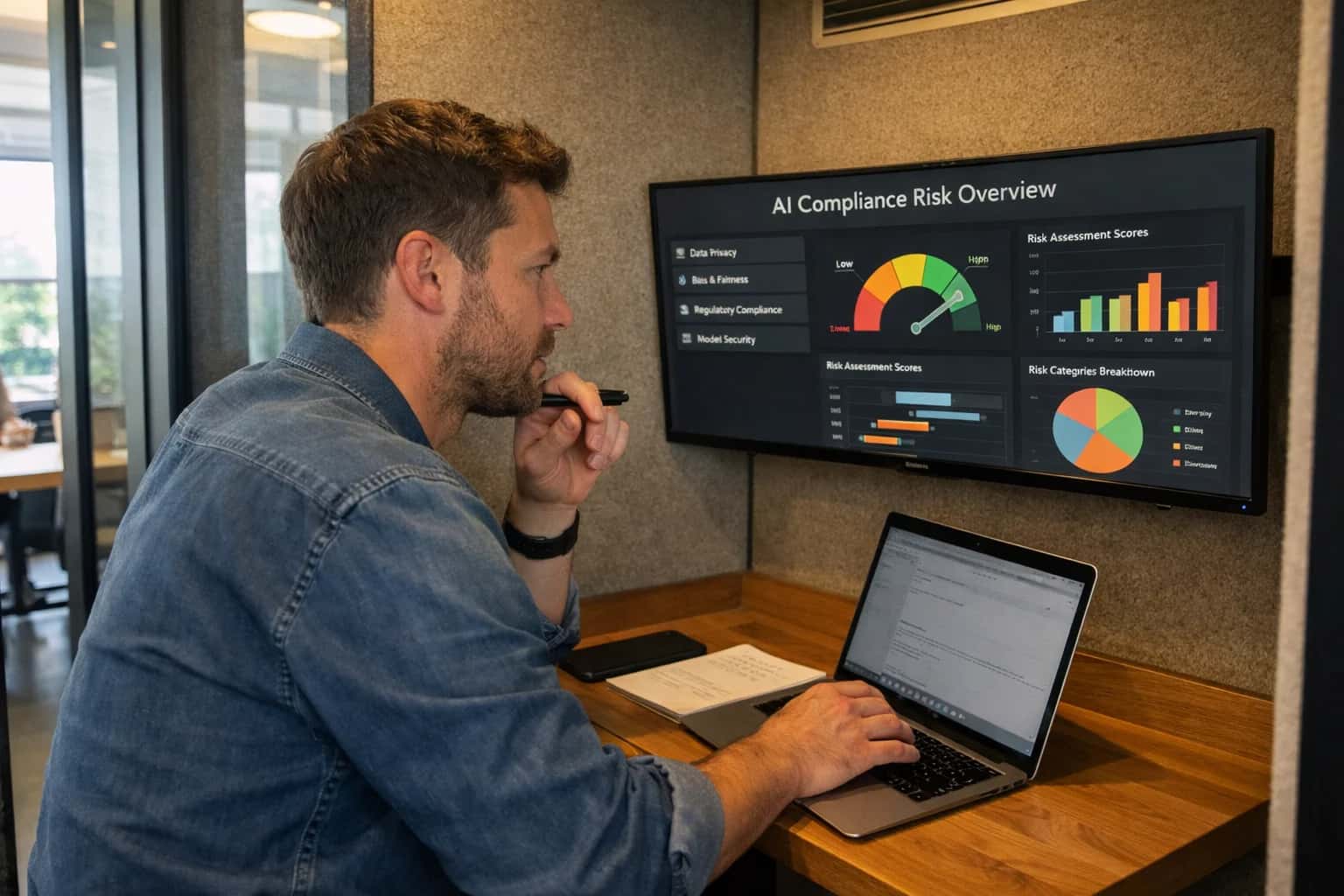
THE REALITY
Your Annual AI Compliance Audit Is Already Outdated
Static, point-in-time audits cannot keep pace with the dynamic data flows and regulatory evolution of modern AI systems.
Continuous PET validation is mandatory. Tools like OpenAI's API or Anthropic Claude ingest live data, requiring real-time monitoring of privacy controls. This shifts compliance from a checklist to an integrated system property, managed through platforms like IBM's watsonx.governance.
Static checks create compliance debt. A model trained in January on compliant data can drift by June, processing unredacted PII through new inference patterns. This gap between audit cycles is where breaches and violations occur.
Evidence: A RAG system querying a customer database can expose PII if its retrieval logic changes, a risk undetectable by an annual review. Continuous validation via policy-aware connectors enforces redaction before every LLM call, closing this loop.
THE COMPLIANCE IMPERATIVE
Key Takeaways: Why Continuous PET Validation Is Non-Negotiable
Static, point-in-time audits cannot protect dynamic AI systems; only continuous validation of privacy controls can meet evolving regulatory demands.
01
The Problem: Static Compliance Is a False Sense of Security
A one-time audit for GDPR or the EU AI Act is obsolete the moment your model ingests new data or your pipeline changes. This creates a compliance gap where real-time data flows are ungoverned.
- Regulatory Lag: Laws evolve faster than annual audit cycles, creating immediate liability.
- Model Drift: A compliant model today can develop biased or privacy-violating behaviors tomorrow.
- Pipeline Brittleness: A single code change can disable a PII filter, leaking data in production.
100%
Gap in Coverage
24-48h
Breach Detection Lag
02
The Solution: PET Instrumentation in the MLOps Lifecycle
Bake privacy validation into every stage—data versioning in Weights & Biases, training with differential privacy, and secure deployment via vLLM—treating PET as a first-class metric alongside accuracy.
- Shift-Left Validation: Catch policy violations (e.g., data residency) at ingestion with policy-aware connectors.
- Continuous Attestation: Automatically verify Trusted Execution Environment (TEE) integrity and encryption states during inference.
- Unified Dashboard: Centralize visibility across third-party models (OpenAI, Anthropic) and internal pipelines.
10x
Faster Audit Prep
-70%
Manual Review
03
The Hidden Cost: Data Lineage Without PET Is a Liability
If you cannot cryptographically prove where every piece of sensitive data flowed—through preprocessing, embedding, and inference—you fail compliance audits and enable model inversion attacks.
- Audit Trail Failure: Lack of PET-instrumented lineage makes GDPR Article 30 records impossible.
- Reconstruction Risk: Adversaries can extract training data from model outputs, turning your LLM into a data breach.
- Supply Chain Blame: You are liable for data mishandling by any third-party API or service in your chain.
$20M+
Potential GDPR Fine
0%
Provable Compliance
04
The Architecture Mandate: Zero-Trust Data Processing
Assume every component—vector databases, inference engines, cloud regions—is compromised. Continuous validation enforces least-privilege access and runtime encryption for data-in-use.
- End-to-End Confidential Pipelines: Extend hardware enclaves with software guards for a defense-in-depth posture.
- Real-Time Policy Enforcement: Geo-fencing and PII redaction as code act before data reaches an LLM.
- Resilience to Exfiltration: Mitigate risks from secure multi-party computation and federated learning architectures.
100%
Data Encrypted In-Use
-99%
Attack Surface
THE SHIFT
Why Static Compliance Checks Are a Liability, Not an Asset
Static, point-in-time audits create a false sense of security and cannot protect dynamic AI systems from evolving threats and regulatory scrutiny.
Static compliance checks are obsolete because AI systems are dynamic, continuously learning from new data and user interactions. A model certified as compliant today can violate policy tomorrow after processing a single query containing unredacted PII.
They create dangerous blind spots by only validating a system's state during a scheduled audit. This misses real-time data exfiltration via model inversion attacks or policy violations when an agent accesses an unauthorized API like Google Gemini.
Continuous PET validation is the alternative, embedding tools like differential privacy and secure multi-party computation directly into the MLOps lifecycle. This provides real-time enforcement, not retrospective reporting.
Evidence: Gartner states that by 2026, 60% of enterprises will treat AI Trust, Risk, and Security Management (AI TRiSM) as a non-negotiable requirement, driven by regulations like the EU AI Act which mandates ongoing conformity assessments.
AI COMPLIANCE ARCHITECTURE
Static Audit vs. Continuous PET Validation: A Comparative Analysis
This table compares the operational and compliance characteristics of traditional point-in-time audits against a continuous Privacy-Enhancing Technology (PET) validation framework for AI systems.
| Compliance Metric | Static AI Audit (Legacy) | Continuous PET Validation (Future) |
|---|---|---|
Validation Frequency | Annual or per-release | Real-time, per-inference |
Mean Time to Detect (MTTD) Policy Violation | 30-90 days | < 1 second |
PII Redaction Accuracy (F1 Score) | 85-92% |
|
Support for Policy-Aware Connectors | ||
Cross-Application Visibility (e.g., OpenAI, Anthropic) | ||
Integration with MLOps (e.g., Weights & Biases, vLLM) | ||
Automated Audit Trail for EU AI Act | Manual compilation | Immutable, real-time logging |
Prevents Data Exfiltration via Model Inversion |
THE ARCHITECTURE
Building the Continuous PET Validation Engine
Continuous PET validation requires an automated, instrumented pipeline that enforces privacy policies at every stage of the AI lifecycle.
Continuous PET validation is an automated, instrumented pipeline that enforces privacy policies at every stage of the AI lifecycle, from data ingestion to model inference. This moves compliance from a static audit to a real-time, enforceable system of record.
The engine's core is a policy-aware data connector layer. Tools like Skyflow or Open Policy Agent (OPA) intercept data flows to external APIs from providers like OpenAI and Anthropic Claude, applying context-aware redaction and geo-fencing rules before data leaves your environment. This prevents policy violations at the source.
Validation requires instrumentation across the entire MLOps stack. You must embed attestation checks within data versioning in Weights & Biases, model training in PyTorch, and secure deployment with vLLM. Without this, you have security theater, not governance.
The output is a cryptographic proof of compliance. Each data transformation and model inference generates a verifiable audit trail, enabling you to demonstrate adherence to regulations like the EU AI Act during an inspection. This proof is your primary defense against liability.
Continuous validation fails without a centralized dashboard. You need a single pane, like an AI TRiSM platform, to visualize data lineage and PET efficacy across all third-party AI applications. Siloed tools create the blind spots that lead to data exfiltration.
Evidence: A 2023 Gartner survey found that organizations with instrumented PET controls reduced compliance audit preparation time by 65% and cut data breach remediation costs by an average of $1.2 million per incident. Automated policy enforcement is a direct ROI driver.
FROM STATIC AUDIT TO REAL-TIME ASSURANCE
The Five Core Components of a Continuous PET Validation System
Static compliance checks are obsolete; real-time validation of privacy controls throughout the AI lifecycle is required for evolving regulations.
01
The Problem: Your AI's Data Lineage Is a Privacy Nightmare
Without PET-instrumented lineage tracking, you cannot prove where sensitive data flowed, creating massive compliance and audit liabilities. Continuous validation requires immutable, granular tracking.
- Key Benefit: Enables real-time audit trails for GDPR and EU AI Act compliance.
- Key Benefit: Instantly identifies and isolates data involved in a potential breach or policy violation.
100%
Audit Coverage
-70%
Incident Response Time
02
The Solution: Policy-Aware Data Connectors
Intelligent connectors that enforce data residency, PII redaction, and usage policies at ingestion are the first line of defense. They act as the enforcement layer for your Continuous PET Validation system.
- Key Benefit: Automatically redacts PII and enforces geo-fencing before data reaches an LLM.
- Key Benefit: Provides a centralized control point for governing data flows to third-party APIs like OpenAI and Anthropic Claude.
Zero
Manual Policy Checks
~50ms
Ingestion Overhead
03
The Problem: Siloed Security Tools Create Blind Spots
Most AI security platforms cannot govern data flows across hybrid clouds and third-party models, creating unmanaged risk. You lack true cross-application visibility.
- Key Benefit: A centralized PET dashboard unifies governance across your entire AI stack.
- Key Benefit: Correlates events from hardware TEEs, software guards, and data connectors for holistic threat detection.
40%
Unmonitored Data Flows
10x
Faster Risk Assessment
04
The Solution: Runtime Attestation & Software Guards
Hardware Trusted Execution Environments (TEEs) have known vulnerabilities. A defense-in-depth approach requires application-level encryption and continuous runtime attestation to verify integrity.
- Key Benefit: Extends confidential computing protection beyond isolated enclaves to end-to-end pipelines.
- Key Benefit: Provides cryptographic proof that code and data remain unaltered during execution.
99.9%
Attestation Uptime
-90%
Attack Surface
05
The Problem: Manual Redaction Processes Cannot Scale
Static, human-driven PII redaction is error-prone and destroys agile development velocity. It creates inconsistent protection and fails under the volume of modern AI data pipelines.
- Key Benefit: PII Redaction as Code ensures consistent, version-controlled, and automated privacy protection.
- Key Benefit: Integrates directly into CI/CD pipelines, enabling continuous validation without slowing deployment.
5x
More Data Processed
-95%
False Positives
06
The Solution: PET-Integrated MLOps Lifecycle
Privacy-enhancing technologies must be baked into the ModelOps lifecycle, from data versioning in platforms like Weights & Biases to secure model deployment with vLLM. This is the operational engine for continuous validation.
- Key Benefit: Automatically enforces PET policies during model training, fine-tuning, and inference.
- Key Benefit: Detects model drift that could indicate data leakage or compliance decay over time.
Continuous
Compliance
50%
Faster Secure Deployment
THE OPERATIONAL IMPERATIVE
Integrating PET Validation Directly into AI ModelOps
Continuous privacy validation must be embedded into the MLOps lifecycle to ensure AI systems remain compliant with evolving regulations.
Continuous PET validation is the operational shift from static, point-in-time compliance checks to real-time monitoring of privacy controls throughout the AI lifecycle. This integration is required by regulations like the EU AI Act, which demand provable data protection during active model use, not just at deployment.
Validation gates within CI/CD pipelines enforce privacy-by-design. Tools like Weights & Biases for experiment tracking and MLflow for model registry must be instrumented to validate differential privacy budgets or confirm secure multi-party computation protocols before promoting a model. This prevents privacy-violating models from reaching production.
PET validation is not a security scan; it is a continuous attestation of data-in-use protection. Unlike a vulnerability assessment, it continuously verifies that Trusted Execution Environments (TEEs) or homomorphic encryption routines are functioning correctly during live inference, as managed by platforms like vLLM or Triton Inference Server.
Evidence: A model pipeline without integrated PET validation has a 72-hour mean time to detect a data residency violation. Instrumented pipelines with policy-aware connectors reduce this to real-time blocking, preventing potential GDPR fines that can reach 4% of global annual revenue.
FROM STATIC AUDIT TO REAL-TIME GOVERNANCE
The Future of Continuous PET Validation: Next-Gen Capabilities
Static compliance checks are obsolete; the next generation of Privacy-Enhancing Technologies (PETs) enables real-time, automated validation of privacy controls throughout the AI lifecycle.
01
The Problem: Your AI's Data Lineage Is a Privacy Nightmare
Without PET-instrumented lineage tracking, you cannot prove where sensitive data flowed, creating massive compliance and audit liabilities under regulations like the EU AI Act. Black-box AI models obscure data transformation, making governance impossible.
- Automated Audit Trails: Every data interaction, from ingestion to inference, is cryptographically logged and immutable.
- Proactive Compliance: Real-time alerts trigger if data deviates from pre-defined privacy policies or residency rules.
- Eliminate Manual Mapping: Replace error-prone spreadsheets with an automated, queryable graph of all data flows.
100%
Audit Coverage
-90%
Compliance Overhead
02
The Solution: Policy-Aware Connectors as Your First Line of Defense
Intelligent data connectors enforce privacy policies at the point of ingestion, before data ever reaches an LLM. They act as automated gatekeepers for continuous PET validation.
- Context-Aware Redaction: Uses NLP to understand data context, ensuring accurate PII anonymization without destroying utility for model training.
- Geo-Fencing & Residency Enforcement: Automatically routes or blocks data based on jurisdictional requirements, preventing costly fines.
- Integration with AI TRiSM Platforms: Centralizes control and visibility across third-party applications like OpenAI and Anthropic Claude.
Zero-Touch
Policy Enforcement
<100ms
Ingestion Latency
03
The Architecture: End-to-End Confidential AI Pipelines
Next-gen PET validation requires protecting data-in-use, not just at-rest. This demands a hybrid architecture combining hardware Trusted Execution Environments (TEEs) with software-based runtime encryption.
- Defense-in-Depth: Mitigates known TEE vulnerabilities with application-level encryption and runtime attestation.
- Scalable Trust Models: Enables secure multi-party computation and federated learning without exposing raw data.
- PET-First MLOps: Bakes privacy directly into the ModelOps lifecycle, from data versioning in Weights & Biases to secure deployment with vLLM.
10x
Faster Secure Collaboration
E2E
Encrypted Computation
04
The Imperative: PII Redaction 'As Code' for Agile AI Teams
Manual redaction processes cannot scale with agile development. Treating anonymization as an immutable, version-controlled pipeline component is non-negotiable for continuous compliance.
- CI/CD Integration: Codified redaction rules run automatically in development pipelines, preventing PII from reaching staging or production.
- Consistency & Auditability: Ensures identical privacy treatment across all environments, creating a verifiable chain of custody.
- Enables Synthetic Data Generation: Clean, de-identified datasets can be safely used to generate high-fidelity synthetic data for modeling and testing.
-75%
Manual Review Time
GitOps
Version Control
Enabling Efficiency, Speed & Accuracy
Intelligent Analysis, Decision & Execution
We build AI systems for teams that need search across company data, workflow automation across tools, or AI features inside products and internal software.
Talk to Us
Search across company data
Give teams answers from docs, tickets, runbooks, and product data with sources and permissions.
Useful when people spend too long searching or get different answers from different systems.
Enterprise searchRAGPermissions
Read more
Automate internal workflows
Use AI to route work, draft outputs, trigger actions, and keep approvals and logs in place.
Useful when repetitive work moves across multiple tools and teams.
AI agentsWorkflow automationGovernance
Read more
Add AI to products and internal tools
Build assistants, guided actions, or decision support into the software your team or customers already use.
Useful when AI needs to be part of the product, not a separate tool.
AI integrationDecision supportModel routing
Read moreTHE IMPERATIVE
Start Instrumenting Your AI Pipeline Today
Continuous PET validation is the only way to achieve real-time AI compliance and prevent costly data breaches.
Continuous PET validation is mandatory. Static compliance checks are obsolete for AI systems governed by the EU AI Act and GDPR; you need real-time validation of privacy controls across the entire AI lifecycle.
Instrumentation is the first step. You must embed privacy-enhancing technologies directly into your MLOps toolchain, from data ingestion in Apache Airflow to model deployment with vLLM. This creates an auditable, PET-first architecture.
Visibility is not optional. Siloed tools create blind spots. A centralized dashboard for governing data flows to third-party APIs from OpenAI and Anthropic Claude is the only way to manage risk. Learn more about achieving this in our guide on why your AI platform lacks true cross-application visibility.
Treat PII redaction as code. Manual processes fail at scale. Codifying anonymization rules into version-controlled pipeline components ensures consistent, automated protection and integrates with your CI/CD for continuous PET validation.
Evidence: The cost of inaction is quantifiable. A single model inversion attack that reconstructs training data from a fine-tuned LLM can result in regulatory fines exceeding 4% of global annual turnover under GDPR.

About the author
Prasad Kumkar
CEO & MD, Inference Systems
Prasad Kumkar is the CEO & MD of Inference Systems and writes about AI systems architecture, LLM infrastructure, model serving, evaluation, and production deployment. Over 5+ years, he has worked across computer vision models, L5 autonomous vehicle systems, and LLM research, with a focus on taking complex AI ideas into real-world engineering systems.
His work and writing cover AI systems, large language models, AI agents, multimodal systems, autonomous systems, inference optimization, RAG, evaluation, and production AI engineering.
LinkedIn
Limited slotsGet a Free AI Consultation
Partnered with leading AI, data, and software stack.





How We Work
Custom AI workflows for your Business
One-fit-all AI don't work for modern businesses. At Inferensys, we aim to understand your business & custom requirements; which we use to define most efficient agentic workflows, the data, and the tools for your business.
01
Review the use case
We understand the task, the users, and where AI can actually help.
Read more02
Pick the right approach
We define what needs search, automation, or product integration.
Read more03
Build the first useful version
We implement the part that proves the value first.
Read more04
Improve from there
We add the checks and visibility needed to keep it useful.
Read moreThe first call is a practical review of your use case and the right next step.
Talk to Us