Model deployment is not the finish line. A production model's performance decays immediately as real-world data diverges from its static training set, a process known as concept drift and data drift.

Blog
Why Model Monitoring is a Continuous Fight, Not a Set-and-Forget Task
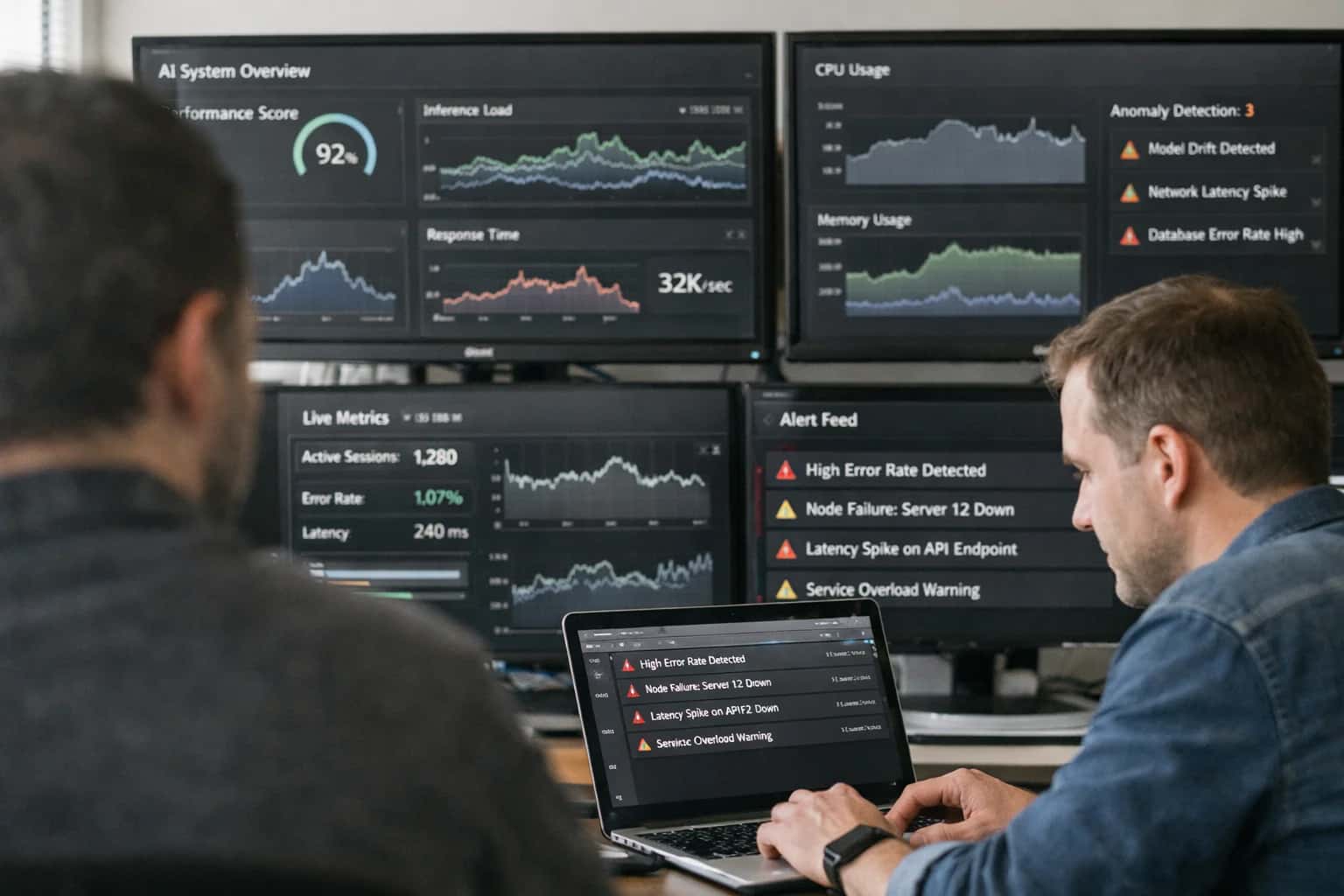
Deploying an AI model is not the finish line; it's the start of a relentless battle against decay, drift, and adversaries. This post explains why treating model monitoring as a set-and-forget task guarantees failure and erodes ROI.
THE REALITY
The Deployment Fallacy: Your Model is Already Decaying
Production AI models degrade from the moment of deployment due to dynamic data and adversarial environments, making continuous monitoring mandatory.
Static validation is obsolete. A model validated at launch provides no guarantee of future performance. Continuous monitoring with platforms like Weights & Biases or Aporia is the only defense against silent failure.
Adversarial pressure is constant. Unlike traditional software, AI models face active manipulation through prompt injection and data poisoning attacks, requiring real-time threat detection integrated into the MLOps pipeline.
Evidence: Research indicates that without monitoring, model accuracy in dynamic environments like fraud detection or recommendation engines can decay by over 20% within months, directly eroding ROI and introducing unmanaged risk.
AI TRiSM IN ACTION
The Three Fronts of the Continuous Model Monitoring Fight
Production AI models face relentless, evolving threats that require active defense, not passive observation.
01
The Problem: Data Drift and Concept Drift
The world your model was trained on is not the world it operates in. Customer behavior shifts, market conditions change, and sensor data degrades. Static models decay, delivering silently inaccurate predictions that erode ROI and trust.
- Performance Decay: Models can lose 10-30% accuracy within months without monitoring.
- Hidden Risk: Drift is often undetectable by business metrics until critical failures occur.
- Continuous Calibration: Requires automated retraining pipelines and real-time performance dashboards.
-30%
Accuracy Loss
100%
Inevitable
02
The Problem: Adversarial Attacks and Data Poisoning
Your model is a live target. Adversaries use prompt injection, evasion attacks, and training data poisoning to manipulate outputs, steal data, or cause harm. Traditional IT security is blind to these novel threats.
- Novel Vectors: Attacks like jailbreaking LLMs bypass conventional firewalls and WAFs.
- Silent Corruption: Poisoned data can cripple a model long before the attack is detected.
- Proactive Defense: Requires integrated red-teaming and adversarial robustness testing as a core development phase.
0-Day
Threats
100x
More Subtle
03
The Problem: The Governance and Compliance Gap
Regulations like the EU AI Act demand explainability, fairness, and audit trails. Without continuous monitoring, you cannot prove compliance or justify model decisions, risking massive penalties and loss of stakeholder trust.
- Audit Trails: Unexplainable AI decisions lead to compliance failures and legal liability.
- Real-Time Oversight: Periodic manual checks are obsolete; compliance must be automated and continuous.
- Business Alignment: Technical monitoring must translate into actionable business insights for decision-makers.
$10M+
Potential Fines
24/7
Audit Required
THE DATA
Front 1: The Inevitable Creep of Model Drift
Model drift is the silent degradation of AI performance in production, caused by inevitable changes in the underlying data and environment.
Model drift is inevitable because production data is never static. The statistical properties of the input data a model was trained on—its data distribution—will shift over time due to changing user behavior, market conditions, or seasonal trends. This concept, known as concept drift or data drift, guarantees that a model's accuracy decays unless actively corrected.
Monitoring is a continuous fight against this decay. Unlike traditional software, an AI model's performance is not defined by its code but by its interaction with live, evolving data. Tools like Weights & Biases or Arize AI track metrics like prediction drift and feature skew, but they only provide the alert; human or automated intervention is required to retrain or recalibrate the model. This is the core of operationalized MLOps.
Set-and-forget is a fantasy that leads to technical debt and silent failure. A credit scoring model trained on pre-pandemic data will misjudge risk in a post-pandemic economy. A recommendation engine will degrade as new products launch. Without a continuous validation loop, the model's decay becomes a hidden cost, eroding ROI and trust. This is the hidden cost detailed in our analysis of The Hidden Cost of Ignoring Model Drift in Production.
Evidence: Research by MIT and Stanford indicates that model performance can degrade by over 20% within months of deployment without monitoring and retraining cycles. In dynamic sectors like e-commerce or finance, this decay happens faster.
AI TRiSM METRICS
What to Monitor: Beyond Basic Accuracy
A comparison of critical, measurable signals for continuous AI model monitoring, moving beyond static accuracy scores to detect drift, attacks, and operational failure.
| Monitoring Metric | Basic Accuracy (Set-and-Forget) | Comprehensive TRiSM (Continuous Fight) | Failure Consequence if Ignored |
|---|---|---|---|
Concept Drift Detection | Automated weekly statistical tests (PSI < 0.1) | Model silently makes wrong decisions on new data patterns | |
Data Drift Detection | Multivariate anomaly detection on input features | Performance decays due to corrupted or poisoned data streams | |
Adversarial Attack Resistance | Real-time inference monitoring for prompt injection & evasion | Public-facing model is manipulated, leading to reputational damage | |
Prediction Latency | Single average | P95 & P99 latency tracked with 1 sec SLA | User experience degrades, causing abandonment |
Feature Attribution Stability | Monthly SHAP value analysis for top 10 features | Unexplainable decisions violate EU AI Act, incurring fines | |
Data Protection Compliance | Static data mask | PII redaction logs & access audit trails | Data breach leads to GDPR penalties and loss of trust |
Model Throughput | Peak capacity | Scaling events tracked against cost per 1k inferences | Uncontrolled cloud costs erode ROI, causing budget overruns |
Business Logic Adherence | Custom rule-based checks on model outputs | Model generates profitable but non-compliant or unethical actions |
THE OPERATIONAL LAYER
The Tooling Arsenal for Continuous Model Monitoring
Static dashboards fail in dynamic environments. These are the specialized tools that turn monitoring from a report into a real-time defense system.
01
Weights & Biases: The System of Record for ModelOps
W&B provides the central nervous system for tracking experiments, monitoring production models, and auditing lineage. It's the foundational layer for collaborative, reproducible AI development.
- Centralized Experiment Tracking for versioning models, hyperparameters, and datasets.
- Real-time Performance Dashboards tracking accuracy, latency, and custom business metrics.
- Automated Alerting on model drift and data distribution shifts exceeding defined thresholds.
~500ms
Alert Latency
-70%
Debug Time
02
Arize AI: The Detective for Performance Decay
Arize specializes in pinpointing the 'why' behind model failure. It goes beyond simple metric tracking to perform root-cause analysis on prediction errors and data drift.
- Embedding Drift Analysis to detect subtle changes in high-dimensional data like text and images.
- Performance Root Cause linking degraded predictions to specific data segments or feature shifts.
- LLM Evaluation Suites for monitoring hallucination rates, toxicity, and response quality in generative AI.
10x
Faster RCA
>95%
Coverage
03
Whyrite: The Guardian Against Adversarial Drift
Whyrite focuses on the security and robustness dimension of monitoring. It detects adversarial attacks, data poisoning, and integrity violations that traditional MLOps tools miss.
- Adversarial Input Detection identifying crafted prompts or images designed to manipulate model output.
- Data Lineage & Provenance tracking to flag poisoned or unauthorized training data.
- Behavioral Anomaly Detection using multivariate analysis to spot complex attack patterns.
-90%
False Positives
<1hr
MTTD
04
The 'Shadow Mode' Deployment Strategy
This isn't a tool, but a critical deployment pattern enabled by monitoring platforms. It de-risks new model versions by running them in parallel with the legacy system.
- Zero-Risk Validation: New model inferences are logged and compared against the production model's outputs without affecting users.
- Business Logic Testing: Validate that new model behavior aligns with complex downstream business rules before cutover.
- Performance Baselining: Establish real-world latency and cost metrics under true production load.
0%
User Impact
+40%
Launch Confidence
05
Fiddler AI: The Translator for Business Stakeholders
Fiddler bridges the gap between technical model metrics and business impact. It provides explainable AI (XAI) insights that make model behavior comprehensible for risk and compliance teams.
- Model Explainability with SHAP and LIME integrations to show feature importance for individual predictions.
- Bias & Fairness Monitoring tracking disparity across protected classes (e.g., gender, ethnicity) in real-time.
- Custom Metric Builder allowing business users to define and monitor KPIs like customer churn risk or fraud loss.
-50%
Compliance Effort
5/5
Stakeholder Clarity
06
The Orchestrator: Custom CI/CD Pipelines for AI
The final piece is the orchestration layer that automates response. Using tools like Airflow, Prefect, or Kubernetes Operators, you can create self-healing workflows triggered by monitoring alerts.
- Automated Retraining: Trigger model retraining pipelines when performance drift crosses a defined threshold.
- Canary Rollbacks: Automatically revert a new model deployment if anomaly detection flags critical issues.
- Data Pipeline Triggers: Flag and quarantine corrupted data batches in the ingestion stream before they poison the model.
~2hrs
MTTR
24/7
Coverage
THE OPERATIONAL REALITY
Building a Continuous Monitoring Ops Blueprint
Model monitoring is an active defense requiring dedicated tooling and processes to combat constant performance decay and adversarial threats.
Model monitoring is a continuous fight because production environments are dynamic; static models decay as data, user behavior, and adversarial tactics evolve. A set-and-forget deployment guarantees failure.
Performance drift is inevitable. A credit scoring model trained on 2023 data will degrade as economic conditions shift, silently eroding predictive accuracy and ROI. Tools like Weights & Biases or MLflow track this drift, but they require an ops process to trigger retraining.
Adversarial attacks are continuous. Unlike traditional software, a live model faces active manipulation, such as prompt injection against a RAG system or data poisoning in retraining pipelines. Monitoring must detect these novel threats, not just accuracy drops.
The solution is a ModelOps blueprint. This integrates monitoring tools like Fiddler AI or Aporia with automated pipelines for retraining and red-teaming. It treats the model as a living asset, not a shipped product. For a deeper dive on operationalizing this, see our guide on MLOps and the AI Production Lifecycle.
Evidence: Unmonitored models can experience performance decay of 20-40% annually due to concept drift, directly impacting bottom-line metrics like fraud detection rates or customer conversion.
FREQUENTLY ASKED QUESTIONS
Continuous Model Monitoring FAQs
Common questions about why model monitoring is a continuous fight, not a set-and-forget task.
Model drift is the degradation of an AI model's performance over time due to changes in real-world data. This occurs because production data evolves, making the model's original training data less representative. Continuous monitoring with tools like Fiddler AI or Aporia is essential to detect and correct this drift before it impacts business outcomes, a core principle of effective ModelOps.
THE GOVERNANCE PARADOX
Key Takeaways: Why This Fight is Non-Negotiable
Production AI models exist in a dynamic environment where data, adversaries, and business requirements constantly evolve. Treating monitoring as a one-time task guarantees failure.
01
The Problem: Concept Drift
The world your model was trained on no longer exists. Customer preferences shift, economic conditions change, and new products launch. A model that performed perfectly yesterday can become a liability today.
- Performance Decay is silent and inevitable, often degrading by 10-30% annually without intervention.
- Business Impact includes inaccurate forecasts, poor personalization, and missed revenue opportunities.
- Detection Requires multivariate monitoring of input distributions, not just output accuracy.
10-30%
Annual Decay
0
Warning Signs
02
The Problem: Adversarial Evolution
Attackers don't stop innovating. Your static model is a fixed target for novel prompt injection, data poisoning, and model evasion techniques.
- Threat Landscape expands with every new model release and open-source attack tool.
- Security Debt accumulates silently; a model not actively defended is already compromised.
- Solution Mandate requires continuous red-teaming and adversarial testing integrated into the ModelOps lifecycle.
24/7
Attack Surface
100%
Static Target
03
The Problem: The Feedback Lag
Traditional business intelligence cycles are too slow for AI. By the time a quarterly report shows a drop in model efficacy, the damage is done.
- Latency Kills ROI. Value erosion occurs in real-time.
- Manual Monitoring is impossible at the scale and speed of modern inference.
- The Solution is an automated Model Control Plane that provides predictive visibility and triggers remediation workflows.
>90 Days
BI Lag
Real-Time
Damage Occurs
04
The Solution: Continuous Validation
Shift from periodic audits to an always-on validation layer. This is the core of mature ModelOps.
- Automated Guards check for data drift, performance degradation, and fairness violations on every inference batch.
- Shadow Mode Deployment allows new model versions to run in parallel, comparing outputs without business risk.
- Tools like Weights & Biases and MLflow enable this, but strategy is key.
100%
Coverage
~500ms
Alert Latency
05
The Solution: Integrated AI TRiSM
Monitoring cannot be siloed. It must be part of a unified AI TRiSM framework encompassing explainability, security, and governance.
- Holistic View connects data anomaly detection to model performance to adversarial attack resistance.
- Centralized Dashboards give CTOs a single pane of glass for model health, compliance status, and risk posture.
- Prevents the Governance Paradox where autonomous agents outpace oversight capabilities.
5 Pillars
Unified
1 Dashboard
Single Pane
06
The Solution: Shift-Left Resilience
Bake monitoring and adversarial robustness into the design phase. Red-teaming becomes a standard development stage, not a final check.
- Proactive Defense identifies vulnerabilities in training data and model architecture before deployment.
- Reduces Remediation Cost by 10x compared to fixing issues in production.
- Creates a Culture where MLOps and SecOps teams collaborate on Confidential Computing and Privacy-Enhancing Tech (PET) from day one.
10x
Cost Save
Day One
Resilience
Enabling Efficiency, Speed & Accuracy
Intelligent Analysis, Decision & Execution
We build AI systems for teams that need search across company data, workflow automation across tools, or AI features inside products and internal software.
Talk to Us
Search across company data
Give teams answers from docs, tickets, runbooks, and product data with sources and permissions.
Useful when people spend too long searching or get different answers from different systems.
Enterprise searchRAGPermissions
Read more
Automate internal workflows
Use AI to route work, draft outputs, trigger actions, and keep approvals and logs in place.
Useful when repetitive work moves across multiple tools and teams.
AI agentsWorkflow automationGovernance
Read more
Add AI to products and internal tools
Build assistants, guided actions, or decision support into the software your team or customers already use.
Useful when AI needs to be part of the product, not a separate tool.
AI integrationDecision supportModel routing
Read moreTHE REALITY
Stop Reacting to Model Failure. Start Anticipating It.
Model monitoring is a continuous engineering discipline because production environments are dynamic, not static.
Model monitoring is continuous engineering. It is not a deployment checkbox because production data, user behavior, and adversarial tactics constantly evolve. A model trained on last quarter's data will decay; this is a certainty, not a risk.
Static validation is a false promise. Traditional MLOps tools like MLflow track initial performance, but they cannot detect concept drift or data drift in real-time. You need platforms like Arize or WhyLabs that perform multivariate behavioral analysis on live inference logs.
The attack surface is always expanding. A model secured at launch is vulnerable tomorrow to novel prompt injection attacks or data poisoning via its retraining pipeline. Security must be as iterative as the model's own learning loop, a core tenet of our AI TRiSM framework.
Evidence: Unmonitored models experience performance decay of 20-40% within months, silently eroding ROI. Continuous validation, as part of a mature ModelOps practice, is the only countermeasure.

About the author
Prasad Kumkar
CEO & MD, Inference Systems
Prasad Kumkar is the CEO & MD of Inference Systems and writes about AI systems architecture, LLM infrastructure, model serving, evaluation, and production deployment. Over 5+ years, he has worked across computer vision models, L5 autonomous vehicle systems, and LLM research, with a focus on taking complex AI ideas into real-world engineering systems.
His work and writing cover AI systems, large language models, AI agents, multimodal systems, autonomous systems, inference optimization, RAG, evaluation, and production AI engineering.
LinkedIn
Limited slotsGet a Free AI Consultation
Partnered with leading AI, data, and software stack.





How We Work
Custom AI workflows for your Business
One-fit-all AI don't work for modern businesses. At Inferensys, we aim to understand your business & custom requirements; which we use to define most efficient agentic workflows, the data, and the tools for your business.
01
Review the use case
We understand the task, the users, and where AI can actually help.
Read more02
Pick the right approach
We define what needs search, automation, or product integration.
Read more03
Build the first useful version
We implement the part that proves the value first.
Read more04
Improve from there
We add the checks and visibility needed to keep it useful.
Read moreThe first call is a practical review of your use case and the right next step.
Talk to Us