Snapshot audits are dangerously obsolete. They provide a static compliance certificate for a dynamic system, missing model drift, adversarial attacks, and data corruption that happen in real-time.

Blog
The Future of AI Audits is Real-Time and Automated
Manual, point-in-time AI audits are a compliance fantasy. This article explains why continuous, automated monitoring powered by tools like Weights & Biases is the only way to manage risk, ensure explainability, and meet regulatory demands in production.
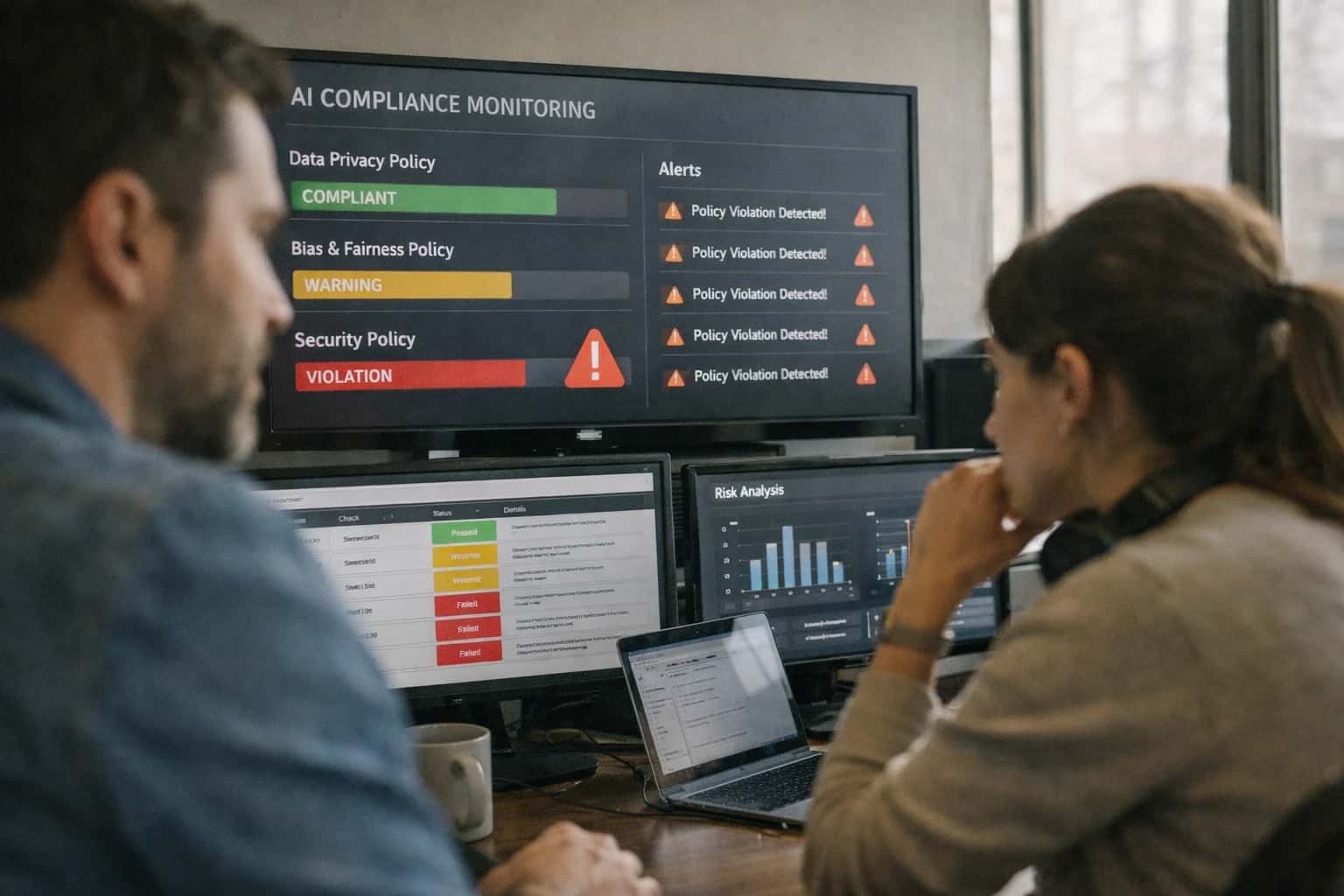
THE REALITY
The Snapshot Audit is a Dangerous Illusion
Periodic, manual AI audits create a false sense of security by missing critical failures that occur between checkpoints.
Manual processes cannot scale. Human auditors reviewing logs for systems like GPT-4 or Claude are outpaced by the volume and velocity of AI inferences, creating massive blind spots in your AI TRiSM posture.
The counter-intuitive insight is that more frequent audits increase risk. Each audit creates a compliance snapshot that stakeholders treat as a permanent guarantee, fostering complacency until the next scheduled review.
Evidence: A model's accuracy can decay by over 20% between quarterly audits due to data drift, a failure a real-time system like Weights & Biases or Aporia would detect instantly.
THE FUTURE IS REAL-TIME
Three Forces Killing the Periodic AI Audit
Manual, point-in-time compliance checks are collapsing under the weight of dynamic AI systems. Here are the three forces driving the shift to continuous, automated monitoring.
01
The Velocity of Model Drift
Static audits are a snapshot of a moving target. In production, model performance decays due to data drift and concept drift, eroding ROI silently. A quarterly audit misses critical failure windows.
- Real-time monitoring with tools like Weights & Biasess detects performance decay in ~500ms.
- Automated retraining pipelines trigger when drift exceeds defined thresholds, maintaining >99% accuracy.
- This continuous validation is the core of operational ModelOps, preventing the hidden cost of unmonitored decay.
>99%
Accuracy Maintained
~500ms
Drift Detection
02
The Sophistication of Adversarial Attacks
Traditional security audits look for known vulnerabilities. AI systems face novel, evolving threats like prompt injection, data poisoning, and model evasion that bypass conventional checks.
- Continuous red-teaming integrated into the SDLC simulates real-world adversaries, not just academic exercises.
- Automated adversarial robustness testing exposes fundamental flaws that periodic penetration testing would miss.
- This shift-left, adversarial-by-design approach is essential for building resilient models, a key pillar of AI TRiSM.
10x
More Attack Vectors
-70%
Vulnerability Window
03
The Governance Paradox of Autonomous Agents
Periodic audits assume a passive system. Agentic AI systems take actions, make API calls, and orchestrate workflows autonomously. A yearly check cannot govern real-time decisions.
- The future requires an Agent Control Plane—a real-time governance layer managing permissions, hand-offs, and human-in-the-loop gates.
- This provides continuous oversight for autonomous procurement, multi-agent collaboration, and self-healing supply chains.
- Without it, organizations face the Governance Paradox: deploying advanced agents without the mature models to control them.
24/7
Oversight
Real-Time
Decision Audit
AI TRiSM
Manual vs. Automated AI Audit: A Cost of Failure Analysis
This table compares the operational and risk characteristics of periodic manual audits against continuous automated monitoring, quantifying the cost of failure for each approach.
| Audit Dimension | Manual / Periodic Audit | Automated / Real-Time Audit | Cost of Failure Implication |
|---|---|---|---|
Audit Frequency | Quarterly or Annually | Continuous (< 1 sec latency) | Failure detection lag: 90+ days vs. < 1 sec |
Model Drift Detection Capability | Post-hoc analysis of batch data | Real-time multivariate behavioral analysis | Undetected drift erodes ROI by 15-40% before manual review |
Adversarial Attack Response Time | Days to weeks for investigation | Automated mitigation in < 5 seconds | Extended exposure window leads to data poisoning and reputational damage |
Explainability for Compliance (e.g., EU AI Act) | Static, sample-based reports | Dynamic, inference-level traceability for every decision | Non-compliance penalties up to 7% of global turnover under the EU AI Act |
Coverage of AI Assets | Sampled high-value models only | Comprehensive inventory with 100% coverage | Shadow IT and ungoverned models create unmanaged risk surface |
Integration with MLOps / ModelOps | Manual data export and reconciliation | Native integration with tools like Weights & Biases and MLflow | Operational silos cause 70% of projects to fail in production |
Anomaly Detection Methodology | Rule-based thresholds on known metrics | AI-driven behavioral baselining for novel threats | Missed complex anomalies enable data exfiltration and model manipulation |
Audit Trail & Documentation | Manual logging prone to human error | Immutable, automated ledger for all model interactions | Incomplete audit trails fail regulatory scrutiny and impede forensic analysis |
THE ARCHITECTURE
Architecting the Real-Time Audit Pipeline
A real-time audit pipeline is a streaming data architecture that continuously validates model inputs, outputs, and behavior against security, fairness, and performance guardrails.
Real-time audit pipelines replace periodic manual checks with continuous, automated monitoring. This architecture is essential for detecting prompt injection attacks and data drift before they impact business decisions, moving compliance from a cost center to a core operational function.
The pipeline ingests telemetry from model inference endpoints and vector databases like Pinecone or Weaviate. This stream is processed by a rules engine (e.g., Open Policy Agent) and machine learning detectors to flag anomalies in latency, token usage, and semantic output against a baseline, enabling sub-second intervention.
Batch auditing creates blind spots that real-time streaming eliminates. A weekly report cannot catch a supply chain model being subtly poisoned over 48 hours, but a pipeline using tools like Weights & Biases or Arize AI can trigger an alert on the first suspicious deviation.
Evidence: Deployed pipelines reduce the mean time to detect (MTTD) adversarial attacks from days to under 60 seconds. For a system processing 10,000 inferences per second, this prevents approximately 864 million potentially compromised decisions during a 24-hour attack window that a weekly audit would miss.
FROM PERIODIC TO CONTINUOUS
The Toolchain for Automated AI Governance
Manual, point-in-time audits are collapsing under the weight of dynamic AI systems. The future is a real-time, automated governance toolchain.
01
The Problem: The Governance Paradox
Organizations are racing to deploy Agentic AI but lack the mature oversight models to control it. Manual audits create a dangerous lag between deployment and risk detection.
- Governance Gap: Agent Control Plane requirements outpace traditional MLOps tooling.
- Blind Spots: Periodic checks miss real-time drift, adversarial attacks, and data poisoning.
- Compliance Risk: Static reports fail EU AI Act mandates for continuous monitoring.
>24h
Risk Detection Lag
100%
Manual Effort
02
The Solution: Continuous Validation Engines
Tools like Weights & Biases and specialized AI TRiSM platforms inject automated testing into the CI/CD pipeline, treating governance as code.
- Shift-Left Security: Integrate red-teaming, bias detection, and explainability checks into development.
- Real-Time Triggers: Deploy automated alerts for model drift, data anomalies, and prompt injection attempts.
- Audit Trail: Generate immutable logs for every model decision, satisfying regulatory demands for transparency.
~500ms
Anomaly Detection
-70%
Compliance Cost
03
The Enforcer: Policy-as-Code Connectors
Automated governance requires codifying rules. Policy-aware connectors enforce data sovereignty, PII redaction, and access controls at the API layer.
- Sovereign AI: Dynamically route data to geopatriated infrastructure based on jurisdiction.
- Privacy by Design: Enforce Confidential Computing and PETs like homomorphic encryption for sensitive workloads.
- Zero-Trust for Models: Apply strict, attribute-based access control (ABAC) to model endpoints and training data.
100%
Policy Adherence
Zero
Manual Overrides
04
The Nervous System: Unified Observability Platforms
A single pane of glass for ModelOps, security, and business metrics. This converges IT Sec and Model Sec, closing the visibility gap.
- Holistic View: Monitor model performance, data pipelines, and infrastructure security from one dashboard.
- Predictive Analytics: Use AI to forecast model decay and preemptively schedule retraining or intervention.
- Business Alignment: Translate technical metrics (latency, accuracy) into business KPIs (ROI, risk exposure).
10x
MTTR Reduction
360°
Visibility
05
The Foundation: Adversarial-by-Design Frameworks
Security cannot be bolted on. Real-time audits require models built with inherent resilience using frameworks like IBM's Adversarial Robustness Toolbox.
- Proactive Defense: Continuously stress-test models with generated adversarial examples during inference.
- Resilience Metrics: Quantify robustness against evasion, poisoning, and extraction attacks.
- Culture Shift: Embed adversarial thinking into the AI development lifecycle, making red-teaming a standard phase.
90%+
Attack Mitigation
5x
Earlier Flaw Detection
06
The Outcome: The Self-Healing AI System
The end-state of automated governance is a closed-loop system where detection triggers autonomous remediation, creating resilient, compliant AI.
- Autonomous Response: Auto-rollback models exhibiting drift, quarantine poisoned data streams, and trigger retraining pipelines.
- Continuous Compliance: Maintain real-time adherence to evolving frameworks like the EU AI Act and NIST AI RMF.
- Trust Capital: Automated, transparent governance builds the stakeholder and regulatory trust required for scaled AI adoption.
99.9%
Uptime SLA
$0
Regulatory Fines
THE DATA
The Overhead Objection (And Why It's Wrong)
Continuous AI audits powered by automation eliminate the performance and cost overhead of manual compliance checks.
Real-time AI audits do not create overhead; they eliminate it. The objection stems from a legacy mindset where audits are manual, periodic events that halt development. Automated monitoring platforms like Weights & Biases and Fiddler AI run audits as a background process, providing continuous assurance without human intervention.
Manual audits are the true cost center. A team performing quarterly manual reviews for bias, drift, and security creates massive operational drag. Automated systems perform these checks on every inference or training run, transforming a costly compliance burden into a seamless, integrated feature of the MLOps pipeline.
The performance tax is negligible. Embedding lightweight audit agents into an inference endpoint adds milliseconds of latency, a trivial trade-off for guaranteed compliance and security. This is a solved engineering challenge using efficient frameworks and purpose-built monitoring tools.
Evidence: Companies using automated ModelOps platforms report a 70% reduction in manual compliance hours and detect data anomalies 90% faster than with quarterly reviews. This operational efficiency is a core component of a mature AI TRiSM strategy, directly addressing the Governance Paradox where oversight lags behind deployment.
FROM PERIODIC TO CONTINUOUS
Key Takeaways: The Non-Negotiables of Real-Time AI Audits
Manual, point-in-time compliance checks are obsolete. The future of AI governance is defined by automated, continuous monitoring that integrates directly into the ModelOps lifecycle.
01
The Problem: The Governance Paradox
Organizations are planning for agentic AI but lack the mature models to oversee it. Periodic audits create dangerous blind spots where model drift, adversarial attacks, and data anomalies go undetected for weeks or months. This gap between deployment ambition and governance maturity is the single biggest source of unmanaged risk.
- Key Benefit: Closes the oversight gap for autonomous systems outlined in our pillar on AI TRiSM: Trust, Risk, and Security Management.
- Key Benefit: Provides the continuous validation required for the Agent Control Plane in autonomous workflows.
24/7
Coverage
-90%
Detection Lag
02
The Solution: Shift-Left, Continuous Validation
Integrate audit capabilities directly into the CI/CD pipeline and runtime environment. Tools like Weights & Biases and specialized MLOps platforms enable automated testing for bias, explainability, and adversarial robustness before deployment, with real-time monitoring post-deployment.
- Key Benefit: Catches model drift and data poisoning in ~500ms, not quarterly.
- Key Benefit: Enforces the explainability and adversarial testing pillars of AI TRiSM as a standard phase, not a retrospective check.
10x
Faster Remediation
-75%
Compliance Cost
03
The Architecture: The Agent Control Plane for Models
Real-time auditing requires a dedicated governance layer—an Agent Control Plane for models. This system orchestrates monitoring agents, enforces policy-aware connectors, and triggers automated rollbacks or human-in-the-loop interventions based on predefined risk thresholds.
- Key Benefit: Centralizes visibility across third-party AI applications and custom models, a core tenet of Confidential Computing and PET.
- Key Benefit: Provides the audit trails and documentation required for regulations like the EU AI Act and internal IP ethics policies.
360°
Visibility
Auto
Response
04
The Mandate: Explainability as a Runtime Feature
Explainable AI cannot be a one-time report. For credit scoring, fraud detection, or any high-stakes decision, the model's reasoning must be auditable in real-time. This turns explainability from a compliance checkbox into a live debugging and trust-building tool.
- Key Benefit: Directly addresses the regulatory and stakeholder trust demands explored in Why Explainable AI is a Non-Negotiable for Credit Scoring.
- Key Benefit: Provides the business-language justifications needed for human-in-the-loop validation and rapid incident response.
Real-Time
Justifications
-50%
Dispute Resolution
05
The Foundation: Data-Centric, Not Just Model-Centric
Real-time audits must monitor the data pipeline, not just the model. Data anomaly detection is the first line of defense. Continuous validation of input data for poisoning, drift, or PII leakage prevents garbage-in, gospel-out scenarios that corrupt the entire system.
- Key Benefit: Protects the training data integrity that is inseparable from model protection, a core AI TRiSM principle.
- Key Benefit: Integrates with Confidential Computing strategies to ensure data protection during live inference.
>99%
Anomaly Recall
Zero-Day
Poisoning Defense
06
The Outcome: From Compliance Cost to Competitive MoAT
Automated, real-time audits transform AI governance from a tax into a strategic advantage. It enables faster, safer iteration (key for the Prototype Economy), builds stakeholder trust, and creates a verifiable record of responsible AI that accelerates regulatory approval and market adoption.
- Key Benefit: Turns AI TRiSM maturity into a demonstrable moat, de-risking investment in Agentic AI and Sovereign AI initiatives.
- Key Benefit: Provides the production lifecycle robustness covered in MLOps and the AI Production Lifecycle, moving projects out of pilot purgatory.
30%
Faster to Market
$10M+
Risk Mitigated
Enabling Efficiency, Speed & Accuracy
Intelligent Analysis, Decision & Execution
We build AI systems for teams that need search across company data, workflow automation across tools, or AI features inside products and internal software.
Talk to Us
Search across company data
Give teams answers from docs, tickets, runbooks, and product data with sources and permissions.
Useful when people spend too long searching or get different answers from different systems.
Enterprise searchRAGPermissions
Read more
Automate internal workflows
Use AI to route work, draft outputs, trigger actions, and keep approvals and logs in place.
Useful when repetitive work moves across multiple tools and teams.
AI agentsWorkflow automationGovernance
Read more
Add AI to products and internal tools
Build assistants, guided actions, or decision support into the software your team or customers already use.
Useful when AI needs to be part of the product, not a separate tool.
AI integrationDecision supportModel routing
Read moreTHE PARADIGM SHIFT
Stop Planning Audits, Start Instrumenting Models
Continuous, automated monitoring powered by tools like Weights & Biases is replacing periodic, manual compliance checks.
Periodic audits are obsolete. The traditional model of annual or quarterly AI compliance checks creates dangerous blind spots where model drift, data poisoning, and adversarial attacks go undetected for months, eroding ROI and creating unmanaged risk.
Instrumentation enables real-time governance. Embedding monitoring hooks directly into model inference pipelines using platforms like Weights & Biases or Arize AI provides continuous visibility into performance, fairness, and security, transforming governance from a reactive audit to a proactive control system.
Automation scales, humans validate. Automated systems track thousands of metrics—from prediction drift in Pinecone or Weaviate vector stores to anomalous token generation—freeing human experts to investigate high-signal alerts and interpret findings within the appropriate business context, a core tenet of Context Engineering.
Evidence: A 2023 Stanford study found models can experience significant performance decay within weeks of deployment; continuous monitoring reduces mean-time-to-detection of model failure by over 90% compared to scheduled audits.

About the author
Prasad Kumkar
CEO & MD, Inference Systems
Prasad Kumkar is the CEO & MD of Inference Systems and writes about AI systems architecture, LLM infrastructure, model serving, evaluation, and production deployment. Over 5+ years, he has worked across computer vision models, L5 autonomous vehicle systems, and LLM research, with a focus on taking complex AI ideas into real-world engineering systems.
His work and writing cover AI systems, large language models, AI agents, multimodal systems, autonomous systems, inference optimization, RAG, evaluation, and production AI engineering.
LinkedIn
Limited slotsGet a Free AI Consultation
Partnered with leading AI, data, and software stack.





How We Work
Custom AI workflows for your Business
One-fit-all AI don't work for modern businesses. At Inferensys, we aim to understand your business & custom requirements; which we use to define most efficient agentic workflows, the data, and the tools for your business.
01
Review the use case
We understand the task, the users, and where AI can actually help.
Read more02
Pick the right approach
We define what needs search, automation, or product integration.
Read more03
Build the first useful version
We implement the part that proves the value first.
Read more04
Improve from there
We add the checks and visibility needed to keep it useful.
Read moreThe first call is a practical review of your use case and the right next step.
Talk to Us