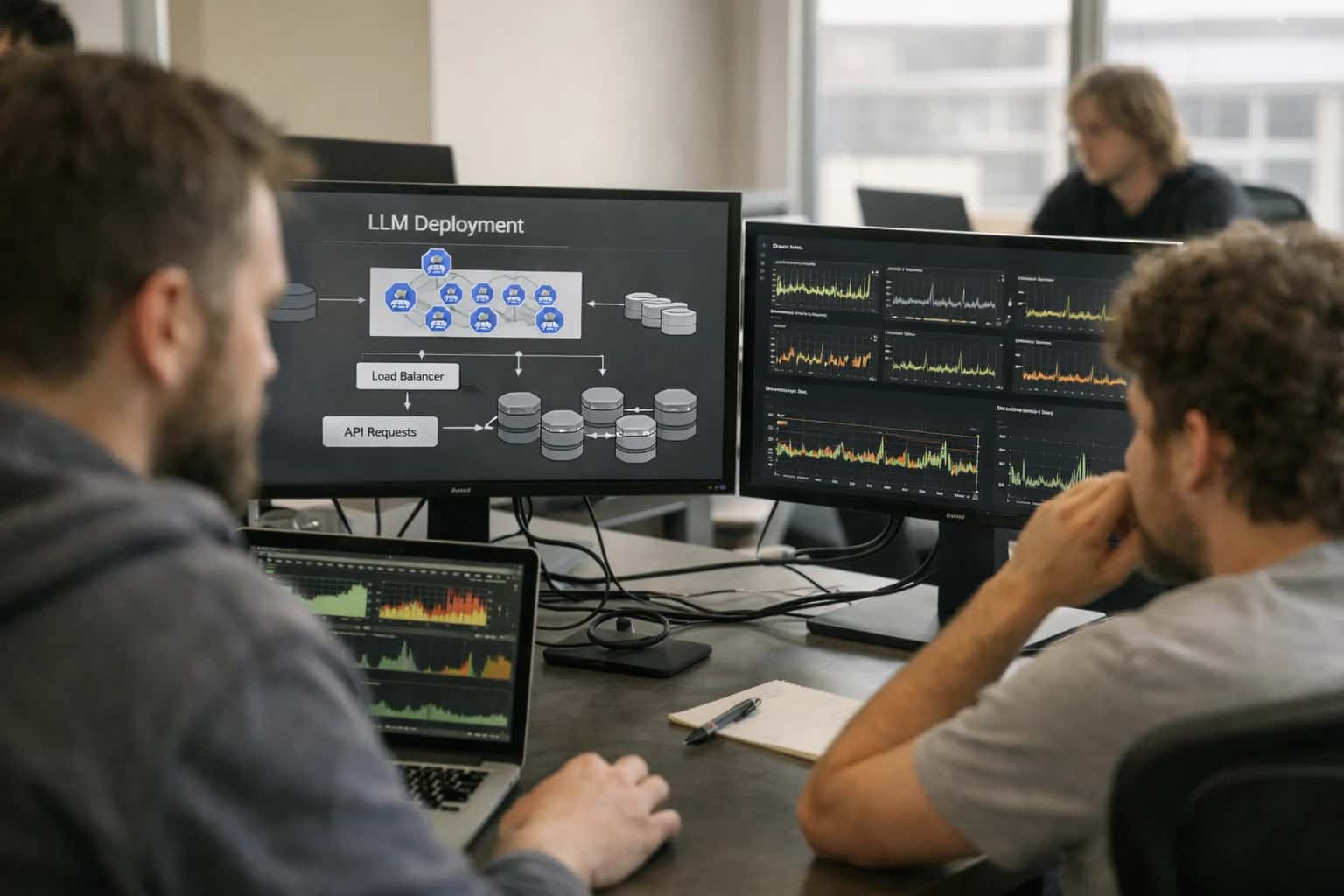
Vellum excels at developer-centric workflow orchestration and production deployment because of its deep integration with popular frameworks and focus on deterministic pipelines. For example, its visual workflow builder supports complex LangChain and LlamaIndex chains with built-in evaluation, versioning, and one-click deployment to scalable endpoints, reducing the time from prototype to production-grade API.

Comparison
Vellum vs. Humanloop
A technical analysis for CTOs and engineering leads comparing Vellum and Humanloop across prompt engineering, workflow orchestration, evaluation, and deployment for production LLM applications.
THE ANALYSIS
Introduction
A data-driven comparison of Vellum and Humanloop, two leading platforms for building and managing production LLM applications.
Humanloop takes a different approach by prioritizing rapid experimentation and collaborative prompt engineering. This results in a superior environment for iterative development and A/B testing across models like GPT-4 and Claude 3, but can introduce more abstraction before reaching a hardened deployment stage compared to Vellum's pipeline-first model.
The key trade-off: If your priority is operationalizing complex, multi-step LLM workflows with rigorous evaluation and governance, choose Vellum. If you prioritize fast iteration, team-based prompt management, and model benchmarking during the R&D phase, choose Humanloop. For a broader view of the LLMOps landscape, see our comparisons of Databricks Mosaic AI vs. MLflow 3.x and Arize Phoenix vs. Langfuse.
HEAD-TO-HEAD COMPARISON
Vellum vs. Humanloop Feature Comparison
Direct comparison of key metrics and features for LLM application development and deployment.
| Metric | Vellum | Humanloop |
|---|---|---|
Primary Architecture | Low-code workflow builder | Code-first SDK & API |
Native Workflow Orchestration | ||
Integrated LLM Evaluation Suite | ||
Production Deployment Model | Managed platform | Self-hosted or managed |
Supported LLM Providers | 10+ (OpenAI, Anthropic, etc.) | 6+ (OpenAI, Anthropic, etc.) |
Granular Cost & Latency Tracking | ||
A/B Testing & Canary Deployments | ||
Direct Git Integration |
Vellum vs. Humanloop
TL;DR Summary
Key strengths and trade-offs at a glance for two leading LLM application development platforms.
01
Choose Vellum for Production Workflows
Strengths in deployment and testing: Vellum excels with a visual workflow builder for complex, multi-step LLM chains and robust A/B testing with statistical significance scoring. Its zero-code deployments and built-in observability dashboards make it ideal for engineering teams needing to move quickly from prototype to monitored production, especially for customer-facing applications.
02
Choose Humanloop for Rapid Experimentation
Strengths in iterative development: Humanloop provides superior tools for rapid prompt iteration, side-by-side model comparisons (GPT-4, Claude, etc.), and collecting human feedback directly in the UI. Its fine-tuning data management and collaborative annotation features are best for research-heavy teams or projects where prompt optimization and model selection are the primary bottlenecks.
03
Vellum's Key Advantage: Operational Rigor
Specific advantage: Deep production integrations. Vellum offers native integrations with tools like Datadog and PagerDuty, and its evaluation suite supports programmatic guardrails (e.g., PII detection, fact-checking). This matters for teams requiring enterprise-grade LLM observability, SLA monitoring, and seamless integration into existing DevOps toolchains for high-stakes deployments.
04
Humanloop's Key Advantage: Developer-Led Optimization
Specific advantage: Integrated feedback loops. Humanloop's SDK and UI are designed to capture and learn from production feedback efficiently, facilitating continuous model improvement. This matters for applications where user preferences evolve, or where reinforcement learning from human feedback (RLHF) is a critical component of the development lifecycle.
CHOOSE YOUR PRIORITY
When to Choose: User Scenarios
Vellum for RAG
Verdict: The superior choice for high-stakes, complex retrieval pipelines. Strengths: Vellum excels with its battle-tested semantic search and hybrid retrieval capabilities, offering granular control over chunking, embedding, and re-ranking strategies. Its prompt management and evaluation suite are deeply integrated, allowing for systematic A/B testing of different RAG configurations against custom metrics. The platform provides robust trace-level logging for debugging retrieval failures, making it ideal for applications where accuracy and auditability are paramount, such as in regulated industries or complex knowledge bases.
Humanloop for RAG
Verdict: A strong contender for teams prioritizing rapid prototyping and developer velocity. Strengths: Humanloop shines with its low-latency API and simpler, more intuitive interface for building RAG workflows. Its focus on collaborative prompt engineering and real-time playground allows product managers and developers to iterate quickly. While it covers core retrieval needs, it may lack the depth of advanced optimization and evaluation tooling found in Vellum for billion-scale vector deployments. It's best for applications where time-to-market and ease of use outweigh the need for ultra-fine-grained pipeline control.
Enabling Efficiency, Speed & Accuracy
Intelligent Analysis, Decision & Execution
We build AI systems for teams that need search across company data, workflow automation across tools, or AI features inside products and internal software.
Talk to Us
Search across company data
Give teams answers from docs, tickets, runbooks, and product data with sources and permissions.
Useful when people spend too long searching or get different answers from different systems.
Enterprise searchRAGPermissions
Read more
Automate internal workflows
Use AI to route work, draft outputs, trigger actions, and keep approvals and logs in place.
Useful when repetitive work moves across multiple tools and teams.
AI agentsWorkflow automationGovernance
Read more
Add AI to products and internal tools
Build assistants, guided actions, or decision support into the software your team or customers already use.
Useful when AI needs to be part of the product, not a separate tool.
AI integrationDecision supportModel routing
Read moreTHE ANALYSIS
Final Verdict and Recommendation
Choosing between Vellum and Humanloop hinges on prioritizing developer-centric workflow orchestration versus a research-driven, evaluation-first approach.
Vellum excels at production-ready workflow orchestration because of its native integration with complex logic, branching, and API calls. For example, its visual workflow builder enables engineers to construct and deploy sophisticated agentic or RAG pipelines with built-in observability, reducing the time from prototype to production. This makes it a strong choice for teams needing to operationalize multi-step LLM applications quickly, as discussed in our pillar on LLMOps and Observability Tools.
Humanloop takes a different approach by prioritizing rigorous, data-driven prompt evaluation and optimization. This results in a trade-off where initial experimentation and A/B testing are more streamlined, but deploying complex, stateful workflows may require more custom engineering. Its strength lies in systematic improvement of prompt quality and cost-efficiency through detailed performance metrics across model providers.
The key trade-off: If your priority is rapid deployment of reliable, complex LLM workflows (e.g., customer support agents, data enrichment pipelines), choose Vellum. Its tooling is built for the engineering discipline outlined in our comparison of Databricks Mosaic AI vs. MLflow 3.x. If you prioritize methodical prompt optimization, comparative model evaluation, and controlled experimentation before scaling, choose Humanloop. Its platform is designed for teams that treat prompt engineering as a continuous, metrics-driven process, similar to the evaluation focus seen in TruLens vs. Langfuse.

About the author
Prasad Kumkar
CEO & MD, Inference Systems
Prasad Kumkar is the CEO & MD of Inference Systems and writes about AI systems architecture, LLM infrastructure, model serving, evaluation, and production deployment. Over 5+ years, he has worked across computer vision models, L5 autonomous vehicle systems, and LLM research, with a focus on taking complex AI ideas into real-world engineering systems.
His work and writing cover AI systems, large language models, AI agents, multimodal systems, autonomous systems, inference optimization, RAG, evaluation, and production AI engineering.
LinkedIn
Limited slotsGet a Free AI Consultation
Partnered with leading AI, data, and software stack.





How We Work
Custom AI workflows for your Business
One-fit-all AI don't work for modern businesses. At Inferensys, we aim to understand your business & custom requirements; which we use to define most efficient agentic workflows, the data, and the tools for your business.
01
Review the use case
We understand the task, the users, and where AI can actually help.
Read more02
Pick the right approach
We define what needs search, automation, or product integration.
Read more03
Build the first useful version
We implement the part that proves the value first.
Read more04
Improve from there
We add the checks and visibility needed to keep it useful.
Read moreThe first call is a practical review of your use case and the right next step.
Talk to Us