TruLens excels at programmatic, chain-of-thought evaluation through its framework of composable feedback functions. It enables developers to define custom metrics—like groundedness, relevance, or toxicity—that run automatically on each LLM trace. This is critical for high-stakes, automated validation where you need to score hallucination rates or verify context faithfulness in a RAG pipeline without manual review. Its strength is turning subjective quality checks into quantifiable, automated gates.

Comparison
TruLens vs. Langfuse
A technical comparison of two leading LLM observability tools. TruLens focuses on programmatic evaluation with feedback functions, while Langfuse provides an integrated platform for tracing, analytics, and human feedback. This analysis helps CTOs and engineering leads select the right tool for debugging and monitoring LLM applications.
THE ANALYSIS
Introduction
A foundational comparison of TruLens and Langfuse, two leading open-source tools for evaluating and debugging LLM applications.
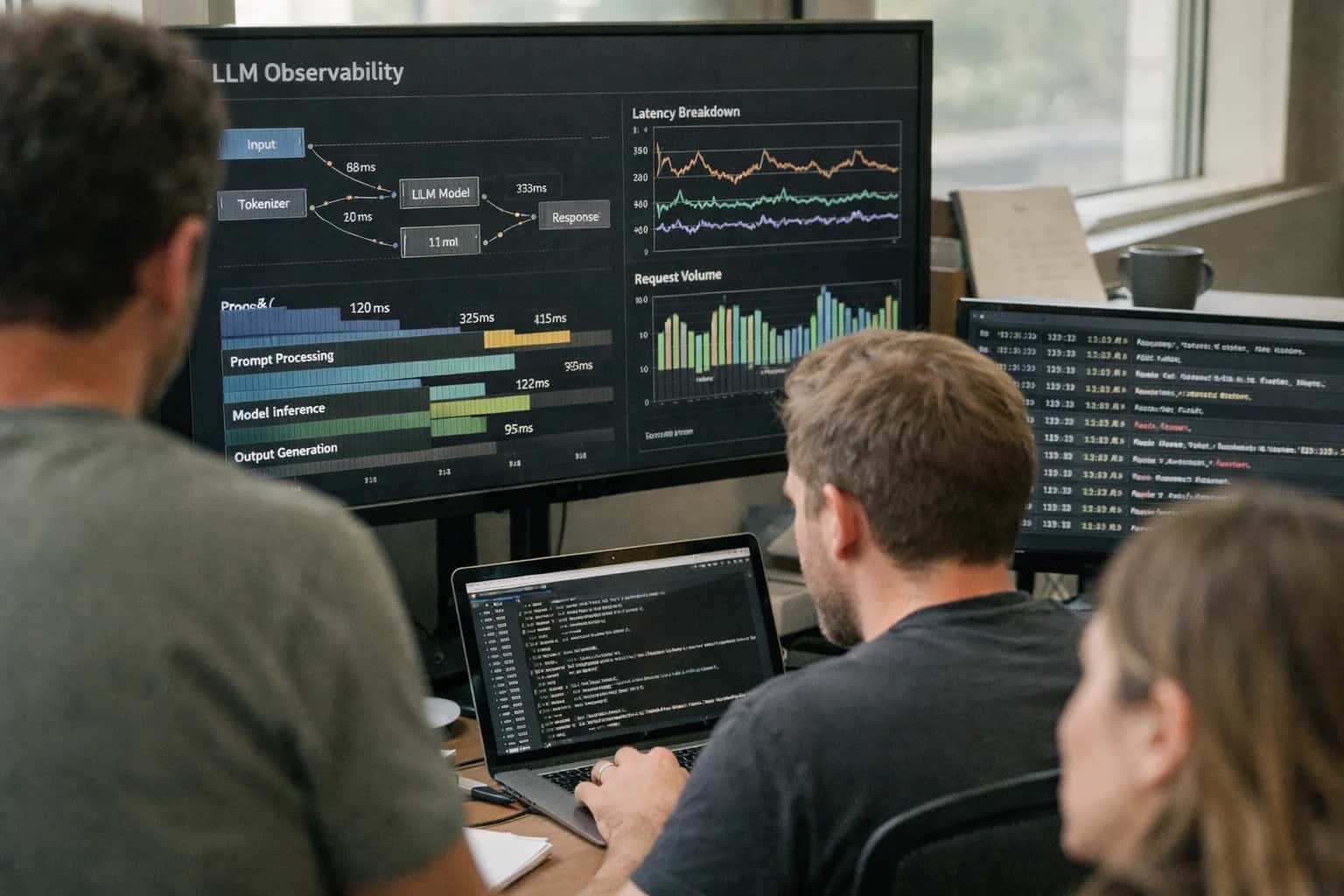
Langfuse takes a different, more holistic approach by integrating tracing, analytics, and human evaluation into a single observability platform. It provides granular, visual traces of complex LLM workflows (e.g., LangGraph agents) and couples them with built-in analytics for cost, latency, and usage. This results in a trade-off: while its evaluation capabilities are more dashboard-centric and geared for human review, its integrated nature offers superior production monitoring and collaborative debugging for teams managing live applications.
The key trade-off: If your priority is automated, quantitative evaluation to enforce quality gates in CI/CD, choose TruLens. Its feedback functions provide the rigor needed for agentic systems and RAG pipelines. If you prioritize integrated production observability with rich tracing and team-based analytics to debug complex, live LLM apps, choose Langfuse. For a broader view of the LLMOps landscape, explore our comparisons of Databricks Mosaic AI vs. MLflow 3.x and Arize Phoenix vs. Langfuse.
HEAD-TO-HEAD COMPARISON
TruLens vs. Langfuse
Direct comparison of key LLM evaluation and observability features for debugging AI applications.
| Metric / Feature | TruLens | Langfuse |
|---|---|---|
Primary Architecture | Programmatic evaluation framework | Integrated tracing & analytics platform |
Core Evaluation Method | Feedback functions (programmatic metrics) | Human & model-based scoring (scorecards) |
Tracing & Logging | Basic chain-of-thought logging | Granular, visual trace explorer |
Human-in-the-Loop Evaluation | ||
Cost & Latency Tracking | Basic cost aggregation | Detailed per-trace token/price/latency |
SDK & Framework Integration | LangChain, LlamaIndex | LangChain, LlamaIndex, OpenAI SDK, LiteLLM |
Self-Hosted Deployment | ||
Pricing Model (Cloud) | Usage-based | Free tier + usage-based |
TruLens vs. Langfuse
TL;DR Summary
Key strengths and trade-offs at a glance for two leading LLM evaluation and observability tools.
01
Choose TruLens for Programmatic Evaluation
Core Strength: A Python-first framework for defining custom, automated feedback functions (e.g., relevance, hallucination, toxicity) using providers like OpenAI or Hugging Face. This matters for teams needing repeatable, objective metrics to score LLM outputs across thousands of runs without manual review. It excels in CI/CD pipelines for regression testing and benchmarking model versions.
02
Choose Langfuse for Integrated Observability
Core Strength: A full-stack platform combining tracing, analytics, and human evaluation in a single UI. It automatically captures detailed traces from frameworks like LangChain and LlamaIndex. This matters for teams requiring end-to-end visibility into complex chains/agents, user analytics (cost, latency, usage), and seamless workflows for human raters to label data directly in the tool.
03
TruLens: Deep Customization & Chain-of-Thought Analysis
Specific advantage: Enables fine-grained instrumentation to track and evaluate intermediate steps (reasoning, tool calls) within an agentic workflow using its TruChain wrapper. This matters for debugging intricate reasoning processes and validating that each step meets defined quality thresholds, which is critical for high-stakes or agentic applications.
04
Langfuse: Production Analytics & Collaboration
Specific advantage: Offers built-in dashboards for monitoring key metrics (token cost, latency, user satisfaction) and facilitates team collaboration via shared projects and dataset management. This matters for product and engineering teams who need to monitor application health, identify cost outliers, and collaboratively improve prompts based on real-user interactions.
CHOOSE YOUR PRIORITY
When to Choose: User Scenarios
TruLens for RAG
Verdict: Choose TruLens for rigorous, programmatic evaluation of retrieval quality and answer faithfulness.
Strengths: Its core competency is feedback functions—custom, automated metrics for evaluating hallucinations, context relevance, and answer correctness. This is critical for validating RAG pipelines before production. You can define precise, chain-of-thought evaluations (e.g., using groundedness or context_relevance) that run automatically on each trace, providing quantitative scores to benchmark against. It integrates deeply with frameworks like LlamaIndex and LangChain.
Limitations: Primarily an evaluation library; you'll need to build your own dashboards or integrate with other tools for long-term analytics and human review workflows.
Langfuse for RAG
Verdict: Choose Langfuse for end-to-end observability, debugging, and collaborative improvement of live RAG applications. Strengths: Provides a production-ready platform with automatic tracing of LLM calls, tool usage, and retrieval steps. Its UI visualizes the entire RAG chain, making it easy to pinpoint where a retrieval failed or the LLM hallucinated. Built-in session analytics and human feedback collection (via thumbs up/down or scorecards) allow teams to continuously improve prompts and retrieval strategies based on real usage. It's a unified system for tracing, analytics, and evaluation. Limitations: Its automated evaluation metrics are less customizable than TruLens's programmatic feedback functions; it's stronger on observability and human-in-the-loop workflows.
Enabling Efficiency, Speed & Accuracy
Intelligent Analysis, Decision & Execution
We build AI systems for teams that need search across company data, workflow automation across tools, or AI features inside products and internal software.
Talk to Us
Search across company data
Give teams answers from docs, tickets, runbooks, and product data with sources and permissions.
Useful when people spend too long searching or get different answers from different systems.
Enterprise searchRAGPermissions
Read more
Automate internal workflows
Use AI to route work, draft outputs, trigger actions, and keep approvals and logs in place.
Useful when repetitive work moves across multiple tools and teams.
AI agentsWorkflow automationGovernance
Read more
Add AI to products and internal tools
Build assistants, guided actions, or decision support into the software your team or customers already use.
Useful when AI needs to be part of the product, not a separate tool.
AI integrationDecision supportModel routing
Read moreTHE ANALYSIS
Final Verdict
Choosing between TruLens and Langfuse hinges on whether your priority is rigorous, automated evaluation or integrated, human-in-the-loop observability.
TruLens excels at programmatic, chain-of-thought evaluation because of its framework-first design centered on feedback functions. For example, you can define custom metrics for hallucination detection, toxicity, or answer relevance and run them automatically across thousands of LLM traces, enabling data-driven iteration on your prompts and chains. This makes it a powerful tool for developers and researchers who need to benchmark and improve model performance systematically before deployment, similar to how you might use Arize Phoenix for deep evaluation.
Langfuse takes a different approach by providing an integrated platform for tracing, analytics, and human feedback. This results in a comprehensive view of your LLM application's behavior in production, where you can visualize granular traces, track costs and latency, and seamlessly collect human ratings. Its strength lies in operational observability and facilitating a collaborative feedback loop between developers and domain experts, a capability also highlighted in our comparison of Langfuse vs. Arize Phoenix.
The key trade-off: If your priority is automated, scalable evaluation and benchmarking to iteratively improve your LLM chains, choose TruLens. Its feedback functions provide the rigor needed for pre-production testing. If you prioritize production monitoring, collaborative debugging, and integrating human judgment into your observability loop, choose Langfuse. Its all-in-one dashboard and feedback mechanisms are designed for ongoing management of live applications, aligning with broader trends in LLMOps and Observability Tools.
TruLens vs. Langfuse
Why Work With Us
Key strengths and trade-offs at a glance. Choose TruLens for programmatic, chain-of-thought evaluation. Choose Langfuse for integrated tracing, analytics, and human feedback.
01
Choose TruLens For
Programmatic Evaluation with Feedback Functions: TruLens excels at defining custom, automated evaluation metrics (like groundedness, relevance) that run on every LLM call. This is critical for high-volume, automated testing of RAG pipelines and agentic workflows where you need consistent, objective scoring.
Custom Metrics
Programmatic Evaluation
02
Choose TruLens For
Deep Chain-of-Thought Debugging: Its framework is built to instrument and evaluate each step in a complex LLM chain or agent. This provides unparalleled visibility into the reasoning process, making it ideal for debugging hallucination sources or performance bottlenecks in multi-step applications.
Step-Level
Reasoning Traces
03
Choose Langfuse For
Integrated Tracing & Analytics Platform: Langfuse combines detailed LLM call tracing with a ready-made dashboard for analytics (latency, cost, usage) and session review. This matters for teams needing a single pane of glass to monitor production applications and understand user interactions.
Unified UI
Tracing + Analytics
04
Choose Langfuse For
Built-in Human Feedback Loops: It natively supports collecting and managing human ratings and categorical labels directly within traces. This is essential for curating golden datasets, calibrating automated evaluators, and implementing continuous improvement cycles based on real user feedback.
Human-in-the-Loop
Feedback Management

About the author
Prasad Kumkar
CEO & MD, Inference Systems
Prasad Kumkar is the CEO & MD of Inference Systems and writes about AI systems architecture, LLM infrastructure, model serving, evaluation, and production deployment. Over 5+ years, he has worked across computer vision models, L5 autonomous vehicle systems, and LLM research, with a focus on taking complex AI ideas into real-world engineering systems.
His work and writing cover AI systems, large language models, AI agents, multimodal systems, autonomous systems, inference optimization, RAG, evaluation, and production AI engineering.
LinkedIn
Limited slotsGet a Free AI Consultation
Partnered with leading AI, data, and software stack.





How We Work
Custom AI workflows for your Business
One-fit-all AI don't work for modern businesses. At Inferensys, we aim to understand your business & custom requirements; which we use to define most efficient agentic workflows, the data, and the tools for your business.
01
Review the use case
We understand the task, the users, and where AI can actually help.
Read more02
Pick the right approach
We define what needs search, automation, or product integration.
Read more03
Build the first useful version
We implement the part that proves the value first.
Read more04
Improve from there
We add the checks and visibility needed to keep it useful.
Read moreThe first call is a practical review of your use case and the right next step.
Talk to Us