iUNU excels at high-resolution, vision-based plant monitoring and robotic orchestration within greenhouses. Its LUNA platform uses a network of high-definition cameras and sensors to track individual plant growth metrics—such as stem diameter, leaf count, and canopy coverage—with millimeter precision. This results in a closed-loop system where data directly controls automated lighting, irrigation, and harvesting robots, demonstrably increasing yield density and operational consistency for large-scale, single-crop facilities.

Comparison
iUNU vs Artemis
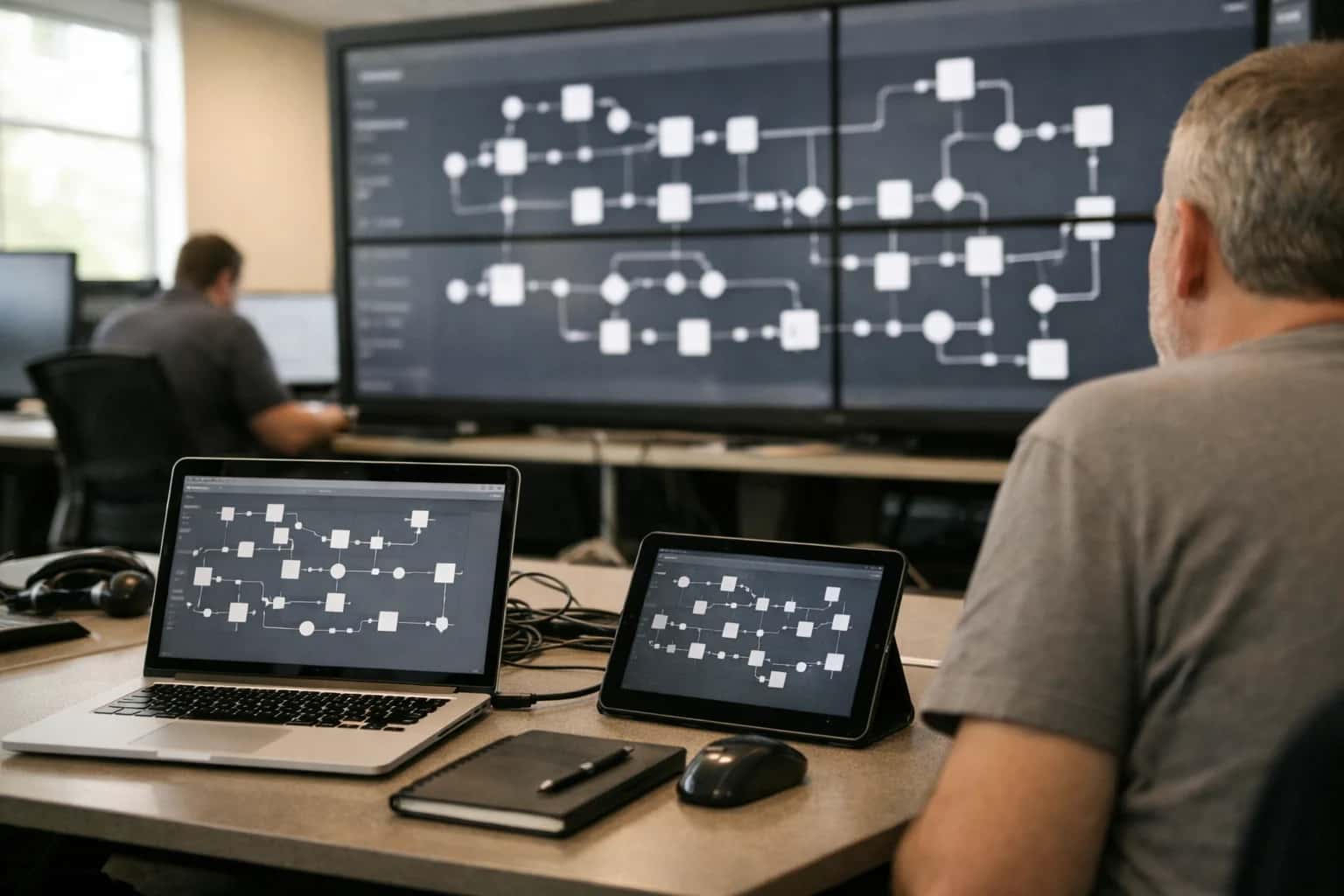
A technical comparison of iUNU and Artemis, two leading AI platforms for greenhouse automation. This analysis evaluates vision-based growth tracking, climate control integration, and robotic system orchestration to help CTOs and engineering leads select the optimal platform for controlled environment agriculture.
THE ANALYSIS
Introduction
A data-driven comparison of two leading AI platforms for controlled environment agriculture.
Artemis takes a different approach by prioritizing broad climate control integration and predictive analytics for diverse, multi-crop environments. Its strength lies in aggregating data from a wider array of environmental sensors (CO2, humidity, PAR light) and external weather APIs to model and predict microclimate conditions. This strategy enables superior energy optimization and risk mitigation against disease outbreaks but can trade off some of the granular, per-plant visibility that iUNU provides.
The key trade-off: If your priority is maximizing yield and automation in a homogeneous crop environment, choose iUNU for its surgical, robot-driven precision. If you prioritize energy efficiency, climate risk resilience, and managing a varied crop portfolio, choose Artemis for its holistic, predictive ecosystem modeling. For further context on AI's role in sustainable infrastructure, explore our pillar on AI for Sustainable Food and Urban Infrastructure and related comparisons like AeroFarms AI vs Plenty AI for vertical farming.
HEAD-TO-HEAD COMPARISON
iUNU vs Artemis: Greenhouse Automation AI Comparison
Direct comparison of key metrics and features for AI-driven controlled environment agriculture platforms.
| Metric | iUNU | Artemis |
|---|---|---|
Core Technology | Fixed-mount, high-resolution camera network | Mobile robotic scouting systems |
Growth Tracking Granularity | Per-plant, continuous monitoring | Per-zone, periodic sampling |
Climate Control Integration | Direct API to BMS/controllers | Data feed to third-party BMS |
Robotic System Orchestration | Limited to fixed infrastructure | Direct control of mobile harvest/trim bots |
Data Output Latency | < 5 seconds | ~2-5 minutes |
Typical Deployment Scale | Single large facility (>5 acres) | Multi-facility enterprise networks |
Actionable Alert Types | Growth rate deviation, stress detection | Pest/disease hotspot, yield forecast |
iUNU vs Artemis
TL;DR Summary
Key strengths and trade-offs at a glance for greenhouse automation AI platforms.
01
Choose iUNU for Vision-Centric Growth Tracking
Specific advantage: Deploys a proprietary LUNA camera network for plant-level, 24/7 computer vision monitoring. This matters for operations requiring granular, real-time growth metrics (e.g., stem diameter, leaf count) to optimize yield and catch diseases early. Its strength is in high-resolution, continuous data capture.
02
Choose Artemis for Climate & Robotic System Orchestration
Specific advantage: Excels at integrating and controlling diverse subsystems (HVAC, irrigation, robotic movers) into a unified automation layer. This matters for large-scale, multi-vendor greenhouse operations seeking to automate complex workflows like harvesting or pruning through centralized robotic orchestration.
03
Choose iUNU for Actionable, Per-Plant Insights
Specific advantage: Transforms visual data into individual plant health scores and predictive yield models. This matters for high-value crops (e.g., cannabis, specialty berries) where maximizing the output and quality of each plant directly impacts profitability and complies with strict cultivation protocols.
04
Choose Artemis for Legacy System Integration & Scalability
Specific advantage: Built with a strong API-first architecture and support for industrial protocols (e.g., Modbus, OPC UA). This matters for retrofitting existing greenhouse infrastructure or scaling across multiple facilities with heterogeneous equipment, minimizing vendor lock-in and integration headaches.
CHOOSE YOUR PRIORITY
When to Choose iUNU vs Artemis
iUNU for RAG
Verdict: Superior for integrating structured operational data. Strengths: iUNU's platform excels at ingesting and structuring time-series data from climate sensors, irrigation systems, and robotic actuators. Its API provides clean, contextualized data streams (e.g., temperature, humidity, growth stage) that are ideal for populating a vector database with precise operational facts. This enables highly accurate retrieval for queries about historical yield under specific conditions or optimal climate setpoints. Considerations: Primarily designed for internal system data, not general web or document scraping.
Artemis for RAG
Verdict: Better for unstructured visual and external data fusion. Strengths: Artemis's core competency is processing high-resolution imagery and video feeds. Its vision models can generate rich, descriptive embeddings of plant phenotypes, pest presence, and canopy coverage. This is perfect for a multimodal RAG system that needs to answer questions by retrieving similar visual scenarios or correlating external research papers with observed plant stress symptoms. Considerations: May require more engineering to tightly couple visual retrieval with structured climate data from other sources.
Enabling Efficiency, Speed & Accuracy
Intelligent Analysis, Decision & Execution
We build AI systems for teams that need search across company data, workflow automation across tools, or AI features inside products and internal software.
Talk to Us
Search across company data
Give teams answers from docs, tickets, runbooks, and product data with sources and permissions.
Useful when people spend too long searching or get different answers from different systems.
Enterprise searchRAGPermissions
Read more
Automate internal workflows
Use AI to route work, draft outputs, trigger actions, and keep approvals and logs in place.
Useful when repetitive work moves across multiple tools and teams.
AI agentsWorkflow automationGovernance
Read more
Add AI to products and internal tools
Build assistants, guided actions, or decision support into the software your team or customers already use.
Useful when AI needs to be part of the product, not a separate tool.
AI integrationDecision supportModel routing
Read moreTHE ANALYSIS
Final Verdict and Recommendation
A data-driven conclusion on which greenhouse automation AI platform is the right strategic fit for your controlled environment agriculture (CEA) operation.
iUNU excels at providing a holistic, integrated command center for greenhouse operations. Its strength lies in the seamless orchestration of vision-based growth tracking (using its LUNA AI camera system), climate control systems, and robotic material handling. For example, its platform can correlate canopy coverage data from computer vision with irrigation schedules and nutrient dosing, enabling closed-loop control that has demonstrated yield increases of 10-15% in commercial tomato operations. This makes it a powerful tool for operators seeking to automate and optimize an entire facility from a single pane of glass.
Artemis takes a different, more modular and API-first approach by focusing on becoming the universal data layer and control plane for CEA. Its strategy is to aggregate and normalize data from a vast array of disparate sensors, equipment brands (e.g., Priva, Argus, TrolMaster), and imaging systems, then expose it via robust APIs. This results in a trade-off: while it offers superior flexibility for custom integrations and building proprietary analytics on top, it requires more in-house engineering effort to achieve the same level of pre-packaged, turnkey automation that iUNU provides out-of-the-box.
The key trade-off is between a comprehensive, vendor-locked ecosystem and a flexible, agnostic data fabric. If your priority is rapid deployment of a fully automated, vision-centric growth optimization system with minimal custom development, choose iUNU. Its integrated stack is ideal for high-value crop production where maximizing yield per square foot is paramount. If you prioritize long-term flexibility, have a heterogeneous equipment environment, or need to build custom AI models and applications on top of your farm data, choose Artemis. Its API-centric model is better suited for large-scale operators, research institutions, or those developing proprietary IP who need to future-proof their tech stack against vendor lock-in. For more on the underlying AI models powering such systems, see our guide on Multimodal Foundation Model Benchmarking.

About the author
Prasad Kumkar
CEO & MD, Inference Systems
Prasad Kumkar is the CEO & MD of Inference Systems and writes about AI systems architecture, LLM infrastructure, model serving, evaluation, and production deployment. Over 5+ years, he has worked across computer vision models, L5 autonomous vehicle systems, and LLM research, with a focus on taking complex AI ideas into real-world engineering systems.
His work and writing cover AI systems, large language models, AI agents, multimodal systems, autonomous systems, inference optimization, RAG, evaluation, and production AI engineering.
LinkedIn
Limited slotsGet a Free AI Consultation
Partnered with leading AI, data, and software stack.





How We Work
Custom AI workflows for your Business
One-fit-all AI don't work for modern businesses. At Inferensys, we aim to understand your business & custom requirements; which we use to define most efficient agentic workflows, the data, and the tools for your business.
01
Review the use case
We understand the task, the users, and where AI can actually help.
Read more02
Pick the right approach
We define what needs search, automation, or product integration.
Read more03
Build the first useful version
We implement the part that proves the value first.
Read more04
Improve from there
We add the checks and visibility needed to keep it useful.
Read moreThe first call is a practical review of your use case and the right next step.
Talk to Us