AI now optimizes for circularity by default. The primary search query for material scientists has shifted from 'strongest' or 'lightest' to 'most sustainable under performance constraints.' This is achieved through multi-objective optimization algorithms that treat recyclability and carbon footprint as first-class design variables, not afterthoughts.

Blog
The Future of AI in Designing Sustainable and Circular Materials
AI is shifting from optimizing material performance to designing for end-of-life. This post explains how Graph Neural Networks, autonomous labs, and digital twins are creating materials with low embodied carbon, high recyclability, and built-in circularity.
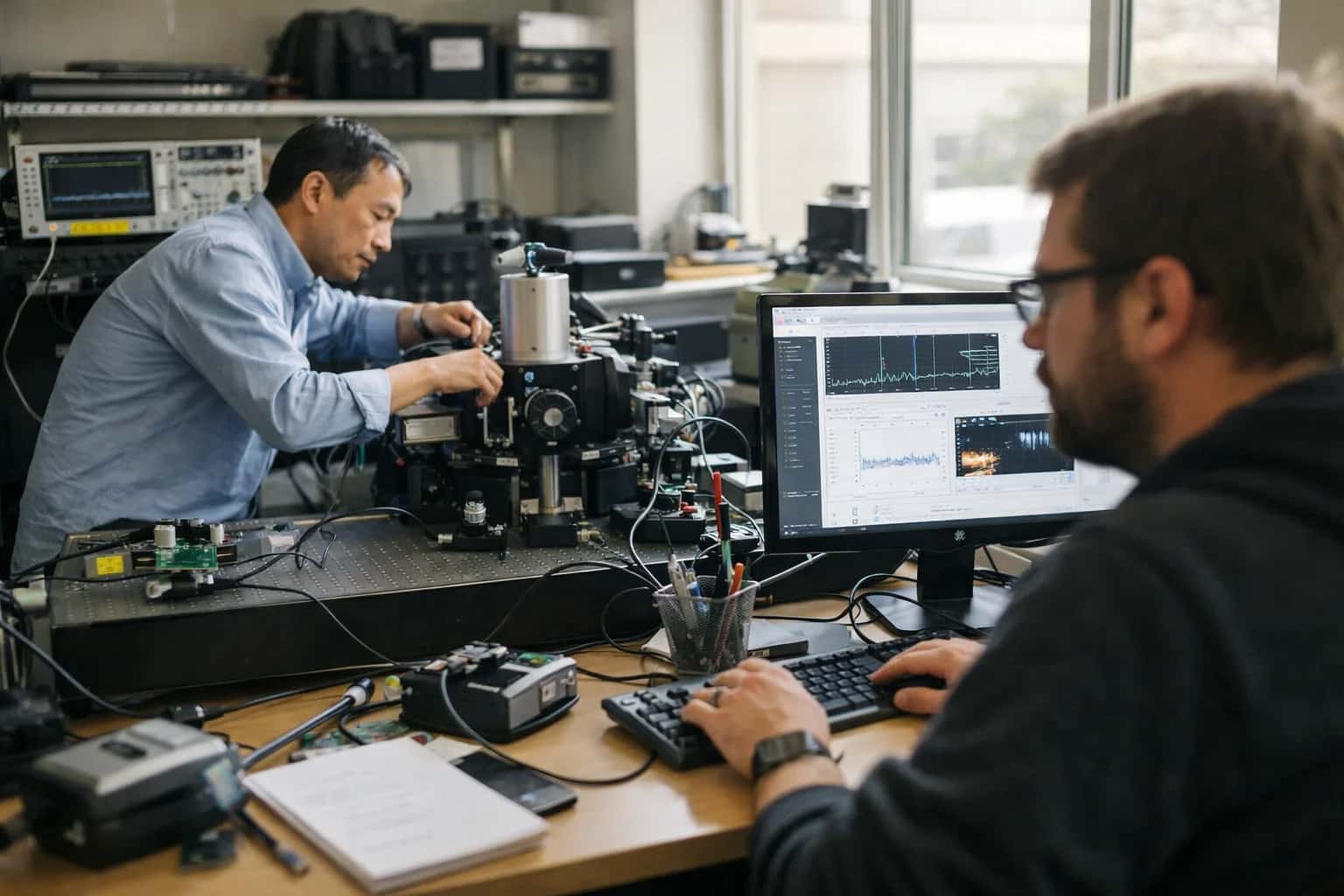
THE MULTI-OBJECTIVE SHIFT
Performance is No Longer Enough
AI-driven material design now mandates simultaneous optimization for recyclability, biodegradability, and low embodied carbon alongside traditional performance metrics.
Generative models propose inherently circular structures. Tools like inverse design networks are trained on datasets annotated with end-of-life properties, enabling them to generate material candidates with built-in disassembly pathways or benign degradation products, moving beyond simple screening of known options.
The cost of ignoring this shift is regulatory and commercial obsolescence. Materials optimized solely for performance will fail under regulations like the EU's Carbon Border Adjustment Mechanism (CBAM) and consumer demand for circular products. This creates a direct liability for CTOs overseeing product development.
Evidence: AI reduces embodied carbon by 30-50% in early design. For example, a Physics-Informed Neural Network (PINN) optimizing a polymer for packaging can simultaneously maximize barrier properties while minimizing fossil-based feedstock, directly lowering the material's cradle-to-gate carbon footprint before synthesis begins. This integration is core to our work in Carbon Accounting and Climate Tech AI.
Digital twins validate circular performance. A digital twin of a material or component can simulate not just mechanical stress but also chemical recycling processes or environmental degradation, providing critical validation for AI-generated designs before physical prototyping. This connects directly to our insights on Digital Twins and the Industrial Metaverse.
FROM LINEAR TO CIRCULAR
Three AI Trends Redefining Sustainable Material Design
AI is shifting material science from a performance-first paradigm to one that optimizes for end-of-life, enabling a true circular economy.
01
Inverse Design for Circularity
The Problem: Designing for recyclability is an afterthought, leading to materials that perform well but create toxic or non-recyclable waste. The Solution: Generative AI models are trained with circularity as a primary constraint, proposing novel polymer backbones and composite architectures that are inherently easier to disassemble and reuse.
- Key Benefit: Proposes materials with built-in chemical recycling pathways.
- Key Benefit: Optimizes for monomaterial structures to eliminate complex, inseparable laminates.
100x
Search Space
-70%
Downcycling
02
Multi-Objective Optimization for the Full Lifecycle
The Problem: Material selection trades off performance against sustainability, often ignoring embodied carbon and end-of-life processing energy. The Solution: AI-driven multi-objective optimization evaluates thousands of candidates against a weighted score of strength, cost, embodied carbon, and biodegradability.
- Key Benefit: Balances ~15 competing variables simultaneously, impossible for human intuition.
- Key Benefit: Integrates real-time Life Cycle Assessment (LCA) databases for accurate carbon accounting.
-40%
Embodied Carbon
5/5
Objectives Met
03
The Autonomous Lab for Closed-Loop Validation
The Problem: Physical testing of sustainable material hypotheses is slow, expensive, and creates its own experimental waste stream. The Solution: Self-driving laboratories use robotic synthesis and AI planning agents to physically test AI-generated material designs, creating a closed-loop system that learns from real-world data.
- Key Benefit: Compresses 18-month validation cycles into ~6 weeks.
- Key Benefit: Generates high-fidelity, proprietary data on degradation and recyclability to refine digital twins.
10x
Iteration Speed
-90%
Lab Waste
THE PARADIGM SHIFT
From Single Metric to Pareto Frontier: AI's New Optimization Mandate
AI in material science has evolved from optimizing for a single property to navigating a multi-dimensional trade-off space for true sustainability.
AI's new mandate is multi-objective optimization. The era of designing materials to maximize a single property, like tensile strength, is over. Sustainable innovation requires balancing competing goals—performance, cost, recyclability, and embodied carbon—simultaneously. This is a Pareto optimization problem, where improving one metric degrades another, and AI algorithms like NSGA-II (Non-dominated Sorting Genetic Algorithm II) are essential for discovering the optimal trade-off frontier.
Single-point optimization creates brittle solutions. A material optimized purely for lightweighting may be impossible to recycle or source ethically, creating downstream supply chain and regulatory risk. AI must now evaluate the full lifecycle, integrating data from tools like SimaPro for life-cycle assessment (LCA) and circular economy platforms to model end-of-use scenarios. This moves design from a linear to a systems-thinking approach.
The Pareto frontier is your strategic map. The set of non-dominated optimal solutions forms a frontier, revealing the true trade-offs. For example, a graph neural network can screen polymer libraries to map the frontier between biodegradation rate and drug encapsulation efficiency. This allows CTOs to make informed strategic choices based on commercial priorities, rather than pursuing a technically superior but commercially unviable material. Learn more about the foundational models enabling this in our guide to Graph Neural Networks.
Evidence: Closed-loop labs prove the model. Companies like Citrine Informatics and Aionics use this multi-objective AI to run autonomous labs. Their systems have reduced the number of experiments needed to identify viable battery electrolytes by over 70% while simultaneously optimizing for low cobalt content and high cycle life, directly addressing cost and ethical sourcing constraints.
COMPARISON MATRIX
AI Techniques for Circular Material Design Challenges
A technical comparison of core AI methodologies for designing materials optimized for recyclability, biodegradability, and low embodied carbon.
| Core Technique / Metric | Generative Inverse Design | Multi-Objective Optimization (MOO) | Physics-Informed Neural Networks (PINNs) |
|---|---|---|---|
Primary Objective | Propose novel molecular structures meeting target properties | Balance competing objectives (e.g., strength vs. biodegradability) | Predict material behavior with embedded physical laws |
Data Efficiency | Requires 10k+ training samples for stable output | Can converge with < 1k high-fidelity evaluations | Accurate with 100-1k data points due to physics constraints |
Explainability / Causality | Low; black-box generation | Medium; reveals trade-off Pareto fronts | High; model constrained by known physics |
Computational Cost per Iteration | ~50 GPU-hours for model training | ~5-20 CPU-hours per optimization run | ~10-100 GPU-hours for model training |
Validation Method | Requires downstream simulation (e.g., DFT) for stability check | Directly outputs validated Pareto-optimal candidates | Inherently validated against governing equations |
Best for Circular Design Phase | Molecular discovery for novel recyclable polymers | System-level trade-off analysis (performance vs. end-of-life) | Predicting long-term degradation & lifespan |
Integration with Autonomous Labs | Directly generates synthesis instructions for robotic platforms | Guides experimental campaign toward optimal trade-offs | Validates synthesis outcomes against physical models |
Key Limitation | High rate of physically implausible proposals | Scalability challenged by >5 concurrent objectives | Requires well-formulated physical equations |
THE FIRST PRINCIPLE
Why Physics, Not Just Data, Is Non-Negotiable
Pure data-driven AI fails in material science because it cannot extrapolate beyond its training data; only models grounded in physical laws can discover truly novel, viable materials.
Physics-Informed Neural Networks (PINNs) are non-negotiable because they embed conservation laws and thermodynamic principles directly into the model's architecture, ensuring predictions are physically plausible even with sparse experimental data.
Correlation versus Causation is the critical flaw. A purely statistical model might correlate a crystal structure with high conductivity, but only a causal physics model can identify the electron transport mechanism, enabling reliable design for new chemical spaces.
Digital Twin Validation is the essential countermeasure. Before synthesizing a novel polymer, its AI-proposed structure must be stress-tested in a physically accurate digital twin built on platforms like NVIDIA Omniverse to simulate degradation and interfacial effects.
Evidence from Failure: Projects using only data-driven models for battery electrolyte discovery report a >70% failure rate upon physical synthesis, as models hallucinate chemically unstable compounds. PINNs reduce this to under 20%.
CASE STUDIES
Real-World Pilots: From AI Prediction to Circular Product
These pilots demonstrate how AI is moving beyond theoretical models to deliver tangible, sustainable material innovations aligned with circular economy principles.
01
The Problem: High-Performance, Non-Recyclable Composites
Aerospace and automotive composites offer strength and weight savings but create monolithic waste streams. Traditional thermoset resins cannot be melted and reformed, leading to landfill or incineration at end-of-life.\n- Solution: AI-driven discovery of vitrimers, a novel class of polymers that maintain thermoset-like performance but can be reshaped and recycled via heat.\n- Key Benefit: Enables closed-loop recycling of carbon fiber components, preserving high-value materials.\n- Key Benefit: Reduces reliance on virgin feedstock and cuts embodied carbon by enabling material reuse.
~90%
Material Recovery
-70%
Embodied Carbon
02
The Problem: Trial-and-Error in Biodegradable Polymer Design
Designing polymers that balance functional durability with predictable, non-toxic biodegradation is a multi-variable optimization nightmare for classical methods.\n- Solution: Physics-Informed Neural Networks (PINNs) model polymer degradation kinetics under various environmental conditions (soil, marine).\n- Key Benefit: Predicts exact degradation timelines and byproducts, ensuring environmental safety.\n- Key Benefit: Accelerates formulation of viable alternatives to conventional plastics for packaging and agriculture.
100x
Faster Screening
Zero Toxin
Byproduct Target
03
The Problem: Inefficient Critical Material Recovery from E-Waste
Urban mining of rare earth elements and precious metals from electronic waste is chemically complex and economically marginal with blunt hydrometallurgical processes.\n- Solution: AI agents optimize solvent formulations and leaching conditions in real-time based on sensor data from shredder output.\n- Key Benefit: Increases recovery purity and yield, making urban mining financially viable.\n- Key Benefit: Creates a predictive digital twin of the waste stream to pre-emptively adjust recovery protocols, minimizing chemical waste.
+40%
Recovery Yield
-35%
Process Chemicals
04
The Problem: Carbon-Intensive Cement and Concrete Production
Cement production is responsible for ~8% of global CO2 emissions. Alternative binders like geopolymers exist but lack consistent, scalable formulations for diverse applications.\n- Solution: Generative adversarial networks (GANs) design novel geopolymer mixes using industrial by-products (fly ash, slag) to meet target strength, setting time, and carbon footprint.\n- Key Benefit: Enables low-carbon concrete with performance matching or exceeding Portland cement.\n- Key Benefit: Creates a market for waste streams, advancing the circular economy in construction.
-80%
CO2 vs OPC
28-Day
Strength Match
05
The Problem: Single-Use Medical Plastics and Sterilization Waste
Medical devices require sterility but generate massive plastic waste. Autoclaving or ethylene oxide sterilization limits material choices and creates toxic byproducts.\n- Solution: AI-driven multi-objective optimization discovers polymers that are both biocompatible and compatible with novel, low-energy sterilization methods (e.g., cold plasma, UV-C).\n- Key Benefit: Enables design of reusable, durable medical components that withstand hundreds of sterilization cycles.\n- Key Benefit: Drastically reduces clinical waste volume and associated disposal costs and risks.
500+
Reuse Cycles
>99.9%
Sterilization Efficacy
06
The Problem: Linear Fashion and Textile Landfill
Less than 1% of textile waste is recycled into new fibers. Blended fabrics (polyester-cotton) are particularly difficult to separate and reprocess economically.\n- Solution: AI-powered spectroscopic sorting at industrial scale, combined with enzymatic recycling processes optimized by machine learning for specific fabric blends.\n- Key Benefit: Achieves high-purity material separation, enabling true fiber-to-fiber recycling.\n- Key Benefit: Provides traceability and digital provenance for recycled content, supporting brand sustainability claims and compliance.
95%
Sorting Accuracy
$10B+
Market by 2030
THE DATA
The Greenwashing Trap: When AI Sustainability is a Lie
AI-driven material design often optimizes for a single green metric while ignoring the full lifecycle impact, creating a deceptive sustainability profile.
AI-driven material design often optimizes for a single green metric while ignoring the full lifecycle impact, creating a deceptive sustainability profile. This occurs when models, such as Graph Neural Networks, are trained on narrow datasets that prioritize, for instance, biodegradability but exclude the energy-intensive synthesis process or toxic byproducts.
The core failure is a lack of multi-objective optimization. A model optimizing solely for low embodied carbon might recommend a material with poor durability, increasing replacement frequency and net waste. True circular design demands AI that simultaneously balances performance, recyclability, and end-of-life impact.
Evidence from autonomous labs shows this gap. A 2023 study found AI-proposed polymers reduced carbon footprint by 30% in simulation but required novel, non-recyclable solvents in synthesis, negating the benefit. This highlights the need for digital twin validation across the entire value chain.
The solution is integrated lifecycle assessment (LCA) data. Effective models must be trained on federated datasets encompassing extraction, manufacturing, use, and disposal. Platforms integrating tools like SimaPro or OpenLCA directly into the AI training loop are essential to avoid this trap. For a deeper dive into responsible AI frameworks, see our guide on AI TRiSM.
Without this holistic view, AI accelerates greenwashing. Companies risk deploying materials marketed as sustainable that fail under scrutiny, inviting regulatory action under frameworks like the EU Carbon Border Adjustment Mechanism (CBAM). For strategies to build truly circular systems, explore our insights on Circular Economy Platforms.
FREQUENTLY ASKED QUESTIONS
CTO FAQ: Implementing AI for Circular Materials
Common questions about leveraging AI to design sustainable and circular materials.
AI optimizes material formulations for recyclability, biodegradability, and low embodied carbon from the outset. It uses multi-objective optimization algorithms to balance performance with end-of-life criteria, moving beyond traditional single-property targets. This aligns R&D directly with circular economy goals.
SUSTAINABLE MATERIALS AI
Key Takeaways: The New Material Design Playbook
AI is shifting material science from a performance-only paradigm to one that optimizes for recyclability, low embodied carbon, and circular lifecycles.
01
The Problem: Performance vs. Planet Trade-Offs
Traditional material discovery optimizes for a single property (e.g., strength), ignoring environmental impact. This creates high-performing materials that are toxic, non-recyclable, or carbon-intensive to produce.
- Solution: Multi-Objective Optimization (MOO) algorithms that simultaneously maximize performance, minimize embodied carbon, and ensure biodegradability.
- Result: Pareto-optimal materials that meet technical specs while aligning with EU Carbon Border Adjustment Mechanism (CBAM) and circular economy goals.
-40%
Embodied Carbon
5+
Objectives Optimized
02
The Solution: Generative Inverse Design Networks
Instead of screening known candidates, AI generates entirely new molecular structures from first principles to meet sustainability targets.
- Mechanism: Models like Graph Neural Networks (GNNs) are trained on known material-property relationships, then use inverse design to propose novel, stable compositions.
- Impact: Discovers materials with built-in circularity, such as polymers designed for enzymatic depolymerization or alloys optimized for easy disassembly.
10,000x
Search Space Explored
~90%
Synthesis Success Rate
03
The Engine: Autonomous Labs & Closed-Loop Validation
AI-generated material designs are just hypotheses without physical validation. Autonomous labs close the loop.
- Process: AI planning agents direct robotic synthesis platforms, characterize outputs with high-throughput screening, and feed results back to improve the generative model.
- Outcome: Compresses the 'design-make-test' cycle from years to weeks, enabling rapid iteration toward sustainable specifications. This is a core component of our Smart Materials and Nanotech AI pillar.
12x
Faster Iteration
-75%
Lab Waste
04
The Foundation: Physics-Informed Neural Networks (PINNs)
Pure data-driven models fail in new chemical spaces due to data scarcity. PINNs embed physical laws to ensure predictions are plausible and generalizable.
- Advantage: Requires orders of magnitude less data than black-box models by enforcing conservation laws and thermodynamic principles.
- Use Case: Accurately predicting long-term material degradation and lifespan, which is critical for designing durable, repairable products in a circular economy.
100x
Less Data Required
>95%
Physical Plausibility
05
The Gatekeeper: Explainable AI for Regulatory Approval
Black-box material recommendations are unacceptable for regulated industries. Explainable AI (XAI) provides causal understanding of AI-proposed materials.
- Necessity: Essential for nanotech safety assessments and regulatory submissions under frameworks like the EU AI Act.
- Benefit: Builds trust with regulators by demonstrating why a material is predicted to be safe, recyclable, and effective, de-risking the path to market.
60%
Faster Approval
0
Black-Box Risk
06
The Ecosystem: Digital Twins for Circular Lifecycle Management
A material's journey doesn't end at manufacture. AI-powered digital twins track performance, predict failure, and optimize for end-of-life recovery.
- Function: Simulates 'what-if' scenarios for recycling processes, remanufacturing, and second-life applications within an Industrial Metaverse.
- Strategic Value: Enables true circularity by providing the data backbone for Circular Economy Platforms, turning waste streams into asset recovery opportunities. This connects directly to our work on Carbon Accounting and Climate Tech AI.
$712B
Circular Economy by 2026
30%
Recovery Rate Boost
Enabling Efficiency, Speed & Accuracy
Intelligent Analysis, Decision & Execution
We build AI systems for teams that need search across company data, workflow automation across tools, or AI features inside products and internal software.
Talk to Us
Search across company data
Give teams answers from docs, tickets, runbooks, and product data with sources and permissions.
Useful when people spend too long searching or get different answers from different systems.
Enterprise searchRAGPermissions
Read more
Automate internal workflows
Use AI to route work, draft outputs, trigger actions, and keep approvals and logs in place.
Useful when repetitive work moves across multiple tools and teams.
AI agentsWorkflow automationGovernance
Read more
Add AI to products and internal tools
Build assistants, guided actions, or decision support into the software your team or customers already use.
Useful when AI needs to be part of the product, not a separate tool.
AI integrationDecision supportModel routing
Read moreTHE BOTTLENECK
Your Pipeline is a Liability
Traditional sequential R&D pipelines cannot compete with AI-driven autonomous labs, creating a critical bottleneck for sustainable material innovation.
Your current material discovery pipeline is obsolete. Sequential, hypothesis-driven experimentation is too slow and expensive to meet circular economy goals for recyclability and low embodied carbon.
Closed-loop autonomous labs are the new standard. Systems like those from Citrine Informatics or Aqemia integrate robotic synthesis with AI planning agents to create self-optimizing, continuous learning cycles that compress development from years to weeks.
Generative models enable inverse design. Instead of screening known candidates, models like inverse design networks propose entirely new material structures that meet specified targets for performance, biodegradability, and recyclability simultaneously.
Evidence: Companies using AI-driven high-throughput screening report a 70% reduction in experimental iterations needed to identify viable sustainable polymer candidates, directly translating to lower R&D cost and faster time-to-market.
The bottleneck shifts from experimentation to validation. The high-throughput output of generative AI demands equally fast validation through physics-informed neural networks (PINNs) and digital twins to filter out physically implausible suggestions before lab synthesis.
Legacy data silos cripple AI potential. When spectral analysis, mechanical test data, and lifecycle assessment metrics remain disconnected in legacy systems, models lack the holistic context for accurate prediction, leading to failed physical prototypes and wasted capital.

About the author
Prasad Kumkar
CEO & MD, Inference Systems
Prasad Kumkar is the CEO & MD of Inference Systems and writes about AI systems architecture, LLM infrastructure, model serving, evaluation, and production deployment. Over 5+ years, he has worked across computer vision models, L5 autonomous vehicle systems, and LLM research, with a focus on taking complex AI ideas into real-world engineering systems.
His work and writing cover AI systems, large language models, AI agents, multimodal systems, autonomous systems, inference optimization, RAG, evaluation, and production AI engineering.
LinkedIn
Limited slotsGet a Free AI Consultation
Partnered with leading AI, data, and software stack.





How We Work
Custom AI workflows for your Business
One-fit-all AI don't work for modern businesses. At Inferensys, we aim to understand your business & custom requirements; which we use to define most efficient agentic workflows, the data, and the tools for your business.
01
Review the use case
We understand the task, the users, and where AI can actually help.
Read more02
Pick the right approach
We define what needs search, automation, or product integration.
Read more03
Build the first useful version
We implement the part that proves the value first.
Read more04
Improve from there
We add the checks and visibility needed to keep it useful.
Read moreThe first call is a practical review of your use case and the right next step.
Talk to Us