Model monitoring is a financial control. Unchecked performance decay in production models silently erodes the ROI of your AI investment by degrading key business metrics like conversion rates and customer retention.

Blog
Why Model Monitoring is a Board-Level Issue
Model performance degradation is a silent killer of revenue and compliance. This article explains why effective model monitoring is a non-delegable board responsibility, not a technical afterthought.
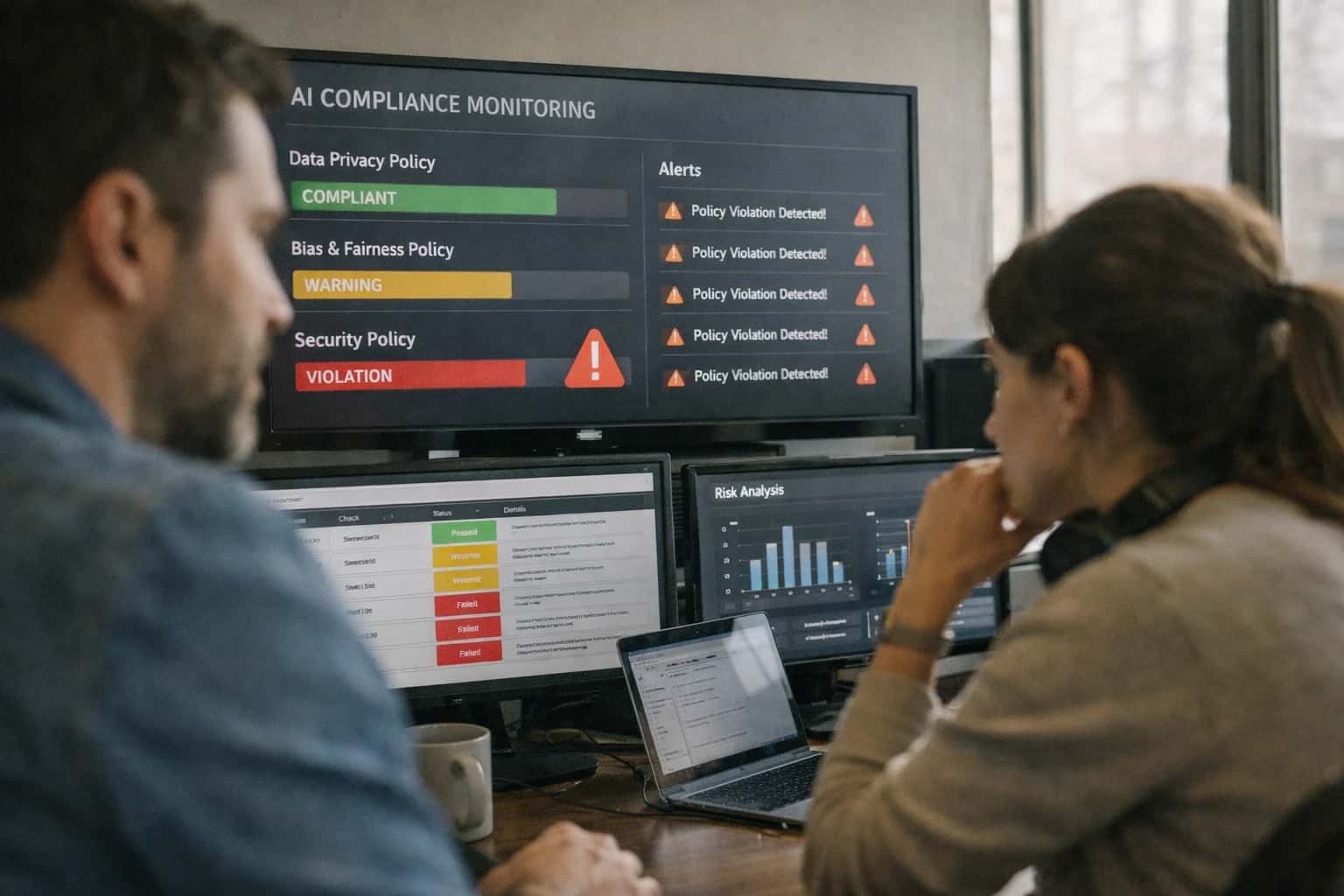
THE BOARDROOM METRIC
Your AI Investment is Leaking Value
Model performance degradation directly impacts financial forecasts and regulatory compliance, making it a core business risk.
Data drift breaks financial models. When the statistical properties of live data diverge from training data—a process called concept drift—your model's predictions become unreliable, directly impacting revenue forecasts and operational efficiency.
Compliance risk escalates silently. In regulated sectors, a decaying model can violate fairness mandates or accuracy thresholds outlined in frameworks like the EU AI Act, leading to audit failures and significant fines.
Evidence: A retail recommendation model suffering from data drift can see a 15-20% drop in click-through rate within months, directly translating to lost sales. Monitoring platforms like Weights & Biases or Arize AI track this decay in real-time.
This is not an IT problem. The financial and reputational impact of a failed model, such as a credit scoring system producing biased outputs, elevates model health to a board-level governance issue requiring direct oversight. Learn more about operationalizing this oversight in our guide to Model Lifecycle Management.
The fix is proactive governance. Implementing a continuous retraining loop triggered by monitoring alerts is the only way to protect your investment, turning a leaking cost center into a resilient, value-generating asset. This is part of a broader shift where The Future of MLOps is Governance, Not Just Code.
FROM IT COST TO BOARD-LEVEL RISK
Three Market Forces Elevating Model Monitoring
Model monitoring is no longer a technical nicety; it is a core business function driven by financial, regulatory, and competitive pressures.
01
The EU AI Act's Compliance Hammer
High-risk AI systems under the EU AI Act require continuous conformity assessment and detailed logging. Non-compliance triggers fines of up to €35 million or 7% of global turnover.
- Key Benefit: Automated audit trails for model decisions, data lineage, and performance logs.
- Key Benefit: Proactive drift detection to maintain declared performance thresholds, avoiding regulatory breaches.
€35M
Max Fine
24/7
Logging Required
02
The Silent Revenue Erosion of Model Drift
A 2-5% drop in model accuracy due to data or concept drift can silently degrade customer conversion rates and lifetime value (LTV) by double-digit percentages.
- Key Benefit: Real-time tracking of prediction drift and business KPIs like cart abandonment.
- Key Benefit: Automated alerts trigger retraining loops before revenue impact becomes material, protecting the bottom line.
-15%
Potential LTV Loss
2-5%
Accuracy Drift
03
The Competitive Moat of Iteration Velocity
Organizations that measure model lifecycle velocity—the speed from detection to retraining to redeployment—outpace competitors. Leaders redeploy in hours, not weeks.
- Key Benefit: Continuous retraining cycles adapt models to market shifts faster than rivals.
- Key Benefit: Integrated monitoring with platforms like Weights & Biases or MLflow turns observability into a strategic accelerator, not just a dashboard.
10x
Faster Iteration
Hours
To Redeploy
FINANCIAL & REGULATORY IMPACT
The Board's Model Monitoring Risk Matrix
A quantitative comparison of monitoring strategies, showing how technical choices directly translate to board-level business risk and financial exposure.
| Risk Dimension & Metric | Basic Logging (Reactive) | Proactive MLOps Platform | Integrated AI Control Plane |
|---|---|---|---|
Mean Time to Detect (MTTD) Performance Drift |
| < 24 hours | < 1 hour |
Mean Time to Repair (MTTR) via Retraining | Manual; 2-4 weeks | Automated pipeline; 48-72 hours | Orchestrated loop; < 24 hours |
Regulatory Audit Trail Completeness | Ad-hoc logs; 60% coverage | Versioned artifacts & data; 95% coverage | Full lineage with policy checks; 100% coverage |
Financial Impact of Undetected Drift (Monthly) | 5-15% revenue erosion | < 2% revenue variance | Modeled & insured; < 0.5% variance |
Cost of Compliance Failure (e.g., EU AI Act) | High; Fines + remediation | Managed; Audit-ready reports | Prevented; Automated compliance gates |
Ability to Explain Model Decay to Stakeholders | Post-hoc analysis | Root-cause dashboards | Causal attribution reports |
Integration with Business KPI Dashboards | |||
Support for Real-Time Shadow Mode Deployment |
THE COMPLIANCE IMPERATIVE
The EU AI Act Makes Monitoring a Legal Requirement
The EU AI Act transforms model monitoring from a technical best practice into a legal mandate with severe financial penalties for non-compliance.
The EU AI Act mandates continuous monitoring for high-risk AI systems, making it a legal requirement, not an optional technical practice. Non-compliance triggers fines up to 7% of global annual turnover, directly linking model performance to corporate liability.
Model monitoring becomes a board-level risk because financial penalties and operational bans under the Act threaten core business continuity. This elevates MLOps governance from an IT concern to a strategic compliance function, requiring tools like Weights & Biases or Arize AI for audit trails.
Compliance requires more than accuracy metrics. The Act demands monitoring for concept drift and data drift to ensure models remain fair and effective over time. This necessitates a multi-dimensional monitoring approach that tracks bias, explainability, and data lineage, as detailed in our guide on AI TRiSM.
Evidence: A 2023 Gartner survey found that 45% of organizations cited regulatory compliance as the primary driver for investing in AI governance platforms, a figure that will surge with the Act's enforcement.
Proactive monitoring is the only defense. Relying on post-incident analysis fails the Act's requirements for risk management. Organizations must implement automated feedback loops and a dedicated Model Control Plane to demonstrate due diligence, a core component of effective MLOps.
BOARD-LEVEL RISK
When Unmonitored Models Fail: A Cost Analysis
Model failure in production is not a technical bug; it's a direct financial liability that impacts revenue, compliance, and brand equity.
01
The $10M Silent Recall: Concept Drift in Credit Scoring
A model trained on pre-2020 economic data fails to adapt to post-pandemic spending patterns. Approval rates for creditworthy applicants drop by ~15%, leading to lost revenue and potential regulatory scrutiny under fair lending laws.
- Direct Cost: Lost interest income from rejected loans.
- Indirect Cost: Regulatory fines and remediation programs.
- Strategic Cost: Erosion of market share to more agile competitors.
15%
Revenue Leak
$10M+
Potential Fine
02
The Compliance Time Bomb: Unauditable Model Decisions
A black-box model denies insurance claims or flags transactions without explainable reasoning. Under the EU AI Act, this constitutes a high-risk violation, mandating human oversight and detailed documentation.
- Operational Cost: Manual review of thousands of automated decisions.
- Legal Cost: Non-compliance penalties up to 7% of global turnover.
- Reputational Cost: Public loss of trust and customer churn.
7%
GDPR-Scale Fine
1000x
Review Overhead
03
The Brand Equity Erosion: Chatbot Hallucination at Scale
An unmonitored customer service agent fabricates product specs or pricing, making false promises to ~5% of daily interactions. Customer frustration escalates to social media, requiring a costly PR campaign.
- Support Cost: Tier-2 human agents overwhelmed with complaint resolution.
- Marketing Cost: Campaigns to rebuild brand trust.
- Retention Cost: Increased churn from damaged customer relationships.
5%
Erroneous Interactions
30%
Support Cost Increase
04
The Supply Chain Cascade: Predictive Maintenance Failure
A drift-affected model misses early signs of turbine failure in a logistics fleet, causing unplanned downtime. A single halted shipment triggers contractual penalties and cascading delays across the network.
- Asset Cost: Emergency repairs and part replacement.
- Contractual Cost: SLA violation penalties.
- Opportunity Cost: Lost capacity and delayed revenue recognition.
48hrs
Avg. Downtime
$250k
Per Incident
05
The Data Poisoning Attack: Adversarial Inputs in Fraud Detection
Malicious actors probe an unmonitored transaction model, learning to craft inputs that evade detection. The model's fraud recall rate plummets, leading to direct financial loss from undetected transactions.
- Security Cost: Incident response and forensic investigation.
- Financial Cost: Stolen funds and chargebacks.
- System Cost: Complete model retraining and redeployment cycle.
-40%
Recall Rate
$2M+
Theft Exposure
06
The Inference Economics Spiral: Unchecked Latency and Cost
Without performance monitoring, model latency creeps from 100ms to 2+ seconds as input data volume grows. Cloud inference costs balloon by 300%, destroying ROI and degrading user experience.
- Infrastructure Cost: Unnecessary compute and GPU spend.
- Business Cost: Abandoned carts and failed sessions due to slow responses.
- Technical Debt: Architectural rework required to optimize the pipeline.
2000%
Latency Increase
300%
Cost Overage
THE BUSINESS RISK
Building a Board-Level Model Monitoring Dashboard
Model performance directly impacts financial forecasts and regulatory compliance, making it a core business risk.
Model monitoring is a board-level issue because model failure is a direct financial and reputational risk. A 10% drop in prediction accuracy can erase millions in revenue from automated pricing or fraud detection systems.
Regulatory compliance is non-negotiable. Frameworks like the EU AI Act mandate auditable model decisions. A dashboard tracking data drift and concept drift provides the evidence trail for compliance officers and auditors.
Board reporting requires business KPIs, not technical metrics. Executives need to see the impact on customer churn, operational cost, and revenue leakage, not just F1 scores. Tools like Weights & Biases or Arize AI translate model health into these business terms.
Evidence: A retail client saw a 15% decline in recommendation engine click-through rate over six months due to unmonitored model drift, directly impacting quarterly sales targets. Proactive monitoring and retraining restored performance.
This shifts AI from an IT cost to a managed asset. Continuous monitoring, as part of a full MLOps lifecycle, provides the governance layer required for scalable, trustworthy AI. Without it, you face the hidden cost of ignoring model drift.
FREQUENTLY ASKED QUESTIONS
Board FAQs on Model Monitoring
Common questions about why model monitoring is a board-level issue for financial and regulatory risk.
Model monitoring is a board-level issue because model performance directly impacts financial forecasts, regulatory compliance, and core business risk. A degrading model can silently erode revenue, violate regulations like the EU AI Act, and damage customer trust, making it a material governance concern beyond just an IT function.
FROM TECHNICAL DEBT TO BUSINESS RISK
Key Takeaways for the Board
Model performance degradation is not an IT issue; it is a direct threat to revenue, compliance, and strategic trust.
01
The Problem: Silent Revenue Erosion
Unchecked model drift degrades prediction accuracy by 15-30% annually, directly impacting core business metrics. This isn't a bug; it's a predictable decay that erodes margins.
- Impact: Degraded models directly reduce conversion rates, increase customer churn, and distort financial forecasts.
- Example: A 5% drop in recommendation accuracy for an e-commerce platform can translate to millions in lost revenue per quarter.
- Link: This operational risk is why we emphasize The Hidden Cost of Ignoring Model Drift.
15-30%
Annual Accuracy Loss
$M+
Quarterly Revenue Risk
02
The Solution: Proactive Governance Plane
Treat models as critical business assets requiring a dedicated control plane for lifecycle management. This shifts MLOps from a technical chore to a strategic governance function.
- Governance: Enforce policy-based access controls, audit trails, and automated compliance checks for frameworks like the EU AI Act.
- Observability: Monitor multi-dimensional signals—data drift, concept drift, latency, and business KPIs—in a single pane.
- Link: This architectural imperative is detailed in The Future of MLOps is Governance, Not Just Code.
24/7
Compliance Audit
100%
Model Lineage
03
The Problem: Regulatory & Reputational Catastrophe
A single biased or non-compliant model decision can trigger regulatory fines, lawsuits, and irreversible brand damage. In regulated industries, poor model documentation is a direct liability.
- Risk: Models making unexplainable decisions fail AI TRiSM audits and violate emerging global AI regulations.
- Exposure: Without model versioning and decision documentation, organizations cannot defend their AI outputs in court or to regulators.
- Link: The stakes of documentation are explored in The Cost of Poor Model Documentation in Regulated Industries.
$10M+
Potential Fine
70%
Audit Failure Risk
04
The Solution: Continuous Iteration as a Moat
Competitive advantage in AI is defined by lifecycle velocity—the speed of the retrain-validate-deploy loop. This requires automated orchestration, not manual heroics.
- Velocity: Companies with mature MLOps iterate models 10x faster, adapting to market changes before competitors.
- De-risking: Shadow mode deployment validates new models against live baselines with zero user impact.
- Link: The strategic value of iteration is the core thesis of Why MLOps is the New Competitive Moat.
10x
Faster Iteration
0%
User Disruption
05
The Problem: The Scaling Wall
Moving from a successful pilot to enterprise-wide deployment fails for 87% of companies due to brittle, manual pipelines. A monolithic AI pipeline is a single point of failure for the entire initiative.
- Bottleneck: Manual processes cannot handle the volume, variety, and velocity of production data and model serving.
- Cost: Inefficient resource usage and manual intervention lead to ballooning cloud spend and stalled ROI.
- Link: This critical scaling challenge is analyzed in Why Your AI Pipeline is a Single Point of Failure.
87%
Fail at Scale
40%
Budget Overrun
06
The Solution: Orchestrated, Model-First Architecture
Build infrastructure designed to serve, monitor, and iterate models—not just host them. A hybrid cloud AI architecture optimizes for inference economics and data sovereignty.
- Resilience: Keep 'crown jewel' data on-prem while leveraging cloud elasticity for training, avoiding vendor lock-in.
- Efficiency: Automated orchestration of data, training, and inference pipelines reduces operational overhead by 50%+.
- Link: The architectural principles for scaling are covered in The Future of Scaling AI is Orchestrated, Not Manual.
-50%
Ops Overhead
99.9%
Uptime SLA
Enabling Efficiency, Speed & Accuracy
Intelligent Analysis, Decision & Execution
We build AI systems for teams that need search across company data, workflow automation across tools, or AI features inside products and internal software.
Talk to Us
Search across company data
Give teams answers from docs, tickets, runbooks, and product data with sources and permissions.
Useful when people spend too long searching or get different answers from different systems.
Enterprise searchRAGPermissions
Read more
Automate internal workflows
Use AI to route work, draft outputs, trigger actions, and keep approvals and logs in place.
Useful when repetitive work moves across multiple tools and teams.
AI agentsWorkflow automationGovernance
Read more
Add AI to products and internal tools
Build assistants, guided actions, or decision support into the software your team or customers already use.
Useful when AI needs to be part of the product, not a separate tool.
AI integrationDecision supportModel routing
Read moreTHE BOARDROOM RISK
Audit Your Model Monitoring Posture Now
Model monitoring is a core business risk because performance degradation directly impacts financial forecasts and regulatory compliance.
Model performance is a financial metric. A 5% degradation in a recommendation model's accuracy directly erodes revenue. Boards must treat model monitoring like any other critical business KPI, as it governs cash flow and customer retention.
Regulatory compliance depends on observability. Frameworks like the EU AI Act mandate continuous monitoring for bias and drift. Tools like Weights & Biases or Arize AI provide the audit trail, but the governance posture is a board-level responsibility.
The cost of failure is operational. A credit scoring model that drifts can trigger a regulatory event, not just a technical ticket. This contrasts with traditional software bugs, where the impact is often contained to system downtime.
Evidence: A retail client saw a 12% drop in conversion after their personalization model experienced concept drift over six months. The silent revenue loss exceeded the cost of a full monitoring suite deployment tenfold. Proactive monitoring with platforms like Fiddler AI or WhyLabs prevents this.
Link monitoring to business outcomes. Track model drift against quarterly forecasts, not just technical accuracy. This requires integrating tools like MLflow or Kubeflow with business intelligence dashboards, a practice detailed in our guide on Model Lifecycle Management.
The governance paradox is real. Companies planning for agentic AI lack the mature monitoring to oversee it. This creates a direct path from unchecked model decay to strategic failure, making it a non-delegable board issue.

About the author
Prasad Kumkar
CEO & MD, Inference Systems
Prasad Kumkar is the CEO & MD of Inference Systems and writes about AI systems architecture, LLM infrastructure, model serving, evaluation, and production deployment. Over 5+ years, he has worked across computer vision models, L5 autonomous vehicle systems, and LLM research, with a focus on taking complex AI ideas into real-world engineering systems.
His work and writing cover AI systems, large language models, AI agents, multimodal systems, autonomous systems, inference optimization, RAG, evaluation, and production AI engineering.
LinkedIn
Limited slotsGet a Free AI Consultation
Partnered with leading AI, data, and software stack.





How We Work
Custom AI workflows for your Business
One-fit-all AI don't work for modern businesses. At Inferensys, we aim to understand your business & custom requirements; which we use to define most efficient agentic workflows, the data, and the tools for your business.
01
Review the use case
We understand the task, the users, and where AI can actually help.
Read more02
Pick the right approach
We define what needs search, automation, or product integration.
Read more03
Build the first useful version
We implement the part that proves the value first.
Read more04
Improve from there
We add the checks and visibility needed to keep it useful.
Read moreThe first call is a practical review of your use case and the right next step.
Talk to Us