MLOps without governance automates failure. A pipeline built on tools like Kubeflow or MLflow deploys code, but it lacks the control plane to enforce access policies, track model lineage, or ensure compliance with regulations like the EU AI Act.

Blog
The Future of MLOps is Governance, Not Just Code
Deployment pipelines are table stakes. The next frontier in MLOps is a governance-first control plane that manages model access, lineage, compliance, and risk across the entire AI production lifecycle.
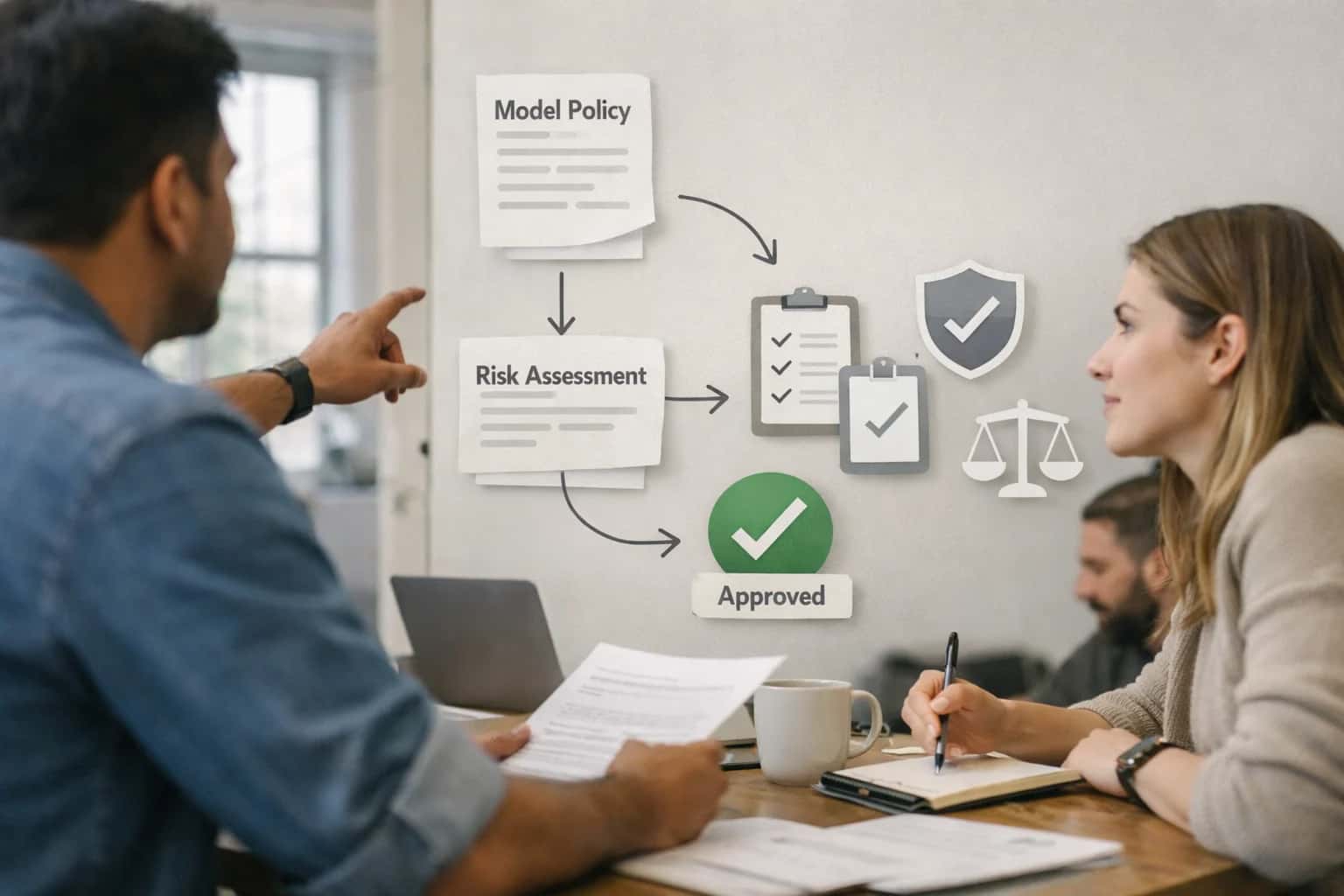
THE CONTROL PLANE
Your MLOps Pipeline is a Liability Without Governance
A CI/CD pipeline automates deployment, but governance controls who deploys, what they deploy, and how models are tracked for compliance.
Code velocity creates compliance debt. Teams that iterate rapidly with TensorFlow or PyTorch models create unmanaged versions and dependencies. Without a governance layer, this technical debt becomes a compliance and security liability, as detailed in our analysis of Model Lifecycle Management.
Governance is the new competitive moat. The ability to audit a model's training data, prove its decision logic, and control its API access separates compliant enterprises from those facing regulatory action. This is a core tenet of AI TRiSM.
Evidence: Gartner states that through 2026, more than 80% of enterprises using AI will have implemented a formal AI governance program. The alternative is unmanaged risk.
THE CONTROL PLANE IMPERATIVE
Three Forces Driving the MLOps Governance Mandate
Effective MLOps now requires a control plane for model access, lineage, and compliance, not just deployment pipelines.
01
The Regulatory Hammer: EU AI Act & Algorithmic Accountability
New regulations like the EU AI Act mandate strict documentation, risk assessments, and human oversight for high-risk AI systems. Non-compliance carries fines of up to 7% of global turnover. This transforms model governance from a best practice into a legal requirement.
- Mandated Audit Trails: Complete lineage tracking for training data, model versions, and deployment decisions.
- Risk Classification: Required conformity assessments for systems in recruitment, credit scoring, and law enforcement.
- Explainability Demands: 'Black box' models face deployment restrictions without technical documentation.
7%
Max Fine
High-Risk
Model Class
02
The Financial Leak: Unchecked Model Drift & Silent Revenue Erosion
Model performance degrades the moment it's deployed. A 10-25% drop in prediction accuracy over months is common, directly impacting core business metrics like conversion rates and customer lifetime value. Without governance, you can't see the leak, let alone fix it.
- Direct P&L Impact: Degraded fraud detection models lose millions to false negatives; poor recommendation engines kill sales.
- Proactive Detection: Governance mandates monitoring for data drift and concept drift, triggering automated retraining loops.
- Attribution Crisis: Without lineage, you cannot trace a bad business decision back to a specific model version.
-25%
Accuracy Drop
$10M+
Revenue Risk
03
The Security Breach: Model APIs as the New Attack Surface
Every deployed model is an API endpoint. Without granular access controls, they become vectors for data exfiltration, adversarial attacks, and unauthorized use. Governance provides the policy layer that acts as a firewall for your AI estate.
- Access Control is the Firewall: Enforce who (users, services) and what (input data types, query rates) can interact with a model.
- Supply Chain Vulnerabilities: Unmanaged dependencies and model artifacts create exploitable weaknesses in your AI pipeline.
- Adversarial Defense: Governance frameworks mandate red-teaming and robustness testing before production deployment, a core tenet of AI TRiSM.
1000+
API Endpoints
Zero-Trust
Access Model
FEATURED SNIPPETS
The MLOps Governance Capability Matrix
A comparison of core governance capabilities required for production AI, moving beyond basic deployment pipelines.
| Governance Capability | Basic MLOps (Code-First) | Governed MLOps (Control Plane) | Enterprise AI Governance (Integrated TRiSM) |
|---|---|---|---|
Automated Model Lineage & Provenance Tracking | |||
Policy-Based Model Access Control (RBAC/ABAC) | |||
Automated Drift Detection & Alert Thresholds | Accuracy only | Data & Concept Drift | Data, Concept, Performance, & Business KPI Drift |
Integrated Audit Trail for Compliance (e.g., EU AI Act) | |||
Centralized Model Registry with Versioned Artifacts | Code & Model Only | Model, Data, Code, & Environment | Model, Data, Code, Environment, & Decisions |
Automated Retraining Trigger & Pipeline Orchestration | Manual trigger only | Rule-based triggers (e.g., on drift) | Dynamic, multi-signal triggers (drift, feedback, KPI) |
Shadow Mode Deployment & A/B Testing Framework | |||
Real-Time Inference Monitoring & Cost Attribution | Aggregate metrics only | Per-model, per-API call | Per-model, per-API call, per-business unit |
THE CONTROL PLANE
Building the Governance Control Plane: Beyond MLflow and W&B
Modern MLOps requires a centralized governance layer for model access, lineage, and compliance that existing experiment trackers cannot provide.
MLflow and Weights & Biases track experiments but fail at governing production models. A true Governance Control Plane is a centralized system that enforces access policies, maintains immutable lineage, and ensures compliance across the entire model lifecycle. This is the critical infrastructure missing in most AI initiatives.
Governance supersedes deployment pipelines. Tools like Kubeflow or Seldon Core automate deployment, but they lack the policy engine to control who can deploy, what data a model uses, or where its outputs flow. This creates unmanaged risk in regulated industries.
The control plane manages the model supply chain. It answers critical questions: Which version of Hugging Face's Llama 3 is in production? What Pinecone or Weaviate index was it trained on? Who approved its last retraining job? Without this audit trail, you cannot comply with the EU AI Act.
Evidence: A 2023 Gartner survey found that 50% of ML projects fail to move past pilot due to governance and scalability issues, not model accuracy. This highlights the infrastructure gap between development tools and production-grade oversight.
Integrate governance from day one. Building this control plane requires weaving policy checks into your existing MLflow pipelines and Kubernetes deployments. For a deeper dive on operationalizing this lifecycle, see our guide on MLOps and the AI Production Lifecycle.
This is a security imperative. In an API-driven world, granular model access control is your new firewall. It prevents data exfiltration and ensures only authorized systems, like a Salesforce integration, can query sensitive models. Learn more about this critical security layer in our article on The Future of Model Deployment is Access Control.
BEYOND PIPELINES
The Cost of Ignoring MLOps Governance
Treating MLOps as just deployment automation ignores the existential risks of ungoverned models in production.
01
The Problem: Unmanaged Model Lineage
Without a provenance trail, you cannot trace a production prediction back to its training data, code, or hyperparameters. This creates a compliance black hole and makes debugging impossible.\n- Audit Failure: Cannot demonstrate model decisions under the EU AI Act or financial regulations.\n- Reproducibility Crisis: Cannot recreate or roll back to a previous, stable model version.\n- Security Blindspot: Unknown dependencies create vulnerabilities in your AI supply chain.
~70%
Longer Debug Time
High
Compliance Risk
02
The Problem: The Access Control Vacuum
Deploying a model as an API endpoint without granular access policies is like leaving your data warehouse unguarded. It's the primary vector for misuse, data exfiltration, and uncontrolled cost overruns.\n- Shadow IT Proliferation: Any developer can spin up unmonitored, costly model instances.\n- Data Leakage: Models can be queried to reverse-engineer sensitive training data.\n- Budget Blowouts: Unmetered inference access leads to unpredictable cloud bills.
10x+
Inference Cost Risk
Critical
Security Gap
03
The Problem: Silent Model Decay
Model drift is inevitable, but without a governance-mandated monitoring and retraining loop, the decay is silent. Performance degrades, revenue erodes, and customer trust evaporates before anyone notices.\n- Revenue Erosion: A 5-10% drop in prediction accuracy can directly impact conversion and retention KPIs.\n- Brand Damage: Customers experience inaccurate recommendations as a broken product promise.\n- Reactive Firefighting: Teams waste cycles diagnosing issues that automated governance would have flagged.
5-10%
Accuracy Loss
Direct
Revenue Impact
04
The Solution: The Model Control Plane
Governance is implemented through a centralized control plane—a system of record for the entire model lifecycle. This is the operating system for production AI, enforcing policies for access, lineage, and retraining.\n- Policy-as-Code: Define and enforce who can deploy, query, and retrain models.\n- Automated Lineage: Every artifact is automatically tracked, enabling full reproducibility.\n- Integrated Observability: Business, performance, and drift metrics are centralized, turning data into actionable alerts.
-40%
MTTR
Full
Audit Trail
05
The Solution: Proactive Drift Governance
Move from reactive monitoring to governance-triggered automation. Define policy rules that automatically trigger retraining pipelines, shadow deployments, or rollbacks when key metrics breach thresholds.\n- Automated Compliance: Retraining logs and validation reports are generated for auditors automatically.\n- Continuous Validation: New model candidates are evaluated in shadow mode against live traffic before any user impact.\n- Business-Alerting: Notifications are tied to revenue-critical KPIs, not just technical metrics.
80%
Faster Iteration
Zero-Touch
Remediation
06
The Solution: Federated Model Registry
A governed, centralized model registry acts as the single source of truth. It's not just a storage bucket; it's a policy engine that gates promotion from staging to production and manages access controls.\n- Lifecycle Gating: Enforce mandatory testing, documentation, and approval workflows.\n- Dependency Management: Track and alert on vulnerabilities in model frameworks and libraries.\n- Cross-Team Visibility: Break down silos between data science, engineering, and compliance teams.
90%
Fewer Rollbacks
Centralized
Security Policy
THE GOVERNANCE IMPERATIVE
The Convergence of MLOps, AI TRiSM, and Sovereign AI
Modern MLOps requires a control plane for model access, lineage, and compliance, not just deployment pipelines.
The future of MLOps is governance. The operational challenge is no longer just deploying a model; it is governing its entire lifecycle across shifting regulatory and geopolitical landscapes. This requires integrating MLOps tooling, AI TRiSM frameworks, and Sovereign AI infrastructure into a unified control plane.
MLOps provides the automation backbone. Platforms like Weights & Biases or MLflow automate the CI/CD for models, but they lack the native controls for compliance and security. This creates a gap between deployment speed and operational safety, a primary cause of model failure in production.
AI TRiSM fills the compliance gap. Frameworks for explainability, adversarial robustness, and data anomaly detection are non-negotiable under regulations like the EU AI Act. Without these, your model is a liability. This is the core of AI TRiSM: Trust, Risk, and Security Management.
Sovereign AI dictates the infrastructure layer. Geopolitical pressure forces workloads off global clouds onto regional providers like OVHcloud or StackPath. This 'geopatriation' ensures data residency and legal compliance but fragments your MLOps stack, making a centralized control plane essential.
Convergence creates the Model Control Plane. The synthesis of these three domains yields a system that manages model lineage, enforces access controls, and triggers automated retraining based on drift detection—all while adhering to regional data laws. This is the evolution from MLOps to Governed AI Operations.
FROM PIPELINES TO CONTROL PLANES
Key Takeaways: Why Governance Defines Modern MLOps
Effective MLOps now requires a control plane for model access, lineage, and compliance, not just deployment pipelines.
01
The Problem: Your Model is a Compliance Liability
Deploying a model without a governance layer is like launching a product without a legal team. Under regulations like the EU AI Act, undocumented model decisions and untraceable data lineage lead to audit failures and fines. Model versioning and audit trails are non-negotiable for regulated industries.
- Key Benefit: Enables compliance with frameworks like GDPR and the EU AI Act.
- Key Benefit: Creates a defensible audit trail for every model prediction and retraining cycle.
-100%
Audit Risk
24/7
Compliance
02
The Solution: A Centralized Model Control Plane
Governance requires a single pane of glass. A Model Control Plane centralizes access controls, model lineage, and performance monitoring. It answers critical questions: Who deployed this version? What data trained it? Who is querying it right now? This is the core of AI TRiSM (Trust, Risk, and Security Management).
- Key Benefit: Enforces policy-based access, acting as a firewall for your AI APIs.
- Key Benefit: Provides deep observability into model lifecycle, dependencies, and drift.
10x
Faster Audits
-70%
Security Incidents
03
The Entity: Model Cards & FactSheets
Governance is codified in documentation. Model Cards and IBM's FactSheets standardize the reporting of model purpose, performance, biases, and limitations. They turn black-box models into accountable assets. This practice is foundational for explainable AI (XAI) and managing the AI supply chain.
- Key Benefit: Mitigates risk by documenting known biases and fairness evaluations.
- Key Benefit: Accelerates model hand-off between data science, engineering, and legal teams.
50%
Faster Onboarding
100%
IP Clarity
04
The Problem: Shadow IT for AI Models
Data scientists bypassing central platforms to deploy models creates unmanaged technical debt and security blind spots. A model running on an engineer's laptop or an unapproved cloud instance is an ungoverned asset. This fractures Model Lifecycle Management and violates data sovereignty policies.
- Key Benefit: Eliminates rogue deployments and consolidates model inventory.
- Key Benefit: Ensures all models adhere to enterprise security and data privacy standards.
-90%
Rogue Models
1 Source
Of Truth
05
The Solution: Policy-as-Code for Model Deployment
Governance must be automated, not manual. Policy-as-Code frameworks (e.g., Open Policy Agent) automatically enforce rules before a model can be deployed: 'Is the training data PII-redacted?' 'Does it have a valid FactSheet?' 'Is it destined for an approved region?' This integrates MLOps with DevSecOps principles.
- Key Benefit: Automates compliance checks, enabling safe continuous deployment.
- Key Benefit: Embeds privacy-enhancing tech (PET) and confidential computing requirements into the deployment pipeline.
~500ms
Policy Check
0 Manual
Gate Reviews
06
The Future: Governance Defines Lifecycle Velocity
The paradox: robust governance accelerates innovation, it doesn't slow it down. A governed system enables safe continuous retraining, automated drift detection, and one-click rollbacks. This increases lifecycle velocity—the speed from retraining trigger to validated redeployment—which is the true competitive moat in production AI. For more on scaling, see our pillar on MLOps and the AI Production Lifecycle.
- Key Benefit: Turns governance from a cost center into an innovation enabler.
- Key Benefit: Maximizes ROI by ensuring models remain accurate and compliant, preventing the silent revenue killer of model decay.
5x
Iteration Speed
-50%
Model Staleness
Enabling Efficiency, Speed & Accuracy
Intelligent Analysis, Decision & Execution
We build AI systems for teams that need search across company data, workflow automation across tools, or AI features inside products and internal software.
Talk to Us
Search across company data
Give teams answers from docs, tickets, runbooks, and product data with sources and permissions.
Useful when people spend too long searching or get different answers from different systems.
Enterprise searchRAGPermissions
Read more
Automate internal workflows
Use AI to route work, draft outputs, trigger actions, and keep approvals and logs in place.
Useful when repetitive work moves across multiple tools and teams.
AI agentsWorkflow automationGovernance
Read more
Add AI to products and internal tools
Build assistants, guided actions, or decision support into the software your team or customers already use.
Useful when AI needs to be part of the product, not a separate tool.
AI integrationDecision supportModel routing
Read moreTHE CONTROL PLANE
Audit Your MLOps Governance Gap Today
Effective MLOps now requires a control plane for model access, lineage, and compliance, not just deployment pipelines.
An MLOps governance gap is the absence of a centralized control plane for model lineage, access, and compliance. This gap creates unmanaged risk where models become liabilities, not assets. You can audit this gap by mapping your current tools against a Model Lifecycle Management framework.
Governance is the new infrastructure. Your deployment pipeline built with Kubeflow or Airflow handles the 'how' of moving code. A governance layer built with MLflow or Weights & Biases controls the 'who,' 'when,' and 'why' for every model version and prediction. This is the shift from DevOps to DevSecOps for AI.
Code deploys models, but policy secures them. Without granular, policy-based access controls, your production model API is an open endpoint. Compare this to the security maturity in AI TRiSM: Trust, Risk, and Security Management, where explainability and adversarial resistance are non-negotiable.
Evidence: Gartner states that through 2026, more than 80% of enterprise AI projects will remain pilot purgatory without a robust MLOps governance strategy. The metric that matters is your mean time to detect (MTTD) model drift or unauthorized access, not just deployment frequency.

About the author
Prasad Kumkar
CEO & MD, Inference Systems
Prasad Kumkar is the CEO & MD of Inference Systems and writes about AI systems architecture, LLM infrastructure, model serving, evaluation, and production deployment. Over 5+ years, he has worked across computer vision models, L5 autonomous vehicle systems, and LLM research, with a focus on taking complex AI ideas into real-world engineering systems.
His work and writing cover AI systems, large language models, AI agents, multimodal systems, autonomous systems, inference optimization, RAG, evaluation, and production AI engineering.
LinkedIn
Limited slotsGet a Free AI Consultation
Partnered with leading AI, data, and software stack.





How We Work
Custom AI workflows for your Business
One-fit-all AI don't work for modern businesses. At Inferensys, we aim to understand your business & custom requirements; which we use to define most efficient agentic workflows, the data, and the tools for your business.
01
Review the use case
We understand the task, the users, and where AI can actually help.
Read more02
Pick the right approach
We define what needs search, automation, or product integration.
Read more03
Build the first useful version
We implement the part that proves the value first.
Read more04
Improve from there
We add the checks and visibility needed to keep it useful.
Read moreThe first call is a practical review of your use case and the right next step.
Talk to Us