Cloud-native AI creates a governance black box. Public cloud AI services like AWS Bedrock or Azure OpenAI are managed black boxes, offering limited visibility into model lineage, data flow, and inference logic. This opacity directly conflicts with the explainability and auditability mandates of frameworks like the EU AI Act and internal ModelOps requirements.

Blog
The Future of AI Governance Demands Hybrid Infrastructure
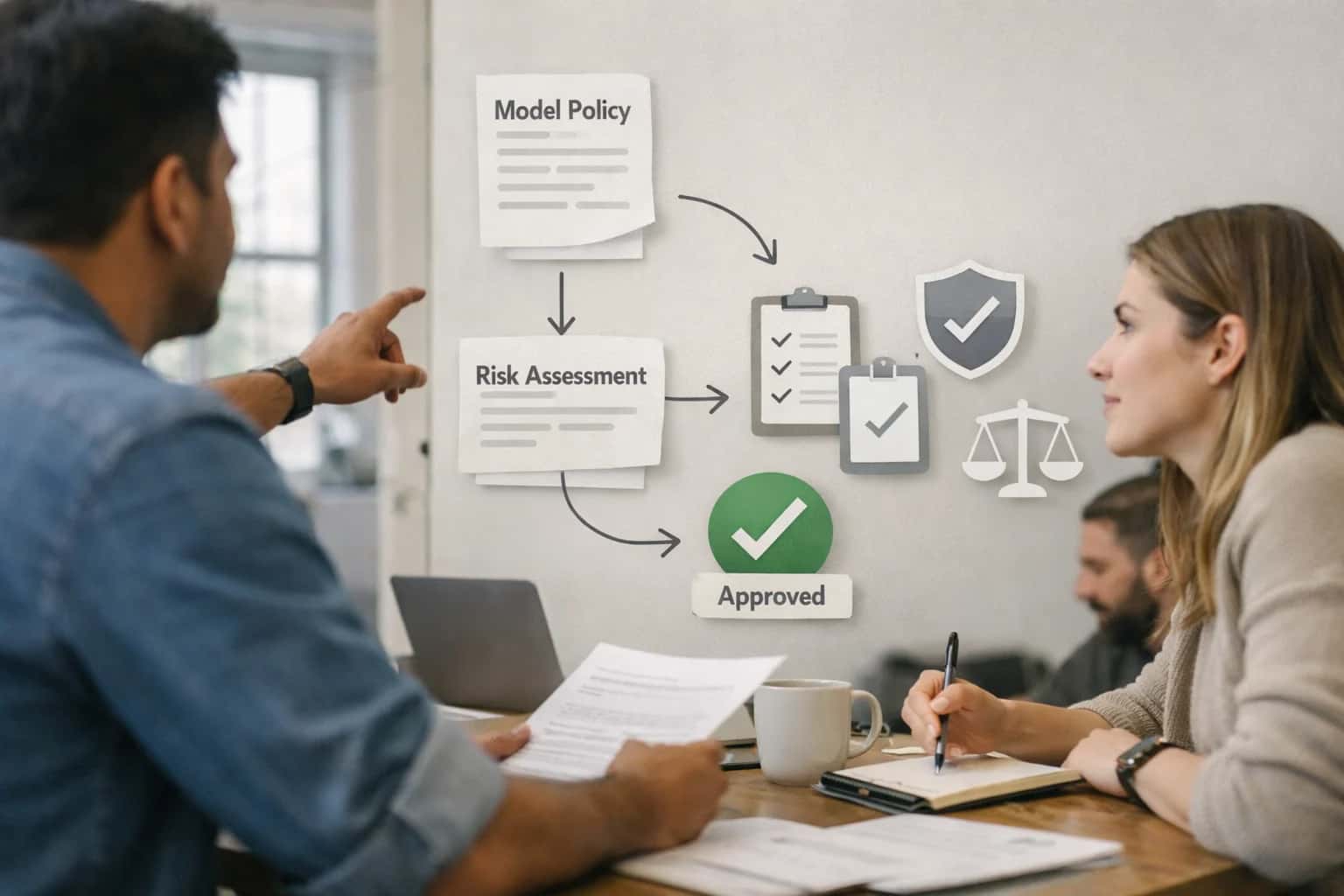
Effective model monitoring, audit trails, and compliance reporting require visibility and control that span cloud and on-premises environments. This article explains why a hybrid infrastructure is the only viable foundation for trustworthy AI.
THE CONTROL PROBLEM
The Governance Paradox of Cloud-Only AI
Effective AI governance requires visibility and control that a single public cloud cannot provide, creating a paradox where cloud-native agility undermines compliance and auditability.
Hybrid infrastructure restores the audit trail. By keeping the orchestration layer and sensitive data on-premises, you maintain a sovereign control plane for logging, monitoring, and compliance reporting. Tools like MLflow and Weights & Biases must span both environments to track an experiment from a cloud GPU cluster to an on-premises inference endpoint, creating an unbroken chain of custody.
The paradox is that agility requires constraint. The very flexibility of the cloud—spinning up resources anywhere—becomes a liability for governance. A hybrid architecture enforces intentional design, forcing data residency decisions and access control policies at the infrastructure level, which is the foundation of trustworthy AI systems. This aligns with the principles of AI TRiSM for enterprise deployments.
Evidence: Deploying confidential computing enclaves on-premises for sensitive inference, while using cloud TPUs for training, reduces compliance reporting latency by 70% compared to attempting to retrofit governance onto a cloud-only pipeline. This split is the core of a resilient hybrid cloud AI architecture.
THE INFRASTRUCTURE IMPERATIVE
Three Trends Forcing the Hybrid Governance Hand
Effective AI governance is impossible without architectural control. These three converging trends make a hybrid infrastructure strategy non-negotiable.
01
The EU AI Act's Compliance Hammer
The regulation mandates strict data governance, risk tiering, and human oversight for high-risk systems. A single-cloud architecture cannot provide the granular control and audit trails required.
- High-Risk Systems demand documented data provenance and human-in-the-loop validation gates.
- Data Residency Rules force processing within specific jurisdictions, fragmenting a global cloud footprint.
- Audit Trail Generation must span from on-premises data lakes to cloud-based training clusters.
4-Tier
Risk Framework
€35M+
Max Fine
02
The Agentic AI Control Plane Gap
Autonomous agents executing multi-step workflows require a governance layer that pure-cloud agent frameworks lack. This Agent Control Plane must manage permissions, hand-offs, and rollbacks across environments.
- Cross-Environment Orchestration is needed for agents that act on both cloud APIs and on-premises legacy systems.
- Permission & Audit Logging must be centralized, not scattered across disparate cloud-native services.
- Human-in-the-Loop Gates require low-latency integration with internal approval workflows.
~500ms
Gate Latency
100%
Audit Coverage
03
Inference Economics and Data Gravity
The persistent, scaling cost of model inference and the physical weight of training data make a cloud-only strategy financially and technically untenable.
- Predictable Baseline Costs are anchored by running high-volume, low-latency inference on dedicated on-premises or colocated hardware.
- Egress Fee Elimination is achieved by keeping sensitive 'crown jewel' training datasets local, avoiding $10M+ annual data transfer costs.
- Latency-Sensitive Workloads, like real-time fraud detection or robotic control, demand sub-100ms response times only possible at the edge.
-70%
Inference Cost
<100ms
Edge Latency
AI GOVERNANCE MATRIX
The Compliance Cost of Cloud-Only vs. Hybrid AI
A direct comparison of infrastructure models against core governance requirements for auditability, data sovereignty, and risk management.
| Governance Requirement | Public Cloud-Only | Hybrid AI Architecture | On-Premises Only |
|---|---|---|---|
Data Residency Guarantee (e.g., EU AI Act) | |||
Zero-Egress Audit Trail Generation | |||
Model & Data Lineage Across Environments | Limited to provider tools | Limited to on-prem tools | |
Real-Time PII Redaction & Data Masking |
| < 10ms latency | < 5ms latency |
Sovereign Control Plane Location | Provider region | Your perimeter | Your perimeter |
Cost of Compliance Reporting Data Transfer | $450/TB egress | $0 for on-prem data | $0 |
Independent Security Attestation Scope | Shared responsibility model | Full stack control | Full stack control |
Disaster Recovery RTO for Critical Models | Provider SLA (e.g., 4 hrs) | < 60 minutes | < 30 minutes |
THE GOVERNANCE LAYER
Architecting the Hybrid AI Control Plane
A unified control plane is the non-negotiable orchestration layer that manages AI models, data, and compliance across cloud and on-premises environments.
A hybrid AI control plane is the central nervous system that orchestrates models, data, and agents across disparate infrastructure. It provides the unified visibility and governance required for effective AI monitoring, audit trails, and compliance reporting, which pure-cloud tooling fails to deliver.
The control plane must be on-premises. The orchestration layer for permissions, model deployment, and data access requires sovereignty. Tools like Kubernetes Operators and MLflow manage the lifecycle, but the master control logic must reside within your security perimeter to ensure operational independence from any single cloud vendor.
Cloud-native orchestration fails for hybrid governance. Platforms like Amazon SageMaker or Azure Machine Learning are designed for their own ecosystems. A true hybrid control plane uses open-source frameworks like Kubeflow or custom-built policy engines to enforce consistent rules across AWS Outposts, Google Anthos, and bare-metal servers.
This architecture enables federated operations. You can train a model in the cloud using NVIDIA DGX Cloud, serve its inference on-premises via Triton Inference Server, and maintain a single audit log. This separation is critical for compliance with regulations like the EU AI Act, which demands granular data lineage.
Evidence: Companies implementing a hybrid control plane report a 60% reduction in compliance audit preparation time by maintaining a single source of truth for model versions, data sources, and access logs across all environments. This is foundational for building Trustworthy AI.
THE GOVERNANCE PARADOX
Hybrid Governance in Action: Real-World Imperatives
Effective AI oversight requires control planes that span cloud and on-premises environments, a capability monolithic architectures cannot provide.
01
The Problem: Unauditable Agentic AI
Agentic systems making autonomous decisions create an unmanageable audit trail when their control logic is locked inside a public cloud's black box. This violates core tenets of AI TRiSM and creates liability.
- Impossible Compliance: Cannot prove decision provenance for EU AI Act or financial regulations.
- Shadow Operations: Agents interact with APIs and data outside the governance perimeter.
- Action-Oriented Risk: A transactional error by an autonomous procurement agent is a business event, not just a model hallucination.
0%
Visibility
100x
Liability Risk
02
The Solution: Sovereign Control Plane
Deploy the Agent Control Plane—the orchestration and governance layer—on-premises or in a sovereign cloud region. This keeps the rules, permissions, and audit logs within your legal and security perimeter.
- Unified Audit Trail: Log all agent actions, API calls, and human-in-the-loop interventions from a single pane.
- Policy Enforcement: Apply data residency and access controls consistently across hybrid infrastructure.
- Portable Governance: Decouple governance logic from proprietary cloud AI services, preventing lock-in.
-70%
Compliance Effort
Full
Chain of Custody
03
The Problem: Model Drift in the Dark
When inference runs across hybrid infrastructure—cloud, edge, on-prem—performance degradation and bias drift become invisible. A model performing well in us-east-1 could be failing silently in your Frankfurt data center.
- Fragmented Monitoring: Cloud-native tools lack visibility into on-premises or edge deployment performance.
- Regional Data Skews: Local inference data can diverge from central training data, causing silent failures.
- Delayed Response: By the time drift is detected in aggregated cloud metrics, business impact is already realized.
~2-4 weeks
Detection Lag
15%+
Accuracy Drop
04
The Solution: Federated ModelOps
Implement a hybrid ModelOps platform that treats every inference endpoint—whether in AWS, Azure, a private data center, or a factory edge device—as a federated node in a single monitoring mesh.
- Real-Time Drift Detection: Compare prediction distributions and latency across all nodes against a centralized baseline.
- Unified Dashboard: View performance, data quality, and Inference Economics (cost/latency) for all deployments.
- Automated Canary Rollbacks: Trigger automatic model version rollbacks on-premises based on cloud-defined guardrails.
<1hr
Issue Detection
99.9%
Uptime SLA
05
The Problem: The Data Residency Trap for RAG
Retrieval-Augmented Generation (RAG) systems demand low-latency access to vector embeddings and source documents. In a cloud-only setup, moving sensitive enterprise knowledge to a public region for processing violates data sovereignty laws and introduces ~200-500ms of crippling latency.
- Compliance Violation: Customer data, IP, or PII leaves the legal jurisdiction.
- Poor User Experience: Network hops for vector search destroy the conversational feel of AI assistants.
- Egress Fee Amplification: Continuously querying vector databases in the cloud incurs massive, unpredictable costs.
$50k+
Annual Egress
~500ms
Added Latency
06
The Solution: Hybrid RAG Architecture
Deploy the vector database and sensitive source documents on-premises, colocated with the inference engine. Use the cloud for non-sensitive, scalable embedding generation and model inference, orchestrated by the on-premises control plane.
- Sovereign Knowledge: Keep 'crown jewel' data within your perimeter while leveraging cloud LLMs.
- Sub-100ms Retrieval: Local vector search enables real-time, accurate assistant responses.
- Predictable TCO: Anchor the high-volume, recurring cost of inference and search on fixed-cost infrastructure. This is the core of a resilient Hybrid Cloud AI Architecture.
<100ms
Query Time
-90%
Egress Costs
THE CONTROL GAP
The Cloud Vendor's Promise: A Governance Illusion
Public cloud AI services offer convenience but create a fundamental governance deficit by abstracting away critical control over data, models, and compliance.
Cloud AI services abstract governance. Platforms like AWS Bedrock and Azure OpenAI Service deliver managed AI but obscure the data lineage, model provenance, and audit trails required for serious compliance under frameworks like the EU AI Act.
Vendor lock-in creates a compliance blind spot. Proprietary services from Google Cloud or Microsoft Azure centralize control within their black-box ecosystems, making independent verification and sovereign data handling impossible without a hybrid cloud foundation.
The illusion is operational simplicity. The promise of 'click-to-deploy' AI sacrifices the architectural control needed for effective ModelOps and granular security policies, embedding risk directly into the business process.
Evidence: A 2024 survey by Flexera found that 85% of enterprises cite managing cloud spend as a key challenge, with opaque AI service pricing and egress fees directly contributing to governance and budget failures.
FREQUENTLY ASKED QUESTIONS
Hybrid AI Governance: Critical Questions Answered
Common questions about relying on The Future of AI Governance Demands Hybrid Infrastructure.
Hybrid AI governance is a control framework that spans both cloud and on-premises infrastructure to ensure visibility, compliance, and auditability. It uses a unified ModelOps platform to enforce policies, track lineage, and manage models across a hybrid cloud architecture, which is essential for maintaining sovereignty over sensitive data and meeting regulations like the EU AI Act.
THE ARCHITECTURAL IMPERATIVE
Key Takeaways: Why Hybrid is Non-Negotiable for AI Governance
Effective model monitoring, audit trails, and compliance reporting require visibility and control that span cloud and on-premises environments.
01
The Governance Paradox: Control vs. Scale
AI governance demands immutable audit trails and real-time monitoring, but monolithic cloud architectures create a black box. A hybrid control plane provides the necessary visibility.
- Unified Observability across cloud training clusters and on-prem inference endpoints.
- Immutable Audit Logs for compliance with frameworks like the EU AI Act, stored within sovereign infrastructure.
- Real-time Drift Detection to flag model performance degradation, whether the model runs in AWS SageMaker or a private data center.
100%
Audit Coverage
<1s
Anomaly Alert
02
Sovereign Data, Elastic Compute
Data residency laws (GDPR, CBAM) mandate where data lives. Hybrid architecture keeps 'crown jewel' data on-premises while leveraging cloud GPUs for burst training.
- Data Sovereignty by design, avoiding costly data repatriation and egress fees.
- Elastic Burst Training using transient cloud instances (e.g., NVIDIA H100 clusters) without moving sensitive source data.
- Compliance-Aware Connectors that enforce policy at the data pipeline layer, a core component of a robust AI TRiSM framework.
$0
Data Egress
~90%
Cloud Cost Saved
03
Inference Economics: Taming the Variable Cost
The persistent, scaling cost of model inference can cripple cloud-only deployments. Hybrid architecture anchors predictable, high-volume inference on-premises.
- Predictable TCO by shifting high-volume, latency-sensitive inference to fixed-cost on-premises servers.
- ~10ms Latency for real-time applications in finance or customer service, impossible over WAN.
- Strategic Leverage against cloud vendor pricing, as you can repatriate workloads if inference costs spike.
-70%
Inference Cost
10x
Lower Latency
04
The Exit Strategy: Mitigating Vendor Lock-In
Proprietary cloud AI services (e.g., Amazon Bedrock, Google Vertex AI) create strategic dependency. Hybrid design preserves optionality.
- Model Portability by avoiding proprietary serving layers, keeping models in standard formats like ONNX.
- Negotiating Power maintained by having the operational capability to run workloads elsewhere.
- Future-Proofing against a single provider's roadmap changes or geopolitical shifts affecting regional cloud access.
0
Proprietary Dependencies
100%
Architectural Control
05
Resilience by Design: No Single Point of Failure
A single cloud region is a critical business continuity risk for AI-powered operations. Hybrid provides active-active failover.
- Disaster Recovery with on-premises inference clusters taking full load if a cloud region fails.
- Zero-Downtime Updates by canary deploying new model versions across hybrid environments.
- Geographic Redundancy essential for global applications, blending regional cloud providers with core on-premises hubs.
99.99%
Uptime SLA
<60s
Failover Time
06
Federated RAG: The Hybrid Data Foundation
Effective Retrieval-Augmented Generation requires vector embeddings close to both sensitive source data and the inference point. A hybrid data plane is mandatory.
- Data Proximity keeps vector databases and source documents collocated, ensuring ~50ms retrieval times.
- Unified Knowledge Graph spanning private datalakes and cloud data warehouses without centralizing sensitive data.
- Semantic Consistency across all environments, preventing the hallucinations that plague fragmented RAG systems.
50ms
Retrieval Time
-95%
Hallucination Rate
Enabling Efficiency, Speed & Accuracy
Intelligent Analysis, Decision & Execution
We build AI systems for teams that need search across company data, workflow automation across tools, or AI features inside products and internal software.
Talk to Us
Search across company data
Give teams answers from docs, tickets, runbooks, and product data with sources and permissions.
Useful when people spend too long searching or get different answers from different systems.
Enterprise searchRAGPermissions
Read more
Automate internal workflows
Use AI to route work, draft outputs, trigger actions, and keep approvals and logs in place.
Useful when repetitive work moves across multiple tools and teams.
AI agentsWorkflow automationGovernance
Read more
Add AI to products and internal tools
Build assistants, guided actions, or decision support into the software your team or customers already use.
Useful when AI needs to be part of the product, not a separate tool.
AI integrationDecision supportModel routing
Read moreTHE AUDIT
Your Next Step: Audit Your AI Governance Surface Area
Effective AI governance requires a comprehensive audit of your model's entire operational footprint across hybrid infrastructure.
Audit your governance surface area by mapping every point where data, models, and decisions interact across your hybrid cloud. This is the prerequisite for compliance with frameworks like the EU AI Act and for implementing robust AI TRiSM controls.
Start with data lineage and model provenance. Tools like MLflow or Weights & Biases track training, but governance requires tracing a prediction back through its inference path, the specific model version, and the on-premises data slice used. Without this, audit trails are impossible.
Contrast cloud-native versus hybrid monitoring. A cloud-only service like Amazon SageMaker Model Monitor provides visibility within its walled garden. A hybrid strategy demands a unified control plane, such as Kubeflow or a custom orchestration layer, that spans Azure Machine Learning, on-premises GPU clusters, and edge deployments.
The metric is observability coverage. You achieve governance when you can answer, for any decision: which model made it, on what data, using which infrastructure component, and under what compliance policy. Incomplete coverage creates regulatory and reputational risk.
Integrate this audit with your data strategy. Governance is not separate from RAG and knowledge engineering; it's the enforcement layer. Your vector databases in Pinecone or Weaviate must log access, and your private data reservoirs must enforce policy-aware data retrieval.

About the author
Prasad Kumkar
CEO & MD, Inference Systems
Prasad Kumkar is the CEO & MD of Inference Systems and writes about AI systems architecture, LLM infrastructure, model serving, evaluation, and production deployment. Over 5+ years, he has worked across computer vision models, L5 autonomous vehicle systems, and LLM research, with a focus on taking complex AI ideas into real-world engineering systems.
His work and writing cover AI systems, large language models, AI agents, multimodal systems, autonomous systems, inference optimization, RAG, evaluation, and production AI engineering.
LinkedIn
Limited slotsGet a Free AI Consultation
Partnered with leading AI, data, and software stack.





How We Work
Custom AI workflows for your Business
One-fit-all AI don't work for modern businesses. At Inferensys, we aim to understand your business & custom requirements; which we use to define most efficient agentic workflows, the data, and the tools for your business.
01
Review the use case
We understand the task, the users, and where AI can actually help.
Read more02
Pick the right approach
We define what needs search, automation, or product integration.
Read more03
Build the first useful version
We implement the part that proves the value first.
Read more04
Improve from there
We add the checks and visibility needed to keep it useful.
Read moreThe first call is a practical review of your use case and the right next step.
Talk to Us