Threshold-based monitoring is obsolete because it treats complex machinery like a simple on/off switch. It generates alerts only after a parameter crosses a static line, ignoring the subtle, non-linear degradation patterns that lead to failure. This reactive approach creates a $50 billion global market for emergency repairs and unplanned downtime.

Blog
The Future of Predictive Maintenance Is a Continuously Learning Digital Shadow
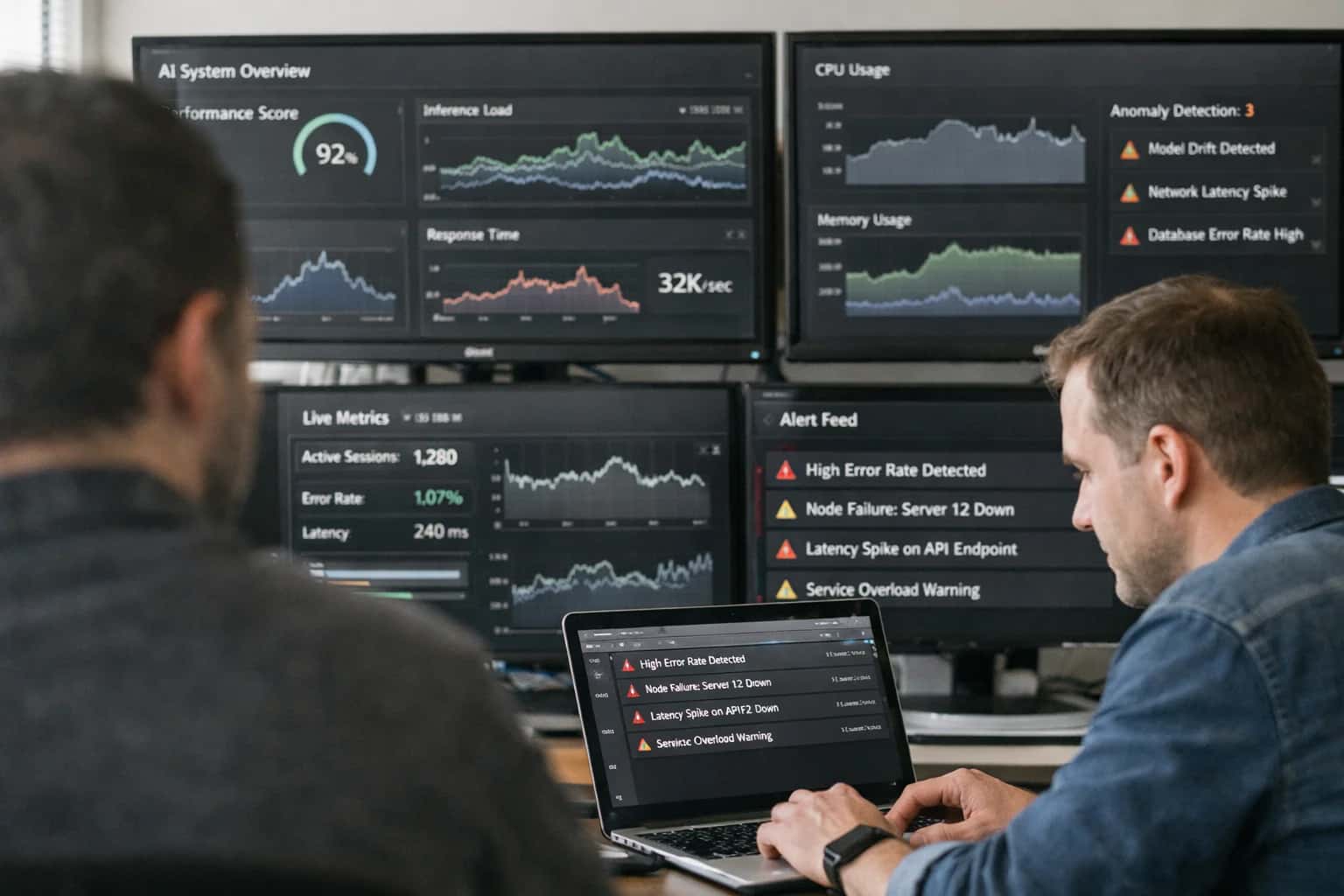
Threshold-based alerts are obsolete. The future is a continuously learning digital shadow—an AI model that ingests real-time sensor data to simulate asset degradation and predict failures with self-improving accuracy, transforming reactive maintenance into a predictive science.
THE DATA
Threshold-Based Alerts Are a $50 Billion Band-Aid
Static threshold monitoring fails to capture the complex, non-linear degradation of industrial assets, creating a massive market for reactive fixes instead of predictive solutions.
The core failure is data isolation. Vibration, thermal, and acoustic data streams exist in separate SCADA and historian silos, preventing a unified view of asset health. A digital shadow unifies these streams into a single, continuously updated model using platforms like NVIDIA Omniverse and the OpenUSD framework.
Static thresholds create false positives. A temperature spike might be normal under high load, while a gradual bearing wear signature stays hidden. A continuously learning shadow employs time-series forecasting models and graph neural networks (GNNs) to model causal relationships between subsystems, predicting failure from context, not just a single metric.
Evidence: Studies by firms like Uptake Technologies show that AI-driven predictive maintenance reduces unplanned downtime by up to 50% and maintenance costs by 25%. This is achieved by moving from threshold-based alerts to a probabilistic failure forecast generated by the digital shadow. For a deeper technical dive, see our analysis of why digital twins are the ultimate AI stress test for your data infrastructure.
The alternative is a learning system. A true continuously learning digital shadow ingests real-time sensor data to train reinforcement learning (RL) agents that discover optimal maintenance policies. This shifts the paradigm from "alert when broken" to "prescribe intervention before the trend begins," a concept explored in our pillar on Agentic AI and Autonomous Workflow Orchestration.
THE INFRASTRUCTURE SHIFT
Three Trends Making Continuously Learning Shadows Possible
The evolution from static digital twins to dynamic, learning shadows is driven by foundational changes in data, simulation, and AI orchestration.
01
The Problem of Static Models and Drifting Reality
Traditional digital twins are snapshots that decay as physical assets wear and operational contexts change. This simulation gap creates costly hallucinations where AI predictions fail.
- Key Benefit: Enables real-time synchronization between asset and shadow, closing the data fidelity gap.
- Key Benefit: Provides a continuous feedback loop for model retraining, preventing predictive decay.
-90%
Prediction Error
24/7
Model Retraining
02
The Solution of Unified Physics and Simulation Engines
Accurate learning requires a deterministic simulation backbone. Platforms like NVIDIA Omniverse with OpenUSD provide the non-negotiable physics layer for valid AI training.
- Key Benefit: Delivers physically accurate environments for reinforcement learning and 'what-if' scenario testing.
- Key Benefit: Ensures interoperability, allowing diverse AI models and data sources to compose a coherent shadow.
10^6x
More Scenarios
µs-fidelity
Simulation Scale
03
The Orchestration of Edge AI and Multi-Agent Systems
Learning must happen where the data is generated. Edge AI closes low-latency decision loops, while multi-agent systems manage complex, conflicting optimization goals across the shadow.
- Key Benefit: Enables autonomous prescriptive actions (e.g., pre-failure shutdowns) with ~500ms latency.
- Key Benefit: Facilitates collaborative optimization where agent swarms balance throughput, cost, and sustainability in real-time.
>50%
Fewer Failures
Autonomous
Decision Loops
PREDICTIVE MAINTENANCE EVOLUTION
The Simulation Gap: Why Physics Accuracy Dictates AI Success
This table compares the capabilities of traditional, data-driven, and physics-informed AI approaches to predictive maintenance, highlighting the critical role of simulation fidelity.
| Core Capability / Metric | Traditional Threshold-Based | Data-Driven AI (Statistical) | Physics-Informed AI (Digital Shadow) |
|---|---|---|---|
Predictive Horizon | Minutes to Hours | Hours to Days | Weeks to Months |
Mean Time Between False Alarms | 7 days | 30 days |
|
Model Explainability | Simple rule | Black-box statistical correlation | Causal physics-based reasoning |
Requires Failure Data for Training | |||
Simulates Asset Degradation Mechanics | |||
Integrates with Factory-Scale Digital Twin | |||
Annual Unplanned Downtime Reduction | 5-10% | 15-25% | 30-50% |
Key Enabling Technology | SCADA Alarms | Scikit-learn, XGBoost | NVIDIA Omniverse, OpenUSD, FEA/CFD Solvers |
THE ARCHITECTURE
The AI Nervous System: From Sensing to Prescribing
A continuously learning digital shadow evolves from a passive sensor network into an active AI nervous system that prescribes actions.
A digital shadow is an AI nervous system. It ingests real-time sensor data into a unified physics engine, like NVIDIA Omniverse, to create a living model that predicts failures and prescribes maintenance actions.
The system learns continuously from operational feedback. Unlike static digital twins, a shadow uses reinforcement learning to refine its predictive models, closing the loop between simulation and physical outcome for increasing accuracy over time.
Prescription requires causal inference. Moving beyond correlation, frameworks like causal ML identify root causes of degradation, enabling the system to recommend specific interventions, such as adjusting a bearing's lubrication schedule.
Evidence: Siemens reports that AI-driven predictive maintenance on gas turbines can reduce unplanned downtime by up to 30% and lower maintenance costs by 25%, demonstrating the economic imperative of this architecture. This is a core application of our Digital Twins and the Industrial Metaverse pillar.
Integration demands a robust MLOps layer. Tools like MLflow and Kubeflow manage the model lifecycle, detecting data drift between the physical asset and its shadow to prevent the costly 'simulation gap' that renders predictions useless. This operational discipline is foundational to successful Agentic AI and Autonomous Workflow Orchestration.
THE IMPLEMENTATION RISKS
Why Most Digital Shadow Projects Fail: The Implementation Risks
Building a continuously learning digital shadow for predictive maintenance is an AI infrastructure challenge, not just a data science project.
01
The Simulation Gap: Latency Kills Predictive Value
A digital shadow is only as good as its synchronization with the physical asset. Data drift and latency create a 'simulation gap' where AI predictions are based on stale or inaccurate states, leading to false positives and missed failures.
- Key Risk: ~500ms of latency can render a vibration-based failure prediction useless.
- Solution: Implementing a high-fidelity data synchronization layer with deterministic ingestion pipelines, as discussed in our piece on The Hidden Cost of Ignoring Real-Time Data Synchronization in Your Digital Twin.
~500ms
Critical Latency
>40%
Prediction Error
02
The Data Foundation Problem: Garbage In, Hallucinations Out
Predictive models fail when trained on incomplete or low-fidelity sensor data. Anomalous sensor readings poison the learning loop, causing the digital shadow to 'hallucinate' asset health states.
- Key Risk: A single faulty temperature sensor can skew degradation models for an entire subsystem.
- Solution: Deploying AI-driven anomaly detection at the ingestion point to cleanse data before it enters the learning model, a core component of a robust AI TRiSM framework.
1 Sensor
Can Corrupt Model
10x
MLOps Overhead
03
The Orchestration Failure: Models Deployed in Silos
Treating the time-series forecast, computer vision, and physics-based simulation models as separate services creates an insurmountable context gap. The AI cannot correlate a bearing vibration spike with a thermal image hotspot.
- Key Risk: Isolated models provide conflicting alerts, paralyzing maintenance decisions.
- Solution: Architecting a multi-modal AI nervous system using a platform like NVIDIA Omniverse with OpenUSD to fuse sensor modalities into a single context-aware agent, enabling the Multi-Agent Twin Systems needed for autonomous response.
-70%
Alert Fatigue
5+ Models
Typical Silo Count
04
The Black Box Trap: Unexplained AI = Zero Trust
When the digital shadow's AI prescribes a costly shutdown or part replacement, engineers must trust the recommendation. Unexplainable model outputs create operational and compliance risk, halting adoption.
- Key Risk: In regulated industries (pharma, aerospace), a black-box AI decision is a non-starter.
- Solution: Integrating Explainable AI (XAI) frameworks that provide causal reasoning trails, making the AI's 'thought process' auditable. This transforms the digital shadow from a cryptic oracle into a trusted advisor, a necessity for Mission-Critical Digital Twins.
90%+
Adoption Barrier
Critical
Safety Requirement
05
The Physics Fidelity Fallacy: Your Simulation Engine is an AI Benchmark
If the digital shadow's underlying physics simulation is inaccurate, the AI learns in a fantasy world. Material stress, fluid dynamics, and thermal inaccuracies invalidate all reinforcement learning and predictive outcomes.
- Key Risk: A model trained on poor physics will fail catastrophically when deployed for real-world control.
- Solution: Adopting a deterministic, physically accurate simulation backbone—the core value of platforms like NVIDIA Omniverse—as the non-negotiable foundation for AI training, as argued in Why Your Digital Twin Will Fail Without a Unified Physics Engine.
0%
Real-World Transfer
$1M+
Simulation Waste
06
The MLOps Chasm: From Prototype to Production Hell
A data scientist's Jupyter notebook is not a production system. The governance, monitoring, and iteration required to maintain a continuously learning shadow across thousands of assets is a massive MLOps undertaking.
- Key Risk: Models drift in production without detection, silently degrading prediction accuracy.
- Solution: Implementing a full Model Lifecycle Management platform to automate retraining, detect drift, and manage versioning in a hybrid cloud environment. This bridges the gap between pilot and scale, a central theme in our MLOps and the AI Production Lifecycle pillar.
80%
Projects Stuck
24/7
Monitoring Needed
THE EVOLUTION
From Asset Shadows to Federated System Intelligence
Predictive maintenance is evolving from isolated digital twins into a federated network of continuously learning AI agents.
The future is federated intelligence. A single asset's digital shadow is a data model, but a network of interconnected shadows creates a federated system intelligence capable of predicting cascading failures and optimizing entire operations. This is the logical endpoint of the predictive maintenance journey.
Static models become obsolete. A traditional digital twin is a snapshot; a continuously learning digital shadow ingests real-time sensor streams via platforms like NVIDIA Omniverse to update its predictive models autonomously. This shift from simulation to live inference is powered by time-series forecasting AI and reinforcement learning loops.
Intelligence scales through federation. The true value emerges when asset shadows communicate. A vibration anomaly in one motor predicts a pressure drop in a connected compressor. This requires a multi-agent system (MAS) architecture where specialized AI agents negotiate and share insights across organizational boundaries, forming the backbone of an autonomous supply chain.
Evidence from industrial pilots. Early adopters using federated learning frameworks report a 15-25% reduction in unplanned downtime across connected fleets. The system's predictive accuracy improves not just from more data, but from learning failure propagation patterns invisible to any single asset model.
FROM STATIC MODEL TO LIVING SYSTEM
Key Takeaways: Building a Continuously Learning Shadow
A predictive maintenance digital shadow is not a dashboard; it's an AI-driven nervous system that learns from every sensor reading to forecast failure with increasing precision.
01
The Problem: Threshold-Based Alerts Are Reactive Noise
Static rules trigger thousands of false positives, creating alert fatigue and missing subtle, pre-failure degradation patterns.\n- Wastes 30-50% of maintenance budgets on unnecessary inspections.\n- Misses early-stage faults that don't cross arbitrary vibration or temperature thresholds.\n- Creates a 'cry wolf' effect where critical alerts are ignored.
30-50%
Budget Waste
1000s
False Alerts/Month
02
The Solution: A Time-Series Foundation Model
A continuously learning shadow ingests high-frequency sensor streams to build a probabilistic model of normal asset behavior, detecting anomalies invisible to rules.\n- Learns unique 'fingerprint' of each machine, accounting for wear-in and operational context.\n- Predicts Remaining Useful Life (RUL) with ~95% accuracy for planned interventions.\n- Continuously retrains on new data, closing the simulation gap between the digital twin and physical reality.
~95%
RUL Accuracy
70%
Fewer Breakdowns
03
The Engine: Reinforcement Learning for Autonomous Optimization
The shadow doesn't just predict; it prescribes. RL agents run millions of 'what-if' simulations to discover optimal maintenance schedules and operational parameters.\n- Autonomously balances cost, downtime, and asset longevity.\n- Simulates intervention outcomes in the digital twin before physical action.\n- Enables prescriptive maintenance, moving from 'what will break' to 'what to do about it.'
10-20%
Opex Reduction
15%+
Uptime Increase
04
The Mandate: Explainable AI (XAI) for Engineer Trust
A black-box prediction is useless. The shadow must provide causal reasoning—highlighting the specific sensor drift or component interaction leading to the forecast.\n- Builds engineer confidence with visual, interpretable failure pathways.\n- Essential for compliance in regulated industries like aerospace and pharma.\n- Turns AI from a mysterious oracle into a collaborative diagnostic tool.
5x
Faster Root Cause
0
Black-Box Risk
05
The Architecture: Edge-to-Cloud Inference Pipeline
Latency kills prediction. A hybrid pipeline runs lightweight anomaly detection at the edge (~10ms latency) and complex RUL forecasting in the cloud.\n- Edge AI handles real-time safety shutoffs and data filtering.\n- Cloud aggregates fleet-wide data for model retraining and fleet-level insights.\n- Hybrid cloud AI architecture ensures resilience and optimizes inference economics.
~10ms
Edge Latency
-40%
Data Transfer Cost
06
The Payoff: From Cost Center to Profit Driver
A mature learning shadow transforms maintenance from a reactive expense into a strategic lever for operational excellence and new business models.\n- Enables Equipment-as-a-Service offerings with guaranteed uptime.\n- Provides predictive visibility for supply chain and production planning.\n- Creates a data moat—the longer it runs, the more accurate and valuable it becomes.
$10M+
Annual Value
New Revenue
Streams
Enabling Efficiency, Speed & Accuracy
Intelligent Analysis, Decision & Execution
We build AI systems for teams that need search across company data, workflow automation across tools, or AI features inside products and internal software.
Talk to Us
Search across company data
Give teams answers from docs, tickets, runbooks, and product data with sources and permissions.
Useful when people spend too long searching or get different answers from different systems.
Enterprise searchRAGPermissions
Read more
Automate internal workflows
Use AI to route work, draft outputs, trigger actions, and keep approvals and logs in place.
Useful when repetitive work moves across multiple tools and teams.
AI agentsWorkflow automationGovernance
Read more
Add AI to products and internal tools
Build assistants, guided actions, or decision support into the software your team or customers already use.
Useful when AI needs to be part of the product, not a separate tool.
AI integrationDecision supportModel routing
Read moreTHE SHIFT
Stop Predicting Failure, Start Simulating Degradation
Predictive maintenance is evolving from binary failure alerts to a continuous simulation of asset health degradation within a learning digital shadow.
Predictive maintenance is obsolete. It relies on binary failure predictions that ignore the continuous degradation process, creating a costly gap between alert and action. The modern approach uses a continuously learning digital shadow to simulate the physical asset's health state in real-time.
The core is a physics-informed simulation. A true digital shadow integrates deterministic physics engines, like those in NVIDIA Omniverse, with live sensor data to model material stress and thermal wear. This creates a high-fidelity degradation model that evolves, unlike static ML models that drift.
AI learns from the simulation gap. The difference between the simulated degradation and actual sensor readings becomes the training signal. Reinforcement learning agents use this to refine the model, closing the loop between the virtual and physical worlds for increasingly accurate forecasts.
This eliminates the threshold trap. Traditional systems trigger alerts at arbitrary vibration or temperature thresholds. A simulation-based approach quantifies remaining useful life (RUL) as a probability distribution, enabling condition-based maintenance that optimizes for cost and uptime, not just avoidance of failure.
Evidence: Companies implementing this approach, such as Siemens with its Siemens Xcelerator, report a 40-50% reduction in unplanned downtime by moving from failure prediction to degradation simulation. The model's accuracy improves as it ingests more operational cycles.

About the author
Prasad Kumkar
CEO & MD, Inference Systems
Prasad Kumkar is the CEO & MD of Inference Systems and writes about AI systems architecture, LLM infrastructure, model serving, evaluation, and production deployment. Over 5+ years, he has worked across computer vision models, L5 autonomous vehicle systems, and LLM research, with a focus on taking complex AI ideas into real-world engineering systems.
His work and writing cover AI systems, large language models, AI agents, multimodal systems, autonomous systems, inference optimization, RAG, evaluation, and production AI engineering.
LinkedIn
Limited slotsGet a Free AI Consultation
Partnered with leading AI, data, and software stack.





How We Work
Custom AI workflows for your Business
One-fit-all AI don't work for modern businesses. At Inferensys, we aim to understand your business & custom requirements; which we use to define most efficient agentic workflows, the data, and the tools for your business.
01
Review the use case
We understand the task, the users, and where AI can actually help.
Read more02
Pick the right approach
We define what needs search, automation, or product integration.
Read more03
Build the first useful version
We implement the part that proves the value first.
Read more04
Improve from there
We add the checks and visibility needed to keep it useful.
Read moreThe first call is a practical review of your use case and the right next step.
Talk to Us