Cloud AI fails for autonomous machinery because round-trip latency to a data center introduces fatal decision delays. A 200ms lag is trivial for a chatbot but catastrophic for a 20-ton excavator avoiding a trench collapse.

Blog
The Future of Heavy Equipment is Edge AI, Not Cloud AI
Cloud-centric AI architectures are failing heavy equipment. Latency, connectivity, and safety demand a fundamental shift to edge compute platforms like NVIDIA Jetson for real-time perception and control.
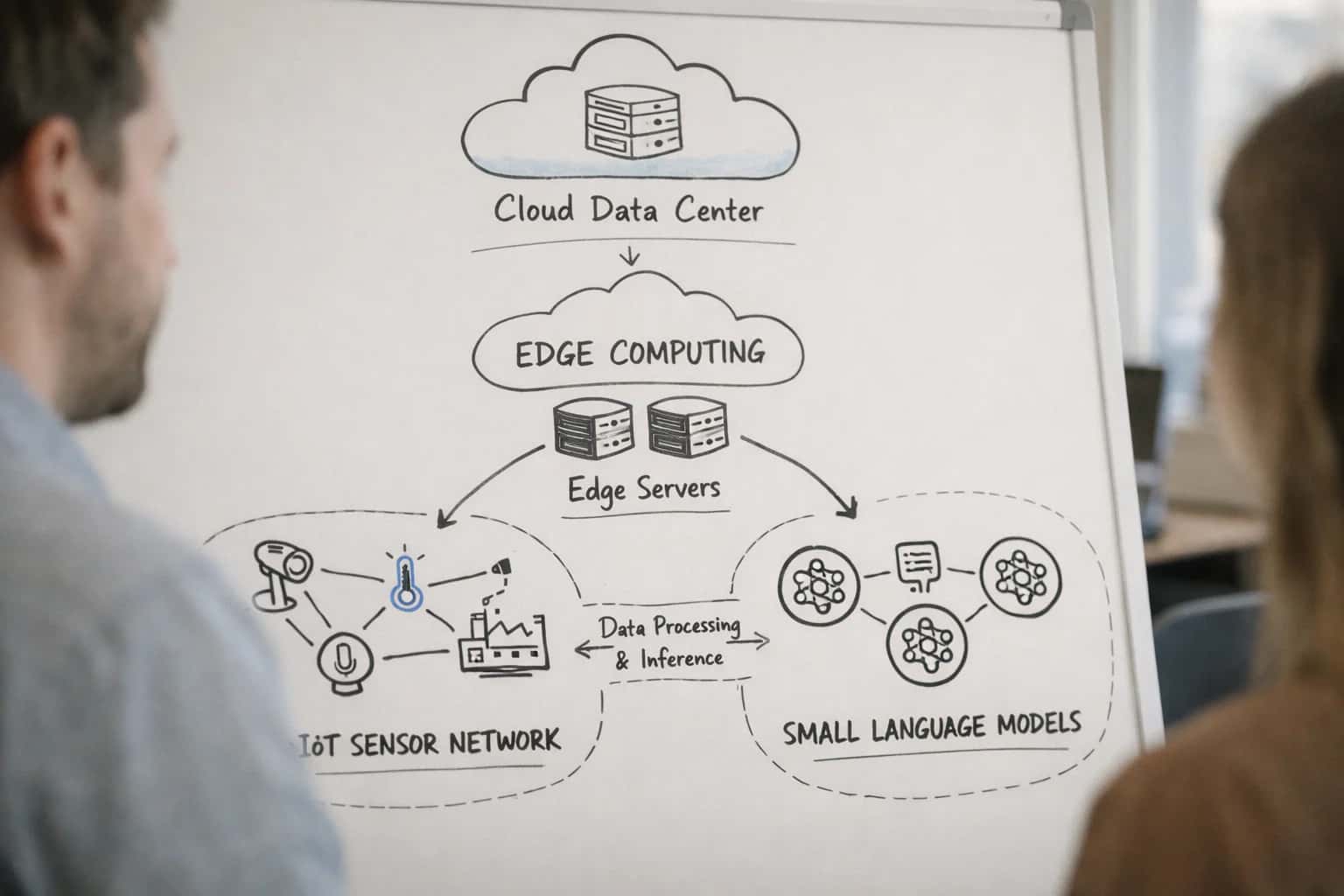
THE LATENCY
The Cloud is a Liability for Moving Machinery
Cloud AI's inherent latency and connectivity dependency make it unsuitable for the real-time perception and control required by autonomous heavy equipment.
Unreliable connectivity on remote construction sites renders cloud-dependent systems useless. Edge compute platforms like the NVIDIA Jetson Orin process LiDAR and camera feeds locally, ensuring operation continues without a 5G or Starlink signal.
Bandwidth economics break down when streaming high-frequency telemetry and multi-sensor data. Edge inference on a device like a Jetson AGX Orin processes terabytes of sensor data on-site, sending only critical insights to the cloud for fleet-level analytics.
Real-world evidence from autonomous vehicle development proves the point: Tesla's Full Self-Driving computer is an edge system; no production AV relies on cloud latency for immediate obstacle avoidance. The same physics of real-time control govern construction robotics.
THE HEAVY EQUIPMENT IMPERATIVE
Key Takeaways: Why Edge AI Wins
For critical perception and control in unstructured environments, the cloud's limitations are fatal. Edge AI is the only viable architecture.
01
The Problem: Unreliable Connectivity
Construction sites are connectivity dead zones. Relying on cloud round-trips for real-time decisions introduces catastrophic latency and single points of failure.
- Latency kills autonomy: A ~500ms cloud delay means a 20-ton excavator moves half a meter before a stop command arrives.
- Bandwidth is a fantasy: Streaming multi-sensor data (LiDAR, cameras, IMU) for 10+ machines requires gigabit+ uplinks that don't exist.
- Offline operation is non-negotiable: Missions cannot halt when a satellite link drops.
500ms+
Cloud Latency
0
Tolerance
02
The Solution: NVIDIA Jetson & On-Device Inference
Deploying trained models directly on NVIDIA Jetson Orin or AGX Xavier platforms turns each machine into an autonomous node.
- Sub-10ms latency: Perception-to-actuation loops happen in real-time, enabling true reactive control.
- Data sovereignty by design: Sensitive site imagery and operational data never leave the machine, mitigating privacy and IP risk.
- Scalable compute: Modular architecture allows for adding perception stacks (e.g., NVIDIA Isaac ROS) without redesigning the entire fleet.
<10ms
Edge Latency
100%
Uptime
03
The Problem: The Physics of Soil and Motion
Cloud-based AI cannot model the granular, non-linear physics of tool-soil interaction or adapt to real-time terrain changes.
- Simulation-reality gap: A cloud-simulated dig path fails when hitting unexpected bedrock or slurry.
- Trajectory data is massive: The proprietary datasets of machine motion required for training are terabytes in size, impossible to stream continuously.
- Control requires haptic feedback: Force and vibration data must be processed locally for immediate adjustment, not sent to a distant server.
TB+
Dataset Size
0ms
Feedback Delay
04
The Solution: Embedded Simulation & Continuous Learning
Edge compute enables physically accurate digital twins to run locally, and continuous learning loops that improve from on-site experience.
- Local digital twins: Run NVIDIA Omniverse-based simulations on the edge to test dig strategies against local terrain data before actuation.
- Federated learning: Aggregate model improvements from the fleet's edge experiences without centralizing raw data, solving the data foundation problem.
- Adaptive path planning: AI recalculates tool paths in real-time based on live LiDAR and force feedback, mastering unstructured environments.
Real-Time
Simulation
On-Site
Learning
05
The Problem: Cost and Scalability of Cloud AI
Cloud AI for heavy equipment is economically unsustainable at scale, with costs dominated by data egress and compute, not value.
- Egress tax: Streaming sensor data out and commands back incurs massive, recurring bandwidth costs for fleets of machines.
- Inference economics are broken: Paying for cloud GPU instances 24/7 for low-latency inference is 10-100x more expensive than edge ASICs.
- No operational leverage: Cloud costs scale linearly with uptime, while edge compute is a fixed capital investment with zero marginal cost per inference.
10-100x
Cost Premium
$0
Marginal Cost
06
The Solution: Predictable TCO & Fleet-Wide Orchestration
Edge AI transforms costs from variable OPEX to predictable CAPEX and enables a site-wide digital nervous system.
- Fixed hardware cost: A one-time investment in Jetson modules delivers a decade of inference, decoupling cost from usage.
- Hybrid cloud architecture: Use the cloud for non-real-time tasks (fleet analytics, model retraining) while the edge handles mission-critical control. This is the core of inference economics.
- Multi-agent coordination: Edge devices communicate directly via local mesh networks for crane-excavator coordination, eliminating the cloud middleman and its latency.
CAPEX
Cost Model
Mesh
Coordination
THE REAL-TIME IMPERATIVE
The Physics of Latency: Why 200ms is a Catastrophe
In heavy equipment operation, network latency is not an inconvenience; it is a fundamental physical constraint that determines system viability.
Cloud AI introduces lethal latency for real-time control. A 200-millisecond round-trip delay to a cloud data center means a 20-ton excavator bucket moves 10 centimeters before a corrective command arrives, turning precision tasks into collisions.
Edge compute platforms like NVIDIA Jetson eliminate network hops. By running perception models—such as object detection with YOLOv8 or semantic segmentation—directly on the machine, inference latency drops to single-digit milliseconds. This enables closed-loop control where sensor data directly drives hydraulic actuators.
The counter-intuitive insight is that connectivity, not compute, is the bottleneck. A 5G or Starlink link adds stochastic jitter, making deterministic control impossible. Edge AI provides predictable, sub-50ms response essential for navigating unstructured terrain and avoiding dynamic obstacles like workers.
Evidence from autonomous vehicle research confirms this. Studies show a 100ms increase in braking latency at 30 mph increases stopping distance by 1.3 meters—the difference between a safe stop and a fatal impact. For a 100,000-pound haul truck, the margin for error is zero. This is why the future of heavy equipment is Edge AI, not Cloud AI, a core tenet of Physical AI and Embodied Intelligence.
FOR HEAVY EQUIPMENT & CONSTRUCTION ROBOTICS
Cloud vs. Edge AI: A Performance Breakdown
A quantitative comparison of deployment architectures for AI in heavy equipment, where latency, reliability, and data sovereignty are critical.
| Critical Performance Metric | Cloud AI (Centralized) | Edge AI (On-Device, e.g., NVIDIA Jetson) |
|---|---|---|
Inference Latency (Perception-to-Action) | 150-500 ms | < 50 ms |
Bandwidth Consumption (Per Device, Daily) | 2-10 GB | 50-200 MB |
Operational Uptime in Poor/No Connectivity | ||
Data Sovereignty & Off-Site Data Transfer | ||
Real-Time Sensor Fusion Capability | Limited by round-trip latency | Native, sub-millisecond synchronization |
Hardware Cost per Compute Node (Approx.) | $0.50-$2.00/hr (cloud instance) | $2,000-$5,000 (one-time, embedded) |
Model Update & Retraining Cycle | Centralized, weekly/monthly | Federated/Continuous Learning possible |
Power Draw for Onboard Compute | N/A (cloud-powered) | 15-60 Watts |
THE REALITY
The Connectivity Myth: Sites Are RF Dead Zones
Construction sites are inherently disconnected environments where cloud-dependent AI architectures fail.
Cloud AI fails on-site because reliable, high-bandwidth connectivity is a fantasy in steel canyons and underground environments. Latency for a round-trip to the cloud is measured in seconds, not the milliseconds required for real-time machine control.
Edge compute is non-negotiable. Critical perception and control loops for autonomous soil removal or obstacle avoidance must run on local hardware like the NVIDIA Jetson Orin or AGX Xavier. This eliminates the single point of failure that a cloud connection represents.
The data foundation is local. The multi-modal sensor streams from LiDAR, cameras, and inertial units are fused and processed at the edge. This creates the real-time 3D understanding needed for navigation, which is a core challenge of Physical AI and Embodied Intelligence.
Evidence: In field tests, a cloud-dependent object detection system experienced over 2 seconds of latency, while an edge-optimized model on a Jetson platform achieved sub-100ms inference. For a 20-ton excavator, that difference is between a near-miss and a collision.
WHY CLOUD FAILS
Edge Compute Platforms for Heavy Machinery
Latency and connectivity constraints mandate that critical perception and control algorithms run on NVIDIA Jetson or similar edge compute platforms, not in the cloud.
01
The Problem: Unpredictable Latency Kills Real-Time Control
Cloud-based inference introduces ~100-500ms latency, a death sentence for autonomous obstacle avoidance or precise robotic path planning. In dynamic environments, this delay turns a safety system into a liability.
- Critical Failure: A 200ms lag at 5 mph equals a 1.5-foot blind spot for decision-making.
- Bandwidth Bankruptcy: Streaming multi-camera HD video and LiDAR point clouds to the cloud is economically and technically infeasible.
200ms
Blind Spot
5 Gbps+
Data Burst
02
The Solution: NVIDIA Jetson AGX Orin as the Onboard Brain
This 275-TOPS AI supercomputer runs physically accurate perception models directly on the machine, enabling sub-10ms inference. It's the standard for turning heavy equipment into intelligent, autonomous agents.
- Sensor Fusion On-Device: Synchronizes LiDAR, cameras, and IMU data into a coherent 3D world model without network dependency.
- Deterministic Performance: Enables reliable control loops for tasks like autonomous soil removal or adaptive welding paths, core to our work in Physical AI and Embodied Intelligence.
275 TOPS
AI Compute
<10ms
Loop Time
03
The Problem: Offline Sites Break Cloud-Dependent AI
Mines, remote construction sites, and disaster zones have zero or intermittent connectivity. A cloud-reliant AI system is a brick the moment the satellite link drops.
- Operational Halts: No connectivity means no AI, shutting down automated fleets.
- Data Blackout: Valuable operational telemetry and machine motion trajectory data is lost, crippling the continuous learning loops needed for model improvement.
0 Bars
Connectivity
100%
System Fail
04
The Solution: Sovereign Data Pods with Federated Learning
Edge platforms act as sovereign data pods, processing and storing sensitive operational data locally. Federated learning aggregates model improvements from distributed fleets without moving raw data, aligning with Sovereign AI principles.
- Data Sovereignty: Proprietary site data and operator expertise never leave the machine or the company's control.
- Collective Intelligence: Enables a global fleet to learn from localized edge experiences, directly addressing the Construction Robotics 'Data Foundation' Problem.
On-Prem
Data Control
Fleet-Wide
Model Learning
05
The Problem: Cloud OpEx Spirals with Scale
The operational expense of cloud compute for a growing fleet of AI-enabled machines is non-linear and unpredictable. Inference economics favor the edge at scale.
- Cost Per Inference: Cloud costs accumulate with every sensor frame processed; edge cost is a fixed capital expenditure.
- Scalability Wall: Deploying 100+ intelligent machines creates a bandwidth and cloud bill that destroys ROI, a key failure point for projects stuck in pilot purgatory.
10x
Cost Growth
$0.001
Edge Cost/Inf
06
The Solution: Hybrid Architecture for Inference Economics
Deploy a strategic hybrid cloud architecture: edge for real-time inference and control, cloud for offline model retraining and fleet-wide analytics. This optimizes both cost and capability.
- Edge-Only Inference: Eliminates recurring cloud costs for the 99% of compute cycles spent on real-time perception.
- Cloud for Orchestration: Uses the cloud sparingly for MLOps pipelines, managing model drift, and simulating 'what-if' scenarios in a digital twin, a concept explored in our Digital Twins and the Industrial Metaverse pillar.
-70%
Cloud Spend
Hybrid
Optimal Stack
THE DATA
Data Efficiency: Curbing the Bandwidth Tax
Edge AI eliminates the prohibitive cost and latency of streaming massive sensor data to the cloud for real-time heavy equipment control.
Edge AI eliminates cloud dependency for real-time perception and control. Sending continuous streams of high-resolution LiDAR, video, and inertial data from a construction site to a cloud server is a prohibitive bandwidth tax. The round-trip latency of 100+ milliseconds makes cloud-based control loops for an autonomous excavator physically impossible and dangerous.
On-device inference is non-negotiable for safety-critical functions. A NVIDIA Jetson Orin or Qualcomm RB5 platform runs trained models locally, processing sensor fusion data in single-digit milliseconds. This enables instant reactions to obstacles, unstable soil conditions, or worker proximity, which a cloud round-trip would fatally delay.
The cloud serves as a model gym, not the runtime. Use the cloud for large-scale training and synthetic data generation with tools like NVIDIA Omniverse. Then, deploy the distilled intelligence to the edge. This hybrid architecture, a core tenet of our Physical AI and Embodied Intelligence pillar, optimizes for both learning scale and operational speed.
Evidence: A single 4K camera stream at 30 FPS consumes ~100 Mbps. A site with 10 cameras and 3 LiDAR units would require a dedicated fiber line just for data egress, making cloud-only AI economically and logistically infeasible for real-time control.
STRATEGIC IMPERATIVE
The Edge-First Roadmap for OEMs
Latency and connectivity mandates are shifting critical perception and control algorithms from the cloud to NVIDIA Jetson and similar edge compute platforms.
01
The Problem: Latency Kills Autonomous Operation
Cloud-dependent AI introduces ~200-500ms latency for round-trip data processing, making real-time obstacle avoidance and precision control impossible. This delay is catastrophic for heavy equipment operating in dynamic, unstructured environments.
- Key Benefit 1: Achieve sub-50ms reaction times for collision prevention and fine-grained actuation.
- Key Benefit 2: Enable true autonomy where split-second decisions are required, independent of cellular or satellite connectivity.
10x
Faster Response
0%
Cloud Dependency
02
The Solution: On-Device Model Inference with NVIDIA Jetson
Deploy compact, optimized neural networks directly on the machine's NVIDIA Jetson Orin or Thor platform. This edge-first architecture processes sensor fusion data (LiDAR, vision, IMU) locally for instantaneous decisioning.
- Key Benefit 1: Operate reliably in remote or connectivity-dead zones, from mines to rural construction sites.
- Key Benefit 2: Drastically reduce data egress costs by processing terabytes of sensor data locally, sending only critical insights or exceptions to the cloud.
90%
Bandwidth Saved
Always-On
Operation
03
The Problem: Data Sovereignty and Security in the Field
Streaming high-fidelity video and operational telemetry to the cloud creates massive attack surfaces and compliance risks. Sensitive site imagery and proprietary machine performance data become vulnerable in transit and at rest.
- Key Benefit 1: Keep PII and IP-sensitive data on the physical asset, complying with regional data laws like the EU AI Act.
- Key Benefit 2: Mitigate risk of operational disruption from network-based cyber attacks targeting cloud endpoints.
100%
On-Device Data
-70%
Attack Surface
04
The Solution: Federated Learning for Continuous Improvement
Edge AI doesn't mean stagnant models. Implement a federated learning pipeline where edge devices train on local data, then share only encrypted model weight updates—not raw data—to a central orchestrator. This creates a continuous learning loop without compromising privacy.
- Key Benefit 1: Aggregate global learning from thousands of machines while maintaining data locality and sovereignty.
- Key Benefit 2: Rapidly adapt models to new site conditions, materials, or operational patterns observed across the global fleet.
Continuous
Model Improvement
Zero-Raw-Data
Shared
05
The Problem: The Crippling Cost of Cloud Inference
Running high-frequency inference for perception stacks (object detection, segmentation) in the cloud incurs prohibitive, variable costs at scale. Sending sensor data for processing becomes the largest line item in the AI budget, eroding ROI.
- Key Benefit 1: Convert variable OpEx cloud costs into predictable, one-time CapEx for edge hardware.
- Key Benefit 2: Achieve superior Inference Economics; the cost per inference on edge hardware approaches zero after the initial deployment.
-80%
Inference Cost
Predictable
TCO
06
The Solution: Hybrid Architecture for Strategic Orchestration
Adopt a hybrid cloud AI architecture. The edge handles all latency-critical perception and control. The cloud aggregates insights, runs large-scale simulations for digital twins, and manages fleet-wide updates. This is the core of a resilient site-wide digital nervous system.
- Key Benefit 1: Use the cloud for its strengths: large-scale simulation, long-term analytics, and MLOps model management, not for real-time control.
- Key Benefit 2: Build a resilient system where edge autonomy ensures operation continues even if cloud connectivity is lost.
Optimal
Workload Split
Resilient
System Design
Enabling Efficiency, Speed & Accuracy
Intelligent Analysis, Decision & Execution
We build AI systems for teams that need search across company data, workflow automation across tools, or AI features inside products and internal software.
Talk to Us
Search across company data
Give teams answers from docs, tickets, runbooks, and product data with sources and permissions.
Useful when people spend too long searching or get different answers from different systems.
Enterprise searchRAGPermissions
Read more
Automate internal workflows
Use AI to route work, draft outputs, trigger actions, and keep approvals and logs in place.
Useful when repetitive work moves across multiple tools and teams.
AI agentsWorkflow automationGovernance
Read more
Add AI to products and internal tools
Build assistants, guided actions, or decision support into the software your team or customers already use.
Useful when AI needs to be part of the product, not a separate tool.
AI integrationDecision supportModel routing
Read moreTHE LATENCY IMPERATIVE
Stop Streaming, Start Computing
Cloud-based AI fails for heavy equipment because real-time control demands sub-second latency that only edge computing provides.
Cloud AI introduces fatal latency for autonomous or assistive heavy equipment. Round-trip data transmission to a cloud server for perception and decision-making creates delays of 100-500ms, a timeframe where a 20-ton excavator has already moved. Real-time control loops for obstacle avoidance or precision grading require deterministic, sub-50ms response times.
Edge compute platforms like NVIDIA Jetson process sensor data locally. This eliminates the dependency on unreliable site connectivity and enables on-device inference for critical functions. Frameworks like TensorRT and PyTorch Mobile are optimized for these embedded systems, delivering the performance needed for split-second actuation.
The cloud is for training, the edge is for inference. The correct architecture streams curated, high-value data from the edge to the cloud for model retraining, while deploying the refined models back to the on-site hardware. This creates a continuous learning loop without sacrificing operational safety or speed.
Evidence: Deploying perception models on an NVIDIA Jetson AGX Orin reduces inference latency to under 30ms, compared to 200ms+ for cloud processing. This 85% reduction is the difference between a safe stop and a collision.

About the author
Prasad Kumkar
CEO & MD, Inference Systems
Prasad Kumkar is the CEO & MD of Inference Systems and writes about AI systems architecture, LLM infrastructure, model serving, evaluation, and production deployment. Over 5+ years, he has worked across computer vision models, L5 autonomous vehicle systems, and LLM research, with a focus on taking complex AI ideas into real-world engineering systems.
His work and writing cover AI systems, large language models, AI agents, multimodal systems, autonomous systems, inference optimization, RAG, evaluation, and production AI engineering.
LinkedIn
Limited slotsGet a Free AI Consultation
Partnered with leading AI, data, and software stack.





How We Work
Custom AI workflows for your Business
One-fit-all AI don't work for modern businesses. At Inferensys, we aim to understand your business & custom requirements; which we use to define most efficient agentic workflows, the data, and the tools for your business.
01
Review the use case
We understand the task, the users, and where AI can actually help.
Read more02
Pick the right approach
We define what needs search, automation, or product integration.
Read more03
Build the first useful version
We implement the part that proves the value first.
Read more04
Improve from there
We add the checks and visibility needed to keep it useful.
Read moreThe first call is a practical review of your use case and the right next step.
Talk to Us