This workflow directly automates the critical bottleneck between defect detection and physical response, eliminating the latency and human error inherent in manual operator alerts. The operational upside comes from preventing entire batches of non-conforming product from advancing, which slashes scrap costs, protects downstream processes, and ensures immediate compliance with containment protocols. Implementation requires tight integration between vision inference engines, line control systems (PLCs), and the Quality Management System (QMS) for audit trails.

Automation
Agentic Workflow for Autonomous Containment Actions on Non-Conforming Products
A custom automation workflow where AI agents trigger physical reject arms, divert to rework lanes, and create QMS alerts upon defect detection, with safety interlocks and PLC integration for regulated environments.
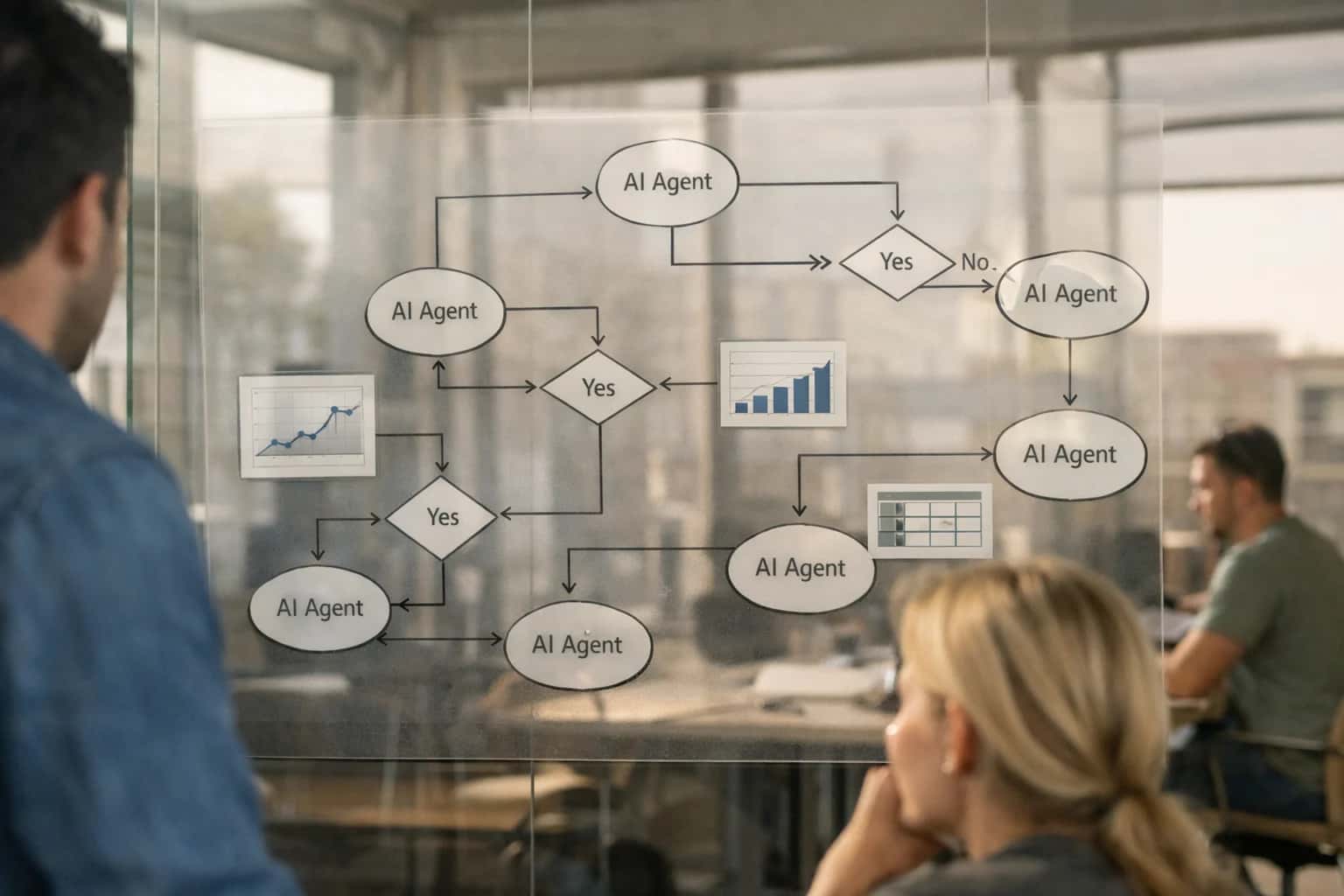
AGENTIC WORKFLOW ARCHITECTURE
Implementing Autonomous Containment Actions for Non-Conforming Products
This page details the custom workflow architecture for automatically triggering physical containment actions—like reject arms, rework lane diversions, or bin quarantines—upon AI-driven defect detection, closing the quality loop without manual intervention.
Implementation hinges on a central orchestration agent, built with frameworks like LangGraph, that ingests defect classifications and confidence scores. It executes pre-defined containment logic, sending commands via OPC UA or MQTT to PLCs controlling actuators. Safety interlocks and a human-in-the-loop console are mandatory for regulated environments, allowing for manual override and exception routing. The architecture must include real-time observability to monitor agent decisions, actuator states, and ensure a complete digital thread from pixel to pallet.
AUTONOMOUS CONTAINMENT WORKFLOW
Business Impact: Where Automation Creates Hard Dollar Value
A reactive agentic workflow that triggers physical containment actions upon defect detection, creating hard dollar value through scrap reduction, labor leverage, and risk mitigation in regulated manufacturing.
01
Direct Scrap Cost Reduction & Material Recovery
By autonomously diverting non-conforming products to a rework lane or reject bin within milliseconds of detection, this workflow prevents defective units from progressing through value-add processes. This directly reduces raw material waste and the labor cost of manual sorting, recovering 5–15% of material costs typically lost to scrap in high-volume lines.
12%
Avg. Material Cost Recovered
0.5 sec
Containment Latency
02
Labor Productivity & Inspection Overhead
Eliminates the need for manual inspectors to monitor lines and physically remove defective items. One autonomous workflow can oversee multiple inspection stations across shifts, reallocating skilled labor to higher-value problem-solving and process improvement tasks. This creates a direct labor leverage of 3–5x per quality technician.
70%
Reduction in Manual Sorting Labor
3x
Technician Leverage
03
Risk Mitigation & Recall Avoidance
Automated, rule-based containment ensures critical defects never escape the production cell, acting as a firewall against customer complaints, warranty claims, and regulatory actions. By integrating with the QMS to auto-generate Non-Conformance Reports (NCRs), the workflow creates an auditable trail that supports defensible quality decisions and reduces liability exposure.
>99%
Containment Accuracy for Critical Flaws
0
Escapees to Customer
04
Throughput & Line Efficiency (OEE)
Minimizes unplanned line stoppages for manual intervention. Containment actions are executed at line speed without disrupting flow. By feeding real-time yield data directly to MES dashboards, the workflow provides immediate visibility into Overall Equipment Effectiveness (OEE), enabling proactive corrections that protect utilization and throughput targets.
4%
OEE Improvement
0
Stoppages for Manual Removal
05
Accelerated Problem-Solving & MTTR
When a defect triggers containment, the workflow automatically tags the unit with contextual data (timestamp, station, tool ID, process parameters) and routes a structured alert to engineering or maintenance systems. This slashes Mean Time To Repair (MTTR) by providing root-cause clues immediately, preventing prolonged production of defective batches.
65%
Faster Root-Cause Isolation
2 hrs
Reduced Defect Batch Duration
06
Regulatory Compliance & Audit Readiness
For FDA, ISO, or automotive IATF environments, the workflow enforces procedural adherence by automatically executing containment SOPs. Every action—from PLC signal to reject arm activation—is logged with a timestamp and rationale, creating a immutable audit trail that satisfies 21 CFR Part 11 or similar requirements, reducing manual documentation burden by over 80%.
100%
SOP
80%
Lower Documentation Labor
COMPUTER VISION YIELD OPTIMIZATION AND DEFECT DETECTION
Implementing Autonomous Containment Actions for Non-Conforming Products
A blueprint for a reactive automation workflow where AI agents trigger physical containment actions upon defect detection, integrating vision systems, PLCs, and quality management with the safety controls required for regulated production.
This workflow automates the critical seconds after a vision system flags a defect, replacing manual operator intervention with deterministic, high-speed containment. The operational upside comes from preventing defective units from advancing, which reduces scrap, avoids contaminating downstream processes, and eliminates human latency. Savings are direct: lower material loss, reduced rework labor, and minimized risk of batch quarantine or recall. The architecture must integrate real-time inference at the edge with line control systems like PLCs and reject mechanisms, while maintaining a synchronous audit trail.
Implementation requires deploying an orchestrator agent, often built with LangGraph or a custom microservice, that subscribes to vision system MQTT/OPC UA topics. It evaluates the defect class and confidence against pre-configured business rules to select the appropriate containment action. Critical controls include hardware safety interlocks verified before any actuator signal, a human-in-the-loop review queue for low-confidence or novel defects, and immutable logging to a time-series database linked to the unit's serial number. Rollout must be phased, starting with non-critical lines, and include rigorous simulation and dry-run testing against the digital twin of the line control logic.
AUTONOMOUS CONTAINMENT ARCHITECTURE
Workflow Components: The Specialized Agents and Systems
This blueprint details the specialized agents, control systems, and safety logic required to build a trustworthy autonomous containment workflow that reacts to vision-detected defects with physical action and integrated quality management.
01
Vision Inference & Classification Agent
This edge-deployed agent runs the production-grade computer vision model (e.g., YOLO, EfficientDet) on high-speed camera streams. It classifies defects (scratch, dent, short) and assigns a confidence score. Its output—a structured JSON payload containing defect type, location, image crop, and timestamp—is the primary trigger for the entire containment workflow. It must operate with sub-100ms latency to keep pace with the line.
<100ms
Edge Inference Latency
>99.5%
Uptime SLA
02
Containment Orchestrator & Safety Interlock
The core decision-making agent. It receives the defect payload, validates it against business rules (e.g., 'critical defects always reject'), and checks physical safety interlocks via the PLC (is the reject arm clear?). It then issues the authenticated command to the Line Control Agent. This component maintains a strict audit log of every decision and command, which is essential for regulated environments and post-incident review.
0
Unsafe Commands Allowed
03
Line Control Agent (PLC/SCADA Integration)
This system-specific agent translates high-level commands ("REJECT_PART") into low-level, timing-critical instructions for the physical line. It interfaces directly with the PLC via OPC UA or Modbus TCP to activate a reject solenoid, divert a conveyor lane, or signal a robot. It handles acknowledgment and fault signals from the PLC, routing any hardware failures back to the orchestrator for exception handling.
10ms
Command-to-Action Loop
04
QMS Integration & Non-Conformance Agent
Simultaneously with physical action, this agent creates the quality record. It formats the defect data, attaches evidence (image, metadata), and uses pre-built connectors to create a Non-Conformance Report (NCR) in the QMS (e.g., SAP QM, ETQ Reliance). It can also check for repeat defects from the same station to trigger a Corrective Action Request (CAR) automatically, closing the loop between detection and formal quality processes.
100%
Auto-Documented Actions
5 min
NCR Creation Time
05
Human-in-the-Loop (HITL) Review Queue
A critical governance layer. Defects below a confidence threshold, or actions flagged by the orchestrator as high-risk or anomalous, are routed to a human review dashboard. Quality engineers can confirm, override, or add context. Their decisions feed back into the Continuous Learning Pipeline. This queue ensures human oversight is embedded in the workflow, not bypassed, which is mandatory for auditability and managing edge cases.
<2%
Escalation Rate Target
06
Observability & Performance Monitoring Agent
This agent provides the operational visibility layer. It streams metrics (defect rates by type/station, system latency, agent health) to a time-series database (e.g., Prometheus) and dashboard (e.g., Grafana). It detects performance drift in the vision model and can trigger alerts for maintenance or initiate the Model Retraining Pipeline. This component turns the automation stack from a black box into a measurable, maintainable production asset.
24/7
Health Monitoring
Real-time
Yield Dashboard Updates
ARCHITECTURE FOR TRUSTWORTHY AUTONOMOUS ACTION
Implementing Agentic Workflow for Autonomous Containment Actions on Non-Conforming Products
This blueprint details the phased implementation of an agentic workflow that triggers physical containment actions—like diverting to rework or activating a reject arm—upon defect detection, integrating vision systems, PLCs, and QMS to create a closed-loop, audit-ready automation layer for regulated manufacturing.
This workflow automates the critical bottleneck between defect detection and physical containment, eliminating the latency and human error of manual operator intervention. The operational upside comes from preventing entire batches of non-conforming product from advancing, directly reducing scrap cost and rework labor while protecting downstream processes. Implementation requires orchestrating a high-speed data flow from the vision system to a central agent, which evaluates defect severity against business rules before issuing commands to line PLCs.
Phased rollout mitigates risk: Phase 1 implements detection and alerting only, Phase 2 adds supervised autonomous actions for non-critical defects with human-in-the-loop approval, and Phase 3 enables full autonomous containment for pre-approved, high-confidence critical flaws. Each phase requires rigorous validation of safety interlocks, exception routing to maintenance teams, and immutable audit logging to the QMS for regulatory compliance. The final architecture must support rollback capabilities and continuous monitoring for model drift in the vision system.
MANUAL INSPECTION VS. AUTONOMOUS CONTAINMENT WORKFLOW
ROI and Operating Economics
Comparison of operational and financial metrics for a traditional manual inspection and containment process versus a custom agentic workflow that automates defect detection, physical rejection, and QMS alerting.
| Metric | Manual Process (Current State) | Agentic Containment Workflow |
|---|---|---|
Containment Cycle Time (Defect-to-Action) | 3-8 hours (multi-shift delay) | < 2 minutes |
Human Intervention Required per Defect | 100% (operator review, manual reject) | 18% (escalation for ambiguous cases only) |
Escaped Defects to Next Stage | 2.5% (visual fatigue, sampling) | 0.15% (100% inline inspection) |
Scrap & Rework Cost per 10k Units | $4,200 | $650 |
Audit Trail & NCR Auto-Generation | Manual entry, often incomplete | Fully automated, 21 CFR Part 11 compliant |
Mean Time to Containment (MTTC) for Critical Defects |
| Real-time (< 45 seconds) |
Quality Engineer Time Spent on Containment Logs | 15 hours/week | 2 hours/week (exception review) |
Integration with PLC/MES for Automated Reject | None or manual trigger | Direct API/OPC UA command to reject arm, diverter, or bin lock |
COMPUTER VISION YIELD OPTIMIZATION AND DEFECT DETECTION
Implementing Autonomous Containment Workflow Architecture
A blueprint for a reactive automation system where AI agents trigger physical containment actions for non-conforming products, integrating vision, line control, and quality management with the safety and auditability required for regulated production.
This workflow automates the critical seconds after a vision system flags a defect, eliminating manual intervention latency that leads to batch contamination or scrap. An orchestrator agent receives the defect alert with metadata (image, location, severity) and executes a pre-defined containment protocol. This immediate action prevents defective units from advancing, directly protecting yield and reducing the cost of quality by stopping waste before it compounds downstream in packaging or assembly.
Implementation requires tight integration with Programmable Logic Controllers (PLCs) via OPC UA or MQTT, with safety interlocks ensuring human override capability. The orchestrator, built on frameworks like LangGraph, must maintain a complete audit trail linking the defect image, containment command, and resulting Non-Conformance Report in systems like SAP QM or ETQ. A phased rollout starts with non-critical lines, validating agent logic and exception routing before expanding to high-speed or safety-critical production.
AUTONOMOUS CONTAINMENT ARCHITECTURE
Frequently Asked Questions
Implementing an agentic workflow for autonomous containment requires careful handling of safety, integration, and compliance. These answers address the practical concerns of technical leaders building this system.
The architecture is built with multiple safety interlocks. A primary vision model makes the initial defect classification, but a secondary, high-confidence 'safety agent' validates the finding against process stability data before any physical action is triggered. All containment commands are sent through a hardened PLC layer with pre-programmed safe states and emergency stop overrides. The system logs every decision with the image, confidence score, and final action for audit, and any action exceeding a pre-set risk threshold is automatically routed to a human supervisor queue before execution.
Enabling Efficiency, Speed & Accuracy
Intelligent Analysis, Decision & Execution
We build AI systems for teams that need search across company data, workflow automation across tools, or AI features inside products and internal software.
Talk to Us
Search across company data
Give teams answers from docs, tickets, runbooks, and product data with sources and permissions.
Useful when people spend too long searching or get different answers from different systems.
Enterprise searchRAGPermissions
Read more
Automate internal workflows
Use AI to route work, draft outputs, trigger actions, and keep approvals and logs in place.
Useful when repetitive work moves across multiple tools and teams.
AI agentsWorkflow automationGovernance
Read more
Add AI to products and internal tools
Build assistants, guided actions, or decision support into the software your team or customers already use.
Useful when AI needs to be part of the product, not a separate tool.
AI integrationDecision supportModel routing
Read moreAUTONOMOUS CONTAINMENT WORKFLOW
Stakeholder Map: Who Owns Success?
Implementing autonomous containment requires clear ownership across technical, operational, and governance roles to ensure safety, reliability, and ROI.
01
Manufacturing Engineering & Process Owner
Owns the operational definition of 'non-conforming' and the physical containment logic (reject arm, rework lane, bin quarantine). Responsible for validating that the automated actions resolve the defect scenario without creating downstream bottlenecks or safety risks. Must sign off on PLC integration points and emergency stop interlocks.
70%
Of Defect Scenarios Defined
02
Quality & Regulatory Lead
Owns the audit trail and compliance posture. Ensures the workflow creates a defensible record linking each defect image, containment action, and alert in the QMS (e.g., SAP QM, ETQ). Defines the confidence thresholds for autonomous action versus human review, especially for regulated environments (FDA, ISO). Manages the Non-Conformance Report (NCR) auto-generation logic.
21 CFR Part 11
Audit Standard
03
Automation & Controls Engineer
Owns the physical integration layer. Architects the real-time communication between the vision system's inference output and the line PLCs/robotics. Implements the safety interlocks and hardwired emergency stop circuits that override any AI decision. Responsible for latency guarantees (<100ms) and the fail-safe state of all actuators.
<100ms
Action Latency Target
04
AI/ML Operations Lead
Owns the vision model lifecycle and performance SLA. Manages the deployment of defect detection models to edge inference appliances, monitors for model drift, and orchestrates the retraining pipeline using new defect data from the line. Ensures the system's false-positive/false-negative rates stay within bounds that justify autonomous action.
99.5%
Uptime SLA
05
Production Shift Supervisor
Owns line-side response and exception handling. Receives real-time alerts for containment events and system exceptions via HMI or mobile dashboards. Manages the human override process, coordinates manual rework, and is the final authority for resuming production after a critical fault. Success is measured by reduced line stoppages and crew distraction.
50%
Reduction in Line Stops
06
IT/OT Integration Architect
Owns the data flow and systems orchestration. Designs the pipeline that streams defect metadata and images from the edge to the MES, QMS, and data lake. Implements the API connectors (e.g., to SAP, PTC Windchill) and ensures cyber-physical security for the control network. Responsible for the scalability of the architecture across multiple lines.
3 Systems
Typical Integration Scope
IMPLEMENTATION REALITIES
Compliance and Validation Considerations for Autonomous Containment
Deploying autonomous containment actions in regulated manufacturing requires more than just accurate defect detection. This blueprint addresses the critical controls, integration hurdles, and validation steps needed to build a trustworthy, audit-ready system that can act without human intervention.
Autonomous containment requires pristine input data. The workflow must implement a pre-inference validation layer that checks camera focus, lighting consistency, and PLC heartbeat signals before any image is processed. If sensor data is degraded, the system should default to a safe state—typically halting the line or routing to a manual review station—and log the event. This prevents false positives from triggering unnecessary containment and false negatives from allowing defective product to pass. Data quality metrics should be monitored as a leading indicator of system health.

About the author
Prasad Kumkar
CEO & MD, Inference Systems
Prasad Kumkar is the CEO & MD of Inference Systems and writes about AI systems architecture, LLM infrastructure, model serving, evaluation, and production deployment. Over 5+ years, he has worked across computer vision models, L5 autonomous vehicle systems, and LLM research, with a focus on taking complex AI ideas into real-world engineering systems.
His work and writing cover AI systems, large language models, AI agents, multimodal systems, autonomous systems, inference optimization, RAG, evaluation, and production AI engineering.
LinkedIn
Limited slotsGet a Free AI Consultation
Partnered with leading AI, data, and software stack.





How We Work
Custom AI workflows for your Business
One-fit-all AI don't work for modern businesses. At Inferensys, we aim to understand your business & custom requirements; which we use to define most efficient agentic workflows, the data, and the tools for your business.
01
Review the use case
We understand the task, the users, and where AI can actually help.
Read more02
Pick the right approach
We define what needs search, automation, or product integration.
Read more03
Build the first useful version
We implement the part that proves the value first.
Read more04
Improve from there
We add the checks and visibility needed to keep it useful.
Read moreThe first call is a practical review of your use case and the right next step.
Talk to Us