For most enterprises, Scope 3 emissions—those from purchased goods, logistics, and waste—represent over 70% of their carbon footprint, yet remain a data black box. Manual data requests to suppliers are slow, inconsistent, and unverifiable, creating regulatory risk under frameworks like CSRD and leaving millions in potential savings from efficiency and green procurement untapped. This lack of visibility turns decarbonization from a strategic goal into a guessing game.

Use Case
Supply Chain Emissions Tracker
AI-powered system to pinpoint and quantify Scope 3 emissions across complex supply chains, enabling cost-effective compliance, risk mitigation, and collaborative decarbonization.
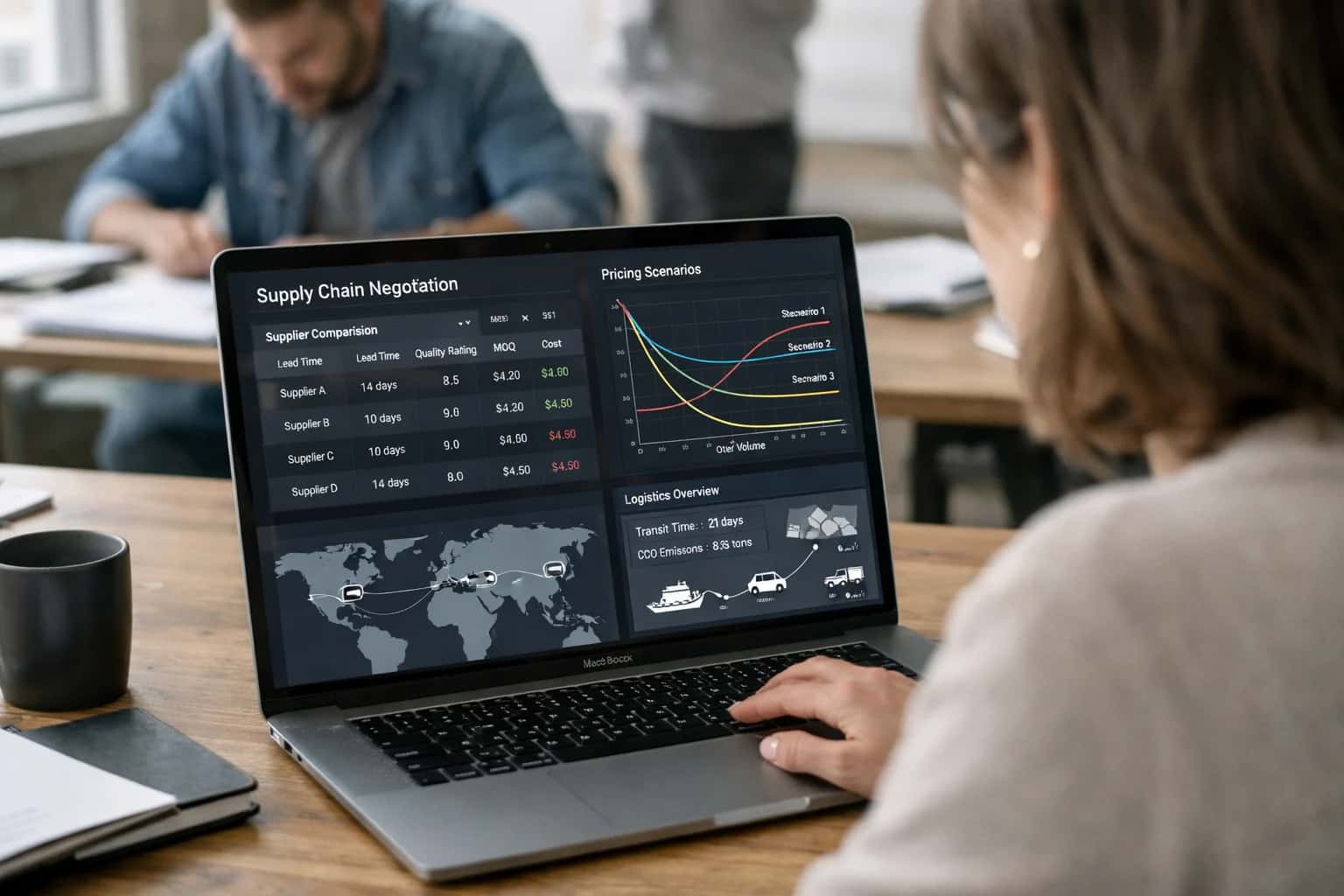
OPERATIONALIZING NET-ZERO
What is Supply Chain Emissions Tracker Used For?
A Supply Chain Emissions Tracker is a specialist AI tool that transforms opaque Scope 3 emissions into a strategic, actionable asset for procurement, finance, and sustainability teams.
An AI-powered tracker solves this by automating data ingestion from invoices, logistics records, and supplier databases, applying activity-based and spend-based models to calculate emissions with audit-ready precision. It pinpoints high-impact suppliers and materials, enabling targeted collaborative decarbonization initiatives. The outcome is a live emissions dashboard that drives procurement decisions, secures green financing, and delivers a clear ROI through risk mitigation, compliance efficiency, and identified cost-saving opportunities. For a deeper dive into automating the entire compliance workflow, see our guide on the Automated ESG Disclosure Engine.
SUPPLY CHAIN EMISSIONS TRACKER
Common Use Cases & Business Problems Solved
Move from opaque estimates to precise, actionable Scope 3 data. These use cases demonstrate how AI-powered supply chain tracking delivers immediate financial and compliance ROI.
01
Automated Supplier Data Collection & Validation
Manually chasing suppliers for emissions data is a costly, low-response-rate process. Our AI automates this by:
- Ingesting data from invoices, logistics records, and supplier portals in any format.
- Applying emission factors dynamically using region and industry-specific databases.
- Flagging anomalies and data gaps for review, creating an audit-ready data trail.
Real Example: A manufacturer reduced data collection time by 70% and improved supplier response accuracy by identifying inconsistent reporting from a key component vendor.
02
High-Impact Supplier Identification & Engagement
Not all suppliers are created equal. Pinpoint the 20% of vendors causing 80% of your Scope 3 footprint to focus decarbonization efforts where they matter most.
- AI ranks suppliers by total emissions, emission intensity, and reduction potential.
- Generates tailored engagement plans with specific asks and shared savings models.
- Models collaborative scenarios to forecast the ROI of joint efficiency projects.
Result: A retail chain identified that switching to low-carbon transportation with its top 5 logistics partners would cut 15% of its Scope 3 emissions with a positive NPV.
03
Real-Time Carbon Costing for Procurement
Embed carbon as a cost factor in procurement decisions to align purchasing with sustainability goals.
- AI calculates a 'shadow carbon price' for every RFQ and purchase order.
- Integrates with ERP systems to provide buyers with alternate low-carbon options and cost trade-offs.
- Tracks performance against internal carbon budgets by category and business unit.
Business Impact: Enables procurement teams to make value-driven decisions that reduce both cost and carbon, turning sustainability from a constraint into a competitive lever.
04
CSRD & Climate Disclosure Readiness
The EU's CSRD mandates detailed, audited Scope 3 reporting. Manual processes are error-prone and unsustainable.
- AI maps your supply chain data directly to CSRD, TCFD, and GRI disclosure requirements.
- Continuously calculates Scope 3 categories (1-15) with full data lineage.
- Generates pre-formatted reports and audit packs, slashing preparation time and compliance risk.
ROI: One client cut their annual ESG report preparation time from 6 months to 6 weeks, while significantly improving audit confidence.
05
Scenario Modeling for Decarbonization Pathways
Justify capital investments in green initiatives by modeling their precise impact on your supply chain footprint.
- 'What-if' analysis for switching suppliers, changing materials, or adopting new logistics routes.
- Quantifies financial ROI alongside carbon savings, incorporating potential carbon tax exposures.
- Optimizes for dual objectives (cost vs. carbon) to find the most efficient path to net-zero targets.
Use Case: An automotive company modeled the impact of localizing a battery supply chain, proving a 40% emissions reduction justified the strategic capital expenditure.
06
Risk Mitigation & Supply Chain Resilience
Carbon-intensive supply chains are vulnerable to regulatory shifts, carbon taxes, and stakeholder pressure.
- AI monitors for regulatory changes and models their financial impact on your specific supply chain.
- Identifies single points of failure where high emissions and geographic concentration create dual risk.
- Provides early warning on suppliers likely to face compliance issues or cost increases.
Strategic Value: Transforms sustainability from a reporting function into a core component of enterprise risk management and long-term resilience planning.
SUPPLY CHAIN EMISSIONS TRACKER
How It Works: The AI Implementation Journey
Scope 3 emissions are the largest and most opaque part of a company's carbon footprint. This use case details the AI-driven journey to illuminate and manage these hidden costs.
The primary pain point is data opacity. Most enterprises lack visibility beyond their Tier 1 suppliers, making Scope 3 emissions—often 70%+ of a total footprint—a major blind spot for compliance (like CSRD) and financial risk. Manual data requests are slow, inconsistent, and create friction with partners, leaving you exposed to regulatory penalties and stranded assets in a decarbonizing economy. This lack of granular intelligence blocks effective decarbonization strategy.
Our AI solution automates data ingestion from invoices, logistics feeds, and supplier databases, applying activity-based and spend-based models to calculate emissions with audit-ready precision. The outcome is a live, supplier-level dashboard that pinpoints high-impact hotspots, enabling targeted supplier collaboration and Scope 3 reduction initiatives. This transforms a compliance burden into a source of competitive advantage and cost savings through optimized logistics and procurement. For a broader view, explore our pillar on Sustainability Intelligence and Automated ESG Operations.
Enabling Efficiency, Speed & Accuracy
Intelligent Analysis, Decision & Execution
We build AI systems for teams that need search across company data, workflow automation across tools, or AI features inside products and internal software.
Talk to Us
Search across company data
Give teams answers from docs, tickets, runbooks, and product data with sources and permissions.
Useful when people spend too long searching or get different answers from different systems.
Enterprise searchRAGPermissions
Read more
Automate internal workflows
Use AI to route work, draft outputs, trigger actions, and keep approvals and logs in place.
Useful when repetitive work moves across multiple tools and teams.
AI agentsWorkflow automationGovernance
Read more
Add AI to products and internal tools
Build assistants, guided actions, or decision support into the software your team or customers already use.
Useful when AI needs to be part of the product, not a separate tool.
AI integrationDecision supportModel routing
Read moreSUPPLY CHAIN EMISSIONS TRACKER
Pilot to Scale: A 90-Day Implementation Roadmap
Move from manual estimation to automated, auditable Scope 3 intelligence. This roadmap delivers a working pilot in 30 days, actionable insights by day 60, and a scalable enterprise platform by day 90.
01
Phase 1: Rapid Data Onboarding & Baseline (Days 1-30)
We establish a single source of truth for supply chain emissions in under a month. Our AI automates the ingestion and classification of supplier data from invoices, transport logs, and material databases, applying the correct emission factors.
- Automated Data Extraction: Parse thousands of PDFs and spreadsheets to identify key activity data (e.g., kg of steel, km shipped).
- Intelligent Factor Mapping: AI matches materials and processes to the latest, region-specific emission databases (e.g., Ecoinvent, DEFRA).
- Pilot Outcome: A validated baseline report for your top 20 suppliers, identifying which contribute 80% of your Scope 3 footprint.
80%
of Scope 3 footprint mapped
< 30 days
to first baseline report
02
Phase 2: Supplier Engagement & Hotspot Analysis (Days 31-60)
Transform data into actionable decarbonization strategy. The platform identifies high-impact suppliers and models reduction scenarios.
- Prioritized Heat Maps: Visual dashboards rank suppliers by emission volume, risk, and reduction potential.
- Collaborative Portals: Provide key suppliers with tailored insights and data requests to improve accuracy.
- Scenario Modeling: Test the financial and carbon impact of switching materials, consolidating shipments, or nearshoring.
- Business Value: Pinpoint the 3-5 supplier collaboration projects with the highest ROI, turning compliance into cost savings.
20-40%
potential reduction in key categories
04
Quantifiable ROI & Risk Mitigation
Justify the investment with hard numbers tied to cost avoidance and new value creation.
- Compliance Cost Savings: Reduce manual data collection and reporting labor by 70%+, saving hundreds of FTE hours annually.
- Supply Chain Resilience: Identify single-source, high-carbon suppliers as a critical business risk.
- Financial Leverage: Use granular data to negotiate better terms with logistics providers and qualify for green financing.
- Brand Equity: Demonstrate credible, data-backed progress to customers and investors, mitigating greenwashing risk.
Real-World Example: A manufacturing client identified that switching to regional suppliers for 4 components would cut transport emissions by 28% and reduce costs by $1.2M annually.

About the author
Prasad Kumkar
CEO & MD, Inference Systems
Prasad Kumkar is the CEO & MD of Inference Systems and writes about AI systems architecture, LLM infrastructure, model serving, evaluation, and production deployment. Over 5+ years, he has worked across computer vision models, L5 autonomous vehicle systems, and LLM research, with a focus on taking complex AI ideas into real-world engineering systems.
His work and writing cover AI systems, large language models, AI agents, multimodal systems, autonomous systems, inference optimization, RAG, evaluation, and production AI engineering.
LinkedIn
Limited slotsGet a Free AI Consultation
Partnered with leading AI, data, and software stack.





How We Work
Custom AI workflows for your Business
One-fit-all AI don't work for modern businesses. At Inferensys, we aim to understand your business & custom requirements; which we use to define most efficient agentic workflows, the data, and the tools for your business.
01
Review the use case
We understand the task, the users, and where AI can actually help.
Read more02
Pick the right approach
We define what needs search, automation, or product integration.
Read more03
Build the first useful version
We implement the part that proves the value first.
Read more04
Improve from there
We add the checks and visibility needed to keep it useful.
Read moreThe first call is a practical review of your use case and the right next step.
Talk to Us