The Pain Point: Procurement teams are often blindsided by sudden demand spikes or troughs, leading to costly bullwhip effects—excess inventory or critical stockouts. Relying solely on historical sales data means you're always a step behind, reacting to yesterday's problems. This volatility erodes margins, strains supplier relationships, and fails customers. In today's volatile climate, guessing is not a strategy.

Use Case
AI-Driven Demand-Sensing for Procurement
Use AI to fuse real-time sales, social, and weather data to predict short-term demand spikes, optimizing purchase orders and reducing the costly bullwhip effect by 15-30%.
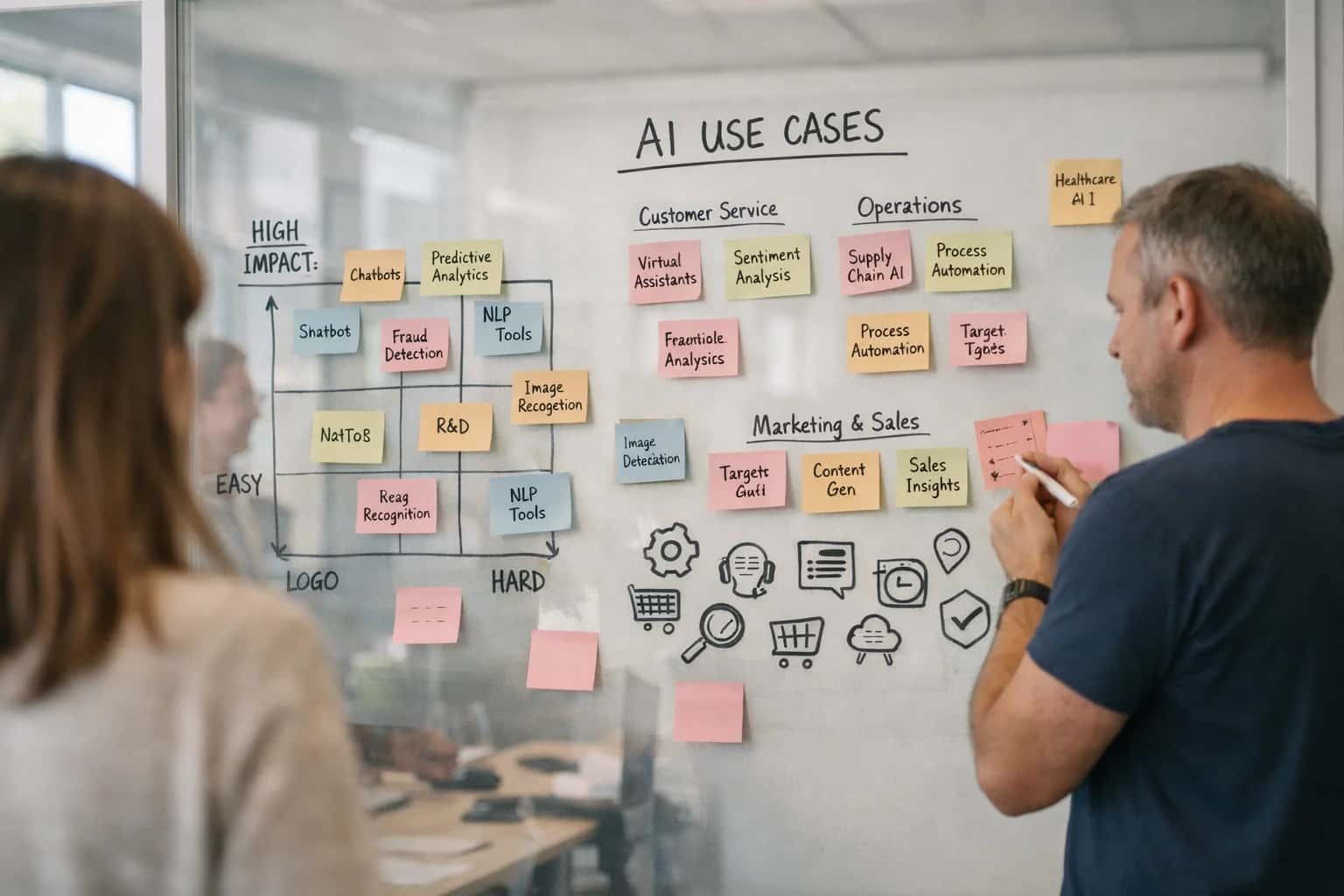
USE CASE
What is AI-Driven Demand-Sensing for Procurement Used For?
Traditional procurement relies on lagging indicators, leaving you reactive to market shifts. AI-driven demand-sensing fuses real-time data streams to predict short-term demand, transforming procurement from a cost center into a strategic advantage.
The AI Fix: By integrating real-time signals—point-of-sale data, social sentiment, weather patterns, and local events—AI models predict near-term demand with unprecedented accuracy. This enables dynamic purchase order optimization, aligning procurement precisely with actual consumption. The outcome? Reduce safety stock by 15-30%, slash carrying costs, and improve service levels by anticipating needs before they become emergencies. Explore how this connects to broader Supply Chain Resilience and Dynamic Inventory Rebalancing.
FROM REACTIVE TO PREDICTIVE
Key AI Demand-Sensing Use Cases
Move beyond historical averages. These AI-driven use cases fuse real-time signals to predict demand with unprecedented accuracy, turning procurement from a cost center into a strategic advantage.
01
Predict Short-Term Demand Spikes
Fuse real-time sales data, social media sentiment, and hyper-local weather forecasts to anticipate sudden demand surges weeks before traditional ERP systems react. This enables proactive purchase orders, preventing stockouts during critical sales windows.
- Example: A beverage company uses weather data and local event calendars to predict a 40% spike in demand for a specific product in a region, triggering an automated replenishment order.
15-30%
Reduction in Stockouts
2-4 weeks
Lead Time Advantage
02
Mitigate the Bullwhip Effect
AI models analyze order patterns across your entire supply network to distinguish true consumer demand from amplified upstream volatility. By providing a single source of demand truth, you stabilize order quantities, reducing costly overstock and emergency air freight.
- Example: An electronics manufacturer reduces component order volatility by 25%, cutting excess inventory carrying costs by millions annually.
20-35%
Lower Safety Stock
03
Optimize Promotional & Seasonal Planning
Move from guesswork to precision. AI evaluates historical promotion lift, competitive pricing moves, and macro-economic indicators to forecast the exact impact of a marketing campaign on material needs. This ensures procurement is aligned with commercial strategy, not trailing it.
- Example: A retailer accurately forecasts material needs for a Black Friday campaign, avoiding both last-minute premium freight and post-event clearance of excess raw materials.
04
Enable Dynamic Sourcing & Supplier Switching
When AI detects a demand signal that exceeds a primary supplier's capacity or indicates a cost opportunity, it can automatically trigger alternative sourcing scenarios. This builds inherent resilience and cost optimization into your procurement operations.
- Example: A surge in demand for a specialty chemical triggers an AI agent to evaluate pre-qualified alternate suppliers, negotiate spot pricing, and generate a purchase order—all within hours.
05
Integrate New Product Launch Intelligence
For new products with no sales history, AI uses analogous product data, pre-launch marketing engagement metrics, and early retailer orders to create a probabilistic demand forecast. This de-risks launch inventory investments and prevents launch-day failures.
- Example: A consumer packaged goods company uses social media buzz and pre-order data to accurately forecast initial production runs for a new skincare line, achieving a 95% fill rate at launch.
06
Automate Purchase Order Generation & Adjustment
Transform demand forecasts into immediate action. AI agents can automatically generate and adjust purchase orders based on agreed-upon business rules, freeing procurement teams from administrative tasks to focus on strategic supplier relationships and negotiation.
- Example: An AI system continuously monitors demand forecasts and inventory levels, automatically issuing adjusted POs to suppliers via EDI, reducing manual PO processing by over 70%.
70%+
Reduction in Manual PO Work
Enabling Efficiency, Speed & Accuracy
Intelligent Analysis, Decision & Execution
We build AI systems for teams that need search across company data, workflow automation across tools, or AI features inside products and internal software.
Talk to Us
Search across company data
Give teams answers from docs, tickets, runbooks, and product data with sources and permissions.
Useful when people spend too long searching or get different answers from different systems.
Enterprise searchRAGPermissions
Read more
Automate internal workflows
Use AI to route work, draft outputs, trigger actions, and keep approvals and logs in place.
Useful when repetitive work moves across multiple tools and teams.
AI agentsWorkflow automationGovernance
Read more
Add AI to products and internal tools
Build assistants, guided actions, or decision support into the software your team or customers already use.
Useful when AI needs to be part of the product, not a separate tool.
AI integrationDecision supportModel routing
Read moreIMPLEMENTATION
AI Demand Sensing for Procurement
Traditional procurement relies on lagging indicators, causing costly overstock and stockouts. AI demand sensing fuses real-time signals to predict what you'll need, when you'll need it.
Procurement teams face the bullwhip effect, where small demand fluctuations amplify into massive inventory swings. Relying on historical sales data and manual forecasts leads to excess safety stock tying up capital or critical stockouts halting production. This reactive approach creates a constant cycle of firefighting, eroding margins and customer trust. The pain is a supply chain that is both expensive and fragile.
AI-driven demand sensing ingests real-time data streams—point-of-sale, social sentiment, local weather, and promotional calendars—to model short-term demand probability. The system generates dynamic purchase orders, automatically adjusting quantities and timing. The outcome is a 15-30% reduction in safety stock and a 40% improvement in forecast accuracy for the upcoming 4-8 weeks, transforming procurement from a cost center to a strategic advantage. For a broader view, see our pillar on Supply Chain Resilience.

About the author
Prasad Kumkar
CEO & MD, Inference Systems
Prasad Kumkar is the CEO & MD of Inference Systems and writes about AI systems architecture, LLM infrastructure, model serving, evaluation, and production deployment. Over 5+ years, he has worked across computer vision models, L5 autonomous vehicle systems, and LLM research, with a focus on taking complex AI ideas into real-world engineering systems.
His work and writing cover AI systems, large language models, AI agents, multimodal systems, autonomous systems, inference optimization, RAG, evaluation, and production AI engineering.
LinkedIn
Limited slotsGet a Free AI Consultation
Partnered with leading AI, data, and software stack.





How We Work
Custom AI workflows for your Business
One-fit-all AI don't work for modern businesses. At Inferensys, we aim to understand your business & custom requirements; which we use to define most efficient agentic workflows, the data, and the tools for your business.
01
Review the use case
We understand the task, the users, and where AI can actually help.
Read more02
Pick the right approach
We define what needs search, automation, or product integration.
Read more03
Build the first useful version
We implement the part that proves the value first.
Read more04
Improve from there
We add the checks and visibility needed to keep it useful.
Read moreThe first call is a practical review of your use case and the right next step.
Talk to Us