Global supply chains are paralyzed by opaque, multi-tier dependencies and geopolitical flashpoints. Relying on external, cloud-hosted analytics for risk assessment creates a critical vulnerability: your most sensitive logistics data—supplier locations, shipment volumes, contingency plans—is processed outside your control. This exposes you to regulatory non-compliance, intellectual property theft, and an inability to act swiftly during a crisis, turning data into a liability rather than an asset.

Use Case
Sovereign Supply Chain Risk Monitor
Deploy an AI risk monitor on your sovereign infrastructure to gain real-time visibility into geopolitical, logistical, and regulatory threats while ensuring complete data control and compliance.
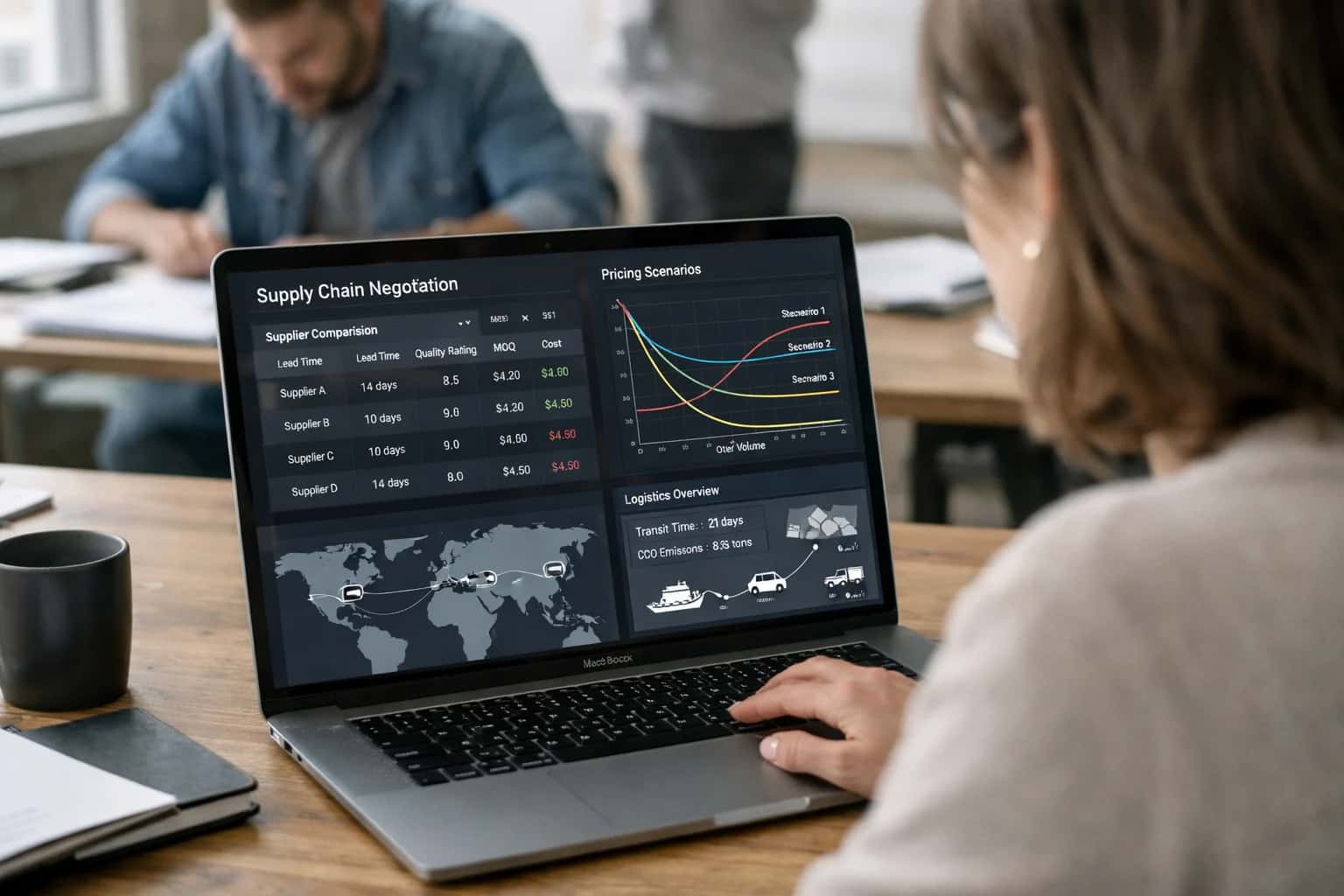
STRATEGIC INDEPENDENCE
What is Sovereign Supply Chain Risk Monitor Used For?
In an era of geopolitical volatility and data sovereignty mandates, traditional cloud-based supply chain analytics expose you to unacceptable risk. The Sovereign Supply Chain Risk Monitor is an AI solution deployed entirely within your own infrastructure, providing real-time threat intelligence while ensuring complete data control.
Our solution deploys a specialized AI model directly onto your sovereign infrastructure—be it an on-premises data center or a private cloud. It ingests your proprietary logistics data, news feeds, and geopolitical signals to provide real-time alerts on port closures, sanctions, or supplier instability. The outcome is a 10-15% reduction in unplanned disruptions and full compliance with data residency laws, transforming your supply chain from a reactive cost center into a proactively managed, strategic advantage. Learn more about building a resilient foundation with our guide on Sovereign AI Infrastructure.
SOVEREIGN SUPPLY CHAIN
Common Use Cases: Where Sovereign AI Mitigates Critical Risk
For CIOs managing global operations, supply chain risk is now a top-tier board concern. Sovereign AI provides the critical capability to monitor geopolitical, logistical, and compliance threats in real-time, with full data control.
01
Real-Time Geopolitical Disruption Alerts
Move from monthly risk reports to real-time intelligence. A sovereign AI model, trained on your proprietary logistics data and deployed on-premises, continuously scans for port closures, regulatory shifts, and political instability. It correlates internal shipment data with sovereign intelligence feeds to provide actionable alerts, enabling proactive rerouting and inventory rebalancing.
- Example: A manufacturer avoided a 3-week delay by receiving an AI alert on potential labor strikes at a key Asian port 72 hours before public news, allowing alternative carrier procurement.
- ROI Driver: Reduces unplanned freight costs by 15-25% and mitigates revenue loss from stockouts.
02
Vendor Financial Health & Concentration Risk
Protect against single-point failures in your supplier network. A sovereign AI platform analyzes confidential financial data, payment terms, and order history—all processed internally—to score vendor stability. It identifies over-concentration risk and simulates the impact of a key supplier's failure on your production lines.
- Example: An automotive OEM discovered 40% of a critical semiconductor component was sourced from a single, financially distressed vendor, triggering a dual-sourcing strategy 6 months before a potential bankruptcy.
- ROI Driver: Prevents catastrophic production halts, protecting millions in daily revenue.
03
Compliance-Aware Logistics Routing
Navigate complex sanctions and export controls autonomously. This sovereign AI system integrates your product classifications with dynamically updated regulatory databases. It automatically flags shipments that risk violating trade restrictions (e.g., OFAC, EU Dual-Use) and suggests compliant alternative routes—all without exposing sensitive shipment data to external cloud APIs.
- Example: A medical device company automatically rerouted shipments containing controlled components away from embargoed regions, avoiding a potential $10M+ fine and reputational damage.
- ROI Driver: Eliminates multi-million dollar compliance penalties and accelerates customs clearance.
04
Predictive Lead Time & Inventory Optimization
Transform static lead times into dynamic, predictive models. Using historical performance data, weather patterns, and carrier telemetry analyzed within your firewall, the AI forecasts accurate delivery windows. It autonomously adjusts safety stock levels and purchase orders to maintain service levels while reducing carrying costs.
- Example: A retailer reduced excess inventory by 18% while improving in-stock rates by 5% by using AI-predicted lead times instead of vendor-provided estimates.
- ROI Driver: Directly lowers working capital requirements and warehousing costs.
05
Secure Multi-Tier Supply Chain Mapping
Achieve visibility beyond Tier 1. This sovereign AI tool uses natural language processing on contracts, invoices, and audit reports—processed on your infrastructure—to map your extended supply network. It identifies hidden dependencies on single-source subcomponents or raw materials from high-risk regions, enabling resilience planning.
- Example: A electronics company mapped its supply chain to Tier 3, identifying a critical rare-earth mineral sourced from a single mine, leading to a strategic stockpiling initiative.
- ROI Driver: Enables strategic sourcing decisions that protect multi-year product roadmaps.
06
Carbon Footprint & ESG Compliance Tracking
Turn sustainability from a reporting burden into a competitive advantage. A sovereign AI model calculates the carbon footprint of every shipment and component based on proprietary logistics data, ensuring accuracy and auditability for ESG disclosures. It identifies high-emission legs and recommends greener alternatives without sharing data externally.
- Example: A consumer goods company reduced its Scope 3 logistics emissions by 12% in one year by implementing AI-optimized routing and modal shifts, strengthening its position with ESG-focused investors.
- ROI Driver: Mitigates regulatory risk, meets investor demands, and can reduce fuel and carbon tax costs.
SOVEREIGN SUPPLY CHAIN RISK MONITOR
How It Works: The Sovereign Implementation Path
Global supply chains are exposed to unpredictable geopolitical, logistical, and regulatory shocks. A sovereign AI implementation provides the control and insight needed to navigate this volatility.
Modern supply chains are a web of hidden vulnerabilities. A single port closure, new trade sanction, or supplier insolvency can halt production and destroy margins. Traditional monitoring tools, often cloud-based and generic, lack the real-time, context-aware intelligence to see these threats coming. More critically, they expose sensitive logistics data and strategic dependencies to third-party platforms, creating unacceptable operational and compliance risks.
Our solution is a Sovereign Supply Chain Risk Monitor, a domain-specific AI model trained and deployed entirely within your own infrastructure. It ingests your proprietary logistics data, supplier contracts, and global intelligence feeds to provide real-time threat alerts and scenario modeling—all while ensuring complete data sovereignty. This translates to measurable outcomes: a 15-30% reduction in unplanned disruptions and the ability to execute contingency plans days or weeks faster than competitors relying on public cloud analytics. For a deeper dive on achieving strategic independence, explore our pillar on Sovereign AI Infrastructure.
SOVEREIGN SUPPLY CHAIN
Real-World Examples & ROI
Move from reactive crisis management to proactive, sovereign control. These examples demonstrate how deploying AI on your own infrastructure delivers measurable ROI by mitigating geopolitical and logistical risks.
01
Mitigate Single-Point-of-Failure Risks
A global electronics manufacturer faced crippling delays when a key semiconductor supplier was impacted by regional tensions. Their sovereign AI monitor, trained on proprietary logistics and geopolitical data, identified this concentration risk 90 days in advance. The system recommended and validated alternative suppliers, enabling a proactive shift that prevented an estimated $220M in lost revenue and maintained production continuity.
$220M
Revenue Protected
90 Days
Early Warning
02
Automate Sanctions & Embargo Compliance
A multinational energy firm struggled with the manual, error-prone process of screening thousands of vendors against dynamically changing sanctions lists. Their sovereign supply chain AI, operating on internal data, automates this screening in real-time. The system:
- Flags non-compliant transactions before purchase orders are issued.
- Provides an immutable audit trail for regulators.
- Reduced compliance team workload by 65%, reallocating FTEs to strategic risk analysis.
65%
Manual Work Reduced
Real-Time
Screening Speed
03
Optimize Inventory for Logistical Volatility
A European automotive OEM used the sovereign monitor to model the impact of port closures and shipping lane disruptions on just-in-time inventory. By analyzing real-time shipping data, weather, and political stability indices, the AI recommended dynamic safety stock levels for critical components. This led to a 15% reduction in carrying costs while simultaneously improving parts availability, avoiding a single production line stoppage that would cost over $1M per hour.
15%
Carrying Cost Reduction
Zero
Line Stoppages
05
Quantify the Cost of Sovereignty
CIOs often face the question: 'What is the premium for sovereign control?' The ROI model is clear. For a typical $10B revenue company, a single major supply chain disruption can cost 3-5% of annual revenue. A sovereign AI monitor, with an average implementation cost of 0.1-0.3% of revenue, pays for itself by preventing just one such event. The business case extends beyond cost avoidance to competitive advantage through guaranteed operational resilience.
10:1
Typical ROI Ratio
3-5%
Disruption Cost
06
From Dashboard to Autonomous Response
The true value is realized when insight triggers action. A pharmaceutical company integrated their sovereign risk monitor with agentic enterprise orchestration workflows. When the AI detects a high-probability air freight delay for active pharmaceutical ingredients (APIs), it doesn't just alert—it autonomously executes a pre-approved workflow: re-routing shipments, adjusting production schedules, and notifying quality assurance. This transforms risk management from a reporting function into an autonomous operational capability.
Enabling Efficiency, Speed & Accuracy
Intelligent Analysis, Decision & Execution
We build AI systems for teams that need search across company data, workflow automation across tools, or AI features inside products and internal software.
Talk to Us
Search across company data
Give teams answers from docs, tickets, runbooks, and product data with sources and permissions.
Useful when people spend too long searching or get different answers from different systems.
Enterprise searchRAGPermissions
Read more
Automate internal workflows
Use AI to route work, draft outputs, trigger actions, and keep approvals and logs in place.
Useful when repetitive work moves across multiple tools and teams.
AI agentsWorkflow automationGovernance
Read more
Add AI to products and internal tools
Build assistants, guided actions, or decision support into the software your team or customers already use.
Useful when AI needs to be part of the product, not a separate tool.
AI integrationDecision supportModel routing
Read moreSOVEREIGN SUPPLY CHAIN RISK MONITOR
Adoption Challenges & Mitigations
Deploying a sovereign AI for supply chain risk involves unique technical and business hurdles. This guide addresses the most common enterprise objections, providing clear mitigation strategies to secure buy-in and ensure a successful, ROI-positive implementation.
The return on investment (ROI) is driven by risk mitigation and operational efficiency, not just software cost. A sovereign AI monitor provides real-time visibility into geopolitical, logistical, and compliance risks, allowing you to proactively reroute shipments or dual-source critical components. Quantifiable benefits include:
- Reduction in stockouts and production delays by 15-30%, protecting revenue.
- Decreased compliance fines by ensuring supplier data residency meets regional regulations (e.g., GDPR, China's DSL).
- Lower insurance premiums by demonstrating proactive risk management with an auditable, on-premises system. The key is tying AI insights directly to cost avoidance and revenue protection metrics in your business case. For a deeper dive on measuring AI value, see our guide on Outcome-Based AI Service Models and ROI Analytics.

About the author
Prasad Kumkar
CEO & MD, Inference Systems
Prasad Kumkar is the CEO & MD of Inference Systems and writes about AI systems architecture, LLM infrastructure, model serving, evaluation, and production deployment. Over 5+ years, he has worked across computer vision models, L5 autonomous vehicle systems, and LLM research, with a focus on taking complex AI ideas into real-world engineering systems.
His work and writing cover AI systems, large language models, AI agents, multimodal systems, autonomous systems, inference optimization, RAG, evaluation, and production AI engineering.
LinkedIn
Limited slotsGet a Free AI Consultation
Partnered with leading AI, data, and software stack.





How We Work
Custom AI workflows for your Business
One-fit-all AI don't work for modern businesses. At Inferensys, we aim to understand your business & custom requirements; which we use to define most efficient agentic workflows, the data, and the tools for your business.
01
Review the use case
We understand the task, the users, and where AI can actually help.
Read more02
Pick the right approach
We define what needs search, automation, or product integration.
Read more03
Build the first useful version
We implement the part that proves the value first.
Read more04
Improve from there
We add the checks and visibility needed to keep it useful.
Read moreThe first call is a practical review of your use case and the right next step.
Talk to Us