Manufacturing leaders operate with a critical blind spot: they only discover production losses—downtime, speed reductions, quality defects—hours or days after they occur. This reactive posture turns minor issues into major disruptions, eroding margins and jeopardizing delivery commitments. The core pain point is a lack of granular, real-time visibility into the three OEE components: Availability, Performance, and Quality. Without it, you're managing by gut feel, not data.

Use Case
Real-Time OEE Monitoring and Analytics
AI provides a live, granular view of Overall Equipment Effectiveness (OEE), highlighting hidden bottlenecks and performance losses to drive continuous improvement and unlock millions in trapped capacity.
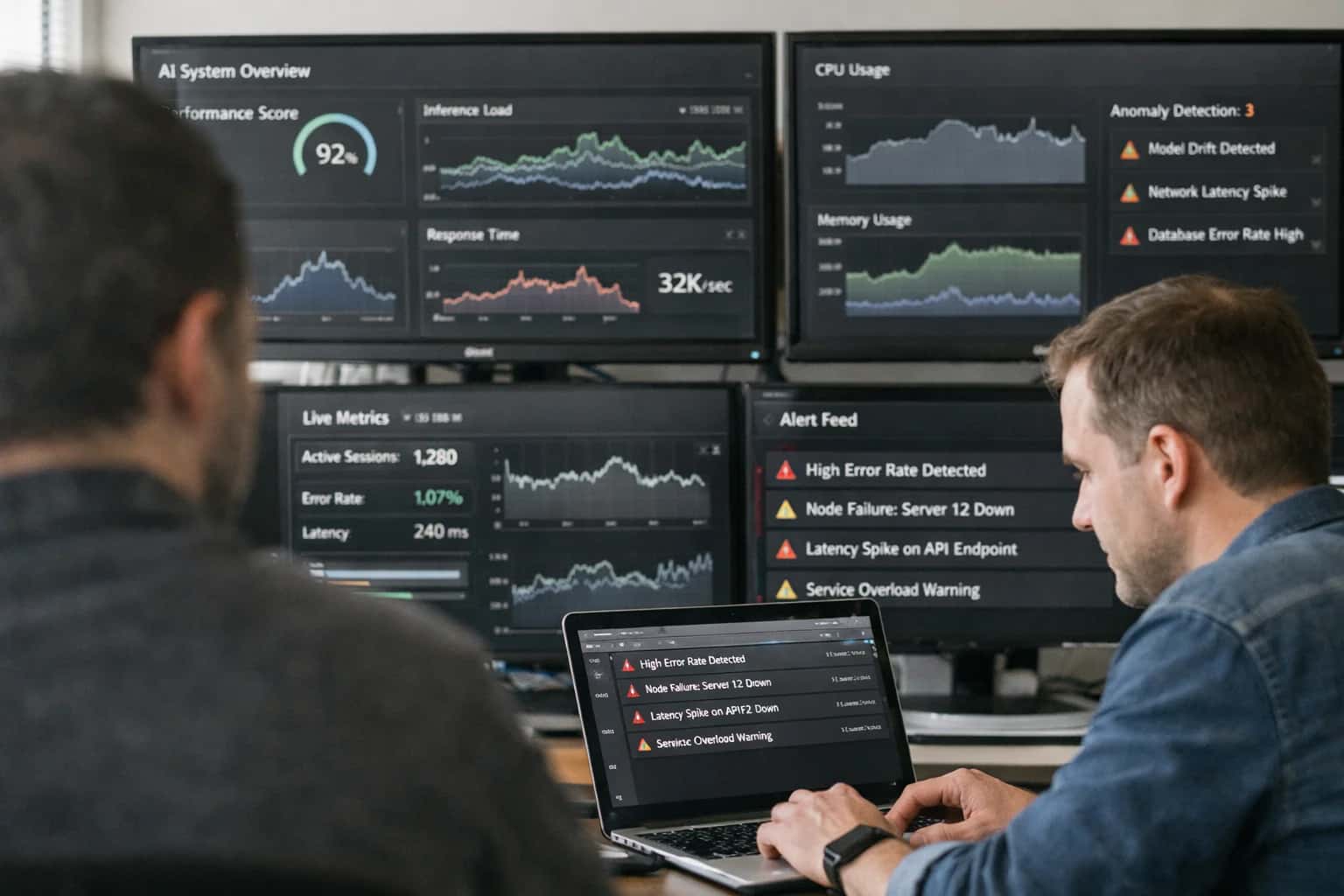
THE OPERATIONAL TRUTH MACHINE
What is Real-Time OEE Monitoring and Analytics Used For?
Overall Equipment Effectiveness (OEE) is the gold standard for manufacturing productivity. Real-time OEE monitoring powered by AI transforms this metric from a backward-looking report into a live, actionable command center for your factory floor.
AI-driven OEE analytics installs a 'central nervous system' across your production lines. By ingesting live data from PLCs, sensors, and MES systems, it calculates OEE second-by-second, highlighting hidden bottlenecks and performance losses as they happen. The measurable outcome is a 5-15% increase in productive capacity from existing assets, as teams shift from fighting fires to preventing them. This continuous improvement engine is foundational for initiatives like Predictive Maintenance for Zero Downtime and Dynamic Production Scheduling.
REAL-TIME OEE MONITORING
Common Use Cases: From Hidden Losses to Quantifiable Gains
Overall Equipment Effectiveness (OEE) is the gold standard for manufacturing productivity, but traditional methods are slow and blind to root causes. AI-powered real-time OEE analytics turn passive data into active intelligence, revealing hidden losses and driving continuous improvement.
01
Eliminate Hidden Capacity Losses
Traditional OEE calculations are lagging indicators, often missing micro-stoppages and speed losses that silently drain 5-15% of capacity. AI provides a live, granular view of every machine, correlating sensor data to identify and quantify previously invisible bottlenecks.
- Real-time alerts flag performance deviations the moment they occur.
- Root cause analysis pinpoints whether losses stem from mechanical issues, material flow, or operator actions.
- Example: A packaging line discovered recurring 30-second jams, invisible to weekly reports, reclaiming 2.5 hours of production daily.
02
Drive Data-Driven Continuous Improvement
Move from reactive problem-solving to a proactive culture of improvement. AI analytics transform OEE from a simple score into a diagnostic tool, providing actionable insights that empower floor managers and engineers.
- Prioritized loss analysis highlights the most impactful opportunities for Kaizen events.
- Trend visualization tracks the impact of process changes over time.
- Example: A metal stamping plant used trend analysis to prove a new tooling procedure increased Availability by 8%, justifying a plant-wide rollout.
03
Quantify ROI with Hard Savings
Justifying capital for improvement projects requires hard numbers. Real-time OEE monitoring delivers a clear ROI framework by directly linking performance gains to financial outcomes like increased throughput and reduced waste.
- Calculate value of lost time in dollars per minute of downtime.
- Benchmark performance across shifts, lines, and plants to identify best practices.
- Typical ROI: A 5-point OEE improvement on a $10M asset can deliver over $500k in annualized incremental output.
04
Enable Predictive & Prescriptive Actions
Beyond monitoring, AI uses OEE trends to predict future losses and recommend corrective actions. This shifts the operational model from descriptive to prescriptive, preventing losses before they impact production.
- Predict performance decay based on maintenance schedules and tool wear.
- Integrate with scheduling to optimize runs for highest OEE equipment.
- Example: An AI system prescriptively rescheduled a high-mix production run to a more reliable line, avoiding a predicted 4-hour quality-related stoppage.
05
Unify Metrics Across the Enterprise
Fragmented data from PLCs, MES, and ERP systems creates conflicting views of performance. An AI OEE platform acts as a single source of truth, harmonizing data streams to provide consistent, comparable metrics from the shop floor to the boardroom.
- Standardized calculations ensure every plant measures OEE the same way.
- Executive dashboards provide a real-time pulse on global production health.
- Benefit: Enables accurate capacity planning and identifies underperforming assets for targeted investment.
06
Enhance Human-in-the-Loop Decision Making
AI doesn't replace skilled workers; it empowers them. Real-time OEE analytics provide operators and supervisors with context-aware intelligence, reducing cognitive load and enabling faster, better decisions.
- Mobile alerts deliver relevant insights directly to floor personnel.
- Visual work instructions are triggered based on specific performance losses.
- Outcome: Technicians resolve issues 60% faster, and supervisors can coach based on data, not intuition.
FROM BLIND SPOTS TO BUSINESS INSIGHTS
How It Works: The 4-Step Implementation Path to Live OEE
Most manufacturers operate with a 20-30% hidden capacity loss. This structured path delivers a live, actionable view of Overall Equipment Effectiveness (OEE) to reclaim it.
The Pain Point: Traditional OEE is a rear-view mirror. Manual data collection creates lag, hiding real-time bottlenecks in Availability, Performance, and Quality. This opacity forces reactive firefighting, inflates operational costs, and leaves millions in potential throughput on the table. You can't optimize what you can't see.
The AI Fix: Our 4-step path delivers live OEE. We connect to your PLCs and sensors, apply edge processing for real-time analytics, and surface losses on an intuitive dashboard. The outcome is a 15-25% increase in productive capacity by targeting the largest hidden losses first, turning data into a competitive weapon. Explore our related solution for Predictive Maintenance for Zero Downtime.
FROM PILOT TO PAYBACK
Your 90-Day Roadmap to Live OEE Intelligence
Move from reactive reporting to proactive performance management. This roadmap delivers a live OEE dashboard, identifies hidden losses, and provides actionable intelligence to boost throughput within one quarter.
01
Pinpoint Hidden Production Losses
Traditional OEE is a lagging, aggregated metric. Our AI delivers a granular, real-time breakdown of the Six Big Losses—Availability, Performance, and Quality. See exactly which machine, shift, or process step is underperforming.
- Example: A packaging line showed 85% OEE. AI analysis revealed a specific filler head caused 15-minute micro-stoppages every hour, a loss invisible to weekly reports.
- Business Impact: Uncover the root causes of your 5-15% performance gap, providing a clear target for immediate operational fixes.
02
Shift from Reporting to Prescribing
Stop just measuring problems; start solving them. The system moves beyond dashboards to deliver prescriptive alerts and recommendations.
- Real-World Case: When a bottling line's speed dropped, the system correlated vibration data with upstream conveyor metrics, alerting maintenance to a specific bearing 30 minutes before a failure would have caused a 4-hour downtime.
- ROI Driver: Transforms your team from data consumers to action-takers, reducing Mean Time To Repair (MTTR) by up to 40%.
03
Quantify the Financial Impact
Justify the investment with hard numbers. Our framework translates OEE gains directly into margin improvement and capacity creation.
- Typical ROI Calculation: A 5% OEE increase on a $10M asset can unlock $500k in annualized throughput value. For a multi-line facility, this quickly justifies the platform cost.
- Business Justification: Provides the CFO-ready language to secure funding, focusing on asset utilization and avoided capital expenditure by getting more from existing lines.
04
Build a Culture of Continuous Improvement
Live OEE intelligence creates a shared, objective language for operations, maintenance, and leadership. It fuels data-driven daily stand-ups and Kaizen events.
- Example: A automotive components manufacturer used live loss codes to run targeted improvement sprints, boosting one line's performance by 8% in 60 days.
- Strategic Advantage: Embeds a sustainable operational excellence framework, turning insights into habitual process improvements that compound over time.
05
Integrate with Your Existing Tech Stack
Deploy rapidly without a 'rip and replace' nightmare. Our agents connect to your PLCs, SCADA, MES, and CMMS systems in weeks, not years.
- Implementation Path: Phase 1 (30 days): Connect 2-3 critical lines for a pilot. Phase 2 (60 days): Scale insights across the plant. Phase 3 (90 days): Integrate recommendations into workflow tools like Microsoft Teams or your MES.
- Reduced Risk: Leverages your current investments in sensors and data historians, ensuring a faster time-to-value.
06
The 90-Day Implementation Guarantee
We de-risk your journey with a clear, phased rollout focused on tangible outcomes.
- Month 1: Foundation & Pilot: Data connectivity established, live dashboard on pilot line, initial loss analysis.
- Month 2: Scale & Analyze: Expand to additional lines, deploy prescriptive alerts, quantify financial opportunity.
- Month 3: Operationalize & Roadmap: Integrate alerts into workflows, train super-users, plan next-phase use cases like Predictive Maintenance or AI-Driven Energy Optimization.
- Outcome: You have a production-proven system driving decisions, with a documented ROI case for plant-wide expansion.
Enabling Efficiency, Speed & Accuracy
Intelligent Analysis, Decision & Execution
We build AI systems for teams that need search across company data, workflow automation across tools, or AI features inside products and internal software.
Talk to Us
Search across company data
Give teams answers from docs, tickets, runbooks, and product data with sources and permissions.
Useful when people spend too long searching or get different answers from different systems.
Enterprise searchRAGPermissions
Read more
Automate internal workflows
Use AI to route work, draft outputs, trigger actions, and keep approvals and logs in place.
Useful when repetitive work moves across multiple tools and teams.
AI agentsWorkflow automationGovernance
Read more
Add AI to products and internal tools
Build assistants, guided actions, or decision support into the software your team or customers already use.
Useful when AI needs to be part of the product, not a separate tool.
AI integrationDecision supportModel routing
Read moreAI ROI JUSTIFICATION
Real-Time OEE Monitoring and Analytics: FAQs for Manufacturing Leaders
Implementing AI for real-time OEE is a strategic investment. These FAQs address the critical business, compliance, and implementation questions from CIOs and Operations VPs to help you build a clear business case.
The ROI is driven by converting hidden losses into measurable gains. Traditional OEE tracking is a lagging indicator, often manual and aggregated. AI-driven OEE provides a real-time, granular view of the three OEE factors—Availability, Performance, and Quality—pinpointing micro-stoppages, speed losses, and quality defects as they happen.
Typical quantifiable returns include:
- 3-7% increase in overall equipment effectiveness by eliminating hidden capacity.
- 15-25% reduction in unplanned downtime through predictive insights.
- 5-10% reduction in quality-related scrap and rework via root cause analysis. The investment typically pays for itself in 6-12 months through increased throughput and reduced waste. For a deeper dive on connecting AI to financial outcomes, see our guide on Outcome-Based AI Service Models and ROI Analytics.

About the author
Prasad Kumkar
CEO & MD, Inference Systems
Prasad Kumkar is the CEO & MD of Inference Systems and writes about AI systems architecture, LLM infrastructure, model serving, evaluation, and production deployment. Over 5+ years, he has worked across computer vision models, L5 autonomous vehicle systems, and LLM research, with a focus on taking complex AI ideas into real-world engineering systems.
His work and writing cover AI systems, large language models, AI agents, multimodal systems, autonomous systems, inference optimization, RAG, evaluation, and production AI engineering.
LinkedIn
Limited slotsGet a Free AI Consultation
Partnered with leading AI, data, and software stack.





How We Work
Custom AI workflows for your Business
One-fit-all AI don't work for modern businesses. At Inferensys, we aim to understand your business & custom requirements; which we use to define most efficient agentic workflows, the data, and the tools for your business.
01
Review the use case
We understand the task, the users, and where AI can actually help.
Read more02
Pick the right approach
We define what needs search, automation, or product integration.
Read more03
Build the first useful version
We implement the part that proves the value first.
Read more04
Improve from there
We add the checks and visibility needed to keep it useful.
Read moreThe first call is a practical review of your use case and the right next step.
Talk to Us