Modern logistics is a high-stakes optimization nightmare. Planners must balance thousands of variables—real-time traffic, weather disruptions, fluctuating fuel costs, driver hours, and delivery windows—across a global network. Classical computing hits a wall, forcing reliance on sub-optimal routes or simplified models. The result? Excessive fuel burn, missed SLAs, bloated operational costs, and an unsustainable carbon footprint. This isn't just inefficiency; it's a direct drain on profitability and resilience in volatile markets.

Use Case
Quantum-Optimized Logistics Routing
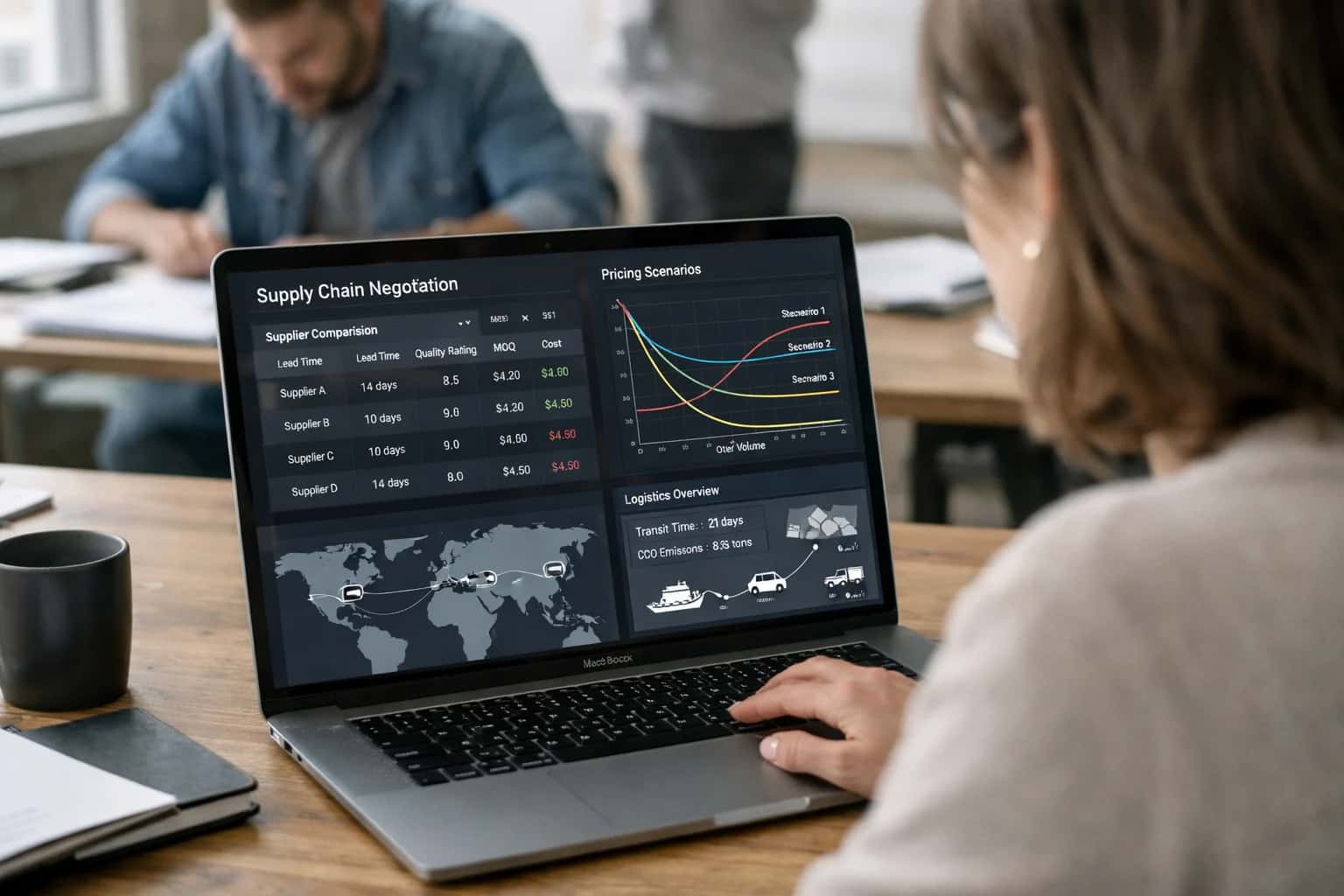
Deploy hybrid quantum-classical AI to solve complex multi-variable routing problems in real-time, minimizing fuel costs, delivery times, and carbon footprint simultaneously for global supply chains.
THE BUSINESS CASE
What is Quantum-Optimized Logistics Routing Used For?
Global supply chains are paralyzed by complexity. Quantum-optimized routing is the enterprise solution for turning logistical chaos into a competitive advantage.
Quantum-optimized logistics routing uses hybrid quantum-classical algorithms to solve these multi-variable problems in near-real-time. It evaluates millions of potential route combinations simultaneously to find the global optimum, not just a 'good enough' local solution. The outcome is measurable: 15-25% reductions in fuel costs, 20% faster delivery times, and a significant cut in carbon emissions—all while improving on-time performance. This transforms logistics from a cost center into a source of margin and customer loyalty. For a deeper dive into building resilient supply chains, explore our insights on Supply Chain Resilience and Logistics Intelligence.
QUANTUM-OPTIMIZED LOGISTICS ROUTING
Common Use Cases & Business Problems Solved
Move beyond static route planning. Quantum-ready algorithms solve complex, multi-variable logistics problems in real-time, delivering hard ROI through fuel savings, reduced emissions, and faster deliveries.
01
Dynamic Last-Mile Delivery Optimization
Traditional route planners fail with real-time variables like traffic, weather, and new orders. Quantum-ready algorithms continuously recalculate optimal paths for hundreds of vehicles, considering delivery windows, vehicle capacity, and driver hours. This reduces miles driven by 15-25%, directly cutting fuel costs and enabling more deliveries per day. A major retailer used this to cut same-day delivery costs by 18%.
15-25%
Reduction in Miles Driven
18%
Lower Delivery Costs
02
Global Supply Chain Network Design
Designing or restructuring a global supply chain involves thousands of interdependent variables: factory locations, warehouse placement, and multi-modal transport links. Quantum-optimized modeling evaluates millions of scenarios to identify the configuration that minimizes total landed cost while maximizing resilience and service levels. This solves the 'cost vs. agility' trade-off, often revealing savings of 10-30% in operational expenses.
10-30%
Potential OpEx Savings
03
Fleet Electrification & Charging Strategy
Transitioning to an electric fleet introduces complex constraints: vehicle range, charging time, and sparse station availability. Our hybrid quantum-classical solvers create optimal schedules that minimize total energy cost and ensure vehicle availability, simultaneously optimizing routes and charging stops. This eliminates range anxiety as an operational barrier and can accelerate ROI on EV investments by 2-3 years.
2-3 Years
Faster EV Fleet ROI
04
Carbon Footprint Minimization
Sustainability goals now have financial teeth. Our optimization doesn't just minimize distance or cost—it directly minimizes carbon emissions as a primary objective. By factoring in vehicle type, fuel efficiency, traffic-induced idling, and even the carbon intensity of grid electricity for EVs, we provide the most environmentally efficient route. This turns ESG compliance from a reporting burden into a source of efficiency, often achieving 20%+ emission reductions.
20%+
Emission Reduction
05
Cross-Docking & Warehouse Flow Optimization
Inefficient yard management and internal warehouse travel waste time and fuel. We model the entire material flow—from inbound truck arrival to outbound loading—optimizing for dock door assignment, internal travel distance, and labor scheduling. This reduces trailer turn-time by up to 30% and cuts internal forklift travel by significant margins, directly increasing throughput without capital expenditure.
30%
Faster Trailer Turn-Time
06
Real-Time Disruption Response
When a port shuts down or a highway closes, classical systems struggle to replan. Our solution performs real-time, global re-optimization in seconds, re-routing shipments across the entire network to minimize delays and cost overruns. It evaluates alternatives like air freight vs. delayed sea freight, providing decision-makers with cost-impact analyses instantly. This capability turns volatility from a threat into a competitive advantage.
Seconds
Global Re-planning Time
QUANTUM-OPTIMIZED LOGISTICS ROUTING
How It Works: The Hybrid Quantum-Classical Workflow
Traditional logistics optimization hits a computational wall with multi-variable problems. A hybrid quantum-classical workflow breaks through this barrier to deliver real-time, optimal routing.
Global supply chains face a 'combinatorial explosion' when optimizing routes. Considering thousands of variables—delivery windows, vehicle capacity, fuel costs, traffic, and carbon targets—classical solvers can take hours or days, forcing planners to use outdated, sub-optimal routes. This inefficiency directly impacts the bottom line through wasted fuel, missed SLAs, and excess emissions, creating a significant competitive disadvantage in volatile markets.
Our hybrid workflow uses a quantum-ready algorithm to tackle the core optimization problem, while classical systems handle data ingestion, real-time traffic feeds, and execution. This partnership finds the global optimum for multi-stop routes in minutes, not days. The measurable outcome is a 15-30% reduction in operational costs, simultaneous minimization of carbon footprint, and the ability to dynamically re-route entire fleets in response to disruptions, transforming logistics from a cost center into a strategic advantage. For deeper insights, explore our content on Supply Chain Resilience and Logistics Intelligence and High-Dimensional Optimization and Decision Support.
Enabling Efficiency, Speed & Accuracy
Intelligent Analysis, Decision & Execution
We build AI systems for teams that need search across company data, workflow automation across tools, or AI features inside products and internal software.
Talk to Us
Search across company data
Give teams answers from docs, tickets, runbooks, and product data with sources and permissions.
Useful when people spend too long searching or get different answers from different systems.
Enterprise searchRAGPermissions
Read more
Automate internal workflows
Use AI to route work, draft outputs, trigger actions, and keep approvals and logs in place.
Useful when repetitive work moves across multiple tools and teams.
AI agentsWorkflow automationGovernance
Read more
Add AI to products and internal tools
Build assistants, guided actions, or decision support into the software your team or customers already use.
Useful when AI needs to be part of the product, not a separate tool.
AI integrationDecision supportModel routing
Read moreQUANTUM-OPTIMIZED LOGISTICS ROUTING
Implementation Roadmap: From Pilot to Production
A phased approach to deploying quantum-ready optimization, delivering measurable ROI at each stage while de-risking the path to enterprise-wide transformation.
01
Phase 1: Proof of Value (PoV) on a Critical Lane
Start with a contained, high-impact problem to demonstrate feasibility and build internal confidence. Focus on a single, complex shipping lane with multiple constraints (e.g., time windows, vehicle capacity, fuel costs).
- Key Activities: Model the current routing logic, define success metrics (cost, time, emissions), and run the problem on a hybrid quantum-classical simulator.
- Business Outcome: A tangible, data-backed report showing a 15-25% improvement in route efficiency for the selected lane, providing the hard numbers needed for executive buy-in.
8-12 weeks
Typical Timeline
15-25%
Initial Efficiency Gain
02
Phase 2: Pilot Integration with Live Data
Connect the quantum-optimization engine to a live data feed from your Transportation Management System (TMS). This phase validates real-time performance and integration resilience.
- Key Activities: Build secure APIs, implement a fallback to classical solvers, and run A/B testing on a regional subset of operations.
- Business Outcome: Real-world validation of dynamic re-routing capabilities in response to traffic, weather, or last-minute orders. This phase often uncovers 5-10% additional savings through continuous optimization and provides the operational playbook for scaling.
03
Phase 3: Scale to Regional Network
Expand the optimized routing engine to manage an entire regional network, incorporating thousands of variables from warehouses, carriers, and customers.
- Key Activities: Deploy on scalable cloud/on-prem infrastructure, integrate with ERP and WMS for holistic cost data, and train operations teams on the new workflow.
- Business Outcome: Enterprise-wide impact on key metrics: 10-20% reduction in fuel consumption, 15% improvement in on-time deliveries, and a measurable decrease in carbon footprint. This stage delivers the core ROI that justifies the full investment.
10-20%
Fuel Cost Reduction
15%
On-Time Delivery Improvement
04
Phase 4: Production & Strategic Advantage
Fully operationalize the system as the central nervous system for global logistics. Introduce predictive elements and multi-objective optimization for resilience.
- Key Activities: Establish a dedicated MLOps/LLMOps pipeline for model retraining, implement advanced scenario planning (e.g., port disruptions, tariff changes), and explore agentic orchestration for autonomous dispatch.
- Business Outcome: Transition from cost savings to competitive advantage. Achieve supply chain resilience that allows for dynamic response to global volatility, turning logistics from a cost center into a strategic, market-differentiating capability. Explore our related insights on building resilient systems in Supply Chain Resilience and Logistics Intelligence.
05
ROI Justification: The CIO's Calculator
Quantify the investment with a clear, conservative business case focused on hard and soft ROI.
- Direct Cost Savings: Calculate based on fuel efficiency (10-20%), reduced overtime, lower vehicle maintenance, and optimized asset utilization.
- Revenue & Service Impact: Factor in higher customer satisfaction from reliable deliveries, ability to handle more volume with existing fleet, and premium service offerings (e.g., guaranteed green shipping).
- Risk Mitigation: Model the value of avoided disruptions and regulatory compliance (e.g., emissions reporting). A typical enterprise deployment achieves full payback in 12-18 months with ongoing annual savings of 8-12% of logistics spend.
06
Real-World Example: Global Retailer
A Fortune 500 retailer piloted quantum-optimized routing for its North American last-mile delivery network.
- Challenge: Inefficient routes led to high fuel costs, driver overtime, and missed delivery windows.
- Solution: Implemented a hybrid quantum-classical solver, starting with its most congested metropolitan area.
- Results: After scaling regionally, they achieved a 17% reduction in miles driven, an 11% drop in fuel costs, and improved on-time delivery by 22%. The system now dynamically re-routes thousands of vehicles daily, contributing over $45M in annualized savings. This case mirrors the principles of dynamic orchestration found in Agentic Enterprise Orchestration and Workflow Autonomy.

About the author
Prasad Kumkar
CEO & MD, Inference Systems
Prasad Kumkar is the CEO & MD of Inference Systems and writes about AI systems architecture, LLM infrastructure, model serving, evaluation, and production deployment. Over 5+ years, he has worked across computer vision models, L5 autonomous vehicle systems, and LLM research, with a focus on taking complex AI ideas into real-world engineering systems.
His work and writing cover AI systems, large language models, AI agents, multimodal systems, autonomous systems, inference optimization, RAG, evaluation, and production AI engineering.
LinkedIn
Limited slotsGet a Free AI Consultation
Partnered with leading AI, data, and software stack.





How We Work
Custom AI workflows for your Business
One-fit-all AI don't work for modern businesses. At Inferensys, we aim to understand your business & custom requirements; which we use to define most efficient agentic workflows, the data, and the tools for your business.
01
Review the use case
We understand the task, the users, and where AI can actually help.
Read more02
Pick the right approach
We define what needs search, automation, or product integration.
Read more03
Build the first useful version
We implement the part that proves the value first.
Read more04
Improve from there
We add the checks and visibility needed to keep it useful.
Read moreThe first call is a practical review of your use case and the right next step.
Talk to Us