CIOs face a critical blind spot: they invest in AI but cannot trace its value to the P&L. The pain point is the 'black box' of AI spending, where costs for cloud compute, data pipelines, and data science teams are clear, but the resulting business benefits—like cost avoidance or revenue uplift—are anecdotal. This lack of attribution makes it impossible to justify budgets, scale successful pilots, or kill underperforming projects, stalling enterprise-wide AI adoption.

Use Case
AI Service ROI Dashboard
A real-time analytics platform that directly attributes AI-driven activities to financial outcomes like cost avoidance, margin improvement, and revenue contribution, turning AI from a cost center into a profit driver.
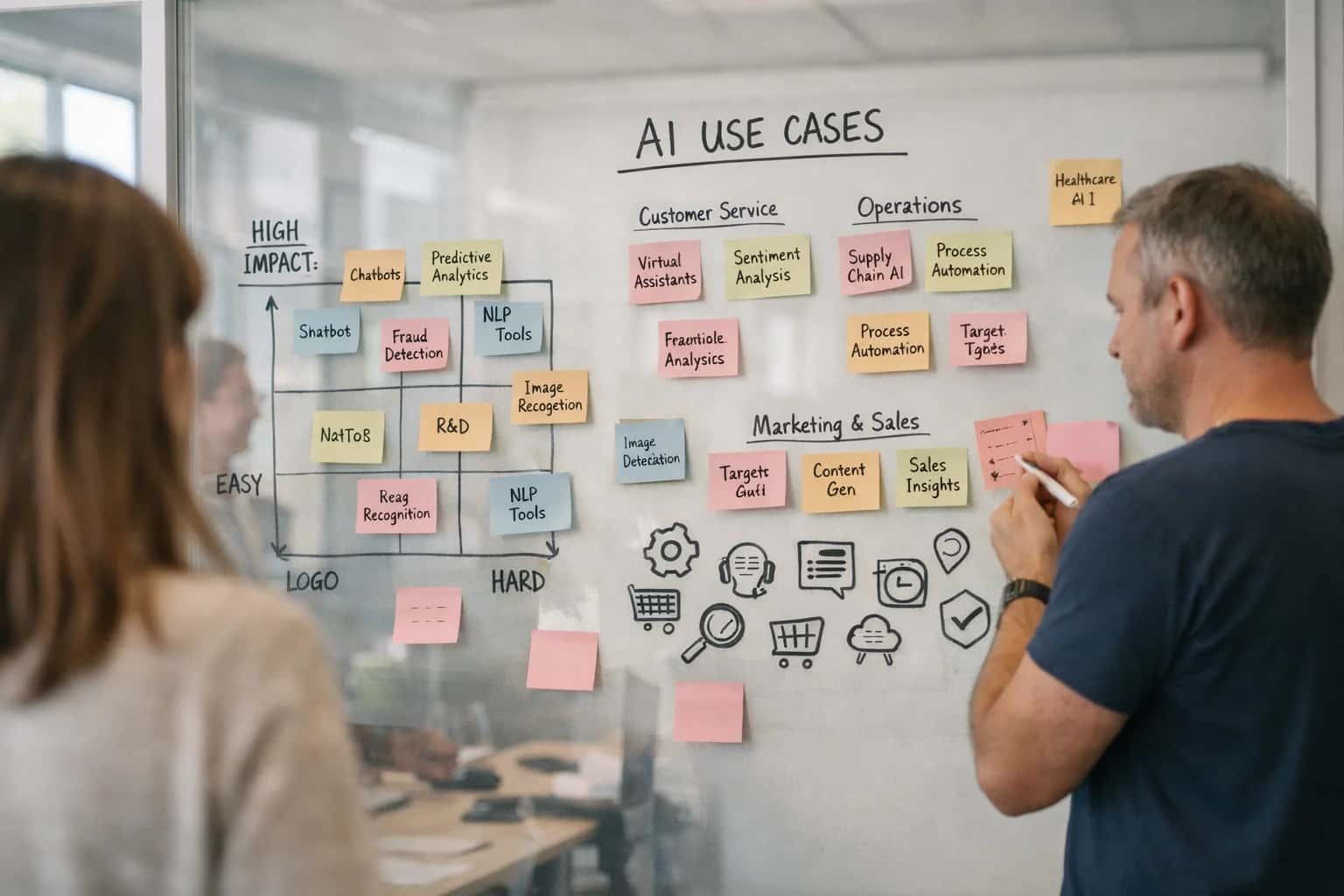
FROM BLACK BOX TO BUSINESS IMPACT
What is AI Service ROI Dashboard Used For?
An AI Service ROI Dashboard transforms AI from a cost center into a measurable profit driver by directly linking model activity to financial outcomes.
The solution is a real-time analytics platform that acts as a value attribution engine. It ingests data from AI services and business systems to create a direct, auditable line from model inferences—like a predictive maintenance alert—to financial outcomes like reduced downtime and maintenance savings. This enables data-driven decisions to double down on high-ROI use cases like Guaranteed Revenue Uplift AI and reallocate spend from low performers, ensuring every dollar of AI investment is accountable.
AI SERVICE ROI DASHBOARD
Common Use Cases
Move from abstract AI potential to concrete financial attribution. These use cases demonstrate how a real-time ROI dashboard transforms AI from a cost center into a measurable profit driver.
01
Marketing Spend Optimization
Stop guessing which campaigns work. Our dashboard directly attributes revenue uplift and customer acquisition cost (CAC) to specific AI-driven activities like personalized ad targeting or dynamic content generation. See which models are driving margin, not just clicks.
- Real Example: A retail client linked their generative product description AI to a 12% increase in add-to-cart rates, directly quantified in the dashboard.
- Continuously reallocates budget to the highest-performing AI agents.
02
Predictive Maintenance Cost Avoidance
Quantify the value of prevented downtime. The dashboard calculates cost avoidance by modeling unplanned outage expenses against AI-predicted failures that were proactively addressed.
- Tracks Mean Time Between Failure (MTBF) improvements and reduced parts inventory costs.
- Real Example: For a manufacturing client, the dashboard showed a $2.1M annual savings from a 15% reduction in line stoppages, justifying the AI Ops investment in 4 months.
03
Customer Service Efficiency & Retention
Move beyond ticket volume. Attribute reduced agent handle time and increased customer satisfaction (CSAT) scores directly to conversational AI and agentic workflows. The dashboard models the lifetime value (LTV) impact of churn reduction initiatives.
- Real Example: A fintech firm used the dashboard to prove their AI triage bot contributed to a 5-point NPS increase and $850k in saved labor costs quarterly.
- Correlates AI deflection rates with repeat purchase behavior.
04
Supply Chain & Logistics Intelligence
Turn volatility into margin. The dashboard attributes freight cost savings, inventory carrying cost reduction, and revenue protection from avoided stockouts to AI-driven dynamic routing and demand forecasting models.
- Calculates ROI of autonomous dispatch and warehouse robotics through labor efficiency and order accuracy metrics.
- Real Example: A logistics provider demonstrated a 23% improvement in asset utilization, tracked as direct contribution to operating income.
05
AI Vendor & Model Performance Governance
Eliminate wasted AI spend. The dashboard provides a single pane to compare cost-per-inference against business value generated for every internal model and third-party AI service (e.g., OpenAI, Anthropic).
- Enforces spend-to-value alignment by identifying underperforming models for retirement or retraining.
- Real Example: A media company saved $300k monthly by shifting workloads from a high-cost, low-impact LLM to a more efficient specialized model, as recommended by the dashboard.
06
Compliance & Risk Mitigation Value
Quantify the cost of not using AI. The dashboard models regulatory fine avoidance and litigation cost savings by attributing value to AI-driven compliance monitoring (RegTech) and contract analysis (LegalTech).
- Calculates FTE efficiency gains in legal and audit teams.
- Real Example: A bank's dashboard showed its AI transaction monitoring system identified $50M in potential AML violations, with a clear ROI based on estimated penalty avoidance.
FROM BLACK BOX TO BUSINESS CASE
How It Works: The Implementation Roadmap
Moving from AI pilots to scaled value requires a disciplined, ROI-centric implementation framework. This roadmap ensures every phase is tied to a measurable business outcome.
The core pain point is the 'AI black box'—significant investment in models and infrastructure with no clear line of sight to financial returns. Leaders struggle to attribute cost savings or revenue uplift to specific AI activities, making it impossible to justify ongoing spend or strategic expansion. This opacity turns AI from a competitive advantage into a costly experiment, stalling enterprise-wide adoption and eroding executive confidence in the technology's promise.
Our solution is a phased implementation of an AI Service ROI Dashboard. We begin by instrumenting your existing workflows to establish a financial baseline. We then deploy lightweight AI agents and models, with the dashboard directly attributing outcomes like reduced processing time or increased conversion rates to each initiative. This creates a closed-loop system where you pay for performance, not promises, and can scale investment with proven confidence. For a deeper dive on aligning costs with value, see our framework for AI Spend-to-Value Alignment.
Enabling Efficiency, Speed & Accuracy
Intelligent Analysis, Decision & Execution
We build AI systems for teams that need search across company data, workflow automation across tools, or AI features inside products and internal software.
Talk to Us
Search across company data
Give teams answers from docs, tickets, runbooks, and product data with sources and permissions.
Useful when people spend too long searching or get different answers from different systems.
Enterprise searchRAGPermissions
Read more
Automate internal workflows
Use AI to route work, draft outputs, trigger actions, and keep approvals and logs in place.
Useful when repetitive work moves across multiple tools and teams.
AI agentsWorkflow automationGovernance
Read more
Add AI to products and internal tools
Build assistants, guided actions, or decision support into the software your team or customers already use.
Useful when AI needs to be part of the product, not a separate tool.
AI integrationDecision supportModel routing
Read moreAI SERVICE ROI DASHBOARD
Timeline to Tangible Value
Move from abstract AI potential to concrete financial impact. Our dashboard directly attributes AI-driven activities to cost savings, margin improvement, and revenue contribution, providing the clear business justification CIOs need.
01
Real-Time Financial Attribution
Stop guessing which AI projects deliver value. Our dashboard provides granular, real-time attribution of AI activities to key financial outcomes. See exactly how a chatbot deployment reduces support costs or how a predictive maintenance model avoids downtime expenses. This transforms AI from a cost center to a quantified profit driver, enabling precise budget allocation and vendor accountability.
100%
Attribution Clarity
04
Dynamic Spend-to-Value Alignment
Eliminate AI waste by continuously aligning infrastructure costs with generated value. The dashboard monitors model performance, cloud spend, and business impact, flagging underperforming assets. This enables FinOps for AI, allowing you to right-size models, shift inference to edge locations, or decommission low-ROI services. It turns AI governance from an IT task into a continuous profit optimization loop.
15-30%
Typical Cost Optimization
06
Portfolio-Level ROI Intelligence
Gain a holistic view of your entire AI investment portfolio. Aggregate data from all initiatives—from conversational AI to predictive maintenance—into a single view of total cost, total value, and overall ROI. Identify synergies, reallocate budget from underperforming areas to high-growth opportunities, and report to leadership on the strategic contribution of AI to corporate objectives with executive-ready dashboards.
360°
Portfolio Visibility

About the author
Prasad Kumkar
CEO & MD, Inference Systems
Prasad Kumkar is the CEO & MD of Inference Systems and writes about AI systems architecture, LLM infrastructure, model serving, evaluation, and production deployment. Over 5+ years, he has worked across computer vision models, L5 autonomous vehicle systems, and LLM research, with a focus on taking complex AI ideas into real-world engineering systems.
His work and writing cover AI systems, large language models, AI agents, multimodal systems, autonomous systems, inference optimization, RAG, evaluation, and production AI engineering.
LinkedIn
Limited slotsGet a Free AI Consultation
Partnered with leading AI, data, and software stack.





How We Work
Custom AI workflows for your Business
One-fit-all AI don't work for modern businesses. At Inferensys, we aim to understand your business & custom requirements; which we use to define most efficient agentic workflows, the data, and the tools for your business.
01
Review the use case
We understand the task, the users, and where AI can actually help.
Read more02
Pick the right approach
We define what needs search, automation, or product integration.
Read more03
Build the first useful version
We implement the part that proves the value first.
Read more04
Improve from there
We add the checks and visibility needed to keep it useful.
Read moreThe first call is a practical review of your use case and the right next step.
Talk to Us