Traditional supply chains operate on fixed schedules and pre-defined routes, making them brittle in the face of real-world volatility. The pain point is clear: a single disruption—a port closure, a traffic jam, or extreme weather—can cascade into delayed shipments, inflated costs, and disappointed customers. This static approach fails to leverage the flood of live data from IoT sensors, GPS, and weather APIs, leaving millions in potential savings and service improvements on the table.

Use Case
Adaptive Supply Chain Routing
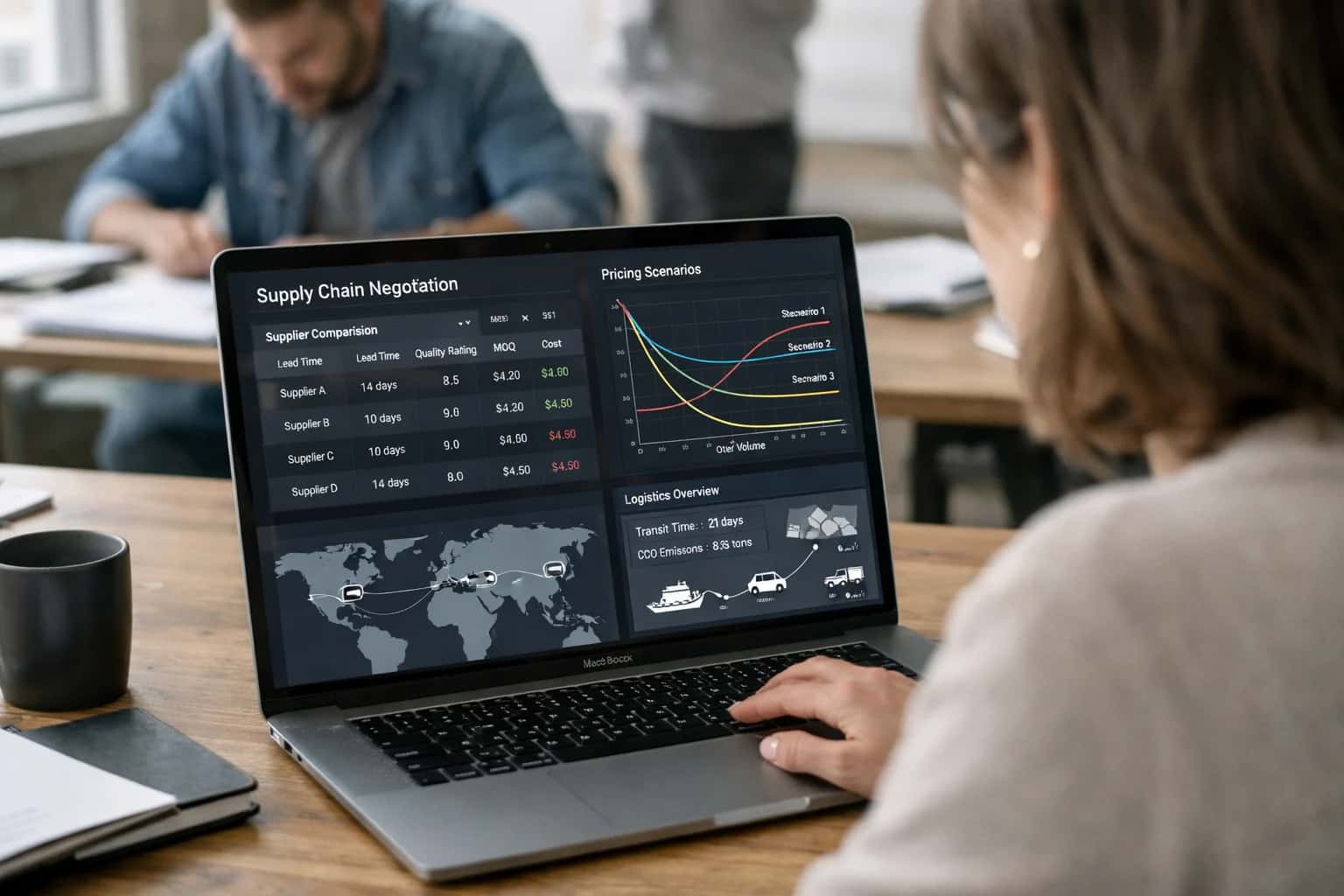
AI systems that dynamically reroute shipments and adjust logistics plans in real-time in response to live disruptions, ensuring on-time delivery and reducing costs.
USE CASES
What is Adaptive Supply Chain Routing Used For?
Adaptive Supply Chain Routing is a core application of Non-Situational AI, transforming static logistics plans into dynamic, self-optimizing networks. It directly addresses the multi-billion dollar problem of supply chain disruption.
The AI fix is a system that learns and reroutes in real time. By continuously ingesting live data on traffic, weather, port congestion, and carrier performance, an adaptive routing AI dynamically selects the optimal path and mode. The measurable outcome is a 10-25% reduction in logistics costs, improved on-time delivery rates by up to 15%, and a more resilient operation that protects revenue. This moves logistics from a cost center to a competitive advantage, as detailed in our analysis of Supply Chain Resilience and Logistics Intelligence.
SUPPLY CHAIN INTELLIGENCE
Common Use Cases: Where Adaptive Routing Delivers ROI
In today's volatile global market, static logistics plans are a liability. Adaptive routing powered by Non-Situational AI transforms supply chains into resilient, self-optimizing networks. Here are the tangible business outcomes.
ADAPTIVE SUPPLY CHAIN ROUTING
How It Works: The AI Implementation Journey
Traditional logistics planning is a static, reactive process. Modern supply chains require a dynamic, predictive nervous system. This is the journey to implementing a Non-Situational AI that learns and adapts in real-time.
The Pain Point: Static routing models fail in a volatile world. A single port closure, weather event, or traffic jam can cascade into days of delays, missed SLAs, and millions in expedited shipping costs. Traditional systems rely on historical data and manual intervention, leaving you reacting to disruptions instead of anticipating them. This rigidity directly impacts customer satisfaction and your bottom line.
The AI Fix: We deploy a Non-Situational AI that acts as a real-time logistics control tower. It ingests live data feeds—weather, GPS, port status, carrier capacity—and continuously updates its routing models. The system dynamically reroutes shipments, balancing cost, speed, and reliability. The outcome? A 10-25% reduction in late deliveries and a 5-15% decrease in annual freight costs through optimized load consolidation and mode shifting. This is the core of building a resilient, intelligent supply chain. Learn more about our approach to Supply Chain Resilience and Logistics Intelligence.
Enabling Efficiency, Speed & Accuracy
Intelligent Analysis, Decision & Execution
We build AI systems for teams that need search across company data, workflow automation across tools, or AI features inside products and internal software.
Talk to Us
Search across company data
Give teams answers from docs, tickets, runbooks, and product data with sources and permissions.
Useful when people spend too long searching or get different answers from different systems.
Enterprise searchRAGPermissions
Read more
Automate internal workflows
Use AI to route work, draft outputs, trigger actions, and keep approvals and logs in place.
Useful when repetitive work moves across multiple tools and teams.
AI agentsWorkflow automationGovernance
Read more
Add AI to products and internal tools
Build assistants, guided actions, or decision support into the software your team or customers already use.
Useful when AI needs to be part of the product, not a separate tool.
AI integrationDecision supportModel routing
Read moreADAPTIVE SUPPLY CHAIN ROUTING
Implementation Roadmap: From Pilot to Scale
A phased approach to deploying Non-Situational AI that learns from live disruptions, ensuring your logistics network becomes a resilient, self-optimizing asset.
01
Phase 1: Pilot for a Single Critical Lane
Start with a high-value, disruption-prone shipping lane (e.g., a key trans-Pacific route). Deploy an AI agent that ingests real-time data feeds for weather, port congestion, and carrier performance. The system learns to predict delays and suggests the first dynamic reroutes, building trust with a controlled scope.
- Example: A consumer electronics company piloting on a lane from Shenzhen to Los Angeles, reducing late arrivals by 15% within the first quarter.
- Key Outcome: Prove ROI on a contained scale and establish a baseline for cost avoidance.
02
Phase 2: Integrate with TMS & Expand Network Visibility
Connect the AI routing engine to your Transportation Management System (TMS) and Enterprise Resource Planning (ERP). Ingest internal data on orders, inventory levels, and carrier contracts. The system now evaluates trade-offs between cost, service level, and carbon footprint in its real-time decisions.
- Bold Benefit: Moves from reactive rerouting to proactive, multi-modal optimization (e.g., shifting from ocean to air freight for critical components).
- ROI Driver: Captures hard savings from reduced expedited freight charges and lower inventory carrying costs.
03
Phase 3: Deploy the Logistics Control Tower
Scale the AI to orchestrate your entire multi-tier supply network. The system acts as an autonomous Logistics Control Tower, making continuous micro-adjustments across thousands of shipments. It employs Multi-Agent System coordination to negotiate with digital carriers and warehouse systems.
- Real-World Impact: A global retailer using this phase maintained 98.5% on-time delivery during a major port strike, while competitors faced weeks of delays.
- Quantifiable Gain: Typical results show a 10-25% reduction in overall logistics costs and a 30-50% drop in stockouts.
04
Phase 4: Enable Predictive & Prescriptive Resilience
The system evolves from real-time reaction to predictive resilience. Using advanced simulation (Digital Twins of the supply chain), it models the impact of potential disruptions (storms, geopolitical events) weeks in advance and prescribes pre-emptive actions.
- Strategic Advantage: Allows for risk-weighted inventory positioning and contractual flexibility with carriers.
- Business Justification: Transforms logistics from a cost center into a competitive moat, directly impacting customer satisfaction and market share.
05
Measuring ROI: The CIO's Dashboard
Justification requires clear metrics. Your dashboard should track:
- On-Time In-Full (OTIF) Rate: Primary service-level indicator.
- Expedited Freight Cost Avoidance: Direct savings from fewer fire drills.
- Inventory Reduction: Enabled by more reliable transit times.
- Carbon Emission Reduction: From optimized routes and modal shifts.
- System Autonomy Rate: Percentage of routing decisions made without human intervention, measuring efficiency gain.
06
Overcoming Common Scaling Challenges
Acknowledge and plan for hurdles to ensure smooth scale-up:
- Data Quality & Integration: Legacy systems often have siloed, poor-quality data. Start with a focused data cleansing effort in Phase 1.
- Change Management: Logistics planners may resist AI recommendations. Use a human-in-the-loop design initially, showcasing AI's accuracy to build confidence.
- Vendor Lock-in: Insist on open APIs and a multi-cloud capable architecture to maintain flexibility and avoid future technical debt.
- Continuous Learning: Ensure your MLOps pipeline is in place to retrain models on new disruption patterns automatically.

About the author
Prasad Kumkar
CEO & MD, Inference Systems
Prasad Kumkar is the CEO & MD of Inference Systems and writes about AI systems architecture, LLM infrastructure, model serving, evaluation, and production deployment. Over 5+ years, he has worked across computer vision models, L5 autonomous vehicle systems, and LLM research, with a focus on taking complex AI ideas into real-world engineering systems.
His work and writing cover AI systems, large language models, AI agents, multimodal systems, autonomous systems, inference optimization, RAG, evaluation, and production AI engineering.
LinkedIn
Limited slotsGet a Free AI Consultation
Partnered with leading AI, data, and software stack.





How We Work
Custom AI workflows for your Business
One-fit-all AI don't work for modern businesses. At Inferensys, we aim to understand your business & custom requirements; which we use to define most efficient agentic workflows, the data, and the tools for your business.
01
Review the use case
We understand the task, the users, and where AI can actually help.
Read more02
Pick the right approach
We define what needs search, automation, or product integration.
Read more03
Build the first useful version
We implement the part that proves the value first.
Read more04
Improve from there
We add the checks and visibility needed to keep it useful.
Read moreThe first call is a practical review of your use case and the right next step.
Talk to Us