Legal and procurement teams waste hundreds of hours manually reviewing contracts, hunting for non-standard terms, auto-renewals, and liability caps. The pain point isn't just volume—it's the hidden risk of missing a critical clause because a keyword search failed or a human reviewer was fatigued. This manual process creates bottlenecks in deal flow, increases compliance exposure, and turns contract data into an unmanageable liability. For more on how AI transforms legal workflows, see our overview of LegalTech, RegTech, and AI-Driven Compliance.

Use Case
Logic-Driven Contract Clause Extraction
Use neuro-symbolic AI to extract and analyze contract clauses with logical reasoning, slashing due diligence time by 80% while providing auditable, rule-based justifications for compliance.
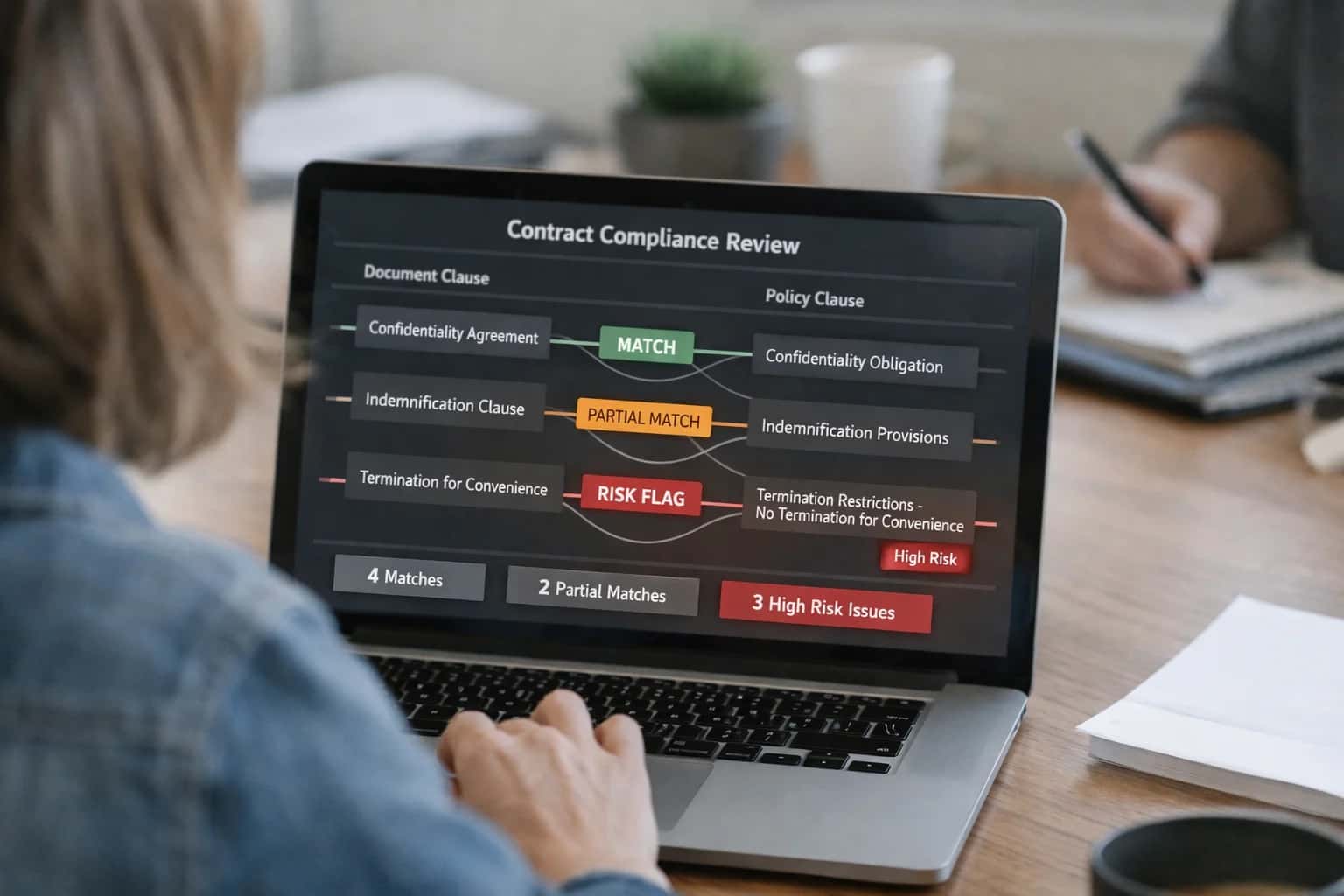
FROM BLACK BOX TO AUDIT TRAIL
What is Logic-Driven Contract Clause Extraction Used For?
Traditional AI for document review is a black box. It finds text but can't explain the 'why' behind a clause's risk. This creates compliance blind spots and slows down critical business processes like M&A due diligence and vendor onboarding.
Logic-driven extraction uses neuro-symbolic AI to apply legal and business rules directly to document analysis. It doesn't just find clauses; it understands their intent and context, flagging a termination-for-convenience clause as high-risk based on your firm's specific playbook. The outcome is a structured, auditable data output with clear justifications, enabling faster reviews, stronger negotiation positions, and a searchable repository of obligations. This directly translates to reduced legal spend, accelerated deal cycles, and mitigated compliance risk. Explore the underlying technology in our pillar on Neuro-symbolic Reasoning and Transparent Decisioning.
LOGIC-DRIVEN CONTRACT ANALYSIS
Common Use Cases & Business Problems Solved
Transform legal document review from a manual, error-prone cost center into a strategic, automated function. Neuro-symbolic AI extracts and interprets clauses with human-like logic, delivering auditable insights.
01
Accelerate M&A Due Diligence
Manual contract review creates a critical bottleneck, delaying deals and increasing costs. Our AI automates the extraction and risk assessment of key clauses (e.g., change-of-control, termination for convenience) across thousands of documents in hours, not weeks.
- Quantifiable ROI: Reduce due diligence timelines by 70-80%, enabling faster deal closure and freeing legal teams for high-value negotiation.
- Real Example: A private equity firm analyzed over 15,000 contracts in 48 hours, identifying $12M in potential liability from non-standard indemnity clauses that manual review had missed.
70-80%
Faster Review
48 hours
For 15k+ Docs
02
Automate Lease Abstraction & Compliance
Managing a real estate portfolio requires tracking critical dates, options, and obligations buried in unstructured lease documents. Manual abstraction is slow and error-prone.
- The AI Fix: Deploy logic-driven extraction to automatically populate a structured database with key terms: expiration dates, renewal options, CPI escalations, and co-tenancy clauses.
- Business Value: Enable proactive portfolio management, avoid missed renewal deadlines, and ensure compliance with financial reporting standards (e.g., ASC 842, IFRS 16). One REIT saved over 5,000 analyst hours annually and improved lease data accuracy to 99.5%.
03
Enforce Supplier Contract Compliance
Without visibility into contractual terms, organizations lose millions to non-compliant pricing, missed SLAs, and auto-renewals. Static repositories offer no active intelligence.
- How It Works: AI continuously monitors executed contracts against procurement and AP systems, flagging invoice discrepancies, SLA breaches, and upcoming renewals.
- ROI Case: A manufacturing conglomerate recovered $4.2M in the first year by enforcing contracted discount rates and identifying suppliers in breach of delivery penalties. The system provided a clear, logical audit trail for supplier negotiations.
04
Streamline Regulatory & Privacy Clause Review
New regulations (GDPR, CCPA, evolving AI Acts) require identifying and amending non-compliant clauses across entire contract libraries—a monumental manual task.
- The Solution: Neuro-symbolic AI understands regulatory logic, scanning for data processing terms, data localization requirements, and liability limitations that conflict with new rules.
- Competitive Advantage: Proactively manage regulatory risk. A global tech firm completed a GDPR readiness review of 8,000 vendor contracts in 3 weeks, versus a projected 9-month manual effort, avoiding potential fines and building trust.
05
Power Intelligent Contract Lifecycle Management (CLM)
Traditional CLM systems are glorified filing cabinets. They store contracts but lack the intelligence to understand them, leaving value trapped in documents.
- The Upgrade: Integrate logic-driven extraction as the brain of your CLM. It automatically classifies contracts, extracts obligations, and triggers workflows for renewals, consent requirements, and milestone deliveries.
- Outcome: Shift from reactive document management to proactive obligation management. A financial services client reduced contract-related operational risks by 40% and improved internal stakeholder satisfaction by providing self-service, AI-powered contract queries.
06
Mitigate Risk in Standard Clause Deviation
Even "standard" contracts are negotiated, creating hidden risks when non-standard language is introduced. Manual review is inconsistent and scales poorly.
- AI-Driven Governance: Establish a digital playbook. AI compares every new contract against approved standard language, highlighting and explaining the business and legal impact of each deviation (e.g., weakened indemnity, extended liability).
- Value Delivered: Ensure contractual consistency and empower legal to focus on strategic deviations. A pharmaceutical company accelerated contract turnaround by 65% while significantly reducing risk exposure from unfavorable boilerplate edits.
NEURO-SYMBOLIC AI IN ACTION
Logic-Driven Contract Clause Extraction
Traditional AI struggles with the nuanced logic of legal language, leaving critical risks hidden in unstructured text. Neuro-symbolic AI fuses deep learning with rule-based reasoning to extract and interpret contract clauses with human-like understanding.
Manual contract review is a costly, error-prone bottleneck. Legal teams spend weeks on due diligence, manually scanning hundreds of pages to identify non-standard terms, liability caps, and auto-renewal clauses. This process is slow, inconsistent, and risks missing critical obligations or exposures buried in dense legalese, directly impacting deal velocity and compliance posture.
Our neuro-symbolic AI applies a layer of contractual logic to document parsing. It doesn't just find keywords; it understands relationships between parties, payment terms, and termination conditions. The system extracts clauses into structured data, flags deviations from playbooks, and provides clear, rule-based justifications for each finding. This enables faster, more accurate reviews, reducing due diligence time by up to 80% and providing an auditable trail for compliance. Explore how this approach powers Justifiable Legal Contract Review and forms the backbone of modern LegalTech, RegTech, and AI-Driven Compliance.
LOGIC-DRIVEN CONTRACT AI
Implementation Roadmap: From Pilot to Production
A phased approach to deploying neuro-symbolic AI for contract analysis, designed to deliver rapid ROI while mitigating implementation risk.
01
Phase 1: Targeted Pilot & Proof of Concept
Start with a high-volume, repetitive document type like NDAs or procurement contracts. The goal is to validate accuracy and define ROI metrics.
- Example: Extract 10 key data points (parties, dates, termination clauses) from 1,000 legacy vendor agreements.
- Business Outcome: Demonstrate 70-80% reduction in manual review time for the pilot scope, quantifying legal team hours saved.
- Key Deliverable: A clear benchmark for accuracy (e.g., >95% precision on key fields) and a documented cost-saving projection.
02
Phase 2: Process Integration & Scale
Integrate the AI engine into the existing document management or CLM system. Focus on automating a complete workflow, not just extraction.
- Example: Connect AI output to a contract repository, triggering automatic alerts for non-standard liability clauses.
- Business Outcome: Achieve end-to-end automation for specific contract lifecycle events, such as renewal management or compliance checks.
- Key Deliverable: Measurable improvement in process cycle time (e.g., due diligence completed in hours vs. weeks).
03
Phase 3: Enterprise-Wide Deployment
Expand the system to handle the full spectrum of complex agreements—M&A documents, joint ventures, and bespoke commercial contracts.
- Example: Deploy logic-driven analysis for entire lease portfolios or global master service agreements.
- Business Outcome: Enterprise-wide visibility into contractual obligations and risks, enabling proactive management and strategic negotiation.
- Key Deliverable: A centralized dashboard providing insights into clause trends, risk exposure, and potential savings opportunities.
04
Phase 4: Continuous Learning & Optimization
Transition to a self-improving system where the AI learns from lawyer feedback and new regulatory changes.
- Example: The system flags emerging clause language from new data privacy laws and suggests compliant alternatives.
- Business Outcome: Sustainable competitive advantage through continuously improving accuracy and adaptability, reducing the cost of legal change management.
- Key Deliverable: Documented reduction in the time and cost required to adapt to new regulatory or business requirements.
05
Quantifying the ROI: A Real-World Model
Justify the investment with hard numbers based on typical enterprise outcomes.
- Direct Cost Savings: Reduce external legal review costs by 30-50% on high-volume contracts.
- Efficiency Gains: Enable legal teams to review 5-10x more contracts annually without increasing headcount.
- Risk Mitigation: Cut compliance audit preparation time by 40% through automated, auditable clause reporting.
- Strategic Value: Accelerate deal velocity by days or weeks, capturing market opportunities faster.
06
Overcoming Common Adoption Hurdles
Address CIO and Legal leadership concerns head-on to secure buy-in.
- Challenge: "AI can't understand legal nuance."
- Solution: Neuro-symbolic AI combines statistical pattern recognition with explicit legal rule sets, providing explainable, logic-backed outputs.
- Challenge: "Integration will disrupt our workflow."
- Solution: A phased roadmap with lightweight API integrations minimizes disruption, allowing teams to adopt new tools gradually.
- Challenge: "How do we ensure data security?"
- Solution: On-premise or private cloud deployment options ensure sensitive contract data never leaves your controlled environment.
Enabling Efficiency, Speed & Accuracy
Intelligent Analysis, Decision & Execution
We build AI systems for teams that need search across company data, workflow automation across tools, or AI features inside products and internal software.
Talk to Us
Search across company data
Give teams answers from docs, tickets, runbooks, and product data with sources and permissions.
Useful when people spend too long searching or get different answers from different systems.
Enterprise searchRAGPermissions
Read more
Automate internal workflows
Use AI to route work, draft outputs, trigger actions, and keep approvals and logs in place.
Useful when repetitive work moves across multiple tools and teams.
AI agentsWorkflow automationGovernance
Read more
Add AI to products and internal tools
Build assistants, guided actions, or decision support into the software your team or customers already use.
Useful when AI needs to be part of the product, not a separate tool.
AI integrationDecision supportModel routing
Read moreLOGIC-DRIVEN CONTRACT AI
Frequently Asked Questions for Decision Makers
Moving from AI pilots to production in legal and compliance requires clear answers on ROI, risk, and implementation. Below, we address the most common questions from CIOs and General Counsels evaluating logic-driven contract extraction.
Standard NLP tools use statistical patterns to find keywords or classify documents. Logic-driven extraction is a neuro-symbolic AI approach that fuses deep learning with explicit, rule-based reasoning. It doesn't just find a 'termination clause'; it understands the logical conditions (e.g., 'if Party A breaches... then rights are granted to Party B'), the obligations of each party, and how clauses interrelate. This creates structured, query-ready data that reflects the actual intent and risk within the contract, powering precise due diligence, compliance audits, and obligation tracking. For a deeper dive into this technology, explore our pillar on Neuro-symbolic Reasoning and Transparent Decisioning.

About the author
Prasad Kumkar
CEO & MD, Inference Systems
Prasad Kumkar is the CEO & MD of Inference Systems and writes about AI systems architecture, LLM infrastructure, model serving, evaluation, and production deployment. Over 5+ years, he has worked across computer vision models, L5 autonomous vehicle systems, and LLM research, with a focus on taking complex AI ideas into real-world engineering systems.
His work and writing cover AI systems, large language models, AI agents, multimodal systems, autonomous systems, inference optimization, RAG, evaluation, and production AI engineering.
LinkedIn
Limited slotsGet a Free AI Consultation
Partnered with leading AI, data, and software stack.





How We Work
Custom AI workflows for your Business
One-fit-all AI don't work for modern businesses. At Inferensys, we aim to understand your business & custom requirements; which we use to define most efficient agentic workflows, the data, and the tools for your business.
01
Review the use case
We understand the task, the users, and where AI can actually help.
Read more02
Pick the right approach
We define what needs search, automation, or product integration.
Read more03
Build the first useful version
We implement the part that proves the value first.
Read more04
Improve from there
We add the checks and visibility needed to keep it useful.
Read moreThe first call is a practical review of your use case and the right next step.
Talk to Us