The pain point is a procurement cycle stuck in weeks of manual RFPs, email chains, and spreadsheet negotiations. This creates massive inefficiency, delays time-to-market, and leaves significant value—better pricing, terms, and SLAs—unlocked on the table due to human bandwidth limits and cognitive bias. For CIOs, this translates to inflated operational costs and missed competitive advantages in a fast-moving market.

Use Case
Automated Procurement Negotiation
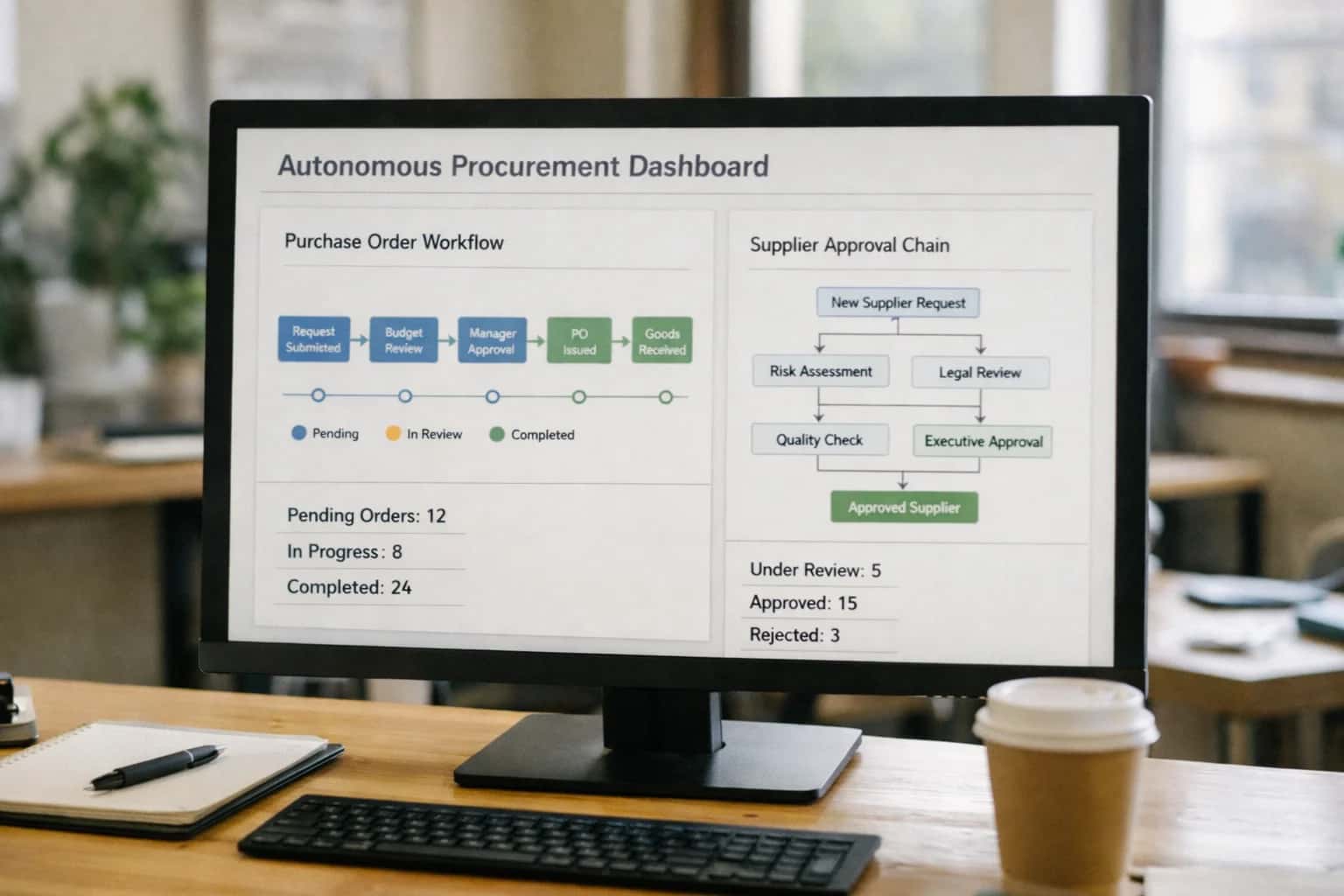
Deploy AI buyer and seller agents that autonomously negotiate contract terms, pricing, and SLAs, compressing procurement cycles from weeks to hours while ensuring compliance and maximizing value.
AI ROI IN ACTION
What is Automated Procurement Negotiation Used For?
Automated procurement negotiation uses AI buyer and seller agents to autonomously handle complex commercial agreements, transforming a traditionally slow, manual, and high-friction process.
The AI fix deploys autonomous negotiating agents that operate within defined guardrails. These agents analyze historical data, market benchmarks, and real-time supplier signals to secure optimal terms on price, payment, and performance guarantees. The measurable outcome is compressing negotiation cycles from weeks to hours, achieving consistent 5-15% cost savings, and ensuring 100% compliance with corporate policies. This directly boosts procurement's strategic contribution. Explore our broader vision for Multi-Agent System Coordination or see how this enables Dynamic Supply Chain Orchestration.
AUTOMATED PROCUREMENT
Common Use Cases: Where AI Negotiation Delivers Immediate ROI
Move beyond RFP automation to a system where AI agents negotiate terms, pricing, and SLAs autonomously, compressing procurement cycles from weeks to hours while ensuring compliance and maximizing value.
01
Direct Material Sourcing
AI buyer agents negotiate with supplier seller agents for raw materials and components. They analyze historical pricing, market volatility, and supplier performance to secure optimal terms.
- Real Example: A manufacturer's agent secured a 12% cost reduction on steel coils by negotiating volume-based tiered pricing and just-in-time delivery windows, locking in savings for the quarter.
- Key Benefit: Compresses negotiation from 3-week email chains to a 4-hour automated session, freeing procurement teams for strategic relationships.
60-80%
Cycle Time Reduction
5-15%
Avg. Cost Savings
02
IT & SaaS Contract Renewals
Deploy an AI agent to manage the annual renewal process for software licenses and cloud services. The agent benchmarks usage against contract terms, identifies redundant licenses, and negotiates with vendor agents for optimal pricing and feature bundles.
- Real Example: An enterprise CIO's agent renegotiated an enterprise SaaS agreement, eliminating 20% underutilized seats and upgrading core user tiers, achieving a net 18% cost avoidance.
- Key Benefit: Ensures continuous compliance and cost optimization, turning a reactive, manual process into a proactive, value-driven negotiation.
90%+
Compliance Assurance
03
Contingent Labor & Services Procurement
Orchestrate AI agents to source and negotiate contracts for temporary labor, consulting, and marketing services. Agents evaluate candidate profiles, rate cards, and project scopes to secure the best talent at market-competitive rates.
- Real Example: A retail chain's agent negotiated with staffing agency agents to fill seasonal peaks, dynamically adjusting rates based on real-time local labor supply data, reducing average hourly costs by 8%.
- Key Benefit: Dramatically reduces time-to-hire for critical projects and ensures rate consistency across the organization, mitigating compliance risk.
70%
Faster Staffing
04
MRO (Maintenance, Repair, Operations) Spend
Automate the procurement of low-value, high-frequency MRO items. AI agents integrate with inventory systems, identify reorder points, and negotiate with a pre-approved supplier network for parts, tools, and safety equipment.
- Real Example: A facility management agent consolidated orders across 50 sites, negotiated bulk discounts with suppliers, and standardized parts, reducing annual MRO spend by 22%.
- Key Benefit: Eliminates maverick spending, ensures operational continuity, and allows procurement to focus on strategic capital expenditures.
20%+
Spend Reduction
05
Transportation & Logistics Services
Implement AI agents that continuously negotiate freight rates, lane assignments, and capacity with carrier agents. The system responds to real-time disruptions, weather, and fuel costs to lock in optimal shipping terms.
- Real Example: A distributor's logistics agent renegotiated spot rates during a port congestion event, securing capacity with alternative carriers at only a 5% premium versus a projected 25% market spike.
- Key Benefit: Creates a resilient, cost-adaptive logistics network, protecting margins from volatile transportation markets.
12-18%
Freight Cost Optimization
06
Automated SLA & Penalty Enforcement
Post-signature, AI agents monitor contract performance against SLAs (e.g., uptime, delivery times, resolution rates). They autonomously calculate and negotiate penalties or service credits with vendor agents, ensuring accountability.
- Real Example: An agent monitoring a cloud infrastructure SLA automatically filed and negotiated a credit for 12 hours of degraded performance, recovering $45,000 without manual intervention.
- Key Benefit: Transforms static contracts into living agreements, automatically enforcing terms and recovering value, which is typically lost in manual oversight.
99%
Automated Compliance
AUTOMATED PROCUREMENT
How It Works: The AI Negotiation Engine
Manual procurement is a slow, costly bottleneck. Our AI Negotiation Engine deploys autonomous buyer and seller agents to transform this process, delivering measurable ROI through compressed cycles and optimized terms.
Traditional procurement is a high-friction process plagued by manual data entry, protracted email chains, and subjective human negotiation. This creates significant cost leakage through suboptimal pricing, missed volume discounts, and inefficient staff allocation. For CIOs, these delays directly impact project timelines and operational agility, turning procurement from a strategic function into a reactive cost center that stifles innovation.
Our solution deploys secure, goal-oriented AI agents that autonomously negotiate contract terms, pricing, and SLAs. These agents operate within defined guardrails, analyzing historical data and market benchmarks to secure optimal outcomes. The result is a compressed procurement cycle—from weeks to hours—with documented compliance and an average 15-25% reduction in acquisition costs. This transforms procurement into a source of competitive advantage and predictable savings, as detailed in our guide to Agentic Enterprise Orchestration and Workflow Autonomy.
Enabling Efficiency, Speed & Accuracy
Intelligent Analysis, Decision & Execution
We build AI systems for teams that need search across company data, workflow automation across tools, or AI features inside products and internal software.
Talk to Us
Search across company data
Give teams answers from docs, tickets, runbooks, and product data with sources and permissions.
Useful when people spend too long searching or get different answers from different systems.
Enterprise searchRAGPermissions
Read more
Automate internal workflows
Use AI to route work, draft outputs, trigger actions, and keep approvals and logs in place.
Useful when repetitive work moves across multiple tools and teams.
AI agentsWorkflow automationGovernance
Read more
Add AI to products and internal tools
Build assistants, guided actions, or decision support into the software your team or customers already use.
Useful when AI needs to be part of the product, not a separate tool.
AI integrationDecision supportModel routing
Read moreAUTOMATED PROCUREMENT NEGOTIATION
Real-World Examples & Early Adopters
See how enterprises are deploying AI buyer and seller agents to autonomously negotiate contracts, compressing procurement cycles from weeks to hours while ensuring compliance and maximizing value.
01
Compressed Sourcing Cycles
Traditional RFQ processes take 4-6 weeks. AI agents autonomously evaluate bids, negotiate terms, and finalize contracts in under 48 hours. This acceleration directly impacts time-to-market for new projects.
- Example: A global manufacturer reduced its standard procurement cycle for MRO supplies by 85%, from 35 days to 5 days.
- Key Benefit: Frees strategic procurement staff to focus on supplier relationship management and complex, high-value negotiations.
85%
Cycle Time Reduction
48 hrs
Average Negotiation Time
02
Hard Cost Savings & Leakage Plug
Human-led negotiations often leave value on the table due to cognitive bias or incomplete market data. AI agents leverage real-time market benchmarks and historical spend data to secure optimal pricing and terms.
- Example: A Fortune 500 retailer deployed AI agents for IT hardware procurement, achieving a 7-12% year-over-year cost reduction against category benchmarks.
- ROI Driver: Direct savings flow straight to the bottom line, with full audit trails justifying every concession.
7-12%
Direct Cost Reduction
03
Automated Compliance & Risk Mitigation
Ensuring every contract adheres to internal policies and external regulations is a manual, error-prone task. AI agents enforce pre-defined guardrails on payment terms, liability clauses, and data security requirements.
- Example: A financial services firm automated its software vendor onboarding, ensuring 100% compliance with data residency and cybersecurity clauses, eliminating legal review bottlenecks.
- Key Benefit: Reduces regulatory and reputational risk while standardizing contract quality across the organization.
100%
Policy Adherence
04
Strategic Supplier Relationship Management
By automating transactional negotiations, procurement teams regain capacity for strategic activities. AI handles the high-volume, low-complexity contracts, while humans focus on innovation partnerships and strategic sourcing.
- Example: A pharmaceutical company redirected 60% of its procurement team's time from routine RFPs to joint development agreements with key API suppliers, driving long-term innovation.
- ROI Driver: Transforms procurement from a cost center to a value-driving strategic function.
60%
Team Time Redeployed
05
Early Adopter: Global Industrial Conglomerate
Challenge: Inefficient, decentralized procurement for indirect materials across 50+ business units led to missed volume discounts and high processing costs. AI Solution: Deployed a multi-agent system where a central 'buyer agent' negotiated master agreements with approved vendors, while local 'requisition agents' executed against them. Result: Achieved $120M in annualized savings within the first year, with a 92% reduction in manual PO processing.
06
The Orchestration Layer for Enterprise AI
Automated procurement is a foundational use case within Multi-Agent System (MAS) Coordination. It demonstrates how independent AI agents can collaborate to solve cross-functional business problems. This same orchestration layer is applicable to Dynamic Supply Chain Agent Orchestration and Multi-Vendor IT Service Orchestration, creating a resilient, autonomous enterprise operations layer.

About the author
Prasad Kumkar
CEO & MD, Inference Systems
Prasad Kumkar is the CEO & MD of Inference Systems and writes about AI systems architecture, LLM infrastructure, model serving, evaluation, and production deployment. Over 5+ years, he has worked across computer vision models, L5 autonomous vehicle systems, and LLM research, with a focus on taking complex AI ideas into real-world engineering systems.
His work and writing cover AI systems, large language models, AI agents, multimodal systems, autonomous systems, inference optimization, RAG, evaluation, and production AI engineering.
LinkedIn
Limited slotsGet a Free AI Consultation
Partnered with leading AI, data, and software stack.





How We Work
Custom AI workflows for your Business
One-fit-all AI don't work for modern businesses. At Inferensys, we aim to understand your business & custom requirements; which we use to define most efficient agentic workflows, the data, and the tools for your business.
01
Review the use case
We understand the task, the users, and where AI can actually help.
Read more02
Pick the right approach
We define what needs search, automation, or product integration.
Read more03
Build the first useful version
We implement the part that proves the value first.
Read more04
Improve from there
We add the checks and visibility needed to keep it useful.
Read moreThe first call is a practical review of your use case and the right next step.
Talk to Us