For CIOs, the pain is twofold: legal overhead and vendor risk. Manually tracking thousands of contracts and SLAs across procurement, IT, and legal is slow and error-prone. Missed renewal dates, unenforced penalties, and non-compliant terms silently drain millions in value. This isn't just a legal problem; it's a direct hit to operational efficiency and financial performance, creating blind spots in your vendor ecosystem.

Use Case
Automated Contract and SLA Management
Deploy AI agents to autonomously monitor performance, negotiate amendments, and enforce SLA penalties, transforming contracts from static documents into dynamic, value-protecting assets. Reduce legal overhead by 70% and capture 95% of eligible vendor credits.
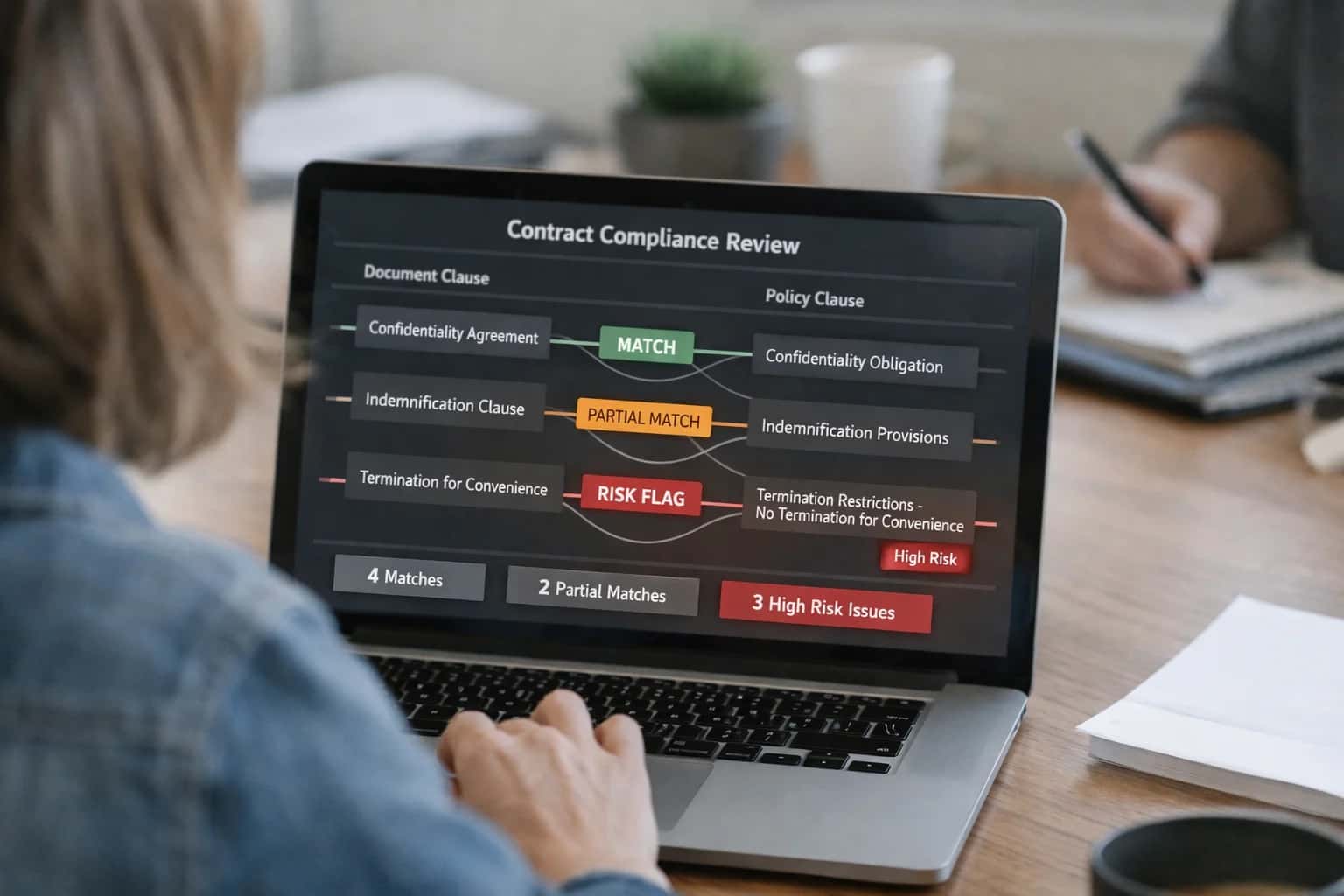
THE BUSINESS PAIN
What is Automated Contract and SLA Management Used For?
Manual contract oversight is a costly, high-risk bottleneck. Automated AI agents transform this liability into a strategic, profit-protecting asset.
The AI fix deploys autonomous agents as a continuous monitoring layer. These agents read contracts, track performance metrics against SLAs in real-time, and automatically flag deviations. They can even negotiate amendments or initiate penalty enforcement. The outcome? A 70% reduction in manual review time, near-elimination of costly auto-renewals, and a fortified, data-driven vendor management posture. This is a core use case of Multi-Agent System (MAS) Coordination, where specialized agents collaborate to manage complex, cross-departmental agreements.
AUTOMATED CONTRACT AND SLA MANAGEMENT
Where Does AI-Driven Contract Management Deliver ROI?
Move beyond static document storage. AI agents transform contracts from legal artifacts into dynamic, self-managing assets that actively protect value and enforce performance.
02
Enforce SLAs & Mitigate Vendor Risk
Service Level Agreements (SLAs) are often forgotten after signing. AI agents provide continuous, real-time performance monitoring against contractual benchmarks.
- Example: A telecom provider uses AI to automatically validate cloud vendor uptime against SLAs, triggering penalty calculations without manual intervention.
- Integrates with IT monitoring tools to track metrics like system availability, response times, and resolution rates.
- Automatically generates breach notifications and initiates remediation workflows, protecting revenue and service quality.
03
Automate Renegotiation & Amendment Cycles
Contract renewal is a reactive, high-pressure event. AI agents enable proactive, data-driven renegotiation by analyzing performance history and market benchmarks.
- Example: A retailer's AI system identified underperforming volume discounts in a supplier contract, providing negotiation leverage that saved $2.3M annually.
- Simulates amendment scenarios based on changing business needs (e.g., scaling services, adding regions).
- Compresses negotiation cycles from months to days by pre-drafting amendments and highlighting optimal terms.
04
Optimize Financial Terms & Obligations
Buried payment terms, auto-renewals, and missed rebates silently erode margin. AI agents act as a financial control layer, ensuring contractual value is captured.
- Example: An energy company recovered $850K in missed early-payment discounts across vendor contracts in one quarter using AI discovery.
- Tracks volume-based pricing tiers and alerts when thresholds are met to trigger better rates.
- Identifies and flags costly auto-renewal clauses well in advance, enabling intentional renewal decisions.
05
Centralize Obligation Management
Contractual duties are scattered across departments, leading to missed deliverables and reputational damage. AI creates a single source of truth for all obligations.
- Example: A construction firm uses an AI agent to track and assign over 5,000 milestone deliverables across its project portfolio, reducing compliance failures by 70%.
- Automatically routes obligations (e.g., reporting, insurance certificates, audits) to the responsible party with deadlines.
- Provides executives with a dashboard view of organizational risk exposure from unmet commitments.
06
Accelerate Due Diligence & M&A
Mergers and acquisitions hinge on understanding contractual liabilities. AI agents perform lightning-fast portfolio analysis to uncover risks and opportunities.
- Example: During an acquisition, AI analyzed 12,000 target company contracts in 48 hours, identifying $50M in potential lease liabilities and exclusivity clauses.
- Summarizes key terms, change-of-control provisions, and termination rights across massive document sets.
- Enables faster, more informed deal decisions and smoother post-merger integration.
AUTOMATED CONTRACT AND SLA MANAGEMENT
How It Works: The Multi-Agent Orchestration Layer
Traditional contract management is a reactive, manual process plagued by oversight and financial leakage. Our multi-agent orchestration layer transforms it into a proactive, autonomous system that continuously enforces business terms.
Manual contract and SLA monitoring creates significant business risk. Legal and procurement teams struggle to track performance across hundreds of vendor agreements, leading to missed renewal deadlines, undetected SLA breaches, and unclaimed penalties. This reactive approach turns contracts from strategic assets into costly administrative burdens, exposing the enterprise to financial loss and compliance gaps. The pain point is a lack of real-time, intelligent oversight.
Our solution deploys a negotiating multi-agent system where specialized AI agents act as autonomous contract managers. One agent continuously monitors performance data against SLA terms, while another can automatically initiate amendments or enforce penalties based on pre-defined business rules. This shifts management from periodic reviews to continuous enforcement, reducing legal overhead by up to 40% and ensuring vendor accountability. The outcome is contracts that actively protect revenue and mitigate risk.
AUTOMATED CONTRACT AND SLA MANAGEMENT
Phased Implementation Roadmap
Transform your legal and procurement functions from a cost center into a strategic asset. This roadmap delivers measurable ROI by automating the contract lifecycle, from negotiation to enforcement.
01
Phase 1: Intelligent Document Ingestion & Analysis
Deploy AI agents to instantly ingest and analyze thousands of legacy contracts and SLAs. This foundational phase creates a single source of truth by extracting key clauses, obligations, and dates.
- Real Example: A global retailer reduced contract review time by 80%, identifying $12M in auto-renewal risks within the first quarter.
- Key Benefit: Unlocks immediate visibility into vendor commitments and expirations, enabling proactive management.
02
Phase 2: Automated Performance Monitoring & Alerts
Implement continuous, 24/7 monitoring of active contracts against real-world performance data. AI agents track SLA compliance, delivery milestones, and cost variances.
- Real Example: A telecom provider automated SLA tracking for 5,000+ vendor contracts, triggering alerts for breaches that saved an estimated $4.7M in potential penalties annually.
- Key Benefit: Shifts from reactive dispute management to proactive performance assurance, protecting revenue and relationships.
03
Phase 3: Agent-Driven Negotiation & Amendment
Enable AI agents to conduct preliminary negotiations on standard terms and propose data-driven amendments. Agents use historical performance and market benchmarks to optimize pricing and risk allocation.
- Real Example: A manufacturing firm's procurement agents autonomously negotiated payment term extensions with 150 suppliers, improving working capital by $15M.
- Key Benefit: Compresses negotiation cycles from weeks to days, freeing legal teams for high-value strategic work.
04
Phase 4: Autonomous Enforcement & Dispute Resolution
Activate AI agents to autonomously enforce contract terms, including calculating and issuing penalty invoices, service credits, and renewal notices based on pre-defined business rules.
- Real Example: A SaaS company automated its credit issuance process for SLA failures, recovering $850K in lost revenue while improving customer satisfaction scores.
- Key Benefit: Ensures contractual terms have tangible financial teeth, directly impacting the bottom line and vendor accountability.
05
Phase 5: Predictive Risk & Portfolio Optimization
Leverage the aggregated contract data and performance history to run predictive simulations. AI models forecast vendor risk, renewal costs, and consolidation opportunities across the entire portfolio.
- Real Example: A financial institution used portfolio analysis to consolidate 40 software vendors into 15, achieving 22% annual cost savings.
- Key Benefit: Transforms contract management from an administrative function into a source of strategic intelligence for CFOs and COOs.
06
Phase 6: Integration with Enterprise Orchestration
Fully integrate the contract management system with other enterprise AI agents for Procurement, Finance, and LegalTech. This creates a closed-loop system where contract terms automatically trigger actions in ERP and payment systems.
- Real Example: An energy company linked its contract agents to its dynamic supply chain orchestration, enabling automatic fuel purchase adjustments based on price caps in master agreements.
- Key Benefit: Achieves true end-to-end autonomy, where contracts become living, operational components of the business.
Enabling Efficiency, Speed & Accuracy
Intelligent Analysis, Decision & Execution
We build AI systems for teams that need search across company data, workflow automation across tools, or AI features inside products and internal software.
Talk to Us
Search across company data
Give teams answers from docs, tickets, runbooks, and product data with sources and permissions.
Useful when people spend too long searching or get different answers from different systems.
Enterprise searchRAGPermissions
Read more
Automate internal workflows
Use AI to route work, draft outputs, trigger actions, and keep approvals and logs in place.
Useful when repetitive work moves across multiple tools and teams.
AI agentsWorkflow automationGovernance
Read more
Add AI to products and internal tools
Build assistants, guided actions, or decision support into the software your team or customers already use.
Useful when AI needs to be part of the product, not a separate tool.
AI integrationDecision supportModel routing
Read moreAUTOMATED CONTRACT & SLA MANAGEMENT
FAQs for Enterprise Decision Makers
Implementing AI agents to manage contracts and SLAs promises significant efficiency gains, but raises critical questions about compliance, ROI, and implementation. These FAQs address the top concerns of CIOs and legal executives.
The core business case is risk reduction and cost savings. Manual contract management is slow, error-prone, and creates significant vendor risk through missed deadlines, non-compliance penalties, and opaque performance. An AI-driven system provides continuous, 24/7 monitoring of all contractual obligations. It quantifies value by:
- Reducing legal overhead by up to 40% on routine reviews and amendments.
- Preventing revenue leakage by automatically enforcing SLA penalties and renewal clauses.
- Improving negotiation leverage with data-driven insights from historical performance. This transforms contracts from static documents into dynamic, performance-managed assets. For related strategies on workflow automation, see our pillar on Agentic Enterprise Orchestration and Workflow Autonomy.

About the author
Prasad Kumkar
CEO & MD, Inference Systems
Prasad Kumkar is the CEO & MD of Inference Systems and writes about AI systems architecture, LLM infrastructure, model serving, evaluation, and production deployment. Over 5+ years, he has worked across computer vision models, L5 autonomous vehicle systems, and LLM research, with a focus on taking complex AI ideas into real-world engineering systems.
His work and writing cover AI systems, large language models, AI agents, multimodal systems, autonomous systems, inference optimization, RAG, evaluation, and production AI engineering.
LinkedIn
Limited slotsGet a Free AI Consultation
Partnered with leading AI, data, and software stack.





How We Work
Custom AI workflows for your Business
One-fit-all AI don't work for modern businesses. At Inferensys, we aim to understand your business & custom requirements; which we use to define most efficient agentic workflows, the data, and the tools for your business.
01
Review the use case
We understand the task, the users, and where AI can actually help.
Read more02
Pick the right approach
We define what needs search, automation, or product integration.
Read more03
Build the first useful version
We implement the part that proves the value first.
Read more04
Improve from there
We add the checks and visibility needed to keep it useful.
Read moreThe first call is a practical review of your use case and the right next step.
Talk to Us