The core pain point is silent model failure. In production, models degrade due to data drift, concept drift, or infrastructure issues, leading to inaccurate predictions that erode customer trust and revenue. Without continuous monitoring, these failures go undetected for weeks, causing significant financial loss and operational risk. For example, a credit scoring model that silently degrades can approve bad loans or reject profitable ones, directly impacting the bottom line.

Use Case
Production-Scale Model Monitoring
Centralized dashboards and automated alerting to ensure AI models deliver consistent business value, prevent costly failures, and maintain regulatory compliance across thousands of production deployments.
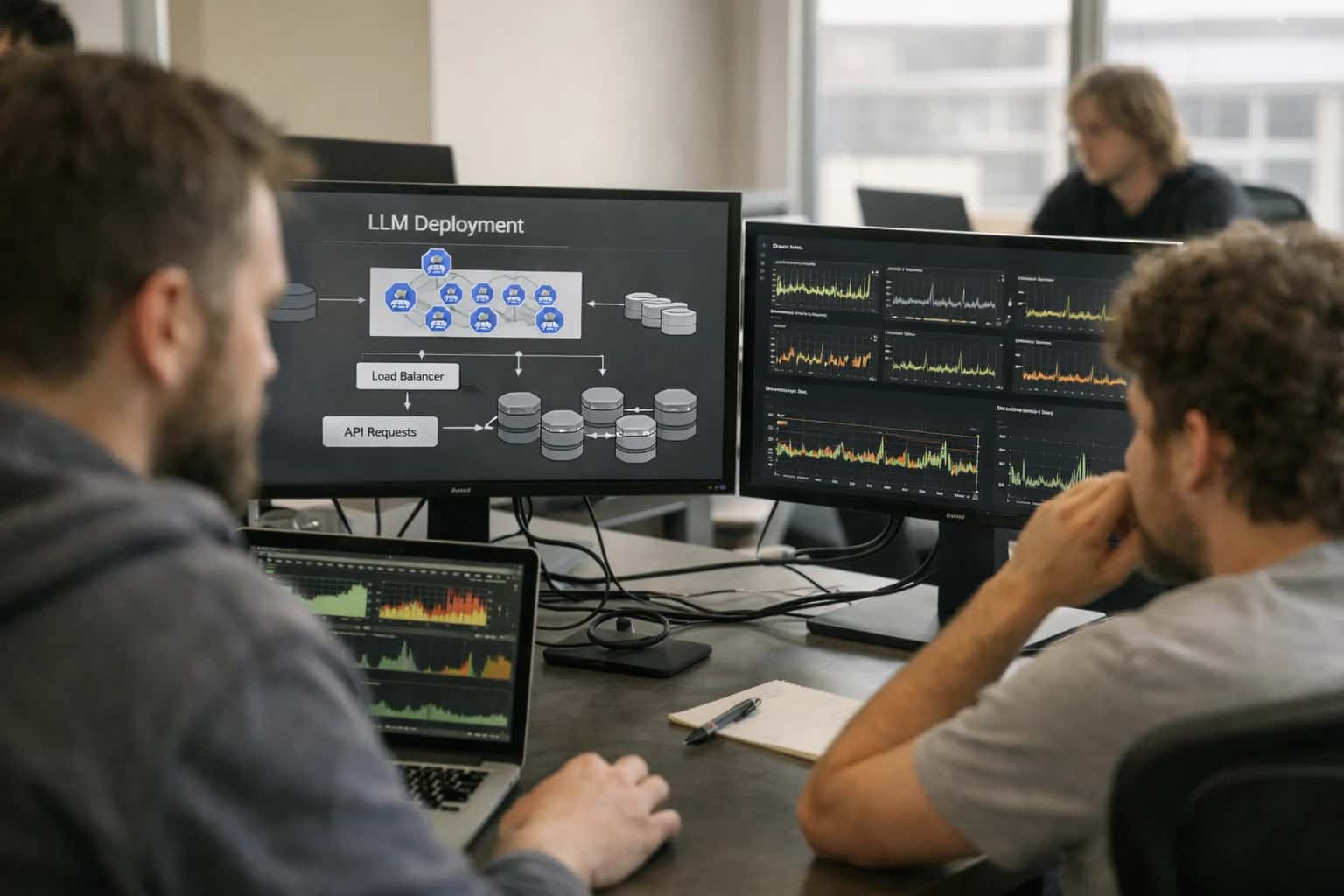
FROM SILENT FAILURE TO PROACTIVE GOVERNANCE
What is Production-Scale Model Monitoring Used For?
Production-scale model monitoring is the critical practice of ensuring AI systems deliver consistent business value after deployment. It moves beyond isolated accuracy checks to provide a centralized, real-time view of model health, performance, and financial impact across thousands of deployments.
The solution is a centralized monitoring platform that provides real-time dashboards tracking key metrics like prediction accuracy, latency, and business KPIs. This enables proactive drift detection and alerting, allowing teams to trigger retraining or rollbacks before models fail. The measurable outcome is protected ROI—maintaining model performance ensures AI investments continue to drive cost savings, efficiency gains, and competitive advantage, as detailed in our guide on Real-Time Drift Detection and Alerting.
PRODUCTION-SCALE MODEL MONITORING
Common Business Use Cases
Move from reactive firefighting to proactive governance. These use cases demonstrate how centralized monitoring transforms AI from a cost center into a reliable, ROI-positive business asset.
01
Prevent Revenue Loss from Model Drift
A 10% drop in model accuracy can translate to millions in lost revenue for a recommendation or pricing engine. Real-time drift detection continuously monitors input data and prediction distributions, triggering alerts the moment performance begins to decay.
- Example: An e-commerce retailer prevented a 15% drop in conversion rates by catching a shift in customer behavior before the weekly business review.
- ROI Driver: Protects top-line revenue by ensuring AI-driven decisions remain accurate and relevant.
>15%
Revenue Protection
02
Ensure Compliance & Audit Readiness
In regulated industries like finance and healthcare, you must prove your models are fair, unbiased, and performing as intended. Centralized dashboards provide a single source of truth for model health, lineage, and performance metrics.
- Example: A bank automated its model risk management reporting, reducing audit preparation time from 3 weeks to 3 days.
- ROI Driver: Eliminates manual reporting, reduces compliance risk, and provides defensible audit trails for regulators.
03
Optimize Cloud Spend on AI Inference
Unmonitored, AI inference costs can spiral as models are scaled. Cost governance tools link inference usage directly to business value, identifying underutilized or inefficient deployments.
- Example: A media company reduced its monthly inference costs by 40% by right-sizing underperforming models and eliminating zombie endpoints.
- ROI Driver: Directly reduces operational expenditure (OpEx) by aligning AI resource consumption with actual business need.
04
Maintain Service Level Agreements (SLAs)
When customer-facing applications depend on AI, latency and uptime are non-negotiable. Performance monitoring tracks inference latency, error rates, and throughput across thousands of model endpoints.
- Example: A fintech platform guarantees sub-100ms response times for fraud detection by automatically scaling infrastructure and alerting on latency spikes.
- ROI Driver: Protects customer experience and prevents SLA breaches that can lead to contractual penalties and churn.
99.9%
Uptime Guarantee
05
Accelerate MLOps with Automated Rollback
A failed model update shouldn't mean hours of downtime. Automated rollback instantly reverts to a previous stable version upon detecting performance degradation, ensuring business continuity.
- Example: An insurance company automated its model deployment pipeline, enabling safe experimentation and reducing mean-time-to-recovery (MTTR) for model failures from hours to seconds.
- ROI Driver: Increases development velocity by making deployments safe and reduces the business impact of failed updates.
06
Govern Foundation Models with LLMOps
LLMs introduce new risks: hallucination, security, and unpredictable costs. LLMOps monitoring tracks token usage, response quality, and prompt injection attempts for every LLM in production.
- Example: A customer service center reduced LLM operational costs by 30% while improving answer accuracy by monitoring and refining prompts in real-time.
- ROI Driver: Manages the unique cost and risk profile of generative AI, ensuring it delivers consistent business value.
OPERATIONALIZING AI ROI
Production-Scale Model Monitoring: The Implementation Blueprint
Moving AI from pilot to production exposes critical blind spots. This blueprint details how centralized monitoring transforms model management from a reactive cost center into a proactive value engine.
The Pain Point: Deploying models at scale creates a visibility crisis. Without centralized monitoring, performance decay from data drift or concept drift goes undetected, leading to silent revenue loss, compliance failures, and eroded user trust. Teams waste weeks manually checking disparate dashboards, unable to correlate model health with business KPIs like customer churn or operational efficiency. This reactive posture turns AI from an asset into a liability.
The AI Fix: A unified monitoring platform provides a single pane of glass for thousands of deployments. It automates real-time drift detection, triggers alerts tied to business impact, and delivers actionable dashboards. The outcome is measurable: a 30-50% reduction in manual oversight, prevention of revenue-impacting model failures, and clear ROI attribution by linking model performance directly to cost savings and revenue protection. This enables proactive governance and continuous optimization, as detailed in our guide to Real-Time Drift Detection and Alerting.
Enabling Efficiency, Speed & Accuracy
Intelligent Analysis, Decision & Execution
We build AI systems for teams that need search across company data, workflow automation across tools, or AI features inside products and internal software.
Talk to Us
Search across company data
Give teams answers from docs, tickets, runbooks, and product data with sources and permissions.
Useful when people spend too long searching or get different answers from different systems.
Enterprise searchRAGPermissions
Read more
Automate internal workflows
Use AI to route work, draft outputs, trigger actions, and keep approvals and logs in place.
Useful when repetitive work moves across multiple tools and teams.
AI agentsWorkflow automationGovernance
Read more
Add AI to products and internal tools
Build assistants, guided actions, or decision support into the software your team or customers already use.
Useful when AI needs to be part of the product, not a separate tool.
AI integrationDecision supportModel routing
Read more90-DAY IMPLEMENTATION ROADMAP TO VALUE
Production-Scale Model Monitoring
Move from reactive firefighting to proactive AI governance. This roadmap delivers measurable ROI by preventing costly model failures and ensuring your AI investments drive consistent business value.
01
Prevent Revenue Loss from Silent Model Failure
Unmonitored models degrade silently, making bad decisions that directly impact your bottom line. Our monitoring provides real-time visibility into model health, catching issues before they affect customers.
- Real-World Example: A retail client's pricing model drifted, causing a 15% drop in margin before detection. With proactive monitoring, similar drift is now flagged within hours, protecting millions in annual revenue.
- Key Benefit: Directly links model performance to financial KPIs, providing the business justification needed for ongoing AI investment.
15%
Margin Protected
< 24 hrs
Issue Detection
02
Reduce MLOps Overhead by 40%
Manual model monitoring is a resource-intensive, error-prone process. Automate it.
- Automated Alerting: Get notified only on actionable issues—data drift, concept drift, or performance degradation—reducing alert fatigue for data science teams.
- Centralized Dashboards: View the health of thousands of models from a single pane of glass, eliminating the need to cobble together disparate tools.
- ROI Impact: Free your data scientists from firefighting to focus on innovation, accelerating the delivery of new AI capabilities.
40%
Ops Time Saved
03
Ensure Regulatory Compliance & Auditability
In regulated industries like finance and healthcare, unexplained model behavior is a compliance risk.
- Full Model Lineage: Track every prediction, data input, and model version. Generate audit-ready reports on demand.
- Bias & Fairness Monitoring: Continuously monitor for unintended bias in model outcomes, providing evidence for frameworks like the EU AI Act.
- Business Justification: Demonstrates proactive governance to regulators and boards, de-risking AI deployment at scale.
100%
Audit Trail
04
Optimize Cloud Spend on AI Inference
Unchecked, model inference costs can spiral. Monitoring provides the granular visibility needed for AI FinOps.
- Cost Attribution: Link cloud spend directly to business units, models, and applications.
- Right-Sizing Insights: Identify underutilized or over-provisioned model endpoints for immediate cost optimization.
- ROI Case: A SaaS company reduced its monthly AI inference bill by 22% by identifying and decommissioning low-value, high-cost models.
22%
Cost Reduction
05
Accelerate Trust in AI-Driven Decisions
For AI to be operationalized, business leaders must trust its outputs. Continuous monitoring builds that trust.
- Explainable Alerts: Understand the 'why' behind every alert with root-cause analysis (e.g., "Drift detected due to new customer segment").
- Stakeholder Dashboards: Provide business leaders with simplified views of model reliability and business impact.
- Outcome: Faster adoption of AI recommendations in critical processes, from loan approvals to inventory forecasting.
4x
Faster Adoption
06
Build a Foundation for Continuous Retraining
Monitoring isn't an endpoint; it's the trigger for a self-improving AI system.
- Closed-Loop Automation: Automatically flag models for retraining when performance drops below a threshold, feeding into your MLOps pipelines.
- Prioritized Work Queue: Data science teams receive a prioritized backlog of models needing attention, based on business criticality.
- Strategic Advantage: Ensures your AI models adapt to changing market conditions, maintaining a competitive edge.

About the author
Prasad Kumkar
CEO & MD, Inference Systems
Prasad Kumkar is the CEO & MD of Inference Systems and writes about AI systems architecture, LLM infrastructure, model serving, evaluation, and production deployment. Over 5+ years, he has worked across computer vision models, L5 autonomous vehicle systems, and LLM research, with a focus on taking complex AI ideas into real-world engineering systems.
His work and writing cover AI systems, large language models, AI agents, multimodal systems, autonomous systems, inference optimization, RAG, evaluation, and production AI engineering.
LinkedIn
Limited slotsGet a Free AI Consultation
Partnered with leading AI, data, and software stack.





How We Work
Custom AI workflows for your Business
One-fit-all AI don't work for modern businesses. At Inferensys, we aim to understand your business & custom requirements; which we use to define most efficient agentic workflows, the data, and the tools for your business.
01
Review the use case
We understand the task, the users, and where AI can actually help.
Read more02
Pick the right approach
We define what needs search, automation, or product integration.
Read more03
Build the first useful version
We implement the part that proves the value first.
Read more04
Improve from there
We add the checks and visibility needed to keep it useful.
Read moreThe first call is a practical review of your use case and the right next step.
Talk to Us