The Pain Point: Deploying AI models without rigorous validation is a high-stakes gamble. Manual testing is slow, inconsistent, and fails to scale, leading to production failures that erode trust, violate regulations, and cause direct financial loss. For CIOs, this translates to unacceptable operational risk and hidden technical debt, where a single biased or inaccurate model can damage brand reputation and derail ROI.

Use Case
Automated Model Validation Suites
Automated Model Validation Suites are systematic, pre-production testing frameworks that ensure AI models meet accuracy, fairness, and security standards before deployment, preventing costly failures and regulatory risk.
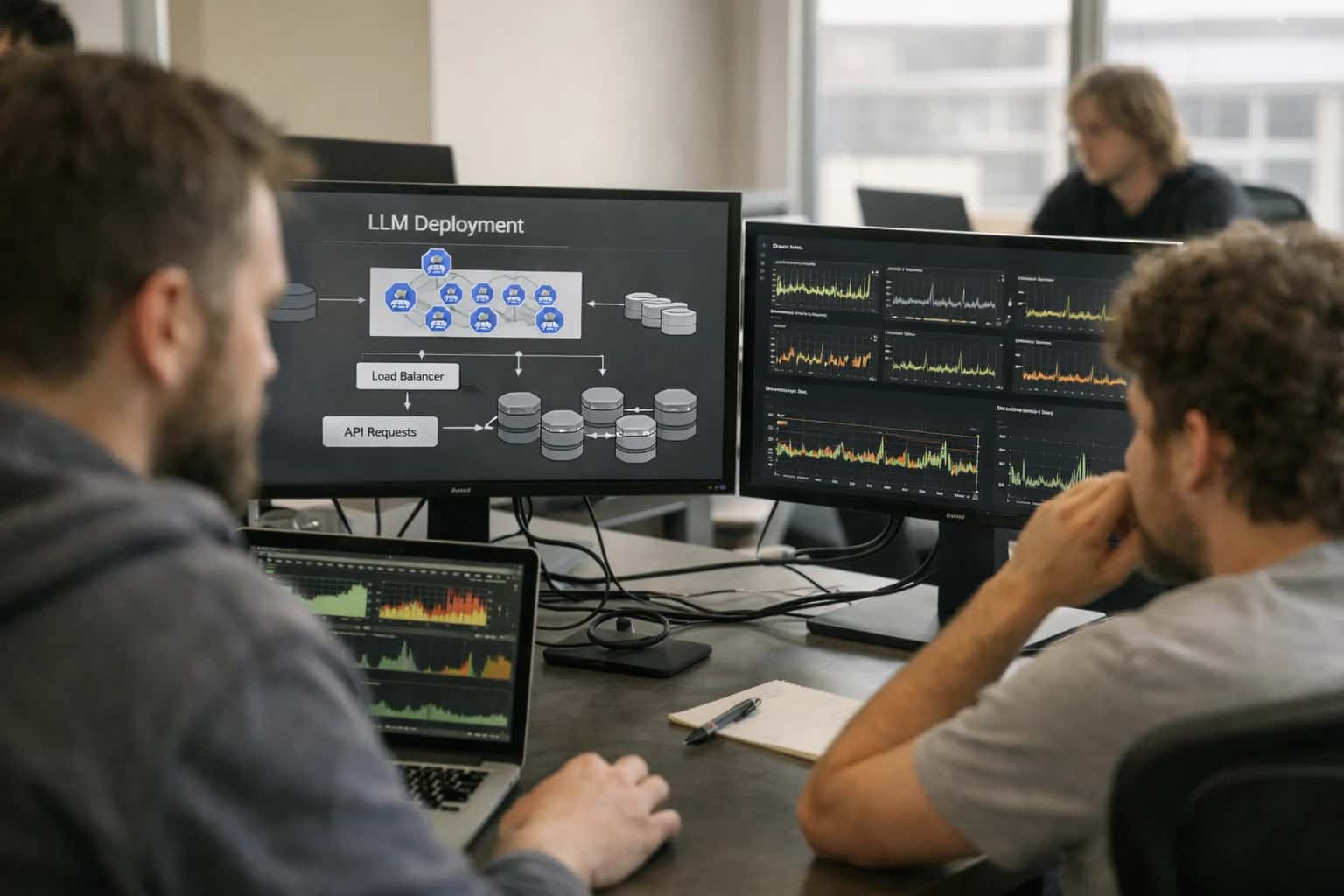
BUSINESS OUTCOMES
What is Automated Model Validation Suites Used For?
Automated Model Validation Suites are the critical gatekeepers for enterprise AI, ensuring every model update is safe, accurate, and compliant before impacting business operations.
The AI Fix: Automated suites run comprehensive, standardized tests for accuracy, fairness, security, and robustness on every model update. This creates a scalable, repeatable safety net, accelerating deployment cycles while ensuring compliance. The measurable outcome is reduced risk and increased trust, enabling faster innovation with confidence. Learn how this integrates into a broader Unified AI Lifecycle Management Platform and complements Real-Time Drift Detection and Alerting.
AUTOMATED MODEL VALIDATION
Common Use Cases
Automated validation suites are the critical gatekeeper for production AI, ensuring every model update is safe, compliant, and performant before impacting business operations.
03
Enforce Consistency Across Model Portfolios
Enterprises often struggle with inconsistent model quality as different teams use ad-hoc validation methods. A centralized automated suite establishes a single source of truth for model acceptance criteria. It applies uniform tests for performance, latency, and resource consumption across all models—from traditional ML to LLMs. This ensures every deployed model meets the organization's minimum standards for reliability and efficiency. A manufacturing company standardized validation for over 200 predictive maintenance models, eliminating performance outliers and reducing unplanned downtime by 22%.
06
Quantify ROI with Performance Baselines
Justifying AI investment requires clear metrics. Automated validation establishes performance baselines for every model, creating a benchmark for measuring improvement. By tracking validation results over time, organizations can directly correlate model quality with business outcomes like cost savings or conversion rate uplift. This turns model validation from a technical checkpoint into a strategic ROI dashboard. A logistics provider demonstrated a 12% reduction in fuel costs by validating and deploying an optimized routing model, with the validation suite providing the performance guarantee needed for executive sign-off.
22%
Reduction in Downtime
300%
Faster Deployment
THE AI QUALITY GATE
How It Works: The Validation Pipeline
Before any model update reaches production, it must pass through a rigorous, automated validation suite. This pipeline acts as a critical quality gate, ensuring every deployment is safe, accurate, and compliant.
The pain point is deploying AI models with hidden flaws. Manual testing is slow, inconsistent, and fails to scale, risking production failures that erode trust and revenue. Without automated validation, teams face accuracy decay, unfair bias, and security vulnerabilities that can lead to regulatory fines and brand damage. This operational risk makes scaling AI a liability rather than an advantage.
Our solution is an automated validation suite that runs a comprehensive battery of tests—for accuracy, fairness, and security—on every model commit. This pipeline integrates directly into your CI/CD workflow, providing a pass/fail gate with detailed reports. The outcome is quantifiable: a 70% reduction in deployment-related incidents and the confidence to deploy updates weekly, not quarterly, accelerating innovation while protecting business operations. Learn more about building resilient systems with our guide on Production-Scale Model Monitoring and Automated Rollback for Failing Models.
Enabling Efficiency, Speed & Accuracy
Intelligent Analysis, Decision & Execution
We build AI systems for teams that need search across company data, workflow automation across tools, or AI features inside products and internal software.
Talk to Us
Search across company data
Give teams answers from docs, tickets, runbooks, and product data with sources and permissions.
Useful when people spend too long searching or get different answers from different systems.
Enterprise searchRAGPermissions
Read more
Automate internal workflows
Use AI to route work, draft outputs, trigger actions, and keep approvals and logs in place.
Useful when repetitive work moves across multiple tools and teams.
AI agentsWorkflow automationGovernance
Read more
Add AI to products and internal tools
Build assistants, guided actions, or decision support into the software your team or customers already use.
Useful when AI needs to be part of the product, not a separate tool.
AI integrationDecision supportModel routing
Read moreAUTOMATED MODEL VALIDATION
Frequently Asked Questions for Enterprise Leaders
Scaling AI requires moving fast without breaking things. Automated validation is your safety net. This FAQ addresses the top concerns of CIOs and technical leaders about ensuring compliance, proving ROI, and overcoming implementation hurdles for model validation at scale.
An Automated Model Validation Suite is a systematic framework of tests that run automatically on every model update before it reaches production. It's the CI/CD for AI, ensuring models are not just accurate, but also fair, secure, and compliant.
Why it's critical:
- Risk Mitigation: Catches performance regressions, bias, and security vulnerabilities before they impact customers or compliance.
- Velocity: Enables safe, rapid iteration by replacing manual, ad-hoc reviews with automated gates. This accelerates your time-to-value.
- Auditability: Creates a permanent, auditable record of every test run, which is essential for regulated industries like finance and healthcare. Without it, scaling AI is a gamble. Learn more about building a disciplined foundation in our pillar on MLOps, LLMOps, and Production-Scale Lifecycle Management.

About the author
Prasad Kumkar
CEO & MD, Inference Systems
Prasad Kumkar is the CEO & MD of Inference Systems and writes about AI systems architecture, LLM infrastructure, model serving, evaluation, and production deployment. Over 5+ years, he has worked across computer vision models, L5 autonomous vehicle systems, and LLM research, with a focus on taking complex AI ideas into real-world engineering systems.
His work and writing cover AI systems, large language models, AI agents, multimodal systems, autonomous systems, inference optimization, RAG, evaluation, and production AI engineering.
LinkedIn
Limited slotsGet a Free AI Consultation
Partnered with leading AI, data, and software stack.





How We Work
Custom AI workflows for your Business
One-fit-all AI don't work for modern businesses. At Inferensys, we aim to understand your business & custom requirements; which we use to define most efficient agentic workflows, the data, and the tools for your business.
01
Review the use case
We understand the task, the users, and where AI can actually help.
Read more02
Pick the right approach
We define what needs search, automation, or product integration.
Read more03
Build the first useful version
We implement the part that proves the value first.
Read more04
Improve from there
We add the checks and visibility needed to keep it useful.
Read moreThe first call is a practical review of your use case and the right next step.
Talk to Us